
Environmental science explores how living things interact with their surroundings...
 AP Environmental Science124 views·Updated Jun 24, 2026·5 pages
Introduction to Basic Biology Concepts
K
kylie@kylie_ywwr



1 / 5
1
of 5
Environmental Levels and Key Concepts
Ever wonder how scientists organize all life on Earth? They use a hierarchy that starts with individual organisms and expands outward. An organism is the basic unit that can survive and reproduce. These organisms form populations (groups with common characteristics), which create communities through their interactions.
Communities exist within ecosystems, which include both living things (biotic) and non-living elements (abiotic). These ecosystems collectively make up our biosphere—the entire living portion of our planet. The environment encompasses all conditions surrounding us that influence life.
Environmental science examines how human systems interact with natural systems. It's incredibly interdisciplinary, combining biology, chemistry, politics, economics, and ethics. Through this field, we can track environmental indicators like biodiversity, global temperatures, and human population to understand our planet's health.
Think about it: Why would scientists need to understand subjects like politics and economics to solve environmental problems?
Within ecosystems, organisms fill specific roles. Biodiversity represents the variety of life forms present. Animals can be classified as herbivores , carnivores , or omnivores (both). Some species are so important they're called keystone species—they keep the entire ecosystem balanced.
2
of 5
Ecological Niches and Species Interactions
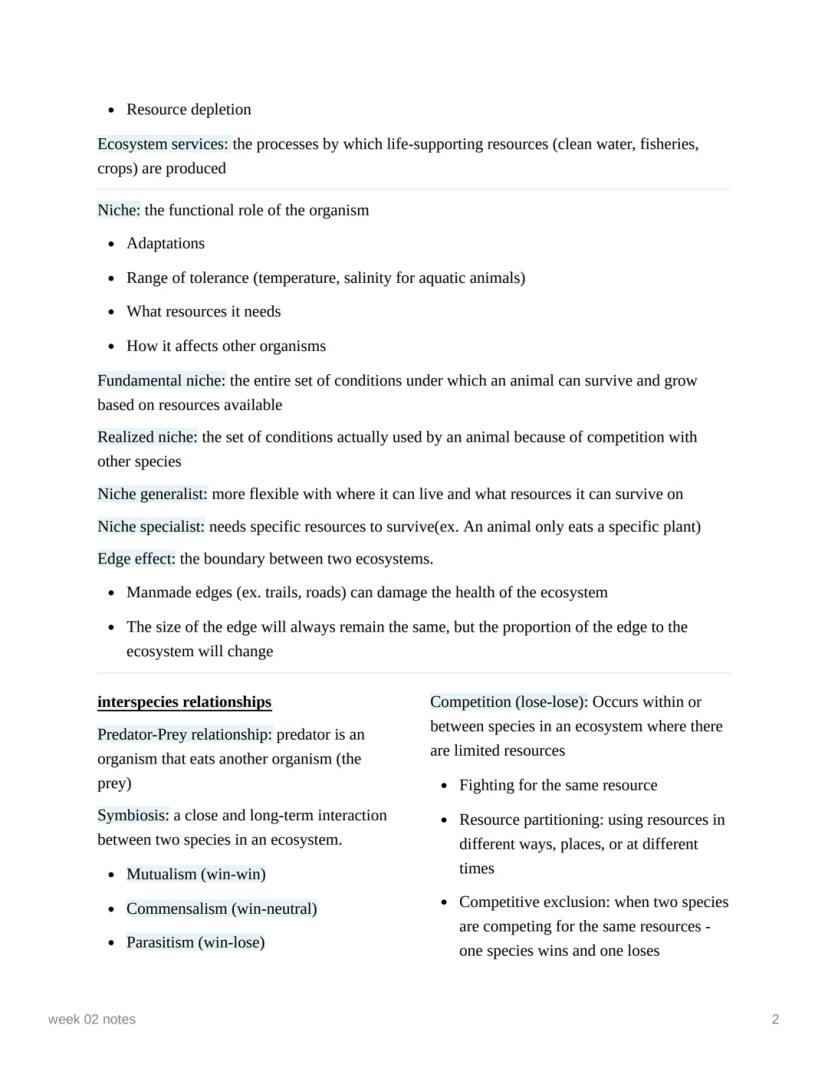
Your place in school might be "star basketball player" or "debate team captain"—similarly, each organism has a specific role in its ecosystem called a niche. A niche includes what an organism eats, where it lives, what temperature it can tolerate, and how it affects others.
An organism's fundamental niche represents all conditions where it could potentially survive, while its realized niche shows where it actually lives due to competition. Some species are niche specialists (requiring specific resources) while others are niche generalists (more adaptable).
Where two ecosystems meet, we find an edge effect. Human-made edges like roads and trails can damage ecosystem health. Though the edge size stays constant, its proportion to the ecosystem can change as habitats shrink.
Important: Understanding niches helps explain why some species can adapt to changing environments while others cannot.
Species interact in various ways. Predator-prey relationships occur when one organism hunts another. Symbiosis involves long-term interactions, including mutualism (both benefit), commensalism (one benefits, one unaffected), and parasitism (one benefits, one harmed). Competition occurs when species fight for limited resources, sometimes leading to competitive exclusion where one species displaces another.
3
of 5
Trophic Levels and Food Webs
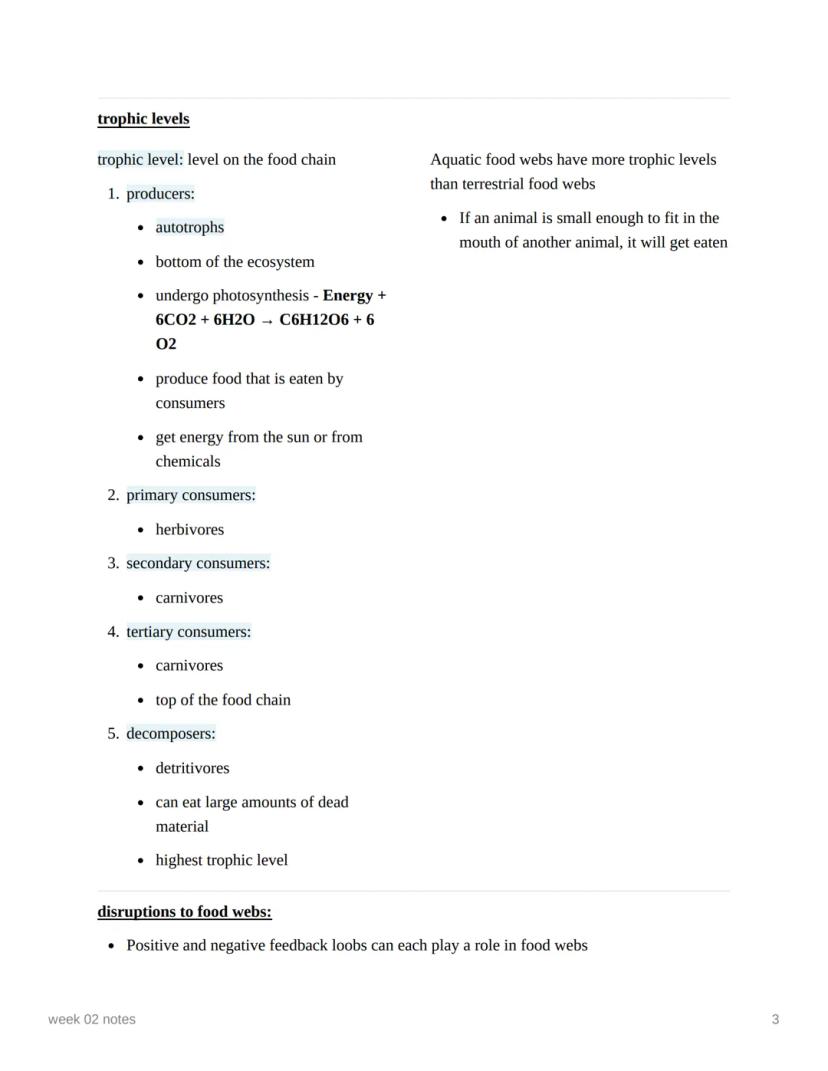
Think of ecosystems as having different "floors" called trophic levels. At the ground floor are producers (autotrophs), which make their own food through photosynthesis using sunlight, carbon dioxide, and water. All other organisms depend on the energy they capture.
Moving up, we find primary consumers (herbivores) that eat plants, followed by secondary consumers (carnivores) that eat herbivores. Tertiary consumers are carnivores at the top of the food chain. Finally, decomposers break down dead material, recycling nutrients back into the system.
Interestingly, aquatic food webs typically have more trophic levels than terrestrial ones. This is partly because in water, predation is often determined simply by mouth size—if you fit in another animal's mouth, you'll probably get eaten!
Fun fact: The position of an organism in the food web can change depending on what it eats at different life stages. Many insects occupy different trophic levels as larvae versus adults.
When a species is removed from or added to a food web, it can cause dramatic ripple effects. Removing a keystone species can lead to population explosions of lower-level consumers, potentially destroying the ecosystem balance.
4
of 5
Energy Flow and Biogeochemical Cycles
Energy flows through ecosystems like a one-way street, while nutrients travel in circles. The sun provides energy that moves from producers to consumers, following the laws of thermodynamics. The first law tells us energy can't be created or destroyed, only converted to different forms. The second law explains why we always lose some energy as heat during these conversions.
Only about 10% of energy transfers from one trophic level to the next—this is called the 10% rule. The other 90% is lost as heat or waste, creating an energy pyramid shape with producers forming a wide base and top predators at the narrow peak.
Photosynthesis and cellular respiration work as opposite processes. Photosynthesis captures energy from sunlight to create sugars, while cellular respiration breaks down those sugars to release energy. Together, these processes cycle carbon and convert energy between forms.
Remember this: While energy flows through an ecosystem and eventually dissipates as heat, matter (like carbon and nitrogen) is recycled. This is why decomposers are so crucial!
Biomass represents the total amount of organic matter in a system. Because energy is lost between trophic levels, there's always more biomass at lower levels than higher ones, which is why we find many plants, fewer herbivores, and even fewer carnivores in healthy ecosystems.
5
of 5
Biological Production and Productivity
How do we measure an ecosystem's energy-capturing ability? We look at its biological production—the capture of usable energy from the environment to create organic compounds.
Primary production happens when producers like plants convert sunlight into chemical energy through photosynthesis. Some unusual organisms use chemosynthesis instead, getting energy from chemical reactions. Secondary production occurs when consumers (heterotrophs) get their energy by eating other organisms.
Scientists measure how efficiently ecosystems capture and store energy using several metrics. Primary productivity (PP) shows how quickly solar energy becomes organic compounds through photosynthesis. Gross primary productivity (GPP) represents the total rate of photosynthesis in an area.
However, producers use some of this energy themselves through respiration. What remains—the energy available to consumers—is called net primary productivity (NPP). This can be calculated using a simple formula: net productivity = gross productivity - respiration.
Think like a scientist: NPP is what matters most for ecosystem health because it represents the energy actually available to support the food web. Areas with high NPP (like tropical rainforests) can support more diverse and complex ecosystems.
We thought you’d never ask...
What is the Knowunity AI companion?
Our AI companion is specifically built for the needs of students. Based on the millions of content pieces we have on the platform we can provide truly meaningful and relevant answers to students. But its not only about answers, the companion is even more about guiding students through their daily learning challenges, with personalised study plans, quizzes or content pieces in the chat and 100% personalisation based on the students skills and developments.
Where can I download the Knowunity app?
You can download the app in the Google Play Store and in the Apple App Store.
Is Knowunity really free of charge?
That's right! Enjoy free access to study content, connect with fellow students, and get instant help – all at your fingertips.
Similar Content
 Ens. Scient.
Most popular content: Energy Flow
1Most popular content in AP Environmental Science
9I
AP Environmental ScienceIntroduction to Ecological Economics
Explore the fundamental principles of ecological economics, including natural capital, ecosystem services, and the valuation of natural resources.
9th4260
AP Environmental ScienceAPES Final Notes
Notes of the high weighted units of APES. Watch Jordan Smedes' videos on youtube and use these notes to review for the AP test.
1,096120
AP Environmental ScienceAPES UNIT 1
Unit 1 APES notes
11th661
AP Environmental ScienceUnit 1 Multiple Choice Test
APES Unit 1 MC test from AP Central. 33 questions with diagrams.
1,80321
AP Environmental ScienceAPES Unit One and Two
brief overview with what you should know for unit 1 and 2 with definitions and examples included.
11th1767
AP Environmental ScienceAPES Sustainability, Biomes, Evolution Review Notes
Chapter 1, 2, 4, 5, 6 Notes REVIEWED
38010
AP Environmental ScienceAPES Unit 2 Key Terms
Unit 2 key terms for APES- biospheres
11th380
AP Environmental ScienceBIOGEOCHEMICAL CYCLES
Gives an overview about chemical elements and movement of elements.
1348
AP Environmental ScienceAPES Unit 3.4 Carrying Capacity
For Unit 3.4 of AP Environmental Science, discusses carrying capacity.
1487
Most popular content
9O
 AP US History
Origins and Dynamics of the Columbian Exchange
Analyze the ecological and economic motivations behind the initial transfer of goods, people, and diseases between the Old and New Worlds.
9th3,1280
I
AP US HistoryIntroduction to Early Cultural Interactions
Analyze the initial social and religious encounters between Europeans, Africans, and Indigenous peoples in the colonial Americas.
9th2,7730
O
 AP World History
Origins of Ancient River Civilizations
Analyze the environmental factors and technological innovations that led to the rise of early states in Mesopotamia, Egypt, and the Indus Valley.
9th3,1870
M
AP US HistoryMotivations for European Exploration
Analyze the economic, religious, and political factors that drove European powers to the Americas during the 15th and 16th centuries.
9th1,7780
F
 AP Psychology
Foundations of Ethical Guidelines in Research
Practice the core principles of the APA ethical code including informed consent, debriefing, and the role of Institutional Review Boards.
9th1,3360
I
AP US HistoryIntroduction to Native American Societies
Examine the diverse social, political, and economic structures of North American indigenous groups prior to European contact.
9th1,1100
I
 AP Biology
Introduction to Biological Elements of Life
Practice identifying the essential elements including carbon, nitrogen, phosphorus, and sulfur that compose biological macromolecules.
9th1,7410
I
AP US HistoryIntroduction to the Spanish Encomienda System
Explore the fundamental economic and social structures of the Spanish colonial system, focusing on the encomienda and the casta social hierarchy.
9th8890
O
AP World HistoryOrigins and Continuity of the Byzantine Empire
Analyze the political and cultural transitions from the Roman Empire to the Byzantine Empire, focusing on the reign of Justinian I and his code.
9th1,6320
Can't find what you're looking for? Explore other subjects.
Students love us — and so will you.
4.6/5App Store
4.7/5Google Play
The app is very easy to use and well designed. I have found everything I was looking for so far and have been able to learn a lot from the presentations! I will definitely use the app for a class assignment! And of course it also helps a lot as an inspiration.
Stefan SiOS user
This app is really great. There are so many study notes and help [...]. My problem subject is French, for example, and the app has so many options for help. Thanks to this app, I have improved my French. I would recommend it to anyone.
Samantha KlichAndroid user
Wow, I am really amazed. I just tried the app because I've seen it advertised many times and was absolutely stunned. This app is THE HELP you want for school and above all, it offers so many things, such as workouts and fact sheets, which have been VERY helpful to me personally.
AnnaiOS user
AP Environmental Science124 views·Updated Jun 24, 2026·5 pagesIntroduction to Basic Biology Concepts
K
kylie@kylie_ywwr
Environmental science explores how living things interact with their surroundings and with each other. This subject helps us understand everything from individual organisms to entire ecosystems, and reveals how humans impact the natural world around us.
1
of 5
Sign up to see the content. It's free!
- Access to all documents
- Improve your grades
- Join milions of students
Environmental Levels and Key Concepts
Ever wonder how scientists organize all life on Earth? They use a hierarchy that starts with individual organisms and expands outward. An organism is the basic unit that can survive and reproduce. These organisms form populations (groups with common characteristics), which create communities through their interactions.
Communities exist within ecosystems, which include both living things (biotic) and non-living elements (abiotic). These ecosystems collectively make up our biosphere—the entire living portion of our planet. The environment encompasses all conditions surrounding us that influence life.
Environmental science examines how human systems interact with natural systems. It's incredibly interdisciplinary, combining biology, chemistry, politics, economics, and ethics. Through this field, we can track environmental indicators like biodiversity, global temperatures, and human population to understand our planet's health.
Think about it: Why would scientists need to understand subjects like politics and economics to solve environmental problems?
Within ecosystems, organisms fill specific roles. Biodiversity represents the variety of life forms present. Animals can be classified as herbivores , carnivores , or omnivores (both). Some species are so important they're called keystone species—they keep the entire ecosystem balanced.
2
of 5Sign up to see the content. It's free!
- Access to all documents
- Improve your grades
- Join milions of students
Ecological Niches and Species Interactions
Your place in school might be "star basketball player" or "debate team captain"—similarly, each organism has a specific role in its ecosystem called a niche. A niche includes what an organism eats, where it lives, what temperature it can tolerate, and how it affects others.
An organism's fundamental niche represents all conditions where it could potentially survive, while its realized niche shows where it actually lives due to competition. Some species are niche specialists (requiring specific resources) while others are niche generalists (more adaptable).
Where two ecosystems meet, we find an edge effect. Human-made edges like roads and trails can damage ecosystem health. Though the edge size stays constant, its proportion to the ecosystem can change as habitats shrink.
Important: Understanding niches helps explain why some species can adapt to changing environments while others cannot.
Species interact in various ways. Predator-prey relationships occur when one organism hunts another. Symbiosis involves long-term interactions, including mutualism (both benefit), commensalism (one benefits, one unaffected), and parasitism (one benefits, one harmed). Competition occurs when species fight for limited resources, sometimes leading to competitive exclusion where one species displaces another.
3
of 5Sign up to see the content. It's free!
- Access to all documents
- Improve your grades
- Join milions of students
Trophic Levels and Food Webs
Think of ecosystems as having different "floors" called trophic levels. At the ground floor are producers (autotrophs), which make their own food through photosynthesis using sunlight, carbon dioxide, and water. All other organisms depend on the energy they capture.
Moving up, we find primary consumers (herbivores) that eat plants, followed by secondary consumers (carnivores) that eat herbivores. Tertiary consumers are carnivores at the top of the food chain. Finally, decomposers break down dead material, recycling nutrients back into the system.
Interestingly, aquatic food webs typically have more trophic levels than terrestrial ones. This is partly because in water, predation is often determined simply by mouth size—if you fit in another animal's mouth, you'll probably get eaten!
Fun fact: The position of an organism in the food web can change depending on what it eats at different life stages. Many insects occupy different trophic levels as larvae versus adults.
When a species is removed from or added to a food web, it can cause dramatic ripple effects. Removing a keystone species can lead to population explosions of lower-level consumers, potentially destroying the ecosystem balance.
4
of 5Sign up to see the content. It's free!
- Access to all documents
- Improve your grades
- Join milions of students
Energy Flow and Biogeochemical Cycles
Energy flows through ecosystems like a one-way street, while nutrients travel in circles. The sun provides energy that moves from producers to consumers, following the laws of thermodynamics. The first law tells us energy can't be created or destroyed, only converted to different forms. The second law explains why we always lose some energy as heat during these conversions.
Only about 10% of energy transfers from one trophic level to the next—this is called the 10% rule. The other 90% is lost as heat or waste, creating an energy pyramid shape with producers forming a wide base and top predators at the narrow peak.
Photosynthesis and cellular respiration work as opposite processes. Photosynthesis captures energy from sunlight to create sugars, while cellular respiration breaks down those sugars to release energy. Together, these processes cycle carbon and convert energy between forms.
Remember this: While energy flows through an ecosystem and eventually dissipates as heat, matter (like carbon and nitrogen) is recycled. This is why decomposers are so crucial!
Biomass represents the total amount of organic matter in a system. Because energy is lost between trophic levels, there's always more biomass at lower levels than higher ones, which is why we find many plants, fewer herbivores, and even fewer carnivores in healthy ecosystems.
5
of 5Sign up to see the content. It's free!
- Access to all documents
- Improve your grades
- Join milions of students
Biological Production and Productivity
How do we measure an ecosystem's energy-capturing ability? We look at its biological production—the capture of usable energy from the environment to create organic compounds.
Primary production happens when producers like plants convert sunlight into chemical energy through photosynthesis. Some unusual organisms use chemosynthesis instead, getting energy from chemical reactions. Secondary production occurs when consumers (heterotrophs) get their energy by eating other organisms.
Scientists measure how efficiently ecosystems capture and store energy using several metrics. Primary productivity (PP) shows how quickly solar energy becomes organic compounds through photosynthesis. Gross primary productivity (GPP) represents the total rate of photosynthesis in an area.
However, producers use some of this energy themselves through respiration. What remains—the energy available to consumers—is called net primary productivity (NPP). This can be calculated using a simple formula: net productivity = gross productivity - respiration.
Think like a scientist: NPP is what matters most for ecosystem health because it represents the energy actually available to support the food web. Areas with high NPP (like tropical rainforests) can support more diverse and complex ecosystems.
We thought you’d never ask...
What is the Knowunity AI companion?
Our AI companion is specifically built for the needs of students. Based on the millions of content pieces we have on the platform we can provide truly meaningful and relevant answers to students. But its not only about answers, the companion is even more about guiding students through their daily learning challenges, with personalised study plans, quizzes or content pieces in the chat and 100% personalisation based on the students skills and developments.
Where can I download the Knowunity app?
You can download the app in the Google Play Store and in the Apple App Store.
Is Knowunity really free of charge?
That's right! Enjoy free access to study content, connect with fellow students, and get instant help – all at your fingertips.
Similar Content
Most popular content: Energy Flow
1Most popular content in AP Environmental Science
9I
AP Environmental ScienceIntroduction to Ecological Economics
Explore the fundamental principles of ecological economics, including natural capital, ecosystem services, and the valuation of natural resources.
9th4260
AP Environmental ScienceAPES Final Notes
Notes of the high weighted units of APES. Watch Jordan Smedes' videos on youtube and use these notes to review for the AP test.
1,096120
AP Environmental ScienceAPES UNIT 1
Unit 1 APES notes
11th661
AP Environmental ScienceUnit 1 Multiple Choice Test
APES Unit 1 MC test from AP Central. 33 questions with diagrams.
1,80321
AP Environmental ScienceAPES Unit One and Two
brief overview with what you should know for unit 1 and 2 with definitions and examples included.
11th1767
AP Environmental ScienceAPES Sustainability, Biomes, Evolution Review Notes
Chapter 1, 2, 4, 5, 6 Notes REVIEWED
38010
AP Environmental ScienceAPES Unit 2 Key Terms
Unit 2 key terms for APES- biospheres
11th380
AP Environmental ScienceBIOGEOCHEMICAL CYCLES
Gives an overview about chemical elements and movement of elements.
1348
AP Environmental ScienceAPES Unit 3.4 Carrying Capacity
For Unit 3.4 of AP Environmental Science, discusses carrying capacity.
1487
Most popular content
9O
AP US HistoryOrigins and Dynamics of the Columbian Exchange
Analyze the ecological and economic motivations behind the initial transfer of goods, people, and diseases between the Old and New Worlds.
9th3,1280
I
AP US HistoryIntroduction to Early Cultural Interactions
Analyze the initial social and religious encounters between Europeans, Africans, and Indigenous peoples in the colonial Americas.
9th2,7730
O
AP World HistoryOrigins of Ancient River Civilizations
Analyze the environmental factors and technological innovations that led to the rise of early states in Mesopotamia, Egypt, and the Indus Valley.
9th3,1870
M
AP US HistoryMotivations for European Exploration
Analyze the economic, religious, and political factors that drove European powers to the Americas during the 15th and 16th centuries.
9th1,7780
F
AP PsychologyFoundations of Ethical Guidelines in Research
Practice the core principles of the APA ethical code including informed consent, debriefing, and the role of Institutional Review Boards.
9th1,3360
I
AP US HistoryIntroduction to Native American Societies
Examine the diverse social, political, and economic structures of North American indigenous groups prior to European contact.
9th1,1100
I
AP BiologyIntroduction to Biological Elements of Life
Practice identifying the essential elements including carbon, nitrogen, phosphorus, and sulfur that compose biological macromolecules.
9th1,7410
I
AP US HistoryIntroduction to the Spanish Encomienda System
Explore the fundamental economic and social structures of the Spanish colonial system, focusing on the encomienda and the casta social hierarchy.
9th8890
O
AP World HistoryOrigins and Continuity of the Byzantine Empire
Analyze the political and cultural transitions from the Roman Empire to the Byzantine Empire, focusing on the reign of Justinian I and his code.
9th1,6320
Can't find what you're looking for? Explore other subjects.
Students love us — and so will you.
4.6/5App Store
4.7/5Google Play
The app is very easy to use and well designed. I have found everything I was looking for so far and have been able to learn a lot from the presentations! I will definitely use the app for a class assignment! And of course it also helps a lot as an inspiration.
Stefan SiOS user
This app is really great. There are so many study notes and help [...]. My problem subject is French, for example, and the app has so many options for help. Thanks to this app, I have improved my French. I would recommend it to anyone.
Samantha KlichAndroid user
Wow, I am really amazed. I just tried the app because I've seen it advertised many times and was absolutely stunned. This app is THE HELP you want for school and above all, it offers so many things, such as workouts and fact sheets, which have been VERY helpful to me personally.
AnnaiOS user