

Understanding how to write effectively means mastering sentence structure, persuasive...
 AP English Literature81 views·Updated Jun 9, 2026·3 pages
Master Rhetorical Strategies: Critical Thinking and Writing Guide

1 / 3
1
of 3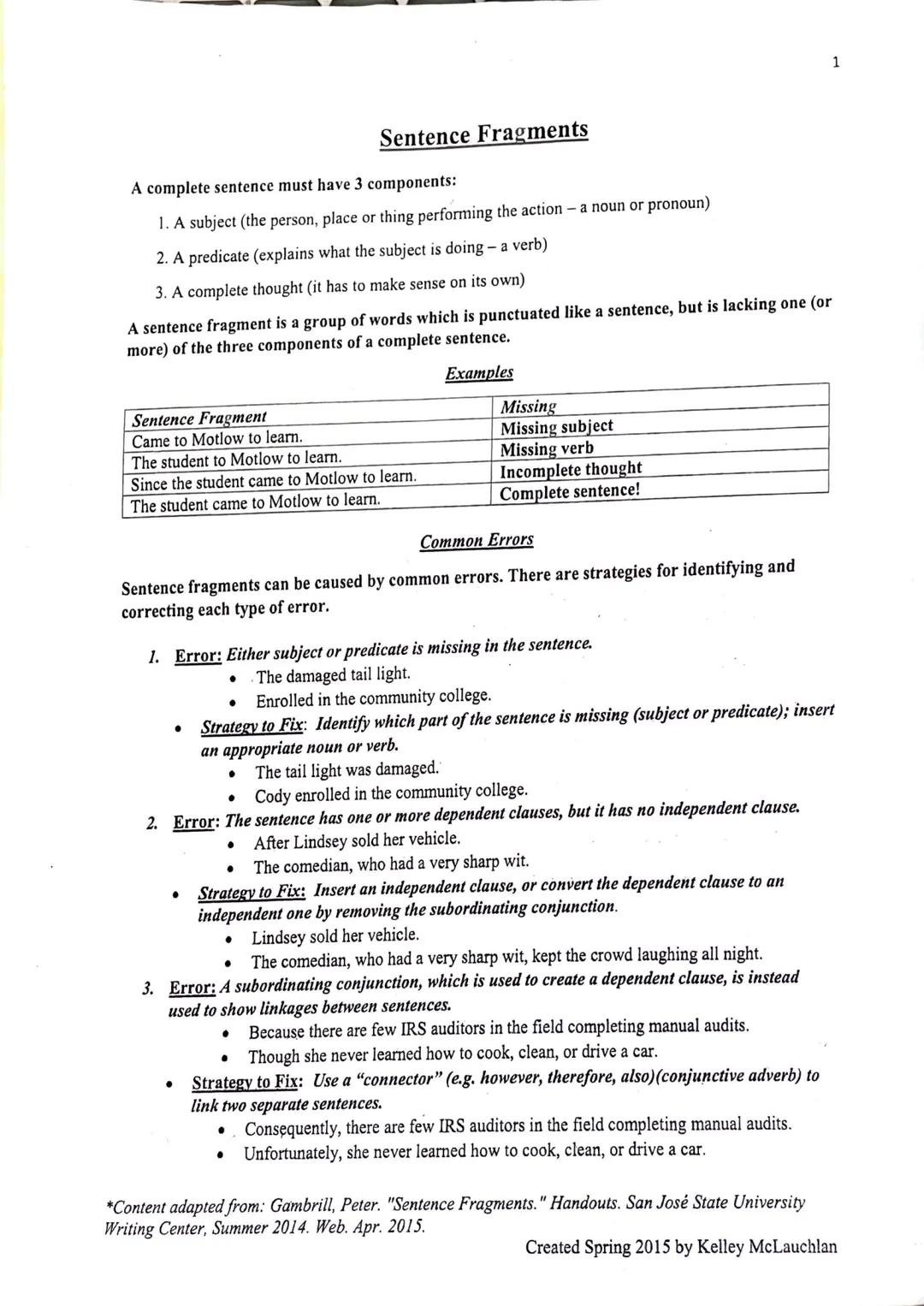
Sentence Fragments
Ever wonder why some groups of words just don't sound right as sentences? A complete sentence needs three essential components: a subject (who or what), a predicate (what they're doing), and a complete thought that makes sense on its own.
Sentence fragments occur when one or more of these components is missing. For instance, "Came to Motlow to learn" lacks a subject, while "The student to Motlow to learn" is missing a verb. Even "Since the student came to Motlow to learn" isn't complete because it leaves us hanging.
You can fix fragments in several ways. If a subject or predicate is missing, simply add the appropriate noun or verb (turning "The damaged tail light" into "The tail light was damaged"). For dependent clauses without independent clauses, either add an independent clause or remove the subordinating conjunction. When a subordinating conjunction incorrectly links sentences, replace it with a connector like "however" or "therefore."
Quick Fix Tip: When proofreading, check each sentence by asking: Who or what is doing something? What are they doing? Does the thought feel complete on its own? If any answer is no, you've found a fragment!
2
of 3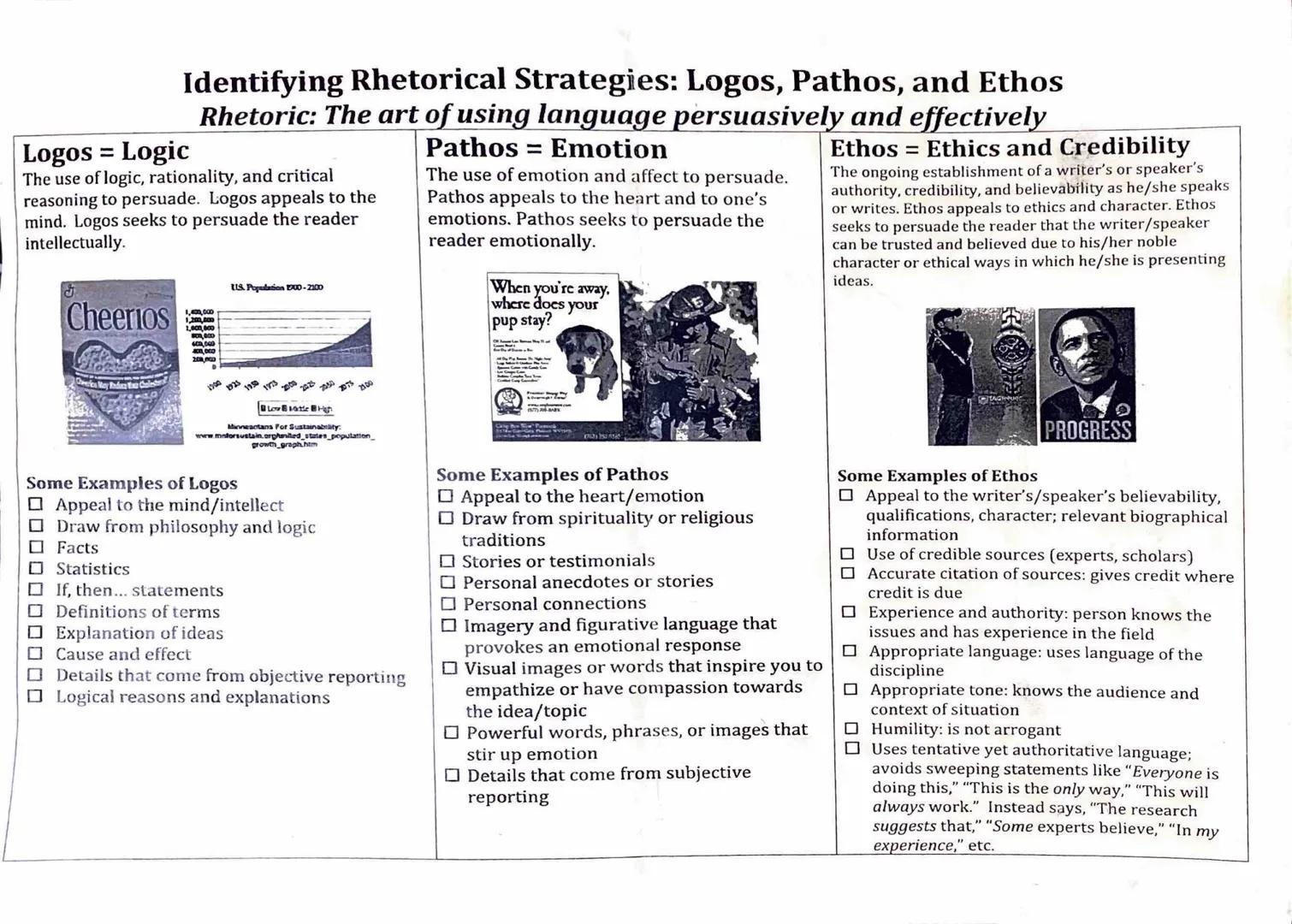
Rhetorical Strategies: Logos, Pathos, and Ethos
Imagine you're trying to convince your parents to increase your allowance. Would you use facts and figures, emotional appeals, or your track record of responsibility? These approaches represent the three main rhetorical strategies that speakers and writers use to persuade their audience.
Logos appeals to logic and rational thinking. When you use logos, you're bringing in facts, statistics, cause-and-effect relationships, and logical reasoning. Think population graphs, scientific evidence, or step-by-step explanations that make your argument impossible to deny based on pure reasoning.
Pathos targets your audience's emotions. This strategy uses personal stories, vivid imagery, and powerful language to create an emotional connection. Those commercials showing sad puppies in shelters? Pure pathos at work, designed to make you feel something that drives you to action.
Ethos establishes credibility and trustworthiness. When using ethos, you demonstrate why people should believe you through qualifications, character, appropriate language, and citing credible sources. Phrases like "As a certified nutritionist..." or "According to Harvard researchers..." build ethos.
Power Tip: The most effective persuasive writing uses a strategic combination of logos, pathos, and ethos rather than relying on just one approach. Match your strategy to your audience!
3
of 3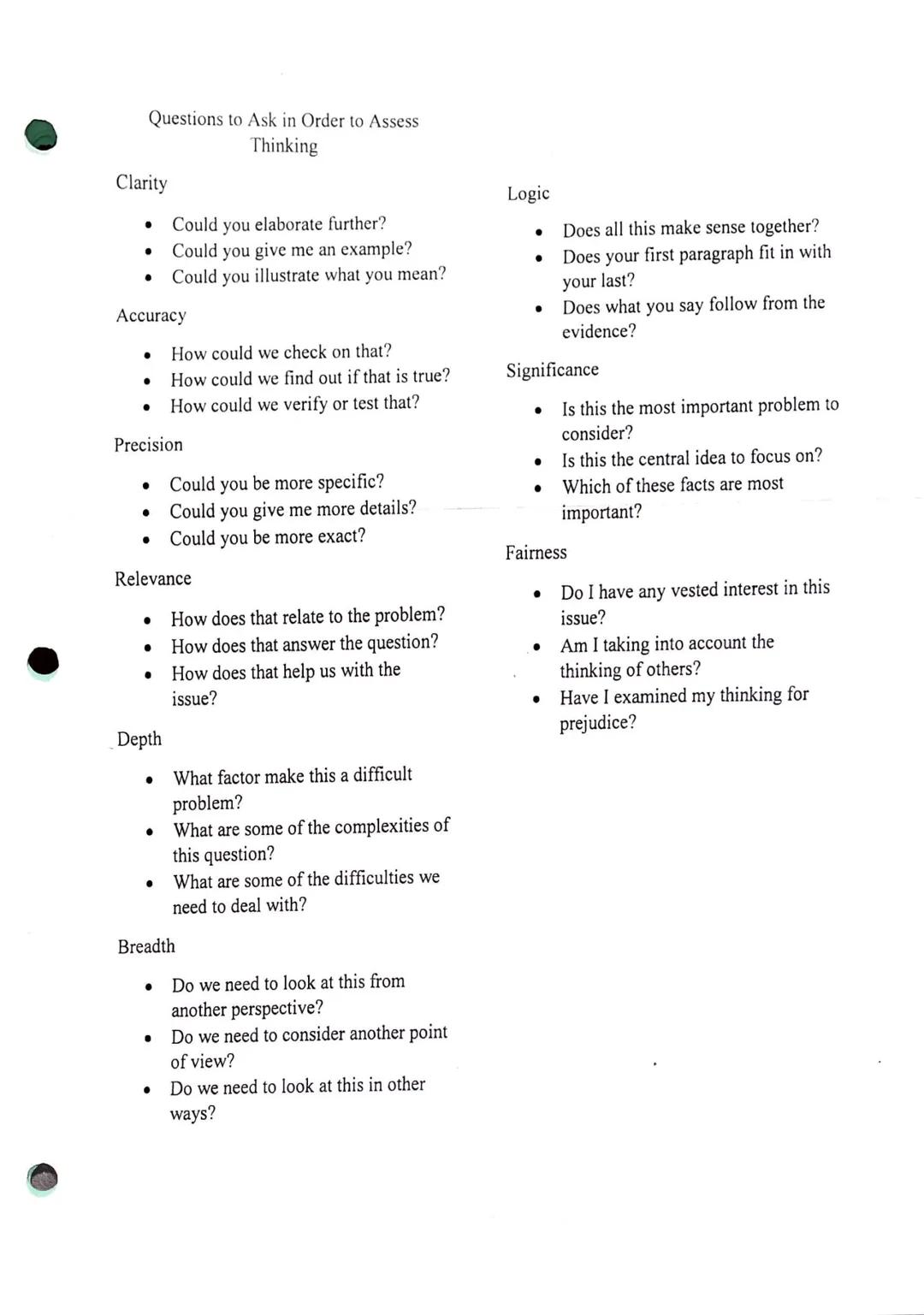
Assessing Critical Thinking
Want to strengthen your arguments and analyze others' thinking more effectively? These critical thinking questions will help you dig deeper into any subject and avoid surface-level understanding.
Start by checking for clarity and precision by asking for examples, illustrations, or more specific details. This ensures you're not dealing with vague ideas. Then examine accuracy by questioning how claims could be verified or tested against reliable evidence.
Assess relevance by determining how ideas connect to the main issue, and explore depth by identifying complexities and difficulties within the problem. Don't forget to consider breadth by looking at multiple perspectives and alternative viewpoints.
The strongest thinking also demonstrates logic (do all parts make sense together?), focuses on significance (prioritizing what matters most), and shows fairness by accounting for potential bias and considering others' viewpoints.
Think Like a Pro: The next time you write an essay or analyze an argument, run through these critical thinking questions. They'll help you spot weaknesses in reasoning and develop more nuanced positions on complex topics.
We thought you’d never ask...
What is the Knowunity AI companion?
Our AI companion is specifically built for the needs of students. Based on the millions of content pieces we have on the platform we can provide truly meaningful and relevant answers to students. But its not only about answers, the companion is even more about guiding students through their daily learning challenges, with personalised study plans, quizzes or content pieces in the chat and 100% personalisation based on the students skills and developments.
Where can I download the Knowunity app?
You can download the app in the Google Play Store and in the Apple App Store.
Is Knowunity really free of charge?
That's right! Enjoy free access to study content, connect with fellow students, and get instant help – all at your fingertips.
Similar Content
Most popular content in AP English Literature
7I
AP English LiteratureIntroduction to Literary Archetypes
Practice identifying universal character types and situational patterns like the Hero, the Mentor, and the Quest in foundational texts.
9th2920
AP English LiteratureRomeo and Juliet
Shakespeare's Romeo and Juliet - notes on themes, quotes, plot analysis
9th4464
AP English LiteratureCatcher In The Rye Complete Notes
This is my complete notes for my English class. Sorry if they are lazy at some points I fell asleep making them so if you need clarification there’s a free audiobook readin chapter by chapter on YouTube.
College382
AP English LiteratureCharacterization in Literature
This presentation contains the definition of characterization in Literature, types of characterization, and several examples.
1617
AP English LiteratureThe Strange Case of Dr. Jekyll and Mr. Hyde Full Summary
This is a full summary of this book. Credits to Sparknotes.
2215
AP English LanguageIn Cold Blood Analysis
Analysis and dive into the book In Cold Blood
1192
AP English LiteratureEdgar Allan Poe biography
This presentation has a brief description about Edgar Allan Poe's life and his literature work
10th503
Most popular content
9O
 AP US History
Origins and Dynamics of the Columbian Exchange
Analyze the ecological and economic motivations behind the initial transfer of goods, people, and diseases between the Old and New Worlds.
9th3,1280
I
AP US HistoryIntroduction to Early Cultural Interactions
Analyze the initial social and religious encounters between Europeans, Africans, and Indigenous peoples in the colonial Americas.
9th2,7730
O
 AP World History
Origins of Ancient River Civilizations
Analyze the environmental factors and technological innovations that led to the rise of early states in Mesopotamia, Egypt, and the Indus Valley.
9th3,1870
M
AP US HistoryMotivations for European Exploration
Analyze the economic, religious, and political factors that drove European powers to the Americas during the 15th and 16th centuries.
9th1,7780
F
 AP Psychology
Foundations of Ethical Guidelines in Research
Practice the core principles of the APA ethical code including informed consent, debriefing, and the role of Institutional Review Boards.
9th1,3360
I
AP US HistoryIntroduction to Native American Societies
Examine the diverse social, political, and economic structures of North American indigenous groups prior to European contact.
9th1,1100
I
 AP Biology
Introduction to Biological Elements of Life
Practice identifying the essential elements including carbon, nitrogen, phosphorus, and sulfur that compose biological macromolecules.
9th1,7400
I
AP US HistoryIntroduction to the Spanish Encomienda System
Explore the fundamental economic and social structures of the Spanish colonial system, focusing on the encomienda and the casta social hierarchy.
9th8890
O
AP World HistoryOrigins and Continuity of the Byzantine Empire
Analyze the political and cultural transitions from the Roman Empire to the Byzantine Empire, focusing on the reign of Justinian I and his code.
9th1,6320
Can't find what you're looking for? Explore other subjects.
Students love us — and so will you.
4.6/5App Store
4.7/5Google Play
The app is very easy to use and well designed. I have found everything I was looking for so far and have been able to learn a lot from the presentations! I will definitely use the app for a class assignment! And of course it also helps a lot as an inspiration.
Stefan SiOS user
This app is really great. There are so many study notes and help [...]. My problem subject is French, for example, and the app has so many options for help. Thanks to this app, I have improved my French. I would recommend it to anyone.
Samantha KlichAndroid user
Wow, I am really amazed. I just tried the app because I've seen it advertised many times and was absolutely stunned. This app is THE HELP you want for school and above all, it offers so many things, such as workouts and fact sheets, which have been VERY helpful to me personally.
AnnaiOS user
AP English Literature81 views·Updated Jun 9, 2026·3 pagesMaster Rhetorical Strategies: Critical Thinking and Writing Guide
Understanding how to write effectively means mastering sentence structure, persuasive techniques, and critical thinking skills. These fundamental elements help you communicate clearly, influence your audience, and develop well-reasoned arguments.
1
of 3
Sign up to see the content. It's free!
- Access to all documents
- Improve your grades
- Join milions of students
Sentence Fragments
Ever wonder why some groups of words just don't sound right as sentences? A complete sentence needs three essential components: a subject (who or what), a predicate (what they're doing), and a complete thought that makes sense on its own.
Sentence fragments occur when one or more of these components is missing. For instance, "Came to Motlow to learn" lacks a subject, while "The student to Motlow to learn" is missing a verb. Even "Since the student came to Motlow to learn" isn't complete because it leaves us hanging.
You can fix fragments in several ways. If a subject or predicate is missing, simply add the appropriate noun or verb (turning "The damaged tail light" into "The tail light was damaged"). For dependent clauses without independent clauses, either add an independent clause or remove the subordinating conjunction. When a subordinating conjunction incorrectly links sentences, replace it with a connector like "however" or "therefore."
Quick Fix Tip: When proofreading, check each sentence by asking: Who or what is doing something? What are they doing? Does the thought feel complete on its own? If any answer is no, you've found a fragment!
2
of 3Sign up to see the content. It's free!
- Access to all documents
- Improve your grades
- Join milions of students
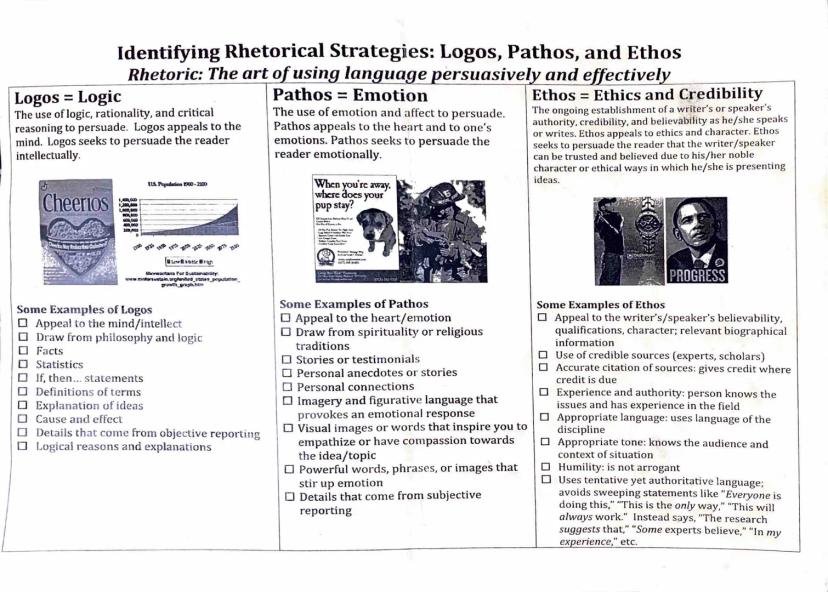
Rhetorical Strategies: Logos, Pathos, and Ethos
Imagine you're trying to convince your parents to increase your allowance. Would you use facts and figures, emotional appeals, or your track record of responsibility? These approaches represent the three main rhetorical strategies that speakers and writers use to persuade their audience.
Logos appeals to logic and rational thinking. When you use logos, you're bringing in facts, statistics, cause-and-effect relationships, and logical reasoning. Think population graphs, scientific evidence, or step-by-step explanations that make your argument impossible to deny based on pure reasoning.
Pathos targets your audience's emotions. This strategy uses personal stories, vivid imagery, and powerful language to create an emotional connection. Those commercials showing sad puppies in shelters? Pure pathos at work, designed to make you feel something that drives you to action.
Ethos establishes credibility and trustworthiness. When using ethos, you demonstrate why people should believe you through qualifications, character, appropriate language, and citing credible sources. Phrases like "As a certified nutritionist..." or "According to Harvard researchers..." build ethos.
Power Tip: The most effective persuasive writing uses a strategic combination of logos, pathos, and ethos rather than relying on just one approach. Match your strategy to your audience!
3
of 3Sign up to see the content. It's free!
- Access to all documents
- Improve your grades
- Join milions of students
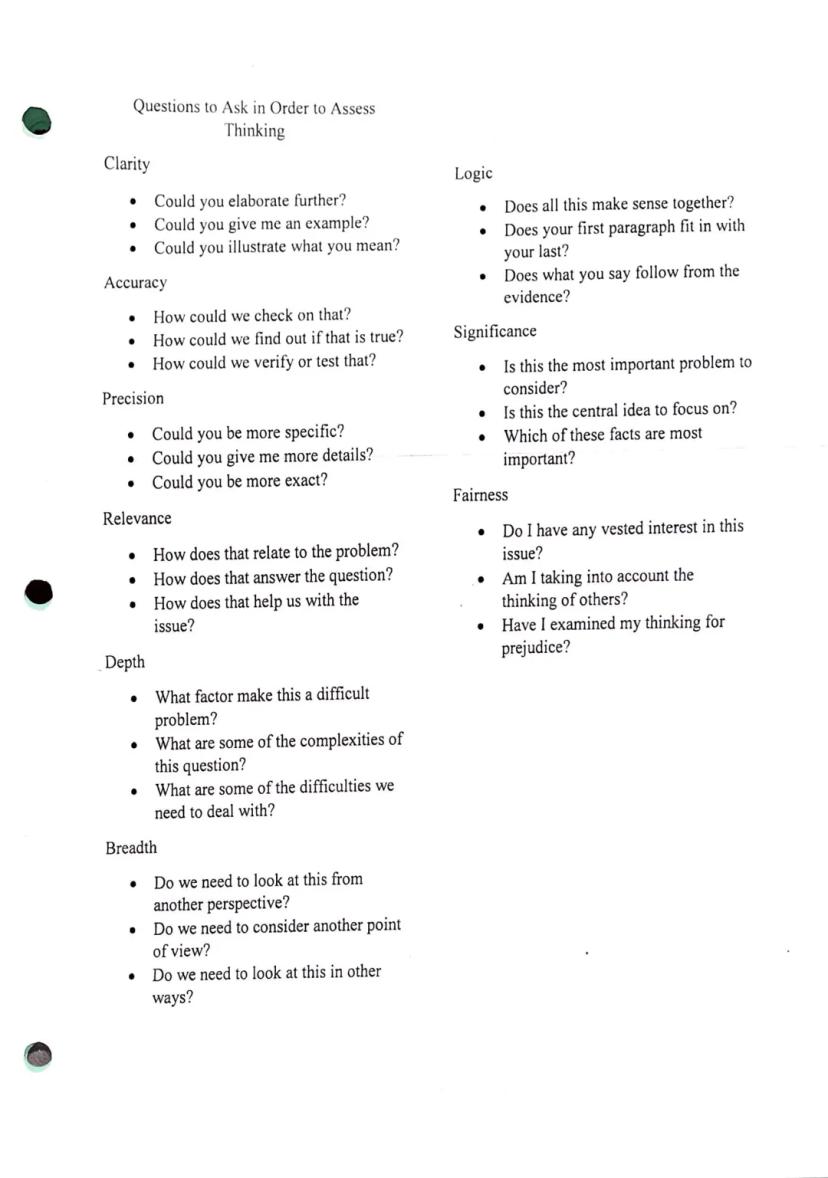
Assessing Critical Thinking
Want to strengthen your arguments and analyze others' thinking more effectively? These critical thinking questions will help you dig deeper into any subject and avoid surface-level understanding.
Start by checking for clarity and precision by asking for examples, illustrations, or more specific details. This ensures you're not dealing with vague ideas. Then examine accuracy by questioning how claims could be verified or tested against reliable evidence.
Assess relevance by determining how ideas connect to the main issue, and explore depth by identifying complexities and difficulties within the problem. Don't forget to consider breadth by looking at multiple perspectives and alternative viewpoints.
The strongest thinking also demonstrates logic (do all parts make sense together?), focuses on significance (prioritizing what matters most), and shows fairness by accounting for potential bias and considering others' viewpoints.
Think Like a Pro: The next time you write an essay or analyze an argument, run through these critical thinking questions. They'll help you spot weaknesses in reasoning and develop more nuanced positions on complex topics.
We thought you’d never ask...
What is the Knowunity AI companion?
Our AI companion is specifically built for the needs of students. Based on the millions of content pieces we have on the platform we can provide truly meaningful and relevant answers to students. But its not only about answers, the companion is even more about guiding students through their daily learning challenges, with personalised study plans, quizzes or content pieces in the chat and 100% personalisation based on the students skills and developments.
Where can I download the Knowunity app?
You can download the app in the Google Play Store and in the Apple App Store.
Is Knowunity really free of charge?
That's right! Enjoy free access to study content, connect with fellow students, and get instant help – all at your fingertips.
Similar Content
Most popular content in AP English Literature
7I
AP English LiteratureIntroduction to Literary Archetypes
Practice identifying universal character types and situational patterns like the Hero, the Mentor, and the Quest in foundational texts.
9th2920
AP English LiteratureRomeo and Juliet
Shakespeare's Romeo and Juliet - notes on themes, quotes, plot analysis
9th4464
AP English LiteratureCatcher In The Rye Complete Notes
This is my complete notes for my English class. Sorry if they are lazy at some points I fell asleep making them so if you need clarification there’s a free audiobook readin chapter by chapter on YouTube.
College382
AP English LiteratureCharacterization in Literature
This presentation contains the definition of characterization in Literature, types of characterization, and several examples.
1617
AP English LiteratureThe Strange Case of Dr. Jekyll and Mr. Hyde Full Summary
This is a full summary of this book. Credits to Sparknotes.
2215
AP English LanguageIn Cold Blood Analysis
Analysis and dive into the book In Cold Blood
1192
AP English LiteratureEdgar Allan Poe biography
This presentation has a brief description about Edgar Allan Poe's life and his literature work
10th503
Most popular content
9O
AP US HistoryOrigins and Dynamics of the Columbian Exchange
Analyze the ecological and economic motivations behind the initial transfer of goods, people, and diseases between the Old and New Worlds.
9th3,1280
I
AP US HistoryIntroduction to Early Cultural Interactions
Analyze the initial social and religious encounters between Europeans, Africans, and Indigenous peoples in the colonial Americas.
9th2,7730
O
AP World HistoryOrigins of Ancient River Civilizations
Analyze the environmental factors and technological innovations that led to the rise of early states in Mesopotamia, Egypt, and the Indus Valley.
9th3,1870
M
AP US HistoryMotivations for European Exploration
Analyze the economic, religious, and political factors that drove European powers to the Americas during the 15th and 16th centuries.
9th1,7780
F
AP PsychologyFoundations of Ethical Guidelines in Research
Practice the core principles of the APA ethical code including informed consent, debriefing, and the role of Institutional Review Boards.
9th1,3360
I
AP US HistoryIntroduction to Native American Societies
Examine the diverse social, political, and economic structures of North American indigenous groups prior to European contact.
9th1,1100
I
AP BiologyIntroduction to Biological Elements of Life
Practice identifying the essential elements including carbon, nitrogen, phosphorus, and sulfur that compose biological macromolecules.
9th1,7400
I
AP US HistoryIntroduction to the Spanish Encomienda System
Explore the fundamental economic and social structures of the Spanish colonial system, focusing on the encomienda and the casta social hierarchy.
9th8890
O
AP World HistoryOrigins and Continuity of the Byzantine Empire
Analyze the political and cultural transitions from the Roman Empire to the Byzantine Empire, focusing on the reign of Justinian I and his code.
9th1,6320
Can't find what you're looking for? Explore other subjects.
Students love us — and so will you.
4.6/5App Store
4.7/5Google Play
The app is very easy to use and well designed. I have found everything I was looking for so far and have been able to learn a lot from the presentations! I will definitely use the app for a class assignment! And of course it also helps a lot as an inspiration.
Stefan SiOS user
This app is really great. There are so many study notes and help [...]. My problem subject is French, for example, and the app has so many options for help. Thanks to this app, I have improved my French. I would recommend it to anyone.
Samantha KlichAndroid user
Wow, I am really amazed. I just tried the app because I've seen it advertised many times and was absolutely stunned. This app is THE HELP you want for school and above all, it offers so many things, such as workouts and fact sheets, which have been VERY helpful to me personally.
AnnaiOS user