

The study of poetry at the GCSElevel requires deep...
 English Literature1,388 views·Updated Jun 25, 2026·11 pages
Cool GCSE Poetry Analysis: Ozymandias and London by William Blake

1 / 10
1
of 10
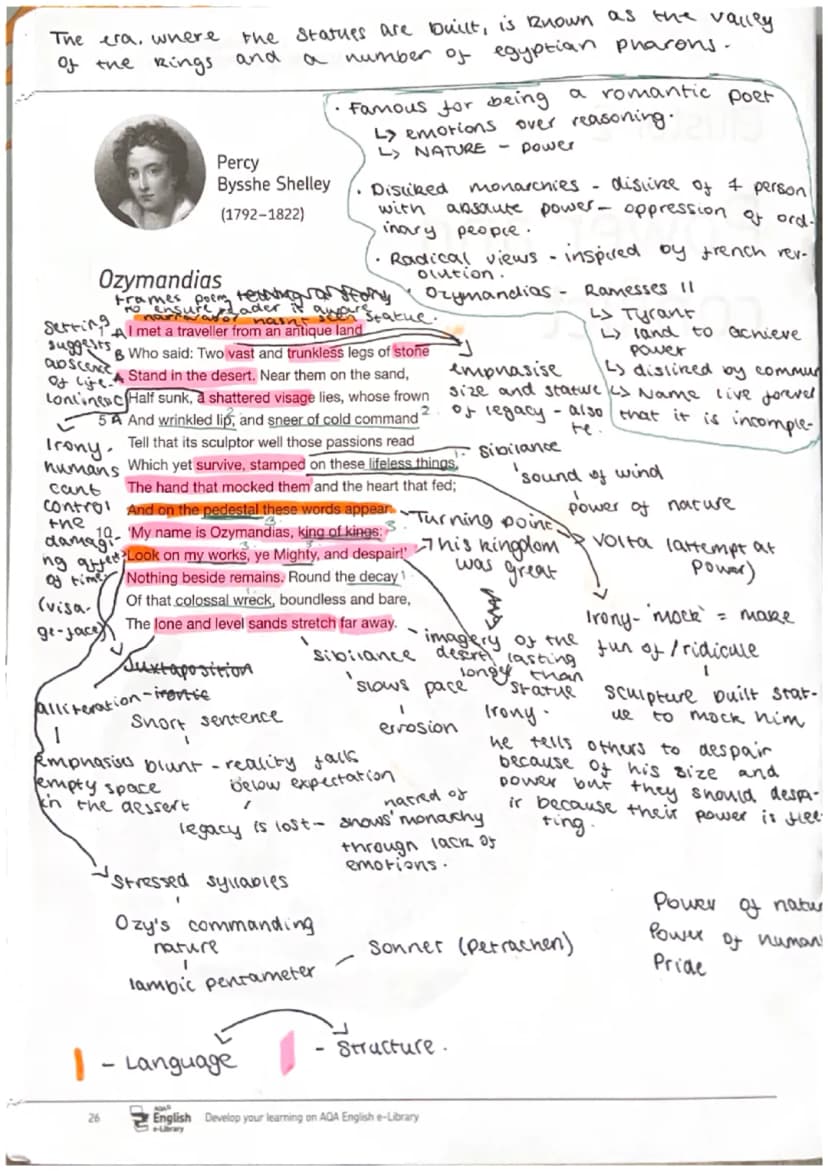
Page 1: Analysis of "Ozymandias"
This page provides a detailed Ozymandias poem analysis English literature GCSE, breaking down the sonnet line by line and examining its key elements.
The poem begins with the narrator recounting a story told by a traveler from an "antique land." This framing device sets the scene for the description of the ruined statue of Ozymandias, believed to be based on the Egyptian pharaoh Ramesses II.
Vocabulary: Antique land - An ancient civilization, likely referring to Egypt
The vivid imagery of the "two vast and trunkless legs of stone" and the "shattered visage" creates a powerful contrast between the statue's former grandeur and its current state of decay.
Highlight: The description of the statue's "frown and wrinkled lip, and sneer of cold command" emphasizes the tyrannical nature of Ozymandias
Shelley employs several poetic techniques to enhance the poem's impact:
- Alliteration: "vast and trunkless"
- Sibilance: "Stand in the desert... sands stretch"
- Enjambment: Lines flow into each other, creating a sense of continuity
Example: The use of enjambment in "whose frown / And wrinkled lip, and sneer of cold command" emphasizes the statue's imposing expression
The poem's structure as a Petrarchan sonnet with iambic pentameter adds to its rhythmic quality and reinforces its themes.
Quote: "My name is Ozymandias, king of kings: / Look on my works, ye Mighty, and despair!"
This central quote reveals the irony at the heart of the poem. The boastful inscription contrasts sharply with the statue's ruined state, highlighting the transience of power and human achievements.
The final lines describe the vast, empty desert surrounding the statue, emphasizing the ultimate power of nature over human creations.
Definition: Irony - The use of words to convey a meaning that is opposite of its literal meaning
Shelley's background as a Romantic poet who disliked absolute monarchies and was inspired by the French Revolution informs the poem's critique of tyranny and oppression.
2
of 10
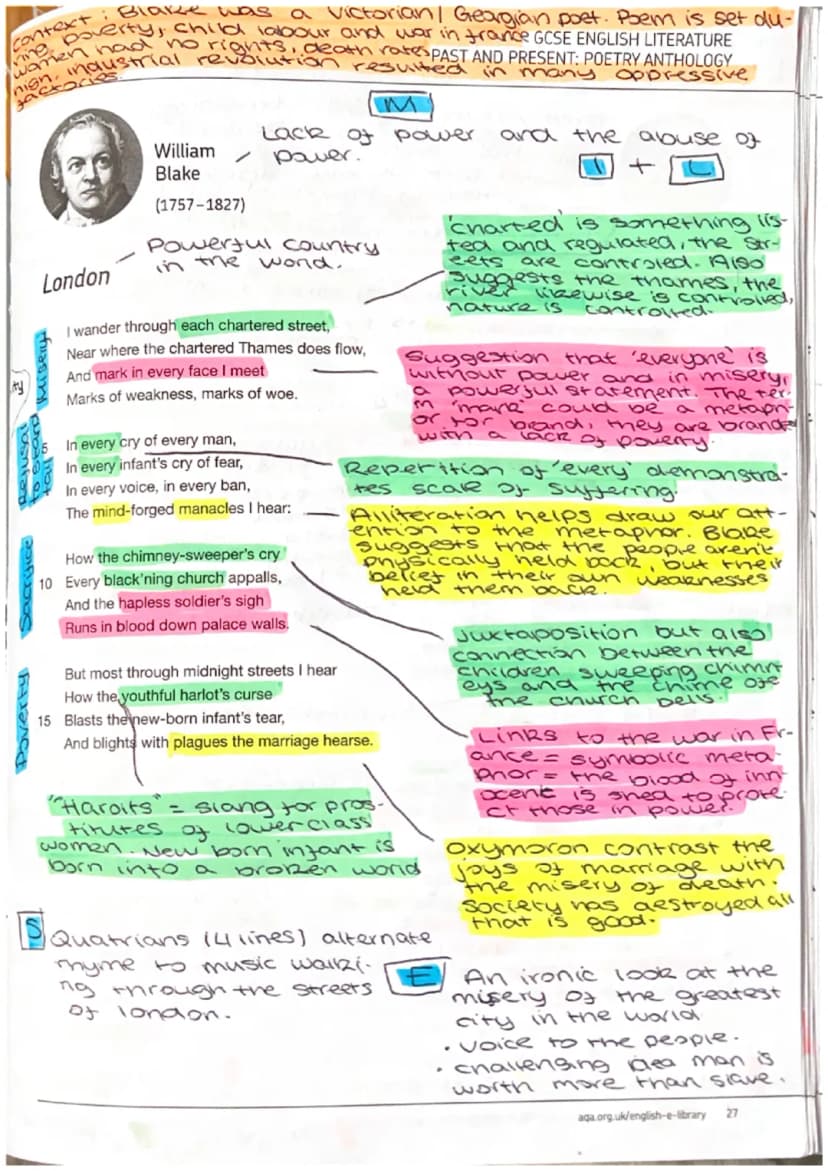
Page 2: Analysis of "London" by William Blake
This page offers a comprehensive London by William Blake analysis, examining the poem's themes, structure, and historical context.
William Blake's "London" presents a scathing critique of the city during the Industrial Revolution, highlighting poverty, oppression, and social injustice.
Context: Blake was a Victorian/Georgian poet writing during a time of significant social and economic change in London
The poem's structure consists of four quatrains with an ABAB rhyme scheme, mirroring the speaker's journey through London's streets.
Key themes explored in the poem include:
- Oppression and lack of power
- Poverty and social inequality
- Corruption of institutions (church, monarchy)
- Loss of innocence
Vocabulary: Chartered - Regulated, controlled; suggests the streets and even the Thames river are under strict control
Blake uses repetition extensively to emphasize the pervasive nature of suffering in London:
Quote: "And mark in every face I meet / Marks of weakness, marks of woe"
This repetition of "every" and "marks" underscores the universality of misery in the city.
Highlight: The phrase "mind-forged manacles" is a powerful metaphor suggesting that people are mentally enslaved by their beliefs and societal constraints
Blake employs vivid imagery to illustrate the city's problems:
- "Chimney-sweeper's cry" represents child labor
- "Hapless soldier's sigh" alludes to war and its consequences
- "Youthful harlot's curse" highlights issues of prostitution and poverty
Example: The image of blood running down palace walls symbolizes how the suffering of common people stains the powerful institutions
The poem concludes with a striking oxymoron:
Quote: "And blights with plagues the marriage hearse"
This final line encapsulates the poem's bleak view of London, where even joyous occasions like marriage are tainted by misery and death.
3
of 10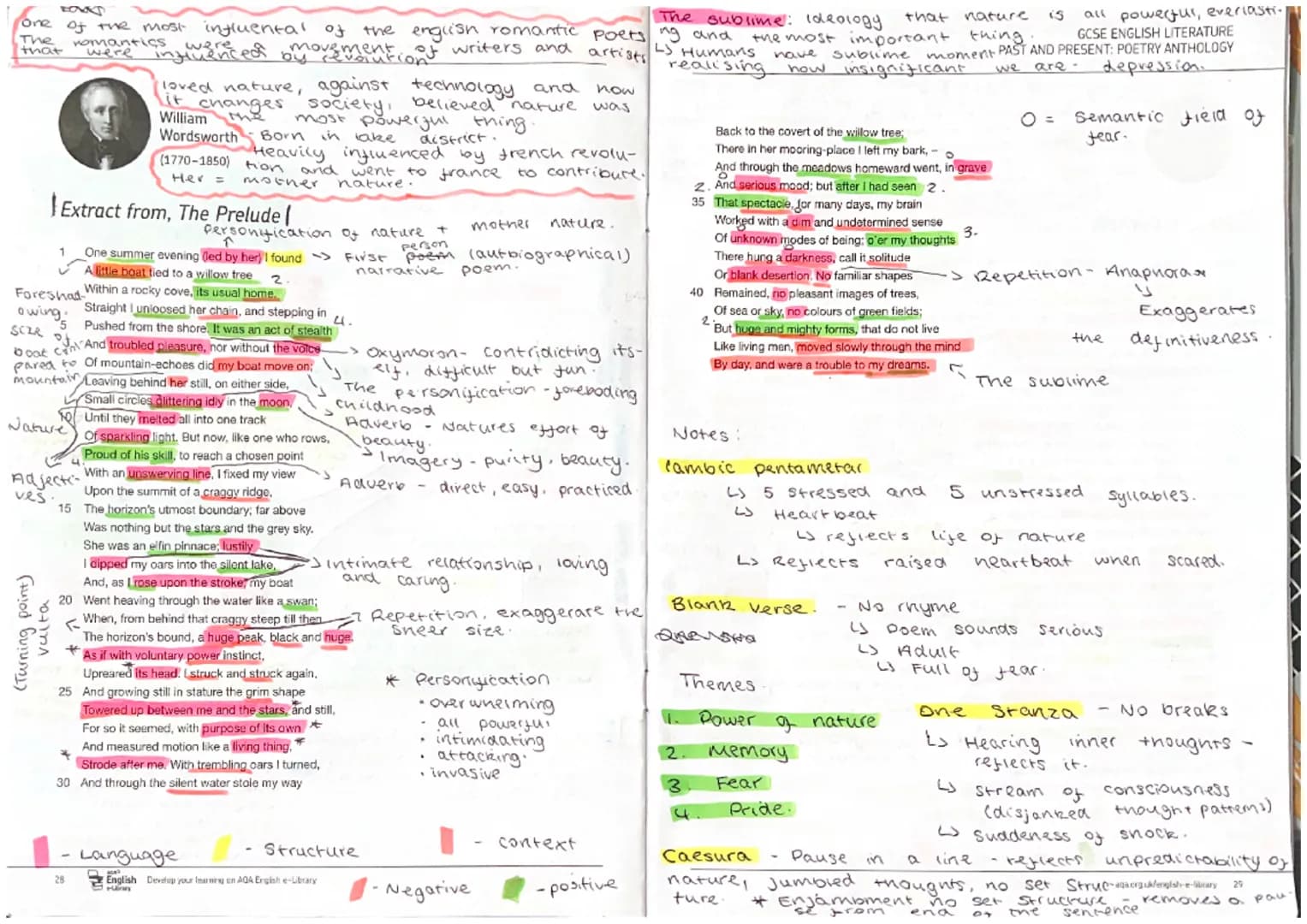
Page 3: Extract from "The Prelude" by William Wordsworth
This page provides an analysis of an extract from "The Prelude" by William Wordsworth, a key figure in the Romantic movement.
The extract describes a summer evening when the speaker finds a small boat tied to a willow tree and decides to take it out on the water. This seemingly simple act becomes a profound experience of nature and self-discovery.
Context: Wordsworth was one of the most influential Romantic poets, known for his love of nature and opposition to industrialization
Key features of the extract include:
- Vivid natural imagery: The rocky cove, willow tree, and moonlit water create a serene setting
- Sense of adventure and transgression: The speaker describes the act as one of "stealth and troubled pleasure"
- Personification of nature: The mountain echoes seem to respond to the boat's movement
Quote: "It was an act of stealth / And troubled pleasure, nor without the voice / Of mountain-echoes did my boat move on"
This quote highlights the mix of excitement and unease the speaker feels, as well as the way nature seems to react to his presence.
The extract employs several poetic techniques:
- Enjambment: Lines flow into each other, creating a sense of continuous movement
- Alliteration: "little boat," "troubled pleasure"
- Imagery: "Small circles glittering idly in the moon"
Highlight: The image of circles in the water melting into "one track" suggests a sense of unity with nature
The extract showcases key themes of Romantic poetry:
- The power and beauty of nature
- The individual's emotional response to the natural world
- The search for transcendent experiences in everyday life
Vocabulary: Cove - A small, sheltered bay
This extract serves as an excellent example of Wordsworth's style and the broader themes of Romantic poetry, making it a valuable piece for GCSE poem analysis.
4
of 10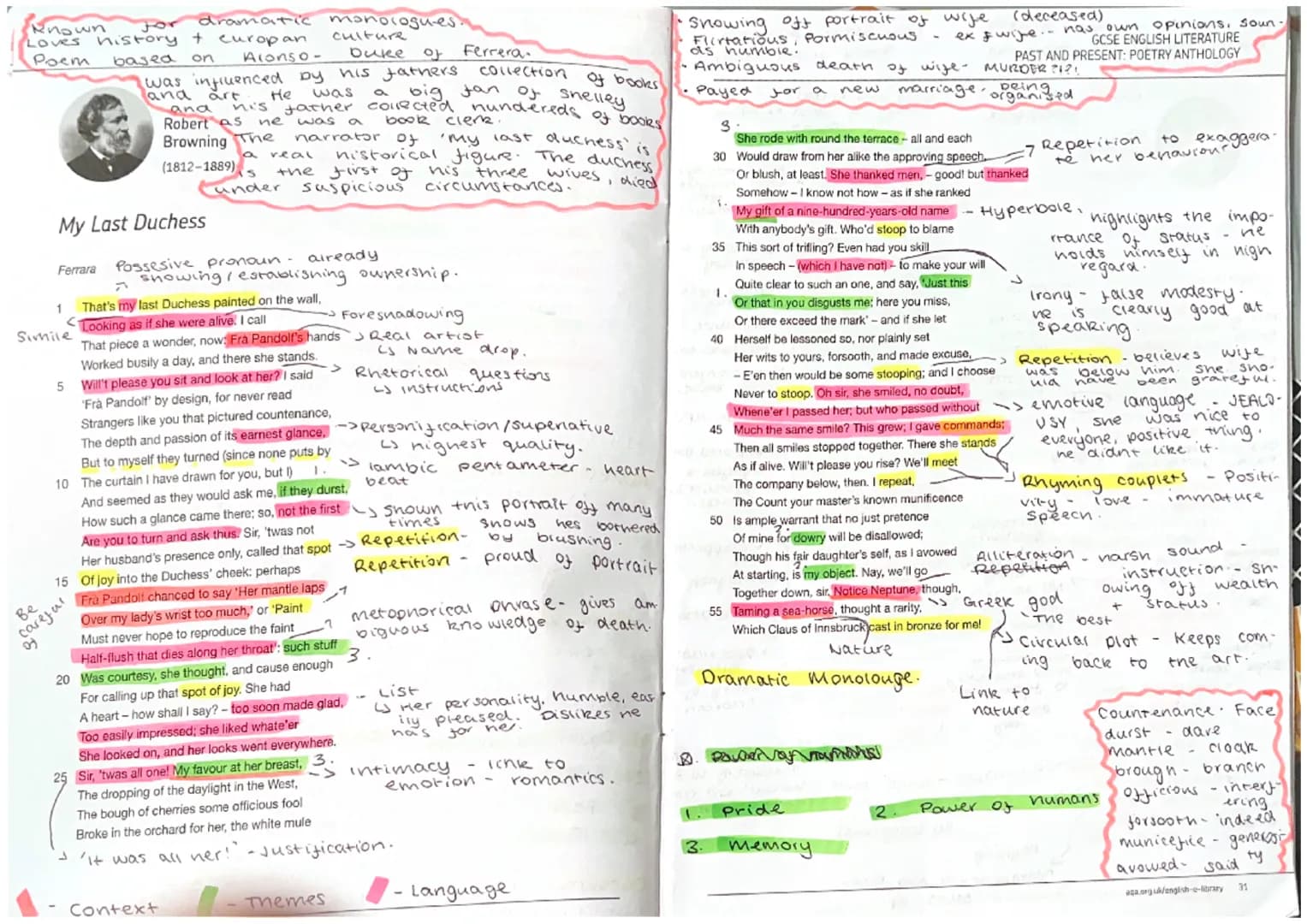
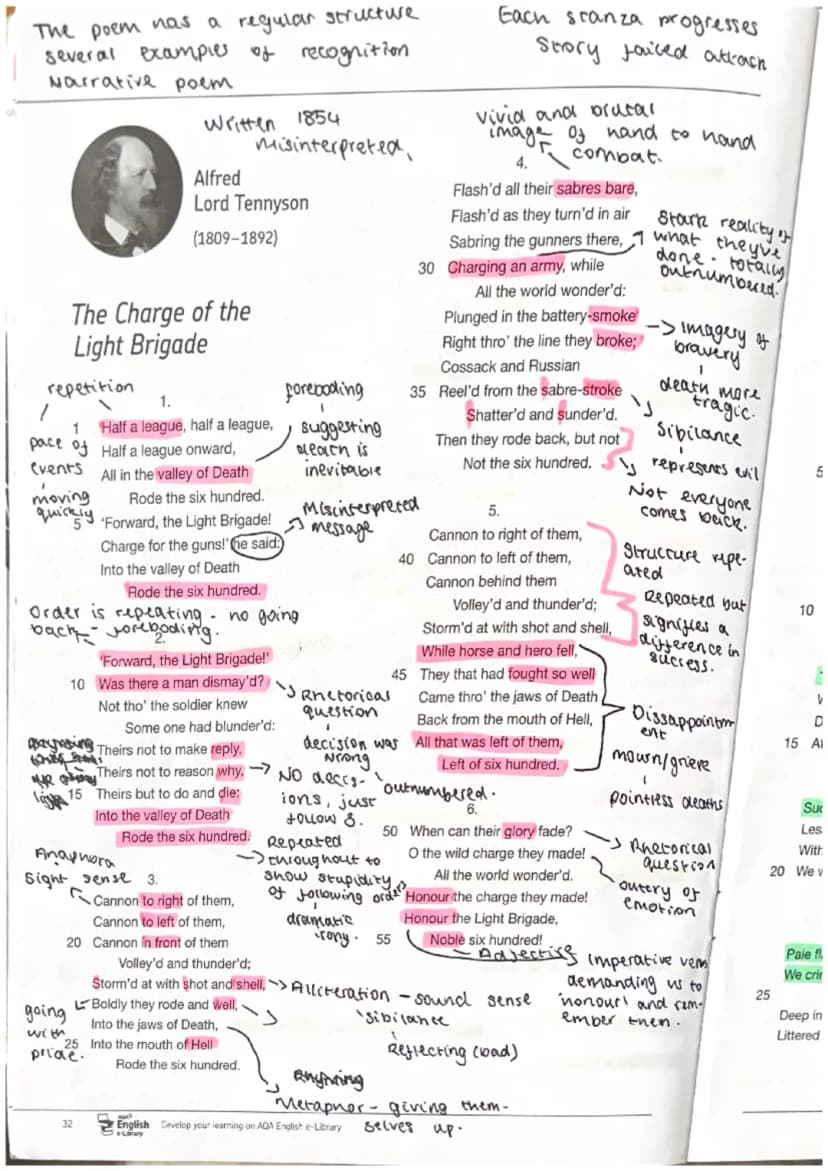
Understanding "The Charge of the Light Brigade" - A Detailed Analysis
"The Charge of the Light Brigade" by Alfred Lord Tennyson stands as one of the most significant Poetry analysis GCSE Power and Conflict pieces. This narrative poem chronicles the tragic charge of British cavalry against Russian forces during the Crimean War in 1854.
The poem's structure employs powerful techniques to convey the futility and heroism of war. Tennyson uses anaphora extensively, repeating phrases like "Half a league" and "Cannon to right of them" to create a rhythmic momentum that mirrors the cavalry's charge. This repetition serves both to emphasize the soldiers' relentless advance and to underscore the tragic inevitability of their fate.
Definition: Anaphora is the repetition of words or phrases at the beginning of successive lines or clauses, used here to create dramatic emphasis and rhythm.
The poem's most striking feature is its portrayal of military obedience and sacrifice. The famous lines "Theirs not to make reply, / Theirs not to reason why, / Theirs but to do and die" encapsulate the soldiers' unquestioning devotion to duty, despite the fatal consequences of their commanders' blunder. This creates dramatic irony that deepens the tragedy of their sacrifice.
Example: The recurring phrase "Into the valley of Death" appears throughout the poem, creating a foreboding atmosphere while referencing Psalm 23, adding biblical gravity to the soldiers' sacrifice.
5
of 10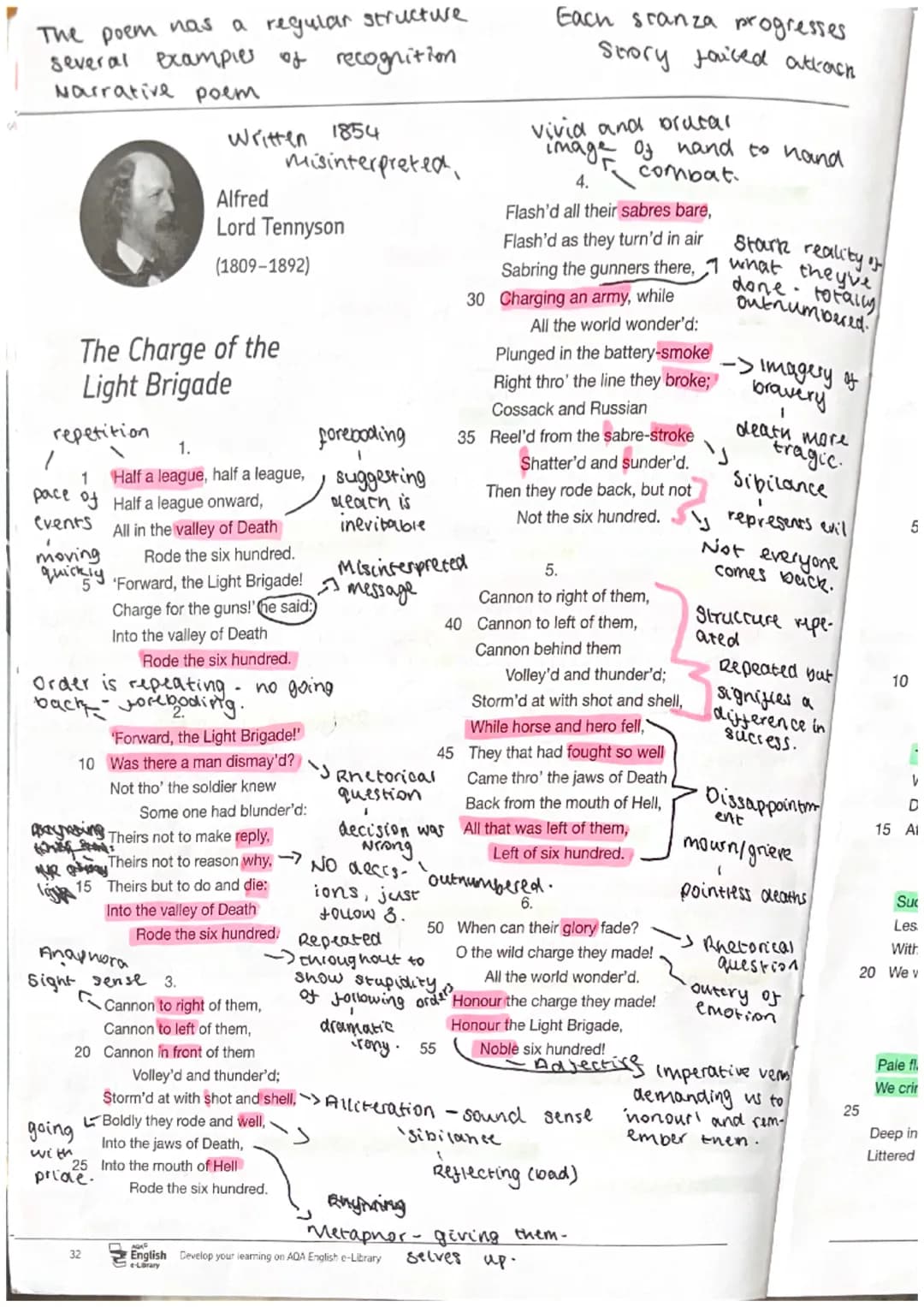
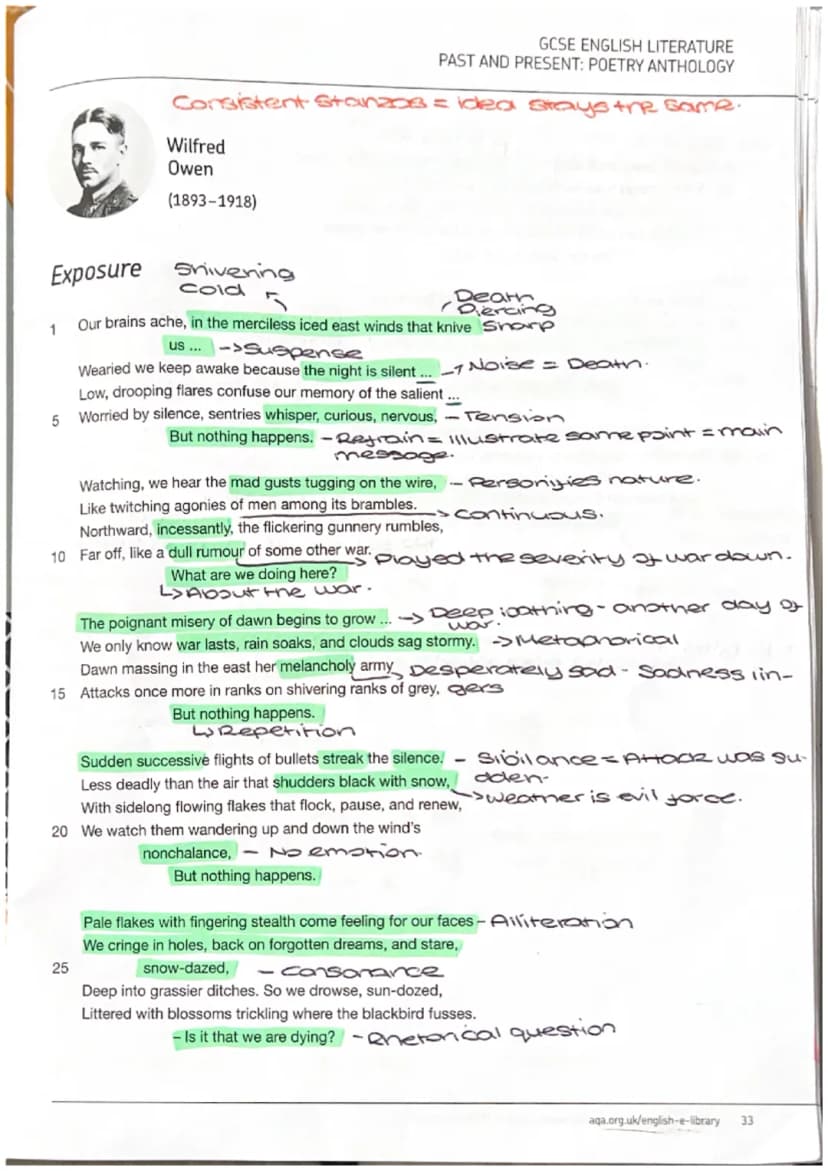
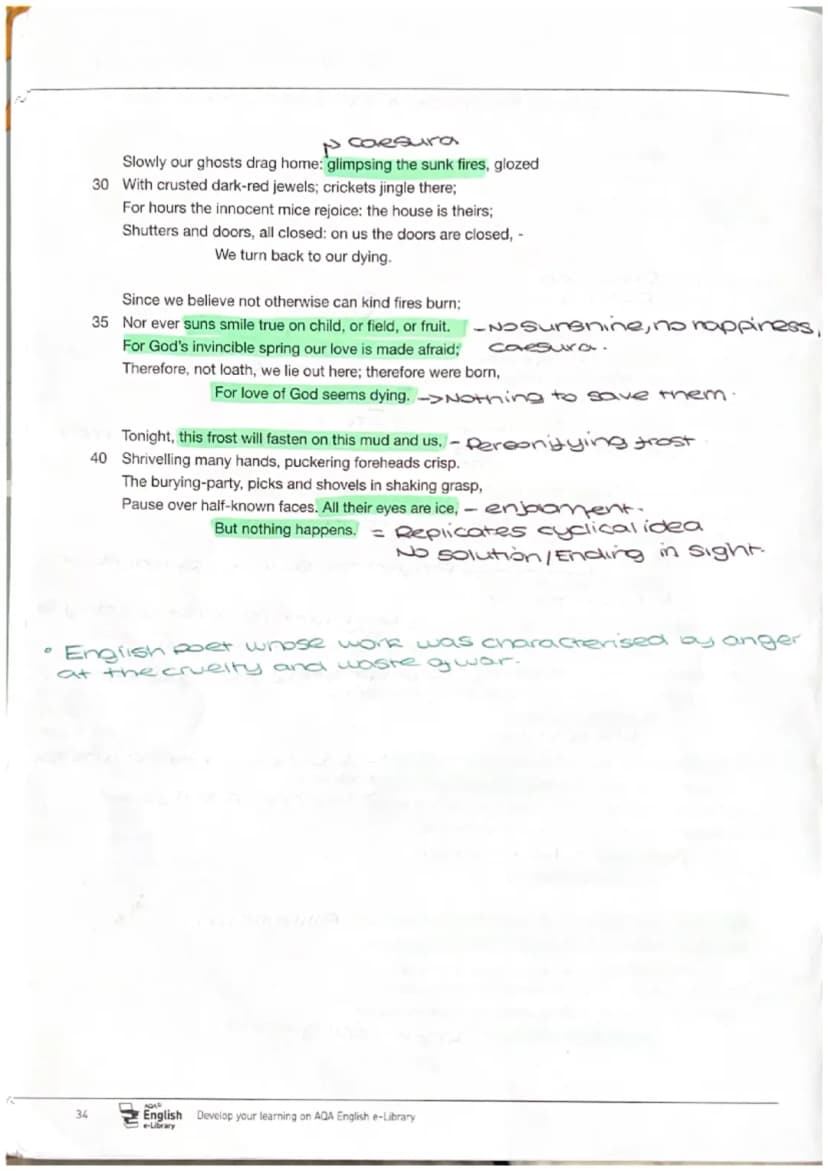
Analyzing "Exposure" by Wilfred Owen - A Comprehensive Study
"Exposure" represents a masterpiece of Poetry techniques GCSE pdf worthy analysis, offering a haunting portrayal of soldiers' experiences during World War I. Owen's vivid imagery and sophisticated sound techniques create an immersive experience of warfare's psychological and physical toll.
The poem's structure reflects the monotony and endless suffering of trench warfare through its regular eight-line stanzas and the recurring refrain "But nothing happens." This repetition emphasizes the soldiers' frustration with their situation - dying not from heroic combat but from exposure to harsh elements.
Highlight: Owen's use of personification in phrases like "merciless iced east winds that knive us" and "dawn massing in the east her melancholy army" creates a sense that nature itself has become an enemy combatant.
The poem masterfully employs sound devices to enhance its meaning. Sibilance in lines like "Sudden successive flights of bullets streak the silence" mimics both the sound of wind and gunfire, while alliteration in phrases like "pale flakes with fingering stealth" creates a sinister atmosphere that pervades the entire work.
6
of 10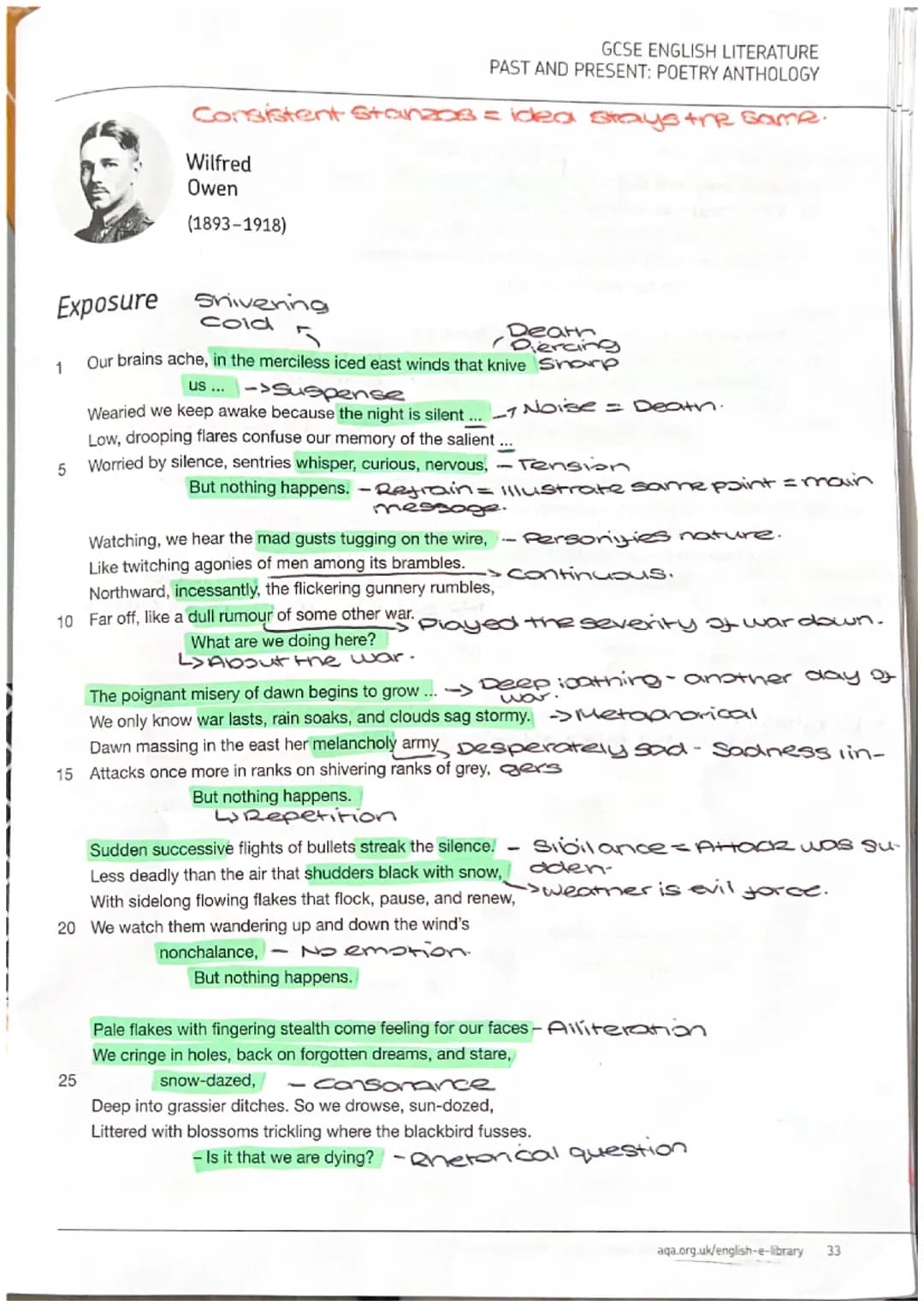
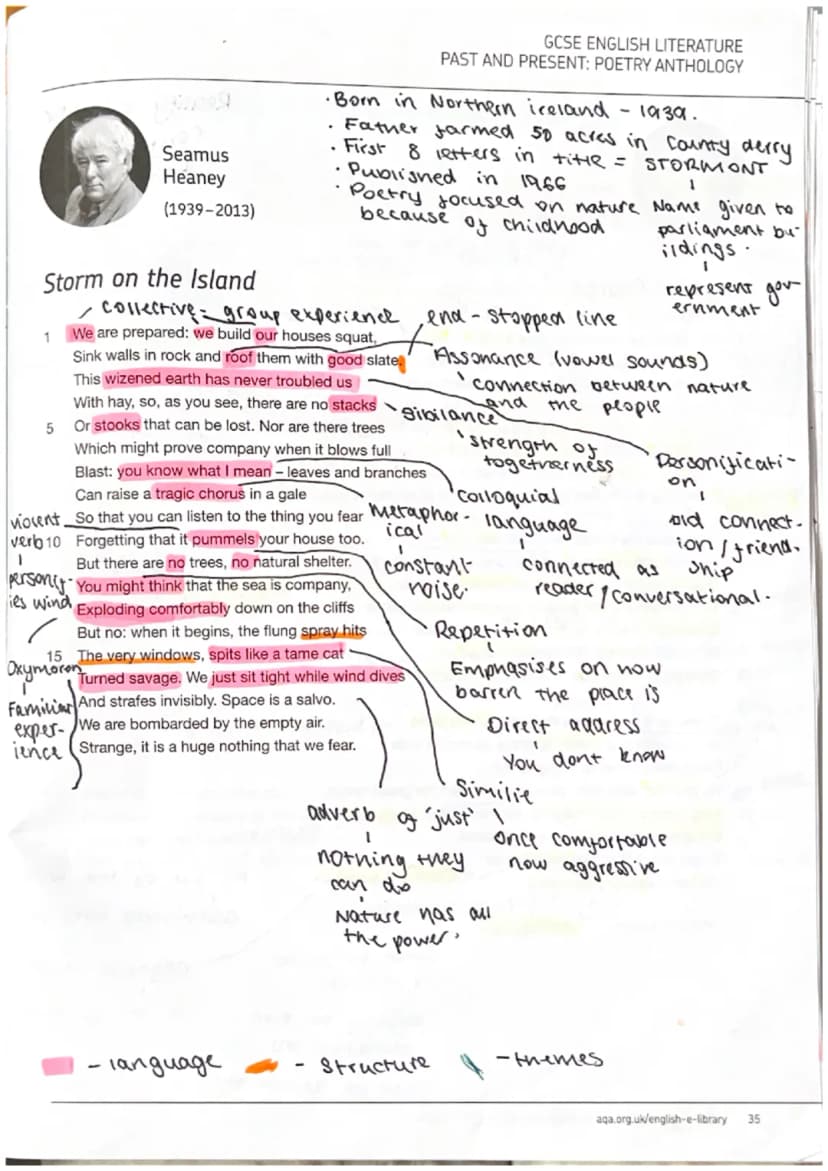
Storm on the Island: A Detailed Literary Analysis
This powerful piece by Seamus Heaney offers excellent material for GCSE poem analysis example study. The poem explores the relationship between humans and nature through the lens of an island community preparing for and experiencing a severe storm.
The poem's structure mirrors its content - beginning with confident preparations but gradually revealing the community's vulnerability. Heaney's use of first-person plural ("we") creates a sense of collective experience and shared adversity, while his careful choice of military metaphors ("strafes," "bombarded," "salvo") suggests a battle between humans and natural forces.
Quote: "Strange, it is a huge nothing that we fear" - this final line encapsulates the poem's central irony: the most threatening force is invisible yet overwhelmingly powerful.
The poem's language evolves from matter-of-fact descriptions to increasingly violent imagery, reflecting the storm's intensification. Heaney's masterful use of enjambment and caesura controls the poem's pace, creating rhythms that mirror the storm's varying intensities.
7
of 10
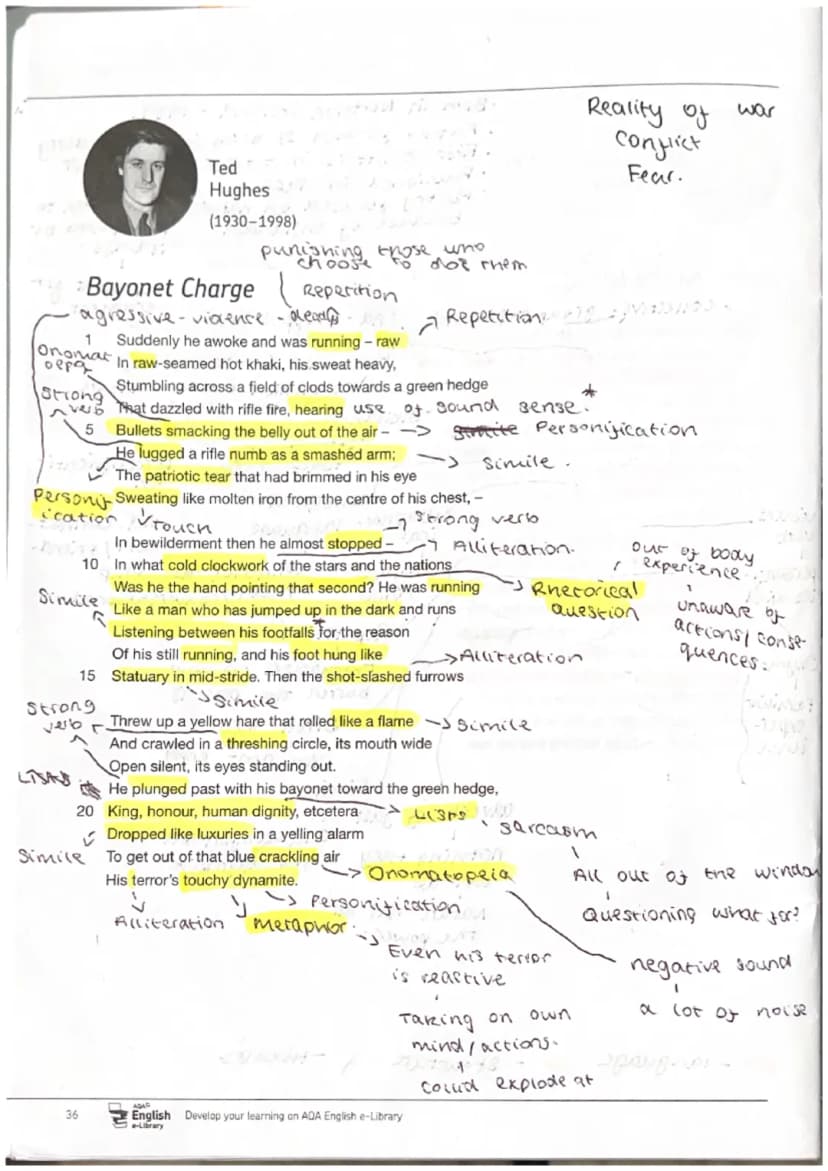
Bayonet Charge: Critical Analysis and Interpretation
Ted Hughes's "Bayonet Charge" provides rich material for Poetry analysis GCSE love and Relationships study through its intense exploration of a soldier's experience in combat. The poem's stream-of-consciousness style captures the chaos and confusion of battle with startling immediacy.
The poem's structure reflects its content, beginning mid-action with "Suddenly he awoke and was running" and maintaining a breathless pace throughout. Hughes uses powerful verbs and vivid imagery to create a visceral sense of the soldier's experience, while his sophisticated use of similes and metaphors deepens the psychological impact.
Vocabulary: The term "patriotic tear" represents both literal tears and the tearing apart of patriotic illusions, demonstrating Hughes's masterful use of double meaning.
The poem's conclusion powerfully conveys the stripping away of abstract ideals in the face of survival instinct. The line "King, honour, human dignity, etcetera / Dropped like luxuries" emphasizes how combat reduces soldiers to their most primitive state, focused solely on survival.
8
of 10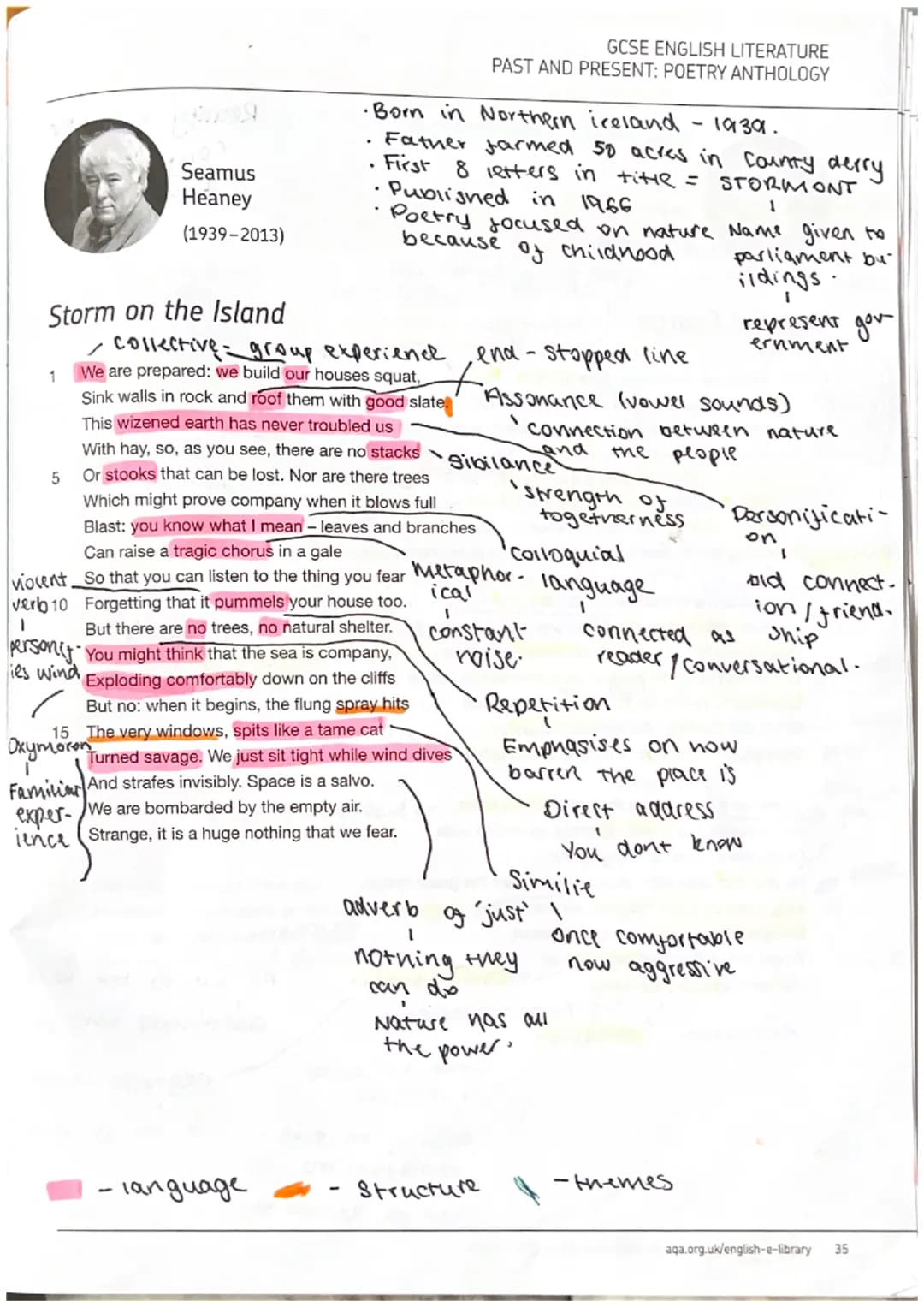
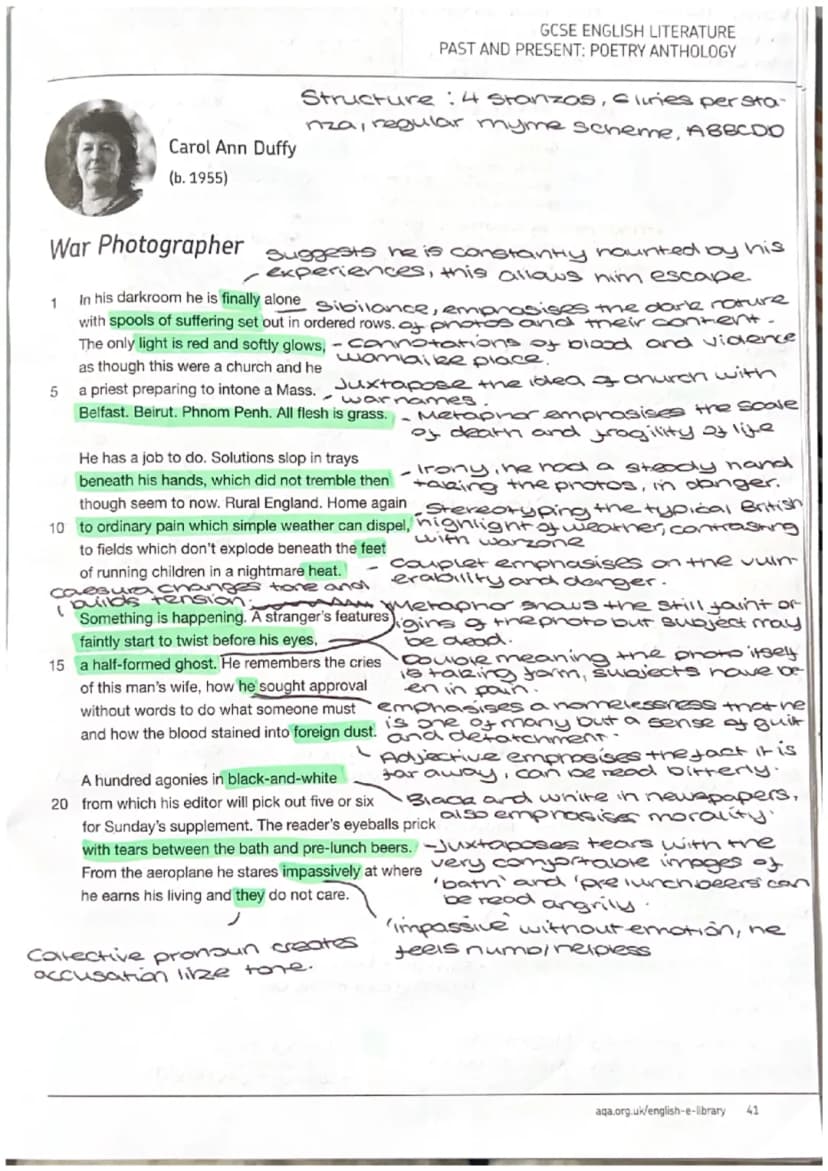
War Photographer by Carol Ann Duffy: A Deep Analysis for GCSE English Literature
In Carol Ann Duffy's powerful poem "War Photographer," we encounter a masterful exploration of conflict, trauma, and the moral complexities of documenting human suffering. This Poetry analysis GCSE Power and Conflict piece reveals layers of meaning through its carefully structured four stanzas, each containing six lines with a regular ABBCDD rhyme scheme.
The poem opens in a darkroom where the photographer processes images of war-torn regions. Through sophisticated Poetry techniques GCSE, Duffy employs sibilance in "spools of suffering" to emphasize the dark nature of the photographs' content. The red glow of the darkroom creates an atmosphere reminiscent of a church, establishing a sacred yet haunting space where the photographer, like a priest, performs his solemn duty.
Definition: Sibilance is a literary device using repeated 's' sounds to create particular effects in poetry. Here, it emphasizes the sinister nature of war photography.
The second and third stanzas delve deeper into the photographer's psychological state. His hands that "did not tremble then" now shake in the safety of Rural England, highlighting the stark contrast between war zones and peaceful homeland. Through powerful imagery and metaphor, Duffy illustrates how the photographer processes both physical photographs and traumatic memories simultaneously.
Highlight: The line "Belfast. Beirut. Phnom Penh. All flesh is grass" uses biblical reference to emphasize the universal nature of human suffering and mortality across different conflict zones.
The final stanza delivers a cutting commentary on society's relationship with war photography. The reduction of "a hundred agonies in black-and-white" to merely "five or six" photos for a Sunday supplement reveals the sanitization of war for comfortable Western consumption. This GCSE poem analysis example demonstrates how Duffy masterfully critiques both the media's presentation of conflict and society's detached response to it.
9
of 10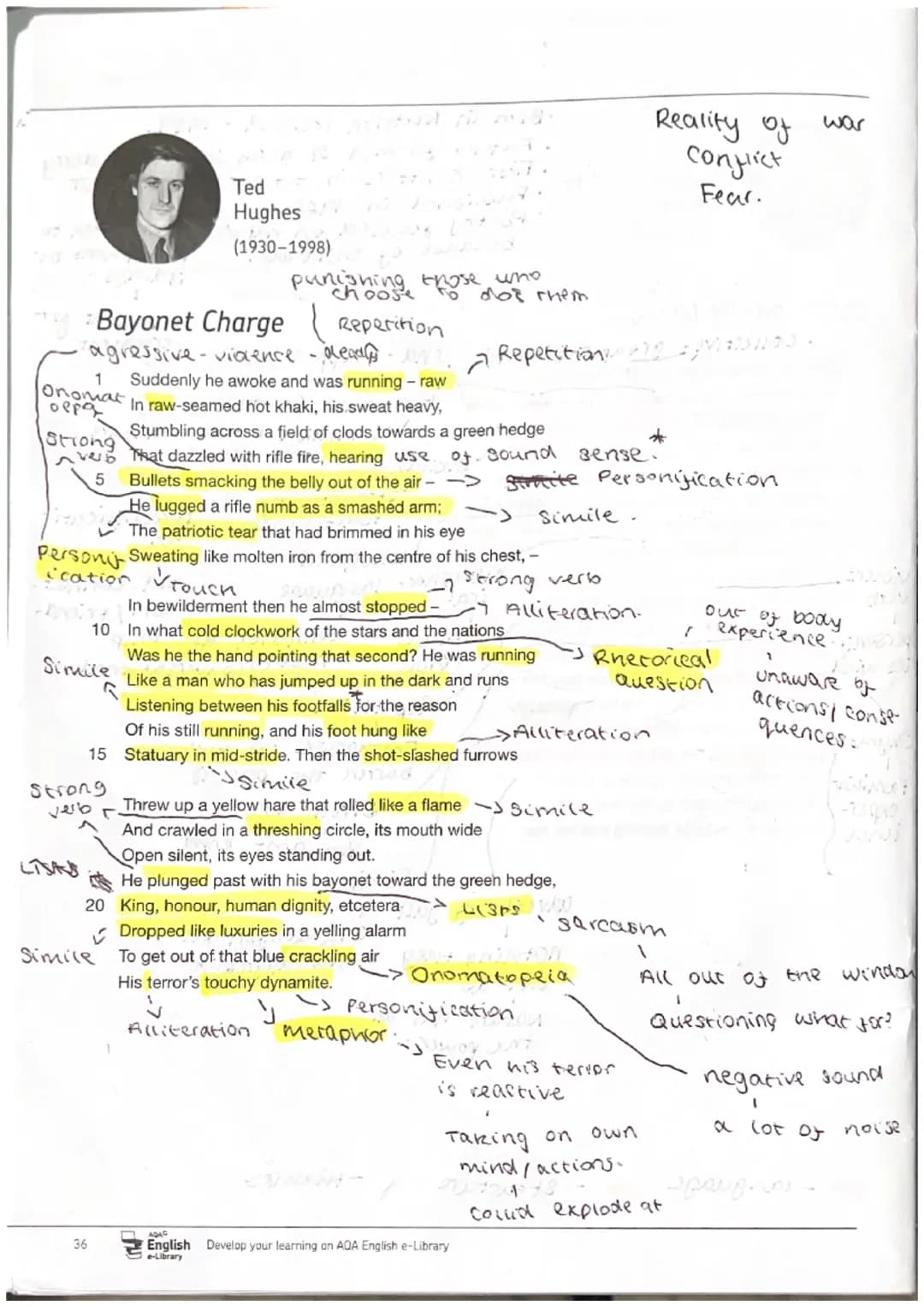
Understanding Poetic Devices and Themes in War Photography
The sophisticated use of poetic devices in "War Photographer" creates a rich tapestry of meaning essential for Poetry analysis GCSE love and Relationships. The poem employs various techniques including metaphor, juxtaposition, and carefully chosen diction to convey its powerful message about war, trauma, and moral responsibility.
Duffy's use of juxtaposition is particularly effective in highlighting the contrast between war zones and peaceful domestic life. The comparison between "Rural England" and fields that "explode beneath the feet" creates a stark contrast that emphasizes the photographer's psychological struggle. This technique is crucial for understanding the poem's exploration of distance and disconnection.
Example: The juxtaposition of "tears between the bath and pre-lunch beers" emphasizes the casual way Western readers consume images of suffering while maintaining their comfortable lifestyles.
The poem's structure mirrors the development of photographs in the darkroom, with images and memories gradually becoming clearer. This technical process serves as an extended metaphor for how we process and understand trauma. The photographer's professional detachment ("impassively") contrasts with his internal turmoil, revealing the psychological cost of bearing witness to atrocity.
Quote: "Something is happening. A stranger's features / faintly start to twist before his eyes" - These lines capture the moment when both photograph and memory materialize, showing how past trauma haunts the present.
10
of 10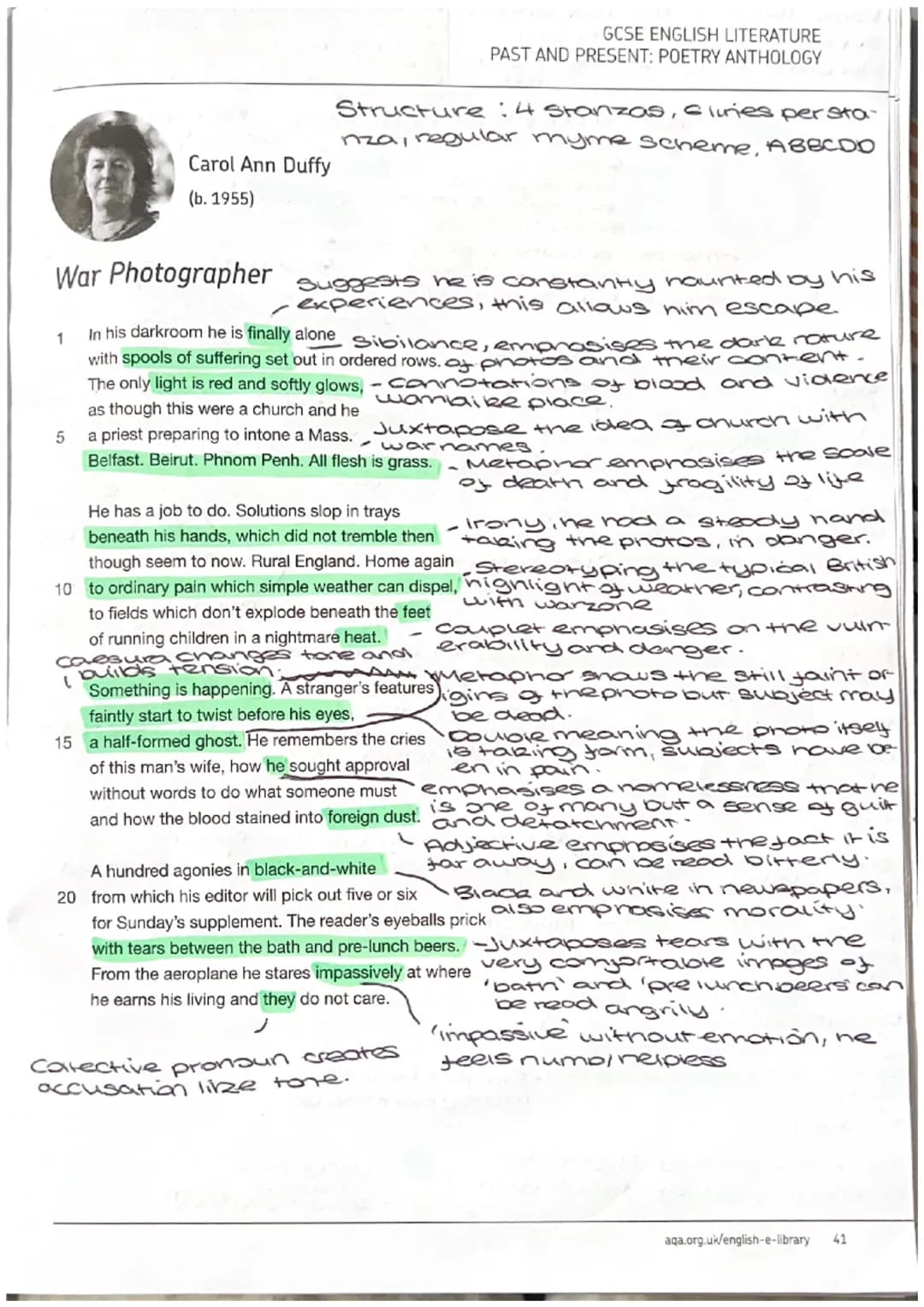
Overall Summary
"Ozymandias" is a sonnet that reflects on the impermanence of power and human achievements through the description of a ruined statue of an ancient king.
Key points:
- The poem uses vivid imagery to describe the shattered remains of a once-mighty statue
- Shelley employs irony to contrast the statue's boastful inscription with its current ruined state
- Themes include the transience of power, human hubris, and nature's supremacy over man's creations
- The poem serves as a critique of tyranny and absolute monarchies
- Poetic techniques like alliteration, sibilance, and enjambment enhance the poem's impact
We thought you’d never ask...
What is the Knowunity AI companion?
Our AI companion is specifically built for the needs of students. Based on the millions of content pieces we have on the platform we can provide truly meaningful and relevant answers to students. But its not only about answers, the companion is even more about guiding students through their daily learning challenges, with personalised study plans, quizzes or content pieces in the chat and 100% personalisation based on the students skills and developments.
Where can I download the Knowunity app?
You can download the app in the Google Play Store and in the Apple App Store.
Is Knowunity really free of charge?
That's right! Enjoy free access to study content, connect with fellow students, and get instant help – all at your fingertips.
Similar Content
Most popular content: Poetic Devices
9English LiteratureKamikaze Poem Analysis
Explore a detailed analysis of Beatrice Garland's 'Kamikaze', focusing on key themes such as honour, nature, and irony. This summary highlights significant quotations, structural techniques, and comparisons with other poems like 'Poppies' and 'The Emigree'. Ideal for students preparing for exams or seeking to deepen their understanding of war poetry.
1013,442568
English LiteraturePower & Conflict Poetry Analysis
Explore in-depth analyses of key poems from the AQA English Literature anthology focusing on themes of power and conflict. This resource covers essential works including 'Ozymandias', 'War Photographer', and 'The Emigree', providing context, techniques, and critical insights to enhance your understanding and exam preparation.
1119,4492,534
English LiteratureHeaney's Storm Analysis
Explore Seamus Heaney's 'Storm on the Island' with in-depth analysis of key themes, structure, and language. This summary highlights the poem's metaphor for human vulnerability and the unpredictable nature of conflict, making it essential for GCSE poetry studies. Key quotes and interpretations included.
113,296187
English LiteratureHeaney's Naturalist Analysis
Explore the themes and context of Seamus Heaney's 'Death of a Naturalist'. This detailed analysis covers the poem's vivid imagery, the shift from innocence to experience, and the use of onomatopoeia. Ideal for Eduqas and AQA students seeking to deepen their understanding of modern poetry.
112,83459
English LanguageLiterary Techniques Explained
Explore essential literary techniques and their effects in English literature. This comprehensive guide covers similes, metaphors, foreshadowing, and more, providing clear definitions and examples to enhance your understanding and analysis skills for GCSE AQA English. Ideal for students seeking to improve their literary analysis and comprehension.
113,93371
English LiteratureNature's Power: Heaney & Wordsworth
Explore the contrasting depictions of nature in Seamus Heaney's 'Storm On the Island' and William Wordsworth's 'The Prelude'. This comparative analysis delves into themes of man vs nature, the structure of each poem, and the poets' unique perspectives on the overwhelming force of the natural world. Ideal for students studying poetry and literary analysis.
112,53760
English LiteratureExploring Blindness in Poetry
Dive into a detailed analysis of the themes of blindness and emotional resilience in poetry. This study note examines the poignant representation of a mother's struggle with blindness, her coping mechanisms, and the impact on family dynamics. Ideal for students studying literary techniques and emotional depth in poetry. Key concepts include stoicism, personal tone, and the use of imagery. Includes annotations and comparisons to other works.
122077
English LiteratureEmpowerment Through Education
Explore the themes of oppression and resilience in Imtiaz Dharker's poem, highlighting the journey of young girls fighting for their rights through education. This analysis delves into metaphors of warfare, the significance of knowledge, and the collective strength of female solidarity. Ideal for students studying contemporary poetry and social issues.
112634
English LiteratureAnalysis of 'Remains'
Explore a detailed analysis of Simon Armitage's poem 'Remains'. This study note covers key literary devices such as enjambment, metaphor, and repetition, highlighting the emotional impact of war and memory. Ideal for students seeking to understand the poem's themes and techniques.
112,69248
Most popular content in English Literature
9English LiteratureAn Inspector Calls: Character Insights
Explore in-depth analysis and key quotes for characters in J.B. Priestley's 'An Inspector Calls'. This resource covers Gerald Croft, Inspector Goole, Sheila Birling, Mrs. Birling, Eric Birling, and Eva Smith, focusing on themes of class, gender roles, and social responsibility. Ideal for students aiming for Grade 8 and above.
1025,429907
English LiteratureRomeo and Juliet: Key themes
Key Romeo and Juliet themes and analysed quotes
106,708198
English LiteratureMacbeth: Guilt and Ambition
Explore the complex themes of guilt and ambition in Shakespeare's 'Macbeth'. This analysis covers key characters, including Macbeth and Lady Macbeth, their moral dilemmas, and the tragic consequences of their ambition. Ideal for students studying character motivations, thematic elements, and the psychological impact of power. Includes insights on the natural order, manipulation, and the descent into madness.
919,093397
I
English LiteratureInspector Calls Quiz (YR 10 MOCKS)
for YR 10 GCSE mock on Inspector Calls
102,1461
E
English LiteratureExplore the World of English Literature
Master the key concepts and works of English literature with this comprehensive flashcard set designed for grade 10 students.
112,0941
English LiteratureExploring Macbeth's Themes
Dive into the intricate themes of Shakespeare's Macbeth, including the supernatural, ambition, guilt, and kingship. This analysis features key quotes and insights that reveal how these themes intertwine to shape the characters and the narrative. Ideal for students seeking a deeper understanding of the play's moral complexities and psychological depth.
1015,849524
E
English LiteratureExploring English Literature: A Journey through Medium
Discover the captivating world of English Literature with this comprehensive medium-level flashcard set. Dive into the works of renowned authors and explore the themes, characters, and literary techniques that make their writing truly remarkable.
111,0580
E
English LiteratureExploring 'A Christmas Carol': Themes, Characters, and Lessons
Delve into the main themes, key characters, and valuable lessons in Charles Dickens' 'A Christmas Carol'. Discover the impact of Scrooge's transformation and the significance of love, redemption, and the true meaning of Christmas.
101,2480
English LiteratureMacbeth Key Themes Essay Plans
Essay plans for key themes in macbeth - guilt, supernatural & ambition
115,186146
Most popular content
9 Sociology
Sociology of Education Overview
Explore comprehensive A-Level Sociology notes on the education system, covering key theories, policies, and sociological perspectives. This resource includes insights on marketisation, gender roles, cultural deprivation, and educational inequalities, providing a thorough understanding of how education shapes social stratification and individual achievement. Ideal for exam preparation and in-depth study.
12102,8693,040
SociologySociology of Families: Comprehensive Revision
Dive into an extensive overview of family dynamics, perspectives, and patterns in sociology. This resource covers key concepts such as family diversity, gender roles, marriage, and the impact of social policies on family structures. Perfect for A-Level Sociology students preparing for Paper 2.
1273,6612,307
CriminologyCriminology: Crime & Punishment Overview
Comprehensive mindmaps covering key concepts in the Crime and Punishment topic for WJEC Criminology Unit 4. This resource includes detailed insights into the Criminal Justice System, crime prevention strategies, sentencing models, and the roles of various agencies. Ideal for A-Level revision, ensuring you grasp essential theories and legislative processes to excel in your exams.
1254,8691,059
SociologyComprehensive Crime & Deviance Overview
Explore an extensive revision of crime and deviance topics, including theories, types of crime, and the impact of media. This resource covers key concepts such as Marxism, functionalism, gender and crime, and the influence of globalization on criminal behavior. Ideal for students seeking a thorough understanding of criminology and its various theories. Type: Full Topic Revision.
1251,6541,399
C
 Biology
Cell Biology and Cell structure
cell structures
93,2490
English LiteratureAn Inspector Calls: Character Insights
Explore in-depth analysis and key quotes for characters in J.B. Priestley's 'An Inspector Calls'. This resource covers Gerald Croft, Inspector Goole, Sheila Birling, Mrs. Birling, Eric Birling, and Eva Smith, focusing on themes of class, gender roles, and social responsibility. Ideal for students aiming for Grade 8 and above.
1025,429907
CriminologyWJEC Unit 4 Criminology
Criminology unit 4 detailed revision note
127,151125
CriminologyCriminology Theories Overview
Explore key criminology theories and their implications on crime and deviance. This comprehensive summary covers biological, psychological, and sociological perspectives, including labelling theory, right realism, and the impact of social campaigns on policy development. Ideal for A-Level criminology students seeking to understand the complexities of criminal behaviour and the factors influencing crime prevention strategies.
129,760210
English LiteratureRomeo and Juliet: Key themes
Key Romeo and Juliet themes and analysed quotes
106,708198
Can't find what you're looking for? Explore other subjects.
Students love us — and so will you.
4.6/5App Store
4.7/5Google Play
The app is very easy to use and well designed. I have found everything I was looking for so far and have been able to learn a lot from the presentations! I will definitely use the app for a class assignment! And of course it also helps a lot as an inspiration.
Stefan SiOS user
This app is really great. There are so many study notes and help [...]. My problem subject is French, for example, and the app has so many options for help. Thanks to this app, I have improved my French. I would recommend it to anyone.
Samantha KlichAndroid user
Wow, I am really amazed. I just tried the app because I've seen it advertised many times and was absolutely stunned. This app is THE HELP you want for school and above all, it offers so many things, such as workouts and fact sheets, which have been VERY helpful to me personally.
AnnaiOS user
English Literature1,388 views·Updated Jun 25, 2026·11 pagesCool GCSE Poetry Analysis: Ozymandias and London by William Blake
The study of poetry at the GCSE level requires deep understanding of literary techniques, historical context, and thematic analysis. Two significant poems frequently studied are "Ozymandias" by Percy Bysshe Shelley and "London" by William Blake, both...
1
of 10
Sign up to see the content. It's free!
- Access to all documents
- Improve your grades
- Join milions of students
Page 1: Analysis of "Ozymandias"
This page provides a detailed Ozymandias poem analysis English literature GCSE, breaking down the sonnet line by line and examining its key elements.
The poem begins with the narrator recounting a story told by a traveler from an "antique land." This framing device sets the scene for the description of the ruined statue of Ozymandias, believed to be based on the Egyptian pharaoh Ramesses II.
Vocabulary: Antique land - An ancient civilization, likely referring to Egypt
The vivid imagery of the "two vast and trunkless legs of stone" and the "shattered visage" creates a powerful contrast between the statue's former grandeur and its current state of decay.
Highlight: The description of the statue's "frown and wrinkled lip, and sneer of cold command" emphasizes the tyrannical nature of Ozymandias
Shelley employs several poetic techniques to enhance the poem's impact:
- Alliteration: "vast and trunkless"
- Sibilance: "Stand in the desert... sands stretch"
- Enjambment: Lines flow into each other, creating a sense of continuity
Example: The use of enjambment in "whose frown / And wrinkled lip, and sneer of cold command" emphasizes the statue's imposing expression
The poem's structure as a Petrarchan sonnet with iambic pentameter adds to its rhythmic quality and reinforces its themes.
Quote: "My name is Ozymandias, king of kings: / Look on my works, ye Mighty, and despair!"
This central quote reveals the irony at the heart of the poem. The boastful inscription contrasts sharply with the statue's ruined state, highlighting the transience of power and human achievements.
The final lines describe the vast, empty desert surrounding the statue, emphasizing the ultimate power of nature over human creations.
Definition: Irony - The use of words to convey a meaning that is opposite of its literal meaning
Shelley's background as a Romantic poet who disliked absolute monarchies and was inspired by the French Revolution informs the poem's critique of tyranny and oppression.
2
of 10Sign up to see the content. It's free!
- Access to all documents
- Improve your grades
- Join milions of students
Page 2: Analysis of "London" by William Blake
This page offers a comprehensive London by William Blake analysis, examining the poem's themes, structure, and historical context.
William Blake's "London" presents a scathing critique of the city during the Industrial Revolution, highlighting poverty, oppression, and social injustice.
Context: Blake was a Victorian/Georgian poet writing during a time of significant social and economic change in London
The poem's structure consists of four quatrains with an ABAB rhyme scheme, mirroring the speaker's journey through London's streets.
Key themes explored in the poem include:
- Oppression and lack of power
- Poverty and social inequality
- Corruption of institutions (church, monarchy)
- Loss of innocence
Vocabulary: Chartered - Regulated, controlled; suggests the streets and even the Thames river are under strict control
Blake uses repetition extensively to emphasize the pervasive nature of suffering in London:
Quote: "And mark in every face I meet / Marks of weakness, marks of woe"
This repetition of "every" and "marks" underscores the universality of misery in the city.
Highlight: The phrase "mind-forged manacles" is a powerful metaphor suggesting that people are mentally enslaved by their beliefs and societal constraints
Blake employs vivid imagery to illustrate the city's problems:
- "Chimney-sweeper's cry" represents child labor
- "Hapless soldier's sigh" alludes to war and its consequences
- "Youthful harlot's curse" highlights issues of prostitution and poverty
Example: The image of blood running down palace walls symbolizes how the suffering of common people stains the powerful institutions
The poem concludes with a striking oxymoron:
Quote: "And blights with plagues the marriage hearse"
This final line encapsulates the poem's bleak view of London, where even joyous occasions like marriage are tainted by misery and death.
3
of 10Sign up to see the content. It's free!
- Access to all documents
- Improve your grades
- Join milions of students
Page 3: Extract from "The Prelude" by William Wordsworth
This page provides an analysis of an extract from "The Prelude" by William Wordsworth, a key figure in the Romantic movement.
The extract describes a summer evening when the speaker finds a small boat tied to a willow tree and decides to take it out on the water. This seemingly simple act becomes a profound experience of nature and self-discovery.
Context: Wordsworth was one of the most influential Romantic poets, known for his love of nature and opposition to industrialization
Key features of the extract include:
- Vivid natural imagery: The rocky cove, willow tree, and moonlit water create a serene setting
- Sense of adventure and transgression: The speaker describes the act as one of "stealth and troubled pleasure"
- Personification of nature: The mountain echoes seem to respond to the boat's movement
Quote: "It was an act of stealth / And troubled pleasure, nor without the voice / Of mountain-echoes did my boat move on"
This quote highlights the mix of excitement and unease the speaker feels, as well as the way nature seems to react to his presence.
The extract employs several poetic techniques:
- Enjambment: Lines flow into each other, creating a sense of continuous movement
- Alliteration: "little boat," "troubled pleasure"
- Imagery: "Small circles glittering idly in the moon"
Highlight: The image of circles in the water melting into "one track" suggests a sense of unity with nature
The extract showcases key themes of Romantic poetry:
- The power and beauty of nature
- The individual's emotional response to the natural world
- The search for transcendent experiences in everyday life
Vocabulary: Cove - A small, sheltered bay
This extract serves as an excellent example of Wordsworth's style and the broader themes of Romantic poetry, making it a valuable piece for GCSE poem analysis.
4
of 10Sign up to see the content. It's free!
- Access to all documents
- Improve your grades
- Join milions of students
Understanding "The Charge of the Light Brigade" - A Detailed Analysis
"The Charge of the Light Brigade" by Alfred Lord Tennyson stands as one of the most significant Poetry analysis GCSE Power and Conflict pieces. This narrative poem chronicles the tragic charge of British cavalry against Russian forces during the Crimean War in 1854.
The poem's structure employs powerful techniques to convey the futility and heroism of war. Tennyson uses anaphora extensively, repeating phrases like "Half a league" and "Cannon to right of them" to create a rhythmic momentum that mirrors the cavalry's charge. This repetition serves both to emphasize the soldiers' relentless advance and to underscore the tragic inevitability of their fate.
Definition: Anaphora is the repetition of words or phrases at the beginning of successive lines or clauses, used here to create dramatic emphasis and rhythm.
The poem's most striking feature is its portrayal of military obedience and sacrifice. The famous lines "Theirs not to make reply, / Theirs not to reason why, / Theirs but to do and die" encapsulate the soldiers' unquestioning devotion to duty, despite the fatal consequences of their commanders' blunder. This creates dramatic irony that deepens the tragedy of their sacrifice.
Example: The recurring phrase "Into the valley of Death" appears throughout the poem, creating a foreboding atmosphere while referencing Psalm 23, adding biblical gravity to the soldiers' sacrifice.
5
of 10Sign up to see the content. It's free!
- Access to all documents
- Improve your grades
- Join milions of students
Analyzing "Exposure" by Wilfred Owen - A Comprehensive Study
"Exposure" represents a masterpiece of Poetry techniques GCSE pdf worthy analysis, offering a haunting portrayal of soldiers' experiences during World War I. Owen's vivid imagery and sophisticated sound techniques create an immersive experience of warfare's psychological and physical toll.
The poem's structure reflects the monotony and endless suffering of trench warfare through its regular eight-line stanzas and the recurring refrain "But nothing happens." This repetition emphasizes the soldiers' frustration with their situation - dying not from heroic combat but from exposure to harsh elements.
Highlight: Owen's use of personification in phrases like "merciless iced east winds that knive us" and "dawn massing in the east her melancholy army" creates a sense that nature itself has become an enemy combatant.
The poem masterfully employs sound devices to enhance its meaning. Sibilance in lines like "Sudden successive flights of bullets streak the silence" mimics both the sound of wind and gunfire, while alliteration in phrases like "pale flakes with fingering stealth" creates a sinister atmosphere that pervades the entire work.
6
of 10Sign up to see the content. It's free!
- Access to all documents
- Improve your grades
- Join milions of students
Storm on the Island: A Detailed Literary Analysis
This powerful piece by Seamus Heaney offers excellent material for GCSE poem analysis example study. The poem explores the relationship between humans and nature through the lens of an island community preparing for and experiencing a severe storm.
The poem's structure mirrors its content - beginning with confident preparations but gradually revealing the community's vulnerability. Heaney's use of first-person plural ("we") creates a sense of collective experience and shared adversity, while his careful choice of military metaphors ("strafes," "bombarded," "salvo") suggests a battle between humans and natural forces.
Quote: "Strange, it is a huge nothing that we fear" - this final line encapsulates the poem's central irony: the most threatening force is invisible yet overwhelmingly powerful.
The poem's language evolves from matter-of-fact descriptions to increasingly violent imagery, reflecting the storm's intensification. Heaney's masterful use of enjambment and caesura controls the poem's pace, creating rhythms that mirror the storm's varying intensities.
7
of 10Sign up to see the content. It's free!
- Access to all documents
- Improve your grades
- Join milions of students
Bayonet Charge: Critical Analysis and Interpretation
Ted Hughes's "Bayonet Charge" provides rich material for Poetry analysis GCSE love and Relationships study through its intense exploration of a soldier's experience in combat. The poem's stream-of-consciousness style captures the chaos and confusion of battle with startling immediacy.
The poem's structure reflects its content, beginning mid-action with "Suddenly he awoke and was running" and maintaining a breathless pace throughout. Hughes uses powerful verbs and vivid imagery to create a visceral sense of the soldier's experience, while his sophisticated use of similes and metaphors deepens the psychological impact.
Vocabulary: The term "patriotic tear" represents both literal tears and the tearing apart of patriotic illusions, demonstrating Hughes's masterful use of double meaning.
The poem's conclusion powerfully conveys the stripping away of abstract ideals in the face of survival instinct. The line "King, honour, human dignity, etcetera / Dropped like luxuries" emphasizes how combat reduces soldiers to their most primitive state, focused solely on survival.
8
of 10Sign up to see the content. It's free!
- Access to all documents
- Improve your grades
- Join milions of students
War Photographer by Carol Ann Duffy: A Deep Analysis for GCSE English Literature
In Carol Ann Duffy's powerful poem "War Photographer," we encounter a masterful exploration of conflict, trauma, and the moral complexities of documenting human suffering. This Poetry analysis GCSE Power and Conflict piece reveals layers of meaning through its carefully structured four stanzas, each containing six lines with a regular ABBCDD rhyme scheme.
The poem opens in a darkroom where the photographer processes images of war-torn regions. Through sophisticated Poetry techniques GCSE, Duffy employs sibilance in "spools of suffering" to emphasize the dark nature of the photographs' content. The red glow of the darkroom creates an atmosphere reminiscent of a church, establishing a sacred yet haunting space where the photographer, like a priest, performs his solemn duty.
Definition: Sibilance is a literary device using repeated 's' sounds to create particular effects in poetry. Here, it emphasizes the sinister nature of war photography.
The second and third stanzas delve deeper into the photographer's psychological state. His hands that "did not tremble then" now shake in the safety of Rural England, highlighting the stark contrast between war zones and peaceful homeland. Through powerful imagery and metaphor, Duffy illustrates how the photographer processes both physical photographs and traumatic memories simultaneously.
Highlight: The line "Belfast. Beirut. Phnom Penh. All flesh is grass" uses biblical reference to emphasize the universal nature of human suffering and mortality across different conflict zones.
The final stanza delivers a cutting commentary on society's relationship with war photography. The reduction of "a hundred agonies in black-and-white" to merely "five or six" photos for a Sunday supplement reveals the sanitization of war for comfortable Western consumption. This GCSE poem analysis example demonstrates how Duffy masterfully critiques both the media's presentation of conflict and society's detached response to it.
9
of 10Sign up to see the content. It's free!
- Access to all documents
- Improve your grades
- Join milions of students
Understanding Poetic Devices and Themes in War Photography
The sophisticated use of poetic devices in "War Photographer" creates a rich tapestry of meaning essential for Poetry analysis GCSE love and Relationships. The poem employs various techniques including metaphor, juxtaposition, and carefully chosen diction to convey its powerful message about war, trauma, and moral responsibility.
Duffy's use of juxtaposition is particularly effective in highlighting the contrast between war zones and peaceful domestic life. The comparison between "Rural England" and fields that "explode beneath the feet" creates a stark contrast that emphasizes the photographer's psychological struggle. This technique is crucial for understanding the poem's exploration of distance and disconnection.
Example: The juxtaposition of "tears between the bath and pre-lunch beers" emphasizes the casual way Western readers consume images of suffering while maintaining their comfortable lifestyles.
The poem's structure mirrors the development of photographs in the darkroom, with images and memories gradually becoming clearer. This technical process serves as an extended metaphor for how we process and understand trauma. The photographer's professional detachment ("impassively") contrasts with his internal turmoil, revealing the psychological cost of bearing witness to atrocity.
Quote: "Something is happening. A stranger's features / faintly start to twist before his eyes" - These lines capture the moment when both photograph and memory materialize, showing how past trauma haunts the present.
10
of 10Sign up to see the content. It's free!
- Access to all documents
- Improve your grades
- Join milions of students
Overall Summary
"Ozymandias" is a sonnet that reflects on the impermanence of power and human achievements through the description of a ruined statue of an ancient king.
Key points:
- The poem uses vivid imagery to describe the shattered remains of a once-mighty statue
- Shelley employs irony to contrast the statue's boastful inscription with its current ruined state
- Themes include the transience of power, human hubris, and nature's supremacy over man's creations
- The poem serves as a critique of tyranny and absolute monarchies
- Poetic techniques like alliteration, sibilance, and enjambment enhance the poem's impact
We thought you’d never ask...
What is the Knowunity AI companion?
Our AI companion is specifically built for the needs of students. Based on the millions of content pieces we have on the platform we can provide truly meaningful and relevant answers to students. But its not only about answers, the companion is even more about guiding students through their daily learning challenges, with personalised study plans, quizzes or content pieces in the chat and 100% personalisation based on the students skills and developments.
Where can I download the Knowunity app?
You can download the app in the Google Play Store and in the Apple App Store.
Is Knowunity really free of charge?
That's right! Enjoy free access to study content, connect with fellow students, and get instant help – all at your fingertips.
Similar Content
Most popular content: Poetic Devices
9English LiteratureKamikaze Poem Analysis
Explore a detailed analysis of Beatrice Garland's 'Kamikaze', focusing on key themes such as honour, nature, and irony. This summary highlights significant quotations, structural techniques, and comparisons with other poems like 'Poppies' and 'The Emigree'. Ideal for students preparing for exams or seeking to deepen their understanding of war poetry.
1013,442568
English LiteraturePower & Conflict Poetry Analysis
Explore in-depth analyses of key poems from the AQA English Literature anthology focusing on themes of power and conflict. This resource covers essential works including 'Ozymandias', 'War Photographer', and 'The Emigree', providing context, techniques, and critical insights to enhance your understanding and exam preparation.
1119,4492,534
English LiteratureHeaney's Storm Analysis
Explore Seamus Heaney's 'Storm on the Island' with in-depth analysis of key themes, structure, and language. This summary highlights the poem's metaphor for human vulnerability and the unpredictable nature of conflict, making it essential for GCSE poetry studies. Key quotes and interpretations included.
113,296187
English LiteratureHeaney's Naturalist Analysis
Explore the themes and context of Seamus Heaney's 'Death of a Naturalist'. This detailed analysis covers the poem's vivid imagery, the shift from innocence to experience, and the use of onomatopoeia. Ideal for Eduqas and AQA students seeking to deepen their understanding of modern poetry.
112,83459
English LanguageLiterary Techniques Explained
Explore essential literary techniques and their effects in English literature. This comprehensive guide covers similes, metaphors, foreshadowing, and more, providing clear definitions and examples to enhance your understanding and analysis skills for GCSE AQA English. Ideal for students seeking to improve their literary analysis and comprehension.
113,93371
English LiteratureNature's Power: Heaney & Wordsworth
Explore the contrasting depictions of nature in Seamus Heaney's 'Storm On the Island' and William Wordsworth's 'The Prelude'. This comparative analysis delves into themes of man vs nature, the structure of each poem, and the poets' unique perspectives on the overwhelming force of the natural world. Ideal for students studying poetry and literary analysis.
112,53760
English LiteratureExploring Blindness in Poetry
Dive into a detailed analysis of the themes of blindness and emotional resilience in poetry. This study note examines the poignant representation of a mother's struggle with blindness, her coping mechanisms, and the impact on family dynamics. Ideal for students studying literary techniques and emotional depth in poetry. Key concepts include stoicism, personal tone, and the use of imagery. Includes annotations and comparisons to other works.
122077
English LiteratureEmpowerment Through Education
Explore the themes of oppression and resilience in Imtiaz Dharker's poem, highlighting the journey of young girls fighting for their rights through education. This analysis delves into metaphors of warfare, the significance of knowledge, and the collective strength of female solidarity. Ideal for students studying contemporary poetry and social issues.
112634
English LiteratureAnalysis of 'Remains'
Explore a detailed analysis of Simon Armitage's poem 'Remains'. This study note covers key literary devices such as enjambment, metaphor, and repetition, highlighting the emotional impact of war and memory. Ideal for students seeking to understand the poem's themes and techniques.
112,69248
Most popular content in English Literature
9English LiteratureAn Inspector Calls: Character Insights
Explore in-depth analysis and key quotes for characters in J.B. Priestley's 'An Inspector Calls'. This resource covers Gerald Croft, Inspector Goole, Sheila Birling, Mrs. Birling, Eric Birling, and Eva Smith, focusing on themes of class, gender roles, and social responsibility. Ideal for students aiming for Grade 8 and above.
1025,429907
English LiteratureRomeo and Juliet: Key themes
Key Romeo and Juliet themes and analysed quotes
106,708198
English LiteratureMacbeth: Guilt and Ambition
Explore the complex themes of guilt and ambition in Shakespeare's 'Macbeth'. This analysis covers key characters, including Macbeth and Lady Macbeth, their moral dilemmas, and the tragic consequences of their ambition. Ideal for students studying character motivations, thematic elements, and the psychological impact of power. Includes insights on the natural order, manipulation, and the descent into madness.
919,093397
I
English LiteratureInspector Calls Quiz (YR 10 MOCKS)
for YR 10 GCSE mock on Inspector Calls
102,1461
E
English LiteratureExplore the World of English Literature
Master the key concepts and works of English literature with this comprehensive flashcard set designed for grade 10 students.
112,0941
English LiteratureExploring Macbeth's Themes
Dive into the intricate themes of Shakespeare's Macbeth, including the supernatural, ambition, guilt, and kingship. This analysis features key quotes and insights that reveal how these themes intertwine to shape the characters and the narrative. Ideal for students seeking a deeper understanding of the play's moral complexities and psychological depth.
1015,849524
E
English LiteratureExploring English Literature: A Journey through Medium
Discover the captivating world of English Literature with this comprehensive medium-level flashcard set. Dive into the works of renowned authors and explore the themes, characters, and literary techniques that make their writing truly remarkable.
111,0580
E
English LiteratureExploring 'A Christmas Carol': Themes, Characters, and Lessons
Delve into the main themes, key characters, and valuable lessons in Charles Dickens' 'A Christmas Carol'. Discover the impact of Scrooge's transformation and the significance of love, redemption, and the true meaning of Christmas.
101,2480
English LiteratureMacbeth Key Themes Essay Plans
Essay plans for key themes in macbeth - guilt, supernatural & ambition
115,186146
Most popular content
9SociologySociology of Education Overview
Explore comprehensive A-Level Sociology notes on the education system, covering key theories, policies, and sociological perspectives. This resource includes insights on marketisation, gender roles, cultural deprivation, and educational inequalities, providing a thorough understanding of how education shapes social stratification and individual achievement. Ideal for exam preparation and in-depth study.
12102,8693,040
SociologySociology of Families: Comprehensive Revision
Dive into an extensive overview of family dynamics, perspectives, and patterns in sociology. This resource covers key concepts such as family diversity, gender roles, marriage, and the impact of social policies on family structures. Perfect for A-Level Sociology students preparing for Paper 2.
1273,6612,307
CriminologyCriminology: Crime & Punishment Overview
Comprehensive mindmaps covering key concepts in the Crime and Punishment topic for WJEC Criminology Unit 4. This resource includes detailed insights into the Criminal Justice System, crime prevention strategies, sentencing models, and the roles of various agencies. Ideal for A-Level revision, ensuring you grasp essential theories and legislative processes to excel in your exams.
1254,8691,059
SociologyComprehensive Crime & Deviance Overview
Explore an extensive revision of crime and deviance topics, including theories, types of crime, and the impact of media. This resource covers key concepts such as Marxism, functionalism, gender and crime, and the influence of globalization on criminal behavior. Ideal for students seeking a thorough understanding of criminology and its various theories. Type: Full Topic Revision.
1251,6541,399
C
BiologyCell Biology and Cell structure
cell structures
93,2490
English LiteratureAn Inspector Calls: Character Insights
Explore in-depth analysis and key quotes for characters in J.B. Priestley's 'An Inspector Calls'. This resource covers Gerald Croft, Inspector Goole, Sheila Birling, Mrs. Birling, Eric Birling, and Eva Smith, focusing on themes of class, gender roles, and social responsibility. Ideal for students aiming for Grade 8 and above.
1025,429907
CriminologyWJEC Unit 4 Criminology
Criminology unit 4 detailed revision note
127,151125
CriminologyCriminology Theories Overview
Explore key criminology theories and their implications on crime and deviance. This comprehensive summary covers biological, psychological, and sociological perspectives, including labelling theory, right realism, and the impact of social campaigns on policy development. Ideal for A-Level criminology students seeking to understand the complexities of criminal behaviour and the factors influencing crime prevention strategies.
129,760210
English LiteratureRomeo and Juliet: Key themes
Key Romeo and Juliet themes and analysed quotes
106,708198
Can't find what you're looking for? Explore other subjects.
Students love us — and so will you.
4.6/5App Store
4.7/5Google Play
The app is very easy to use and well designed. I have found everything I was looking for so far and have been able to learn a lot from the presentations! I will definitely use the app for a class assignment! And of course it also helps a lot as an inspiration.
Stefan SiOS user
This app is really great. There are so many study notes and help [...]. My problem subject is French, for example, and the app has so many options for help. Thanks to this app, I have improved my French. I would recommend it to anyone.
Samantha KlichAndroid user
Wow, I am really amazed. I just tried the app because I've seen it advertised many times and was absolutely stunned. This app is THE HELP you want for school and above all, it offers so many things, such as workouts and fact sheets, which have been VERY helpful to me personally.
AnnaiOS user