
Rhetoric is all about the art of persuasion and effective...
 AP English Language23 views·Updated Jun 11, 2026·2 pages
The Language of Composition Chapter 1 Summary Notes
M
Maya@aya_cnsosibozzasmnhg
1
of 2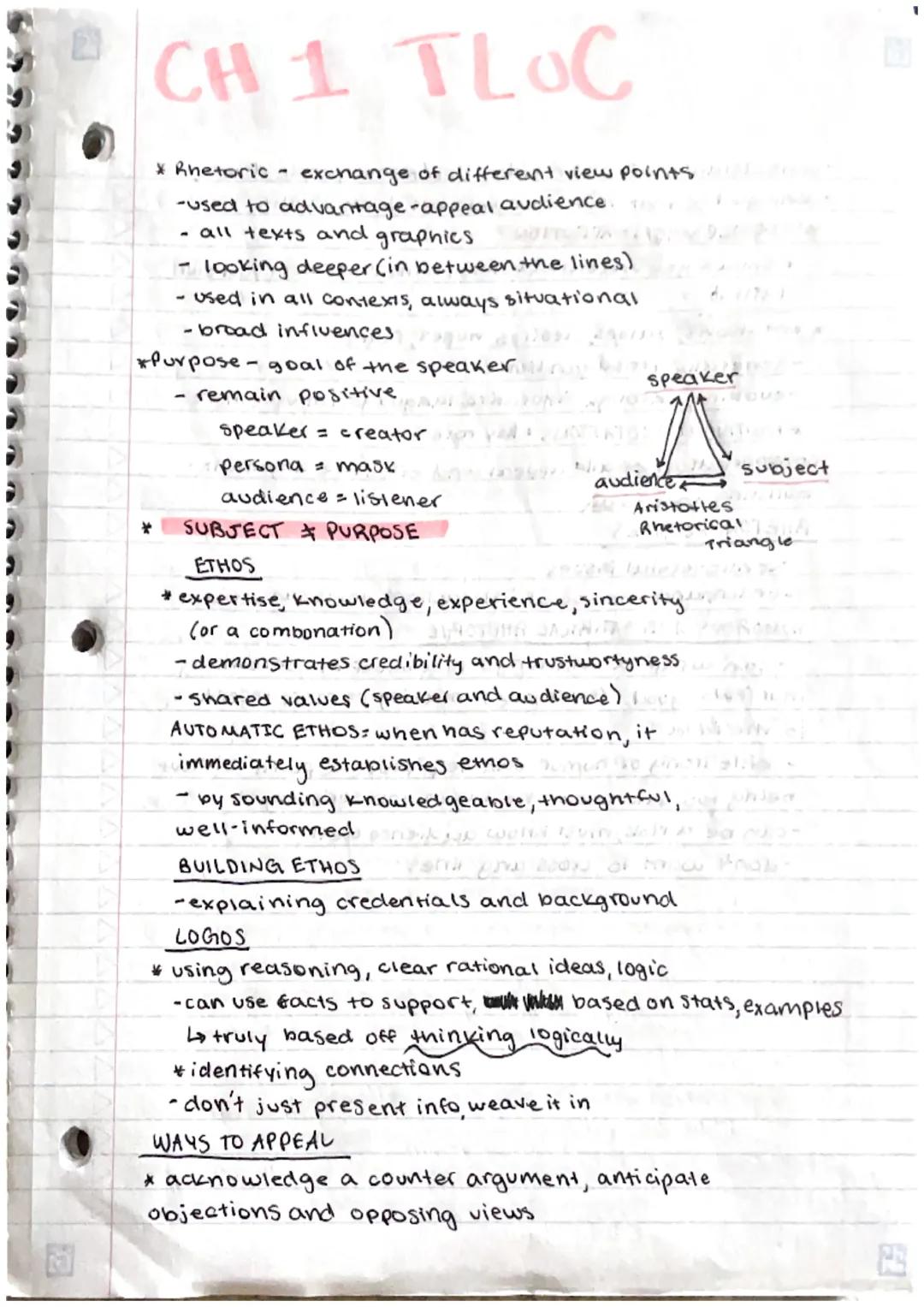
Understanding Rhetoric and Rhetorical Appeals
Rhetoric appears in all texts and graphics we encounter daily. It's not just fancy language—it's about looking deeper between the lines to understand how communication works in different contexts. Every piece of rhetoric involves a speaker (creator), a persona (the character they present), and an audience (listener).
At the heart of effective rhetoric is Aristotle's Rhetorical Triangle, which balances three powerful appeals. Ethos focuses on establishing credibility through expertise, knowledge, and sincerity. Speakers build ethos by explaining their credentials or demonstrating shared values with the audience. Someone with an established reputation enjoys "automatic ethos."
Logos appeals to logic and reason through clear, rational ideas supported by facts, statistics, and examples. Strong logos doesn't just present information—it weaves connections between ideas. One effective logos strategy is acknowledging counterarguments, which shows you've considered multiple perspectives before forming your conclusion.
Pro Tip: When making an argument, don't just rely on one appeal. The strongest persuasion usually combines ethos, logos, and pathos to connect with your audience on multiple levels.
2
of 2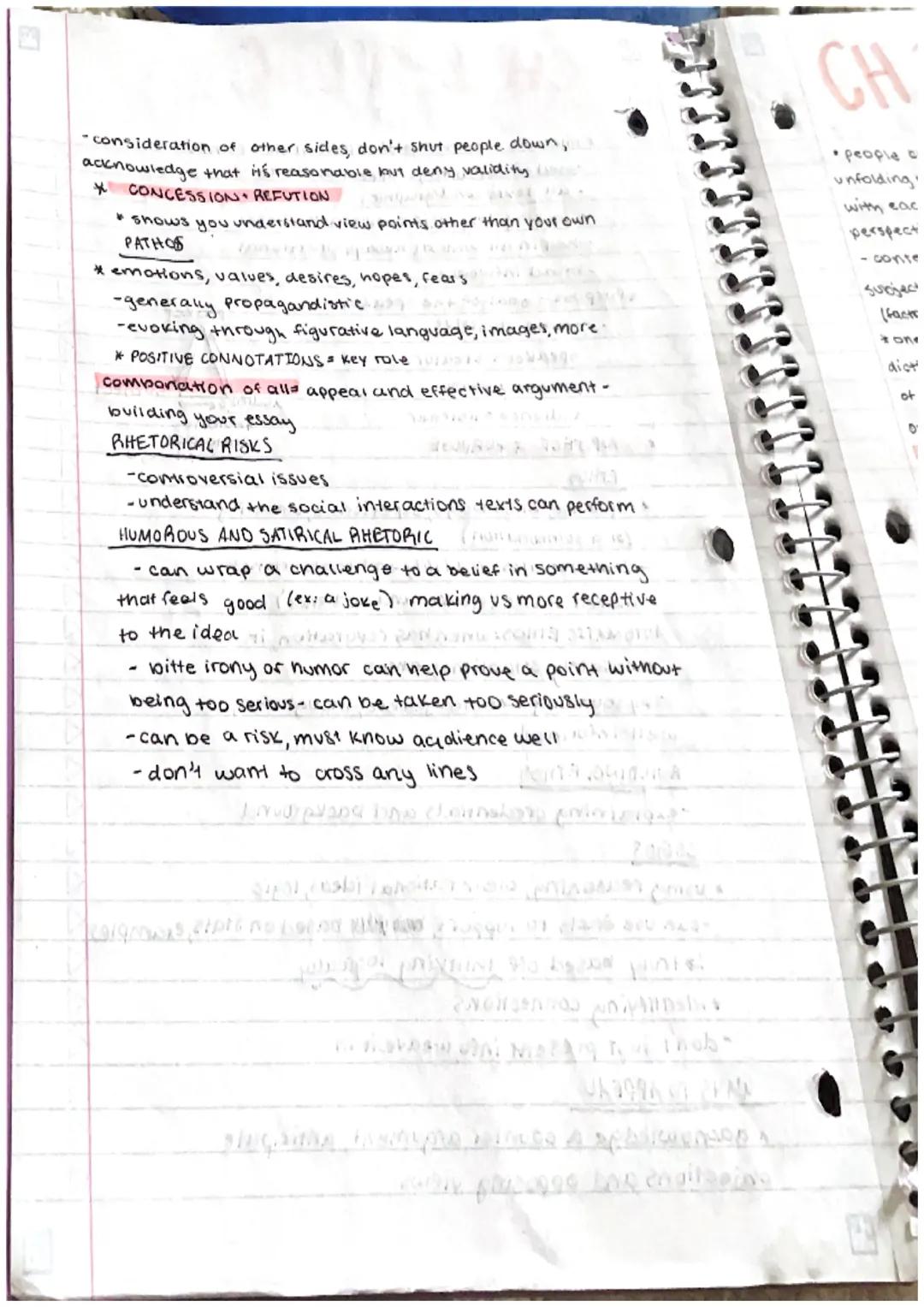
Emotional Appeal and Rhetorical Strategies
Pathos targets emotions, values, and desires to connect with an audience. While sometimes seen as propagandistic, emotional appeals are incredibly powerful when used effectively. Writers create pathos through figurative language, vivid imagery, and words with positive connotations that resonate with readers.
The most effective arguments combine all three appeals—ethos, logos, and pathos—to create well-rounded persuasion. However, rhetoric always involves some risk, especially when addressing controversial topics. Understanding the social interactions that texts perform helps navigate these challenges.
Humor and satire represent specialized rhetorical strategies that can be particularly effective. These approaches wrap challenging ideas in something enjoyable (like a joke), making audiences more receptive to new perspectives. A witty comment or ironic observation can prove a point without seeming overly serious or confrontational.
Remember: Humorous rhetoric requires knowing your audience extremely well. What seems funny to one group might offend another, so consider your audience carefully before using humor in your persuasive writing.
We thought you’d never ask...
What is the Knowunity AI companion?
Our AI companion is specifically built for the needs of students. Based on the millions of content pieces we have on the platform we can provide truly meaningful and relevant answers to students. But its not only about answers, the companion is even more about guiding students through their daily learning challenges, with personalised study plans, quizzes or content pieces in the chat and 100% personalisation based on the students skills and developments.
Where can I download the Knowunity app?
You can download the app in the Google Play Store and in the Apple App Store.
Is Knowunity really free of charge?
That's right! Enjoy free access to study content, connect with fellow students, and get instant help – all at your fingertips.
Similar Content
Most popular content in AP English Language
8I
AP English LanguageIntroduction to Rhetorical Appeals
Practice identifying and understanding the fundamental functions of ethos, pathos, and logos in various short persuasive contexts.
9th7000
I
AP English LanguageIntroduction to the Rhetorical Situation
Practice identifying the foundational components of any rhetorical act, including the speaker, audience, purpose, and the exigence.
9th4300
I
AP English LanguageIntroduction to Argument Framing
Practice identifying how an author's perspective and the specific rhetorical situation shape the initial presentation of a claim or issue.
9th3220
AP English LanguageAP Lang Unit 1.1 Notes (The Rhetorical Situation)
Notes on AP lang unit 1.1, the rhetorical situation
10th28013
V
AP English Languagevocabulary 3 practice quiz for mrs.umstots 9th grade honors class
vocabulary 3 practice quiz for mrs.unstops class
9th930
AP English LanguageGreat Gatsby chapters 1-3 study guide
The great gatsby chapters 1-3 summary study guide aplang
11th1495
AP English LanguageIn Cold Blood Analysis
Analysis and dive into the book In Cold Blood
1192
AP English LanguageThe Crucible - Study Guide
Comprehensive study guide on The Crucible by Arthur Miller
11th460
Most popular content
9O
 AP US History
Origins and Dynamics of the Columbian Exchange
Analyze the ecological and economic motivations behind the initial transfer of goods, people, and diseases between the Old and New Worlds.
9th3,1280
I
AP US HistoryIntroduction to Early Cultural Interactions
Analyze the initial social and religious encounters between Europeans, Africans, and Indigenous peoples in the colonial Americas.
9th2,7730
O
 AP World History
Origins of Ancient River Civilizations
Analyze the environmental factors and technological innovations that led to the rise of early states in Mesopotamia, Egypt, and the Indus Valley.
9th3,1870
M
AP US HistoryMotivations for European Exploration
Analyze the economic, religious, and political factors that drove European powers to the Americas during the 15th and 16th centuries.
9th1,7780
F
 AP Psychology
Foundations of Ethical Guidelines in Research
Practice the core principles of the APA ethical code including informed consent, debriefing, and the role of Institutional Review Boards.
9th1,3360
I
AP US HistoryIntroduction to Native American Societies
Examine the diverse social, political, and economic structures of North American indigenous groups prior to European contact.
9th1,1100
I
 AP Biology
Introduction to Biological Elements of Life
Practice identifying the essential elements including carbon, nitrogen, phosphorus, and sulfur that compose biological macromolecules.
9th1,7390
I
AP US HistoryIntroduction to the Spanish Encomienda System
Explore the fundamental economic and social structures of the Spanish colonial system, focusing on the encomienda and the casta social hierarchy.
9th8890
O
AP World HistoryOrigins and Continuity of the Byzantine Empire
Analyze the political and cultural transitions from the Roman Empire to the Byzantine Empire, focusing on the reign of Justinian I and his code.
9th1,6320
Can't find what you're looking for? Explore other subjects.
Students love us — and so will you.
4.6/5App Store
4.7/5Google Play
The app is very easy to use and well designed. I have found everything I was looking for so far and have been able to learn a lot from the presentations! I will definitely use the app for a class assignment! And of course it also helps a lot as an inspiration.
Stefan SiOS user
This app is really great. There are so many study notes and help [...]. My problem subject is French, for example, and the app has so many options for help. Thanks to this app, I have improved my French. I would recommend it to anyone.
Samantha KlichAndroid user
Wow, I am really amazed. I just tried the app because I've seen it advertised many times and was absolutely stunned. This app is THE HELP you want for school and above all, it offers so many things, such as workouts and fact sheets, which have been VERY helpful to me personally.
AnnaiOS user
AP English Language23 views·Updated Jun 11, 2026·2 pagesThe Language of Composition Chapter 1 Summary Notes
M
Maya@aya_cnsosibozzasmnhg
Rhetoric is all about the art of persuasion and effective communication. Understanding rhetorical strategies helps you analyze how speakers and writers influence their audiences and allows you to become more persuasive in your own writing and speaking.
1
of 2
Sign up to see the content. It's free!
- Access to all documents
- Improve your grades
- Join milions of students
Understanding Rhetoric and Rhetorical Appeals
Rhetoric appears in all texts and graphics we encounter daily. It's not just fancy language—it's about looking deeper between the lines to understand how communication works in different contexts. Every piece of rhetoric involves a speaker (creator), a persona (the character they present), and an audience (listener).
At the heart of effective rhetoric is Aristotle's Rhetorical Triangle, which balances three powerful appeals. Ethos focuses on establishing credibility through expertise, knowledge, and sincerity. Speakers build ethos by explaining their credentials or demonstrating shared values with the audience. Someone with an established reputation enjoys "automatic ethos."
Logos appeals to logic and reason through clear, rational ideas supported by facts, statistics, and examples. Strong logos doesn't just present information—it weaves connections between ideas. One effective logos strategy is acknowledging counterarguments, which shows you've considered multiple perspectives before forming your conclusion.
Pro Tip: When making an argument, don't just rely on one appeal. The strongest persuasion usually combines ethos, logos, and pathos to connect with your audience on multiple levels.
2
of 2Sign up to see the content. It's free!
- Access to all documents
- Improve your grades
- Join milions of students
Emotional Appeal and Rhetorical Strategies
Pathos targets emotions, values, and desires to connect with an audience. While sometimes seen as propagandistic, emotional appeals are incredibly powerful when used effectively. Writers create pathos through figurative language, vivid imagery, and words with positive connotations that resonate with readers.
The most effective arguments combine all three appeals—ethos, logos, and pathos—to create well-rounded persuasion. However, rhetoric always involves some risk, especially when addressing controversial topics. Understanding the social interactions that texts perform helps navigate these challenges.
Humor and satire represent specialized rhetorical strategies that can be particularly effective. These approaches wrap challenging ideas in something enjoyable (like a joke), making audiences more receptive to new perspectives. A witty comment or ironic observation can prove a point without seeming overly serious or confrontational.
Remember: Humorous rhetoric requires knowing your audience extremely well. What seems funny to one group might offend another, so consider your audience carefully before using humor in your persuasive writing.
We thought you’d never ask...
What is the Knowunity AI companion?
Our AI companion is specifically built for the needs of students. Based on the millions of content pieces we have on the platform we can provide truly meaningful and relevant answers to students. But its not only about answers, the companion is even more about guiding students through their daily learning challenges, with personalised study plans, quizzes or content pieces in the chat and 100% personalisation based on the students skills and developments.
Where can I download the Knowunity app?
You can download the app in the Google Play Store and in the Apple App Store.
Is Knowunity really free of charge?
That's right! Enjoy free access to study content, connect with fellow students, and get instant help – all at your fingertips.
Similar Content
Most popular content in AP English Language
8I
AP English LanguageIntroduction to Rhetorical Appeals
Practice identifying and understanding the fundamental functions of ethos, pathos, and logos in various short persuasive contexts.
9th7000
I
AP English LanguageIntroduction to the Rhetorical Situation
Practice identifying the foundational components of any rhetorical act, including the speaker, audience, purpose, and the exigence.
9th4300
I
AP English LanguageIntroduction to Argument Framing
Practice identifying how an author's perspective and the specific rhetorical situation shape the initial presentation of a claim or issue.
9th3220
AP English LanguageAP Lang Unit 1.1 Notes (The Rhetorical Situation)
Notes on AP lang unit 1.1, the rhetorical situation
10th28013
V
AP English Languagevocabulary 3 practice quiz for mrs.umstots 9th grade honors class
vocabulary 3 practice quiz for mrs.unstops class
9th930
AP English LanguageGreat Gatsby chapters 1-3 study guide
The great gatsby chapters 1-3 summary study guide aplang
11th1495
AP English LanguageIn Cold Blood Analysis
Analysis and dive into the book In Cold Blood
1192
AP English LanguageThe Crucible - Study Guide
Comprehensive study guide on The Crucible by Arthur Miller
11th460
Most popular content
9O
AP US HistoryOrigins and Dynamics of the Columbian Exchange
Analyze the ecological and economic motivations behind the initial transfer of goods, people, and diseases between the Old and New Worlds.
9th3,1280
I
AP US HistoryIntroduction to Early Cultural Interactions
Analyze the initial social and religious encounters between Europeans, Africans, and Indigenous peoples in the colonial Americas.
9th2,7730
O
AP World HistoryOrigins of Ancient River Civilizations
Analyze the environmental factors and technological innovations that led to the rise of early states in Mesopotamia, Egypt, and the Indus Valley.
9th3,1870
M
AP US HistoryMotivations for European Exploration
Analyze the economic, religious, and political factors that drove European powers to the Americas during the 15th and 16th centuries.
9th1,7780
F
AP PsychologyFoundations of Ethical Guidelines in Research
Practice the core principles of the APA ethical code including informed consent, debriefing, and the role of Institutional Review Boards.
9th1,3360
I
AP US HistoryIntroduction to Native American Societies
Examine the diverse social, political, and economic structures of North American indigenous groups prior to European contact.
9th1,1100
I
AP BiologyIntroduction to Biological Elements of Life
Practice identifying the essential elements including carbon, nitrogen, phosphorus, and sulfur that compose biological macromolecules.
9th1,7390
I
AP US HistoryIntroduction to the Spanish Encomienda System
Explore the fundamental economic and social structures of the Spanish colonial system, focusing on the encomienda and the casta social hierarchy.
9th8890
O
AP World HistoryOrigins and Continuity of the Byzantine Empire
Analyze the political and cultural transitions from the Roman Empire to the Byzantine Empire, focusing on the reign of Justinian I and his code.
9th1,6320
Can't find what you're looking for? Explore other subjects.
Students love us — and so will you.
4.6/5App Store
4.7/5Google Play
The app is very easy to use and well designed. I have found everything I was looking for so far and have been able to learn a lot from the presentations! I will definitely use the app for a class assignment! And of course it also helps a lot as an inspiration.
Stefan SiOS user
This app is really great. There are so many study notes and help [...]. My problem subject is French, for example, and the app has so many options for help. Thanks to this app, I have improved my French. I would recommend it to anyone.
Samantha KlichAndroid user
Wow, I am really amazed. I just tried the app because I've seen it advertised many times and was absolutely stunned. This app is THE HELP you want for school and above all, it offers so many things, such as workouts and fact sheets, which have been VERY helpful to me personally.
AnnaiOS user