

Hess's Law and Enthalpy Cycles: A Comprehensive Guide
A fundamental...
Knowunity AI
Subjects
Triangle Congruence and Similarity Theorems
Triangle Properties and Classification
Linear Equations and Graphs
Geometric Angle Relationships
Trigonometric Functions and Identities
Equation Solving Techniques
Circle Geometry Fundamentals
Division Operations and Methods
Basic Differentiation Rules
Exponent and Logarithm Properties
Show all topics
Human Organ Systems
Reproductive Cell Cycles
Biological Sciences Subdisciplines
Cellular Energy Metabolism
Autotrophic Energy Processes
Inheritance Patterns and Principles
Biomolecular Structure and Organization
Cell Cycle and Division Mechanics
Cellular Organization and Development
Biological Structural Organization
Show all topics
Chemical Sciences and Applications
Atomic Structure and Composition
Molecular Electron Structure Representation
Atomic Electron Behavior
Matter Properties and Water
Mole Concept and Calculations
Gas Laws and Behavior
Periodic Table Organization
Chemical Thermodynamics Fundamentals
Chemical Bond Types and Properties
Show all topics
European Renaissance and Enlightenment
European Cultural Movements 800-1920
American Revolution Era 1763-1797
American Civil War 1861-1865
Global Imperial Systems
Mongol and Chinese Dynasties
U.S. Presidents and World Leaders
Historical Sources and Documentation
World Wars Era and Impact
World Religious Systems
Show all topics
Classic and Contemporary Novels
Literary Character Analysis
Rhetorical Theory and Practice
Classic Literary Narratives
Reading Analysis and Interpretation
Narrative Structure and Techniques
English Language Components
Influential English-Language Authors
Basic Sentence Structure
Narrative Voice and Perspective
Show all topics
 AP Chemistry148 views·Updated Jun 13, 2026·5 pages
Hess's Law and Enthalpy Cycles: A Comprehensive Guide
A fundamental...

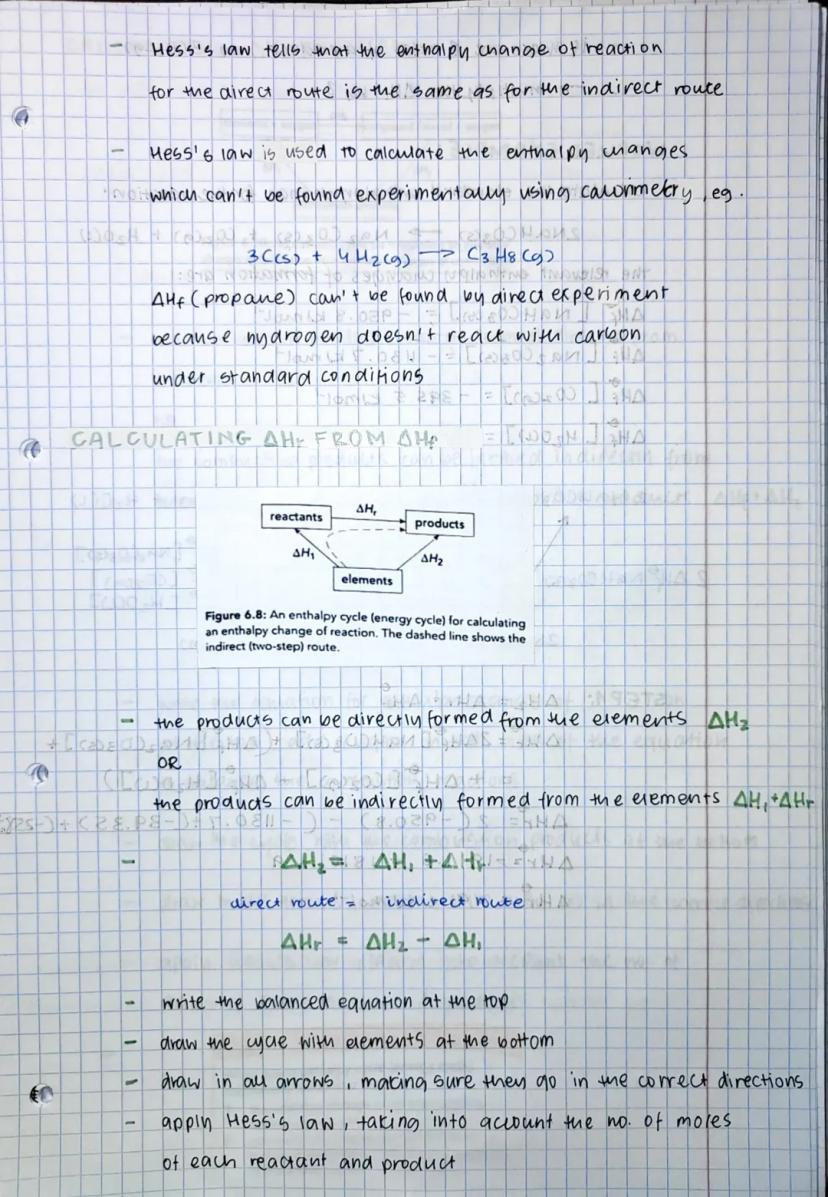
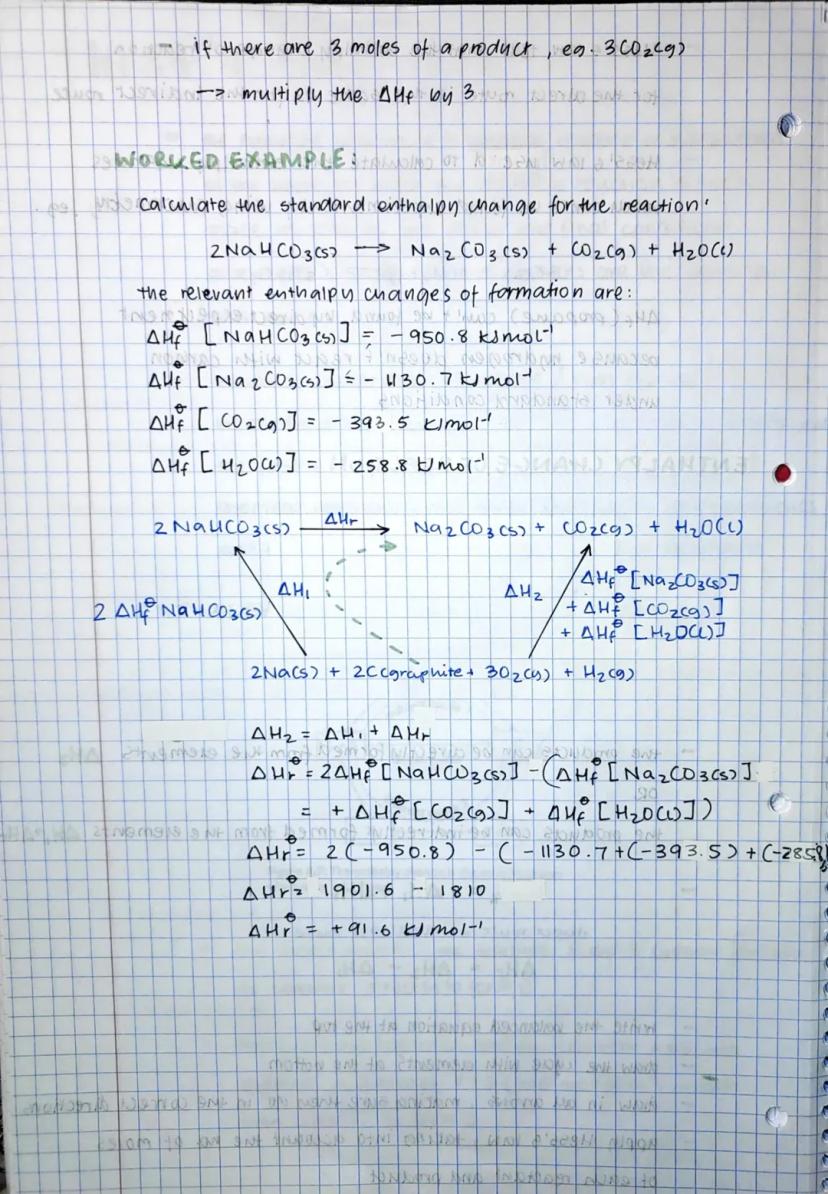

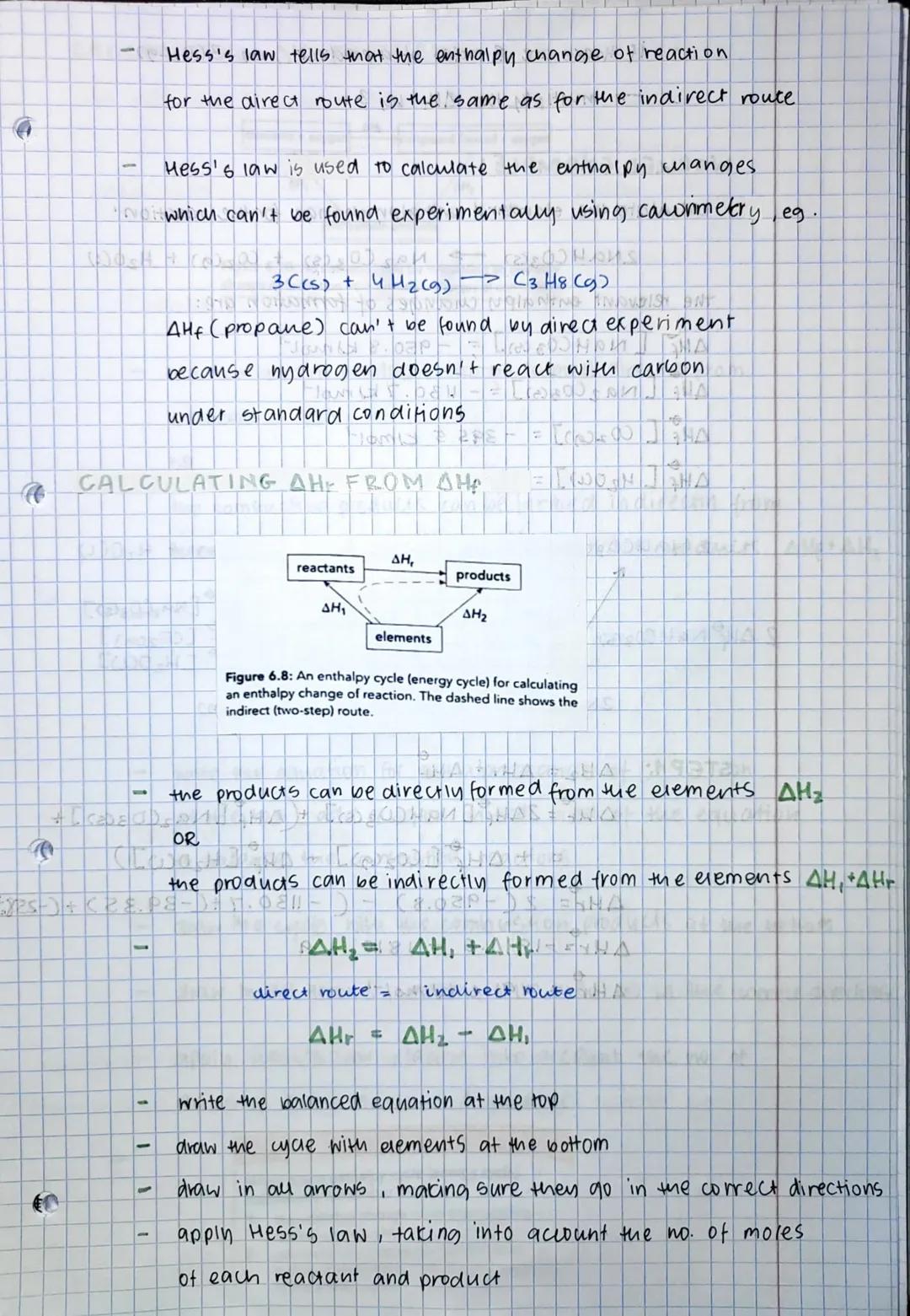
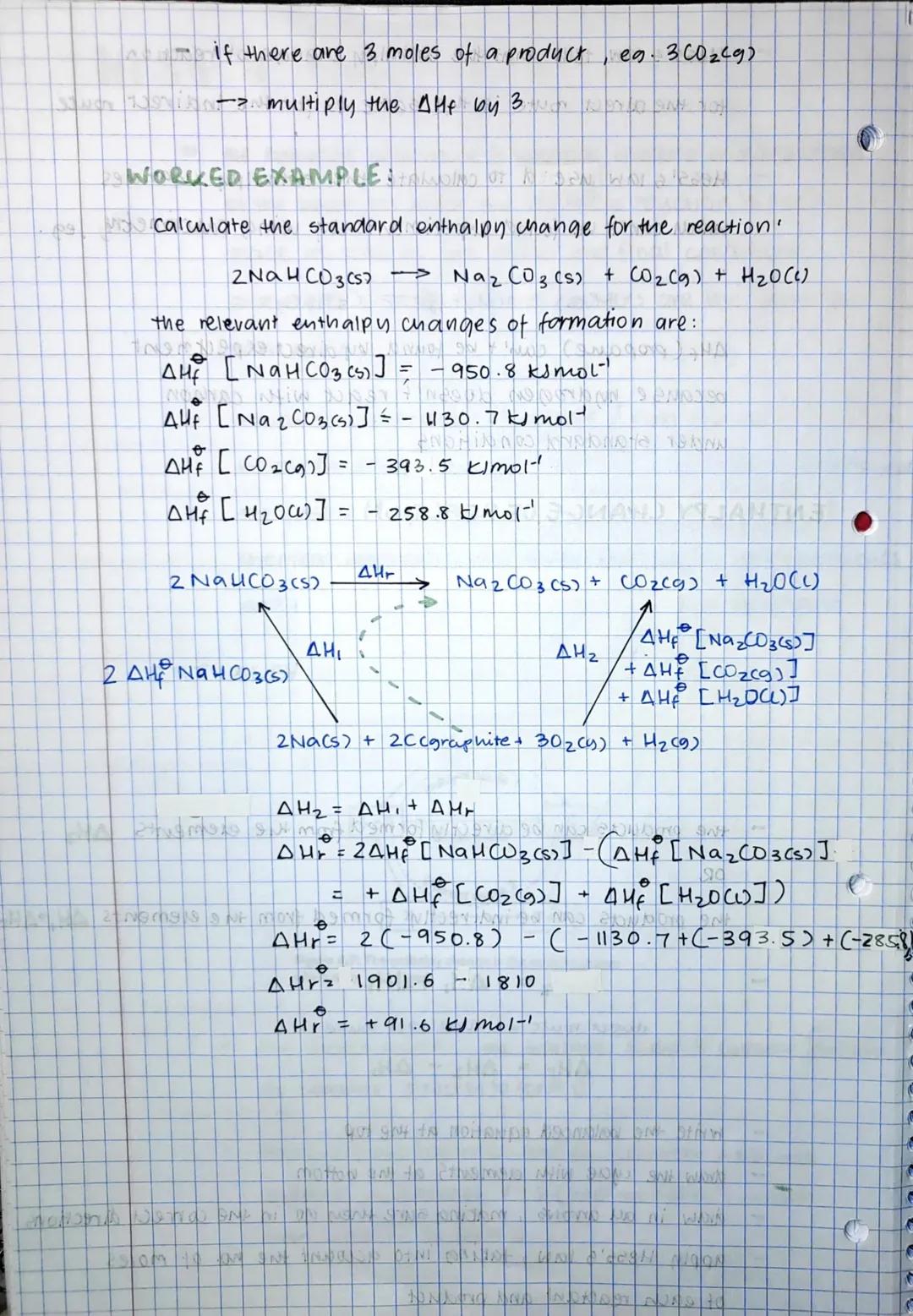
Hess law enthalpy calculator methods involve using known enthalpy values to determine unknown ones. This process often utilizes standard enthalpies of formation (ΔHf°) for reactants and products.
To use Hess's Law to calculate the enthalpy change for the reaction, follow these steps:
Vocabulary: Standard enthalpy of formation (ΔHf°) is the enthalpy change when one mole of a compound is formed from its elements in their standard states.
The enthalpy change formula derived from Hess's Law is:
ΔHreaction = ΣΔHf°(products) - ΣΔHf°(reactants)
Example: For the reaction 2NaHCO₃(s) → Na₂CO₃(s) + CO₂(g) + H₂O(l), the enthalpy change can be calculated using the standard enthalpies of formation of each compound involved.
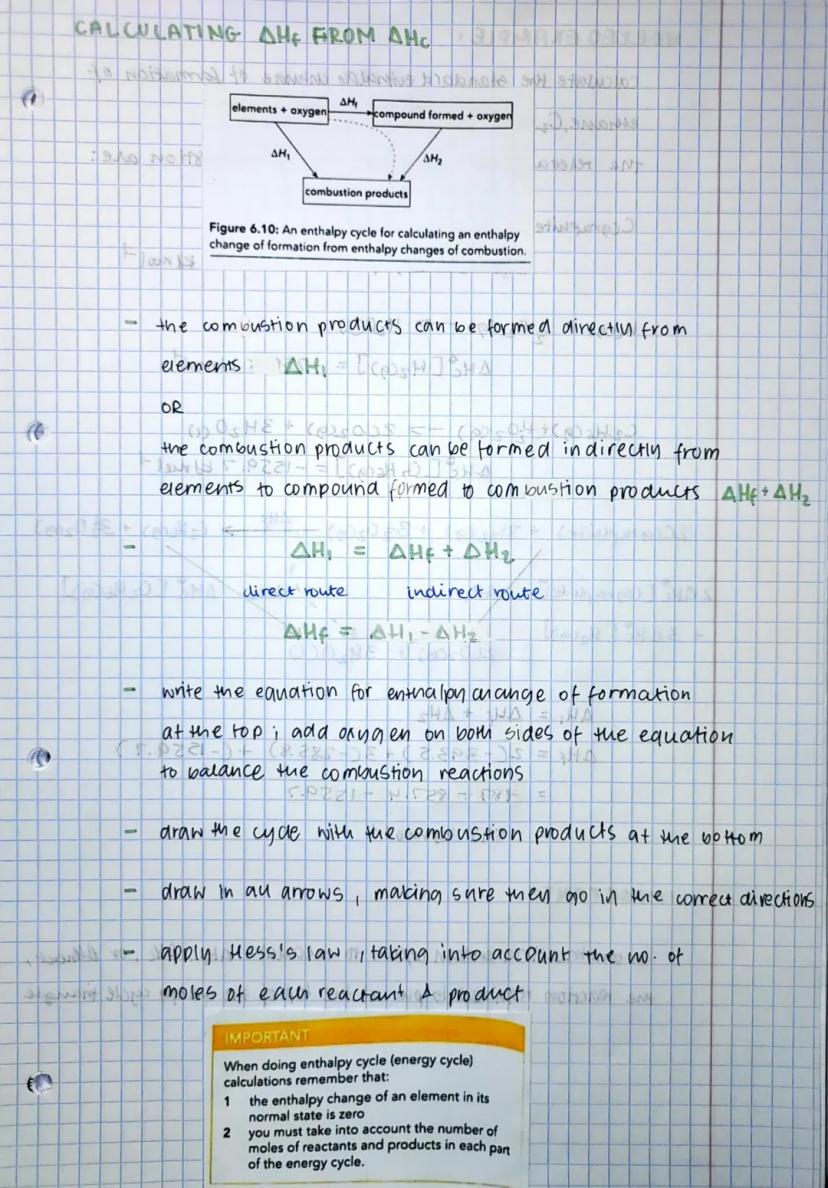
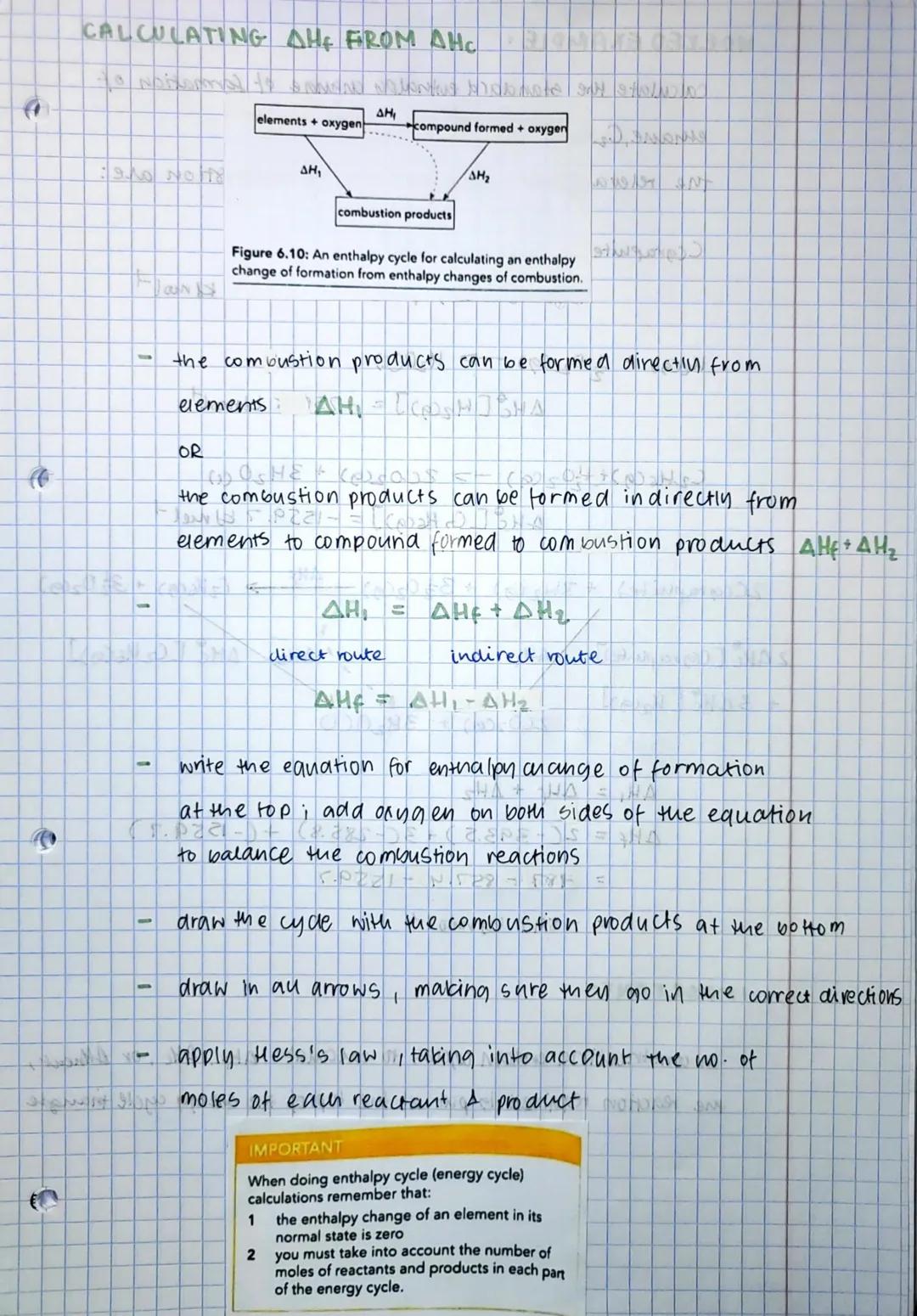
Hess's Law can also be applied to calculate enthalpies of formation using enthalpies of combustion. This method is particularly useful when direct formation reactions are difficult to perform.
The Hess cycle combustion approach involves:
Highlight: When using enthalpy cycles, remember that the enthalpy change of an element in its standard state is zero, and you must account for the number of moles of reactants and products in each part of the cycle.
How to calculate enthalpy change in kJ/mol using combustion data:
ΔHf° = ΣΔHc°(elements) - ΔHc°(compound)
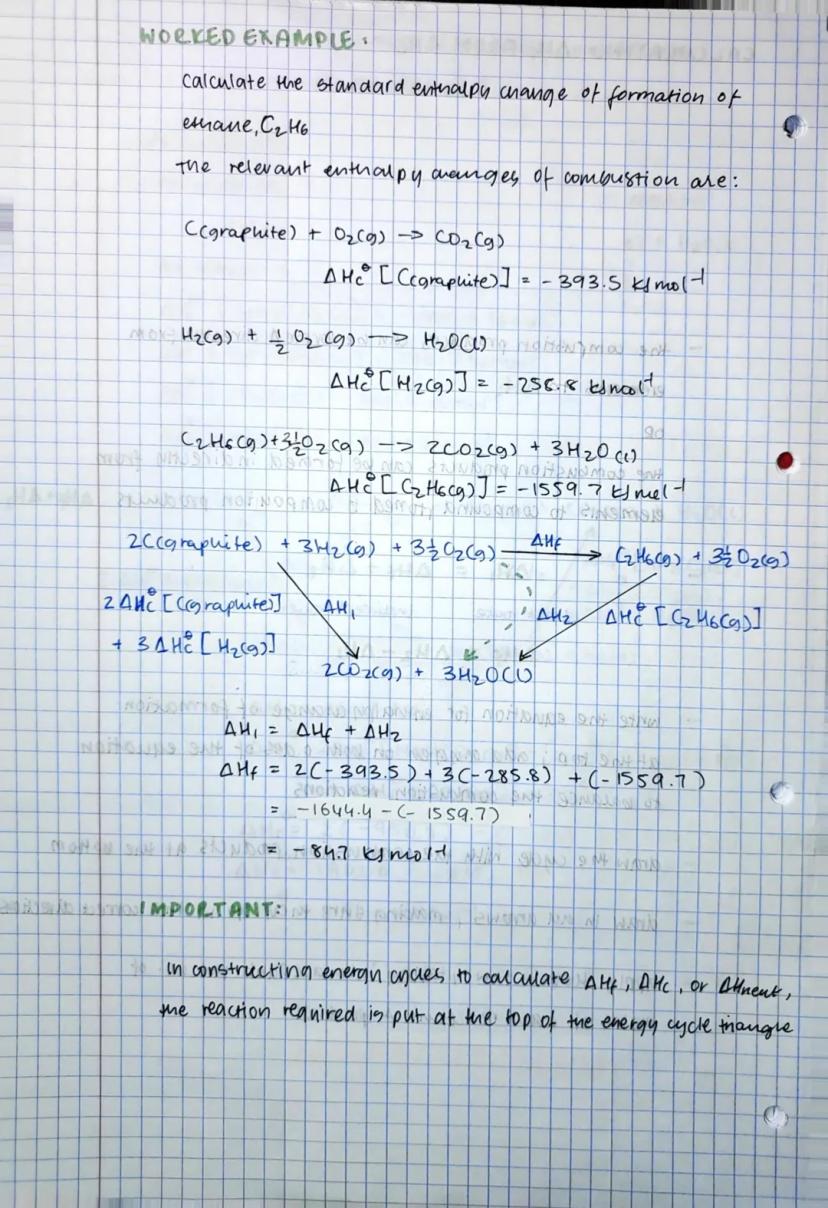
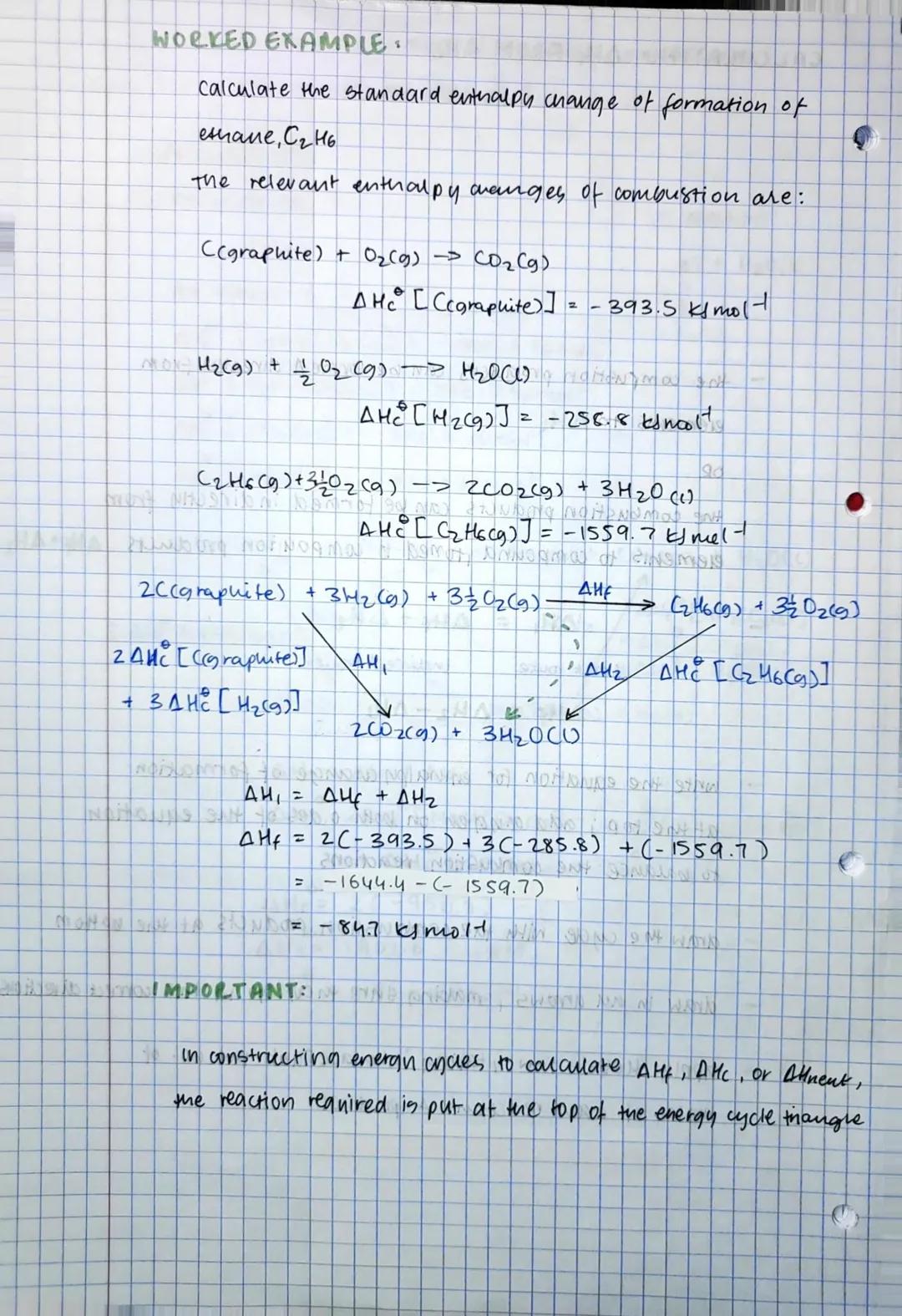
Example: To calculate the standard enthalpy of formation of ethane (C₂H₆), use the enthalpies of combustion of carbon, hydrogen, and ethane itself.
These advanced applications of Hess's Law demonstrate its versatility in thermochemical calculations, making it an indispensable tool for chemists and students alike.
Page 4: Enthalpy of Combustion Calculations
This page focuses on Hess cycle combustion calculations and important principles for solving enthalpy problems.
Definition: The enthalpy change of an element in its standard state is zero.
Highlight: When performing enthalpy cycle calculations, it's crucial to:
Page 5: Advanced Applications and Examples
This page presents complex worked examples demonstrating How to calculate enthalpy change in kJ/mol for organic compounds.
Example: Calculation of standard enthalpy of formation for ethane (C₂H₆) using combustion data.
Highlight: The construction of energy cycles requires careful attention to:
Hess's Law states that the enthalpy change in a chemical reaction is independent of the route taken, as long as the initial and final conditions remain the same. This principle is rooted in the law of conservation of energy and the first law of thermodynamics.
Definition: Hess's Law states that the total enthalpy change during the complete course of a chemical reaction is the same whether the reaction takes place in one step or in several steps.
Enthalpy cycles, also known as energy cycles, are visual representations of Hess's Law. They illustrate different pathways a reaction can take, showing both direct and indirect routes.
Example: In an enthalpy cycle, reactants A and B can combine directly to form C, or they can first form intermediates F and G, which then combine to form C. The total enthalpy change remains the same for both routes.
Hess's law enthalpy cycle calculations are particularly useful when direct experimental measurements are not possible. They allow chemists to calculate enthalpy changes using known values for related reactions.
Highlight: Hess's Law is crucial for calculating enthalpy changes that cannot be determined experimentally using calorimetry.
Our AI companion is specifically built for the needs of students. Based on the millions of content pieces we have on the platform we can provide truly meaningful and relevant answers to students. But its not only about answers, the companion is even more about guiding students through their daily learning challenges, with personalised study plans, quizzes or content pieces in the chat and 100% personalisation based on the students skills and developments.
You can download the app in the Google Play Store and in the Apple App Store.
That's right! Enjoy free access to study content, connect with fellow students, and get instant help – all at your fingertips.
AP ChemistryPractice fundamental concepts of mass percentage and the law of definite proportions to determine the relative mass of elements in a pure substance.
AP ChemistryPractice identifying ground-state electron configurations using the Aufbau principle, Hund's rule, and the Pauli exclusion principle.
AP ChemistryPractice converting between mass, moles, and number of particles using Avogadro's constant and the fundamental concept of the mole.
AP Chemistrydives pretty deeply into each unit of the ap chem curriculum
AP ChemistryUnderstanding the dynamic nature of reversible reactions and the concept of chemical equilibrium, as well as calculating the equilibrium constant for reactions.
AP ChemistryIntroduction to integrated rate law, formulas for finding orders, example of half-life, steps for reaction completion, how to find rate determining step, identifying parts of a multistep energy diagram
AP ChemistryUnderstand how to solve stoichiometry problems.
AP ChemistryThis study note contains information on the basics of Analytical Chemistry, its applications, and minor concepts with examples.
AP ChemistryCovers matter, mass, weight, and the classification of matter.
 AP US History
Analyze the ecological and economic motivations behind the initial transfer of goods, people, and diseases between the Old and New Worlds.
AP US HistoryAnalyze the initial social and religious encounters between Europeans, Africans, and Indigenous peoples in the colonial Americas.
 AP World History
Analyze the environmental factors and technological innovations that led to the rise of early states in Mesopotamia, Egypt, and the Indus Valley.
AP US HistoryAnalyze the economic, religious, and political factors that drove European powers to the Americas during the 15th and 16th centuries.
 AP Psychology
Practice the core principles of the APA ethical code including informed consent, debriefing, and the role of Institutional Review Boards.
AP US HistoryExamine the diverse social, political, and economic structures of North American indigenous groups prior to European contact.
 AP Biology
Practice identifying the essential elements including carbon, nitrogen, phosphorus, and sulfur that compose biological macromolecules.
AP US HistoryExplore the fundamental economic and social structures of the Spanish colonial system, focusing on the encomienda and the casta social hierarchy.
AP World HistoryAnalyze the political and cultural transitions from the Roman Empire to the Byzantine Empire, focusing on the reign of Justinian I and his code.
The app is very easy to use and well designed. I have found everything I was looking for so far and have been able to learn a lot from the presentations! I will definitely use the app for a class assignment! And of course it also helps a lot as an inspiration.
This app is really great. There are so many study notes and help [...]. My problem subject is French, for example, and the app has so many options for help. Thanks to this app, I have improved my French. I would recommend it to anyone.
Wow, I am really amazed. I just tried the app because I've seen it advertised many times and was absolutely stunned. This app is THE HELP you want for school and above all, it offers so many things, such as workouts and fact sheets, which have been VERY helpful to me personally.
AP Chemistry148 views·Updated Jun 13, 2026·5 pagesHess's Law and Enthalpy Cycles: A Comprehensive Guide
A fundamental principle in thermochemistry explaining how to calculate enthalpy change of reaction through different pathways while maintaining the same initial and final conditions.
Key points:
Hess law enthalpy calculator methods involve using known enthalpy values to determine unknown ones. This process often utilizes standard enthalpies of formation (ΔHf°) for reactants and products.
To use Hess's Law to calculate the enthalpy change for the reaction, follow these steps:
Vocabulary: Standard enthalpy of formation (ΔHf°) is the enthalpy change when one mole of a compound is formed from its elements in their standard states.
The enthalpy change formula derived from Hess's Law is:
ΔHreaction = ΣΔHf°(products) - ΣΔHf°(reactants)
Example: For the reaction 2NaHCO₃(s) → Na₂CO₃(s) + CO₂(g) + H₂O(l), the enthalpy change can be calculated using the standard enthalpies of formation of each compound involved.
Hess's Law can also be applied to calculate enthalpies of formation using enthalpies of combustion. This method is particularly useful when direct formation reactions are difficult to perform.
The Hess cycle combustion approach involves:
Highlight: When using enthalpy cycles, remember that the enthalpy change of an element in its standard state is zero, and you must account for the number of moles of reactants and products in each part of the cycle.
How to calculate enthalpy change in kJ/mol using combustion data:
ΔHf° = ΣΔHc°(elements) - ΔHc°(compound)
Example: To calculate the standard enthalpy of formation of ethane (C₂H₆), use the enthalpies of combustion of carbon, hydrogen, and ethane itself.
These advanced applications of Hess's Law demonstrate its versatility in thermochemical calculations, making it an indispensable tool for chemists and students alike.
Page 4: Enthalpy of Combustion Calculations
This page focuses on Hess cycle combustion calculations and important principles for solving enthalpy problems.
Definition: The enthalpy change of an element in its standard state is zero.
Highlight: When performing enthalpy cycle calculations, it's crucial to:
Page 5: Advanced Applications and Examples
This page presents complex worked examples demonstrating How to calculate enthalpy change in kJ/mol for organic compounds.
Example: Calculation of standard enthalpy of formation for ethane (C₂H₆) using combustion data.
Highlight: The construction of energy cycles requires careful attention to:
Hess's Law states that the enthalpy change in a chemical reaction is independent of the route taken, as long as the initial and final conditions remain the same. This principle is rooted in the law of conservation of energy and the first law of thermodynamics.
Definition: Hess's Law states that the total enthalpy change during the complete course of a chemical reaction is the same whether the reaction takes place in one step or in several steps.
Enthalpy cycles, also known as energy cycles, are visual representations of Hess's Law. They illustrate different pathways a reaction can take, showing both direct and indirect routes.
Example: In an enthalpy cycle, reactants A and B can combine directly to form C, or they can first form intermediates F and G, which then combine to form C. The total enthalpy change remains the same for both routes.
Hess's law enthalpy cycle calculations are particularly useful when direct experimental measurements are not possible. They allow chemists to calculate enthalpy changes using known values for related reactions.
Highlight: Hess's Law is crucial for calculating enthalpy changes that cannot be determined experimentally using calorimetry.
Our AI companion is specifically built for the needs of students. Based on the millions of content pieces we have on the platform we can provide truly meaningful and relevant answers to students. But its not only about answers, the companion is even more about guiding students through their daily learning challenges, with personalised study plans, quizzes or content pieces in the chat and 100% personalisation based on the students skills and developments.
You can download the app in the Google Play Store and in the Apple App Store.
That's right! Enjoy free access to study content, connect with fellow students, and get instant help – all at your fingertips.
AP ChemistryPractice fundamental concepts of mass percentage and the law of definite proportions to determine the relative mass of elements in a pure substance.
AP ChemistryPractice identifying ground-state electron configurations using the Aufbau principle, Hund's rule, and the Pauli exclusion principle.
AP ChemistryPractice converting between mass, moles, and number of particles using Avogadro's constant and the fundamental concept of the mole.
AP Chemistrydives pretty deeply into each unit of the ap chem curriculum
AP ChemistryUnderstanding the dynamic nature of reversible reactions and the concept of chemical equilibrium, as well as calculating the equilibrium constant for reactions.
AP ChemistryIntroduction to integrated rate law, formulas for finding orders, example of half-life, steps for reaction completion, how to find rate determining step, identifying parts of a multistep energy diagram
AP ChemistryUnderstand how to solve stoichiometry problems.
AP ChemistryThis study note contains information on the basics of Analytical Chemistry, its applications, and minor concepts with examples.
AP ChemistryCovers matter, mass, weight, and the classification of matter.
AP US HistoryAnalyze the ecological and economic motivations behind the initial transfer of goods, people, and diseases between the Old and New Worlds.
AP US HistoryAnalyze the initial social and religious encounters between Europeans, Africans, and Indigenous peoples in the colonial Americas.
AP World HistoryAnalyze the environmental factors and technological innovations that led to the rise of early states in Mesopotamia, Egypt, and the Indus Valley.
AP US HistoryAnalyze the economic, religious, and political factors that drove European powers to the Americas during the 15th and 16th centuries.
AP PsychologyPractice the core principles of the APA ethical code including informed consent, debriefing, and the role of Institutional Review Boards.
AP US HistoryExamine the diverse social, political, and economic structures of North American indigenous groups prior to European contact.
AP BiologyPractice identifying the essential elements including carbon, nitrogen, phosphorus, and sulfur that compose biological macromolecules.
AP US HistoryExplore the fundamental economic and social structures of the Spanish colonial system, focusing on the encomienda and the casta social hierarchy.
AP World HistoryAnalyze the political and cultural transitions from the Roman Empire to the Byzantine Empire, focusing on the reign of Justinian I and his code.
The app is very easy to use and well designed. I have found everything I was looking for so far and have been able to learn a lot from the presentations! I will definitely use the app for a class assignment! And of course it also helps a lot as an inspiration.
This app is really great. There are so many study notes and help [...]. My problem subject is French, for example, and the app has so many options for help. Thanks to this app, I have improved my French. I would recommend it to anyone.
Wow, I am really amazed. I just tried the app because I've seen it advertised many times and was absolutely stunned. This app is THE HELP you want for school and above all, it offers so many things, such as workouts and fact sheets, which have been VERY helpful to me personally.
