
A comprehensive guide to chemical nomenclature and compound formulas, focusing...
 AP Chemistry139 views·Updated Jun 14, 2026·8 pages
Fun with Naming Compounds: Easy Examples!

Broderick Prendergast@broderickprendergast
1 / 8
1
of 8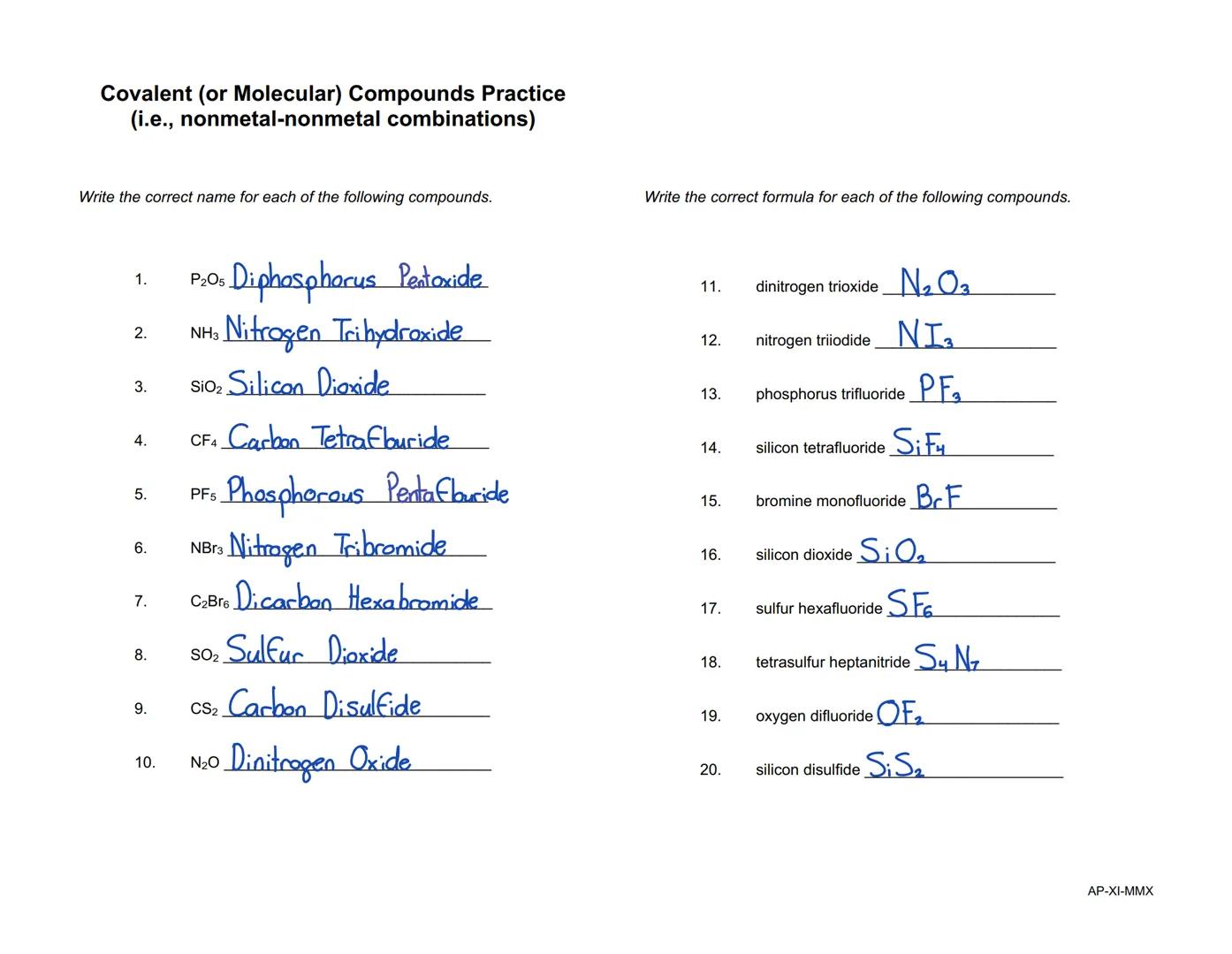
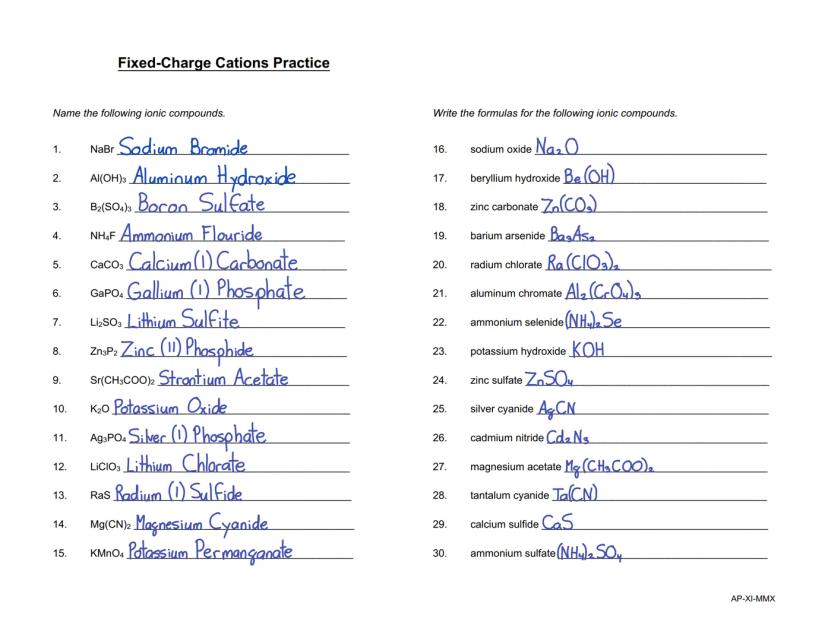
Page 2: Fixed-Charge Cations Practice
This section covers ionic compounds containing fixed-charge cations, presenting a comprehensive set of exercises for both naming compounds and writing formulas.
Definition: Fixed-charge cations are metal ions that form only one type of positive ion.
Example: NaBr is named sodium bromide because sodium only forms Na⁺ ions.
Highlight: The practice includes polyatomic ions such as ammonium (NH₄⁺) and complex anions like permanganate (MnO₄⁻).
2
of 8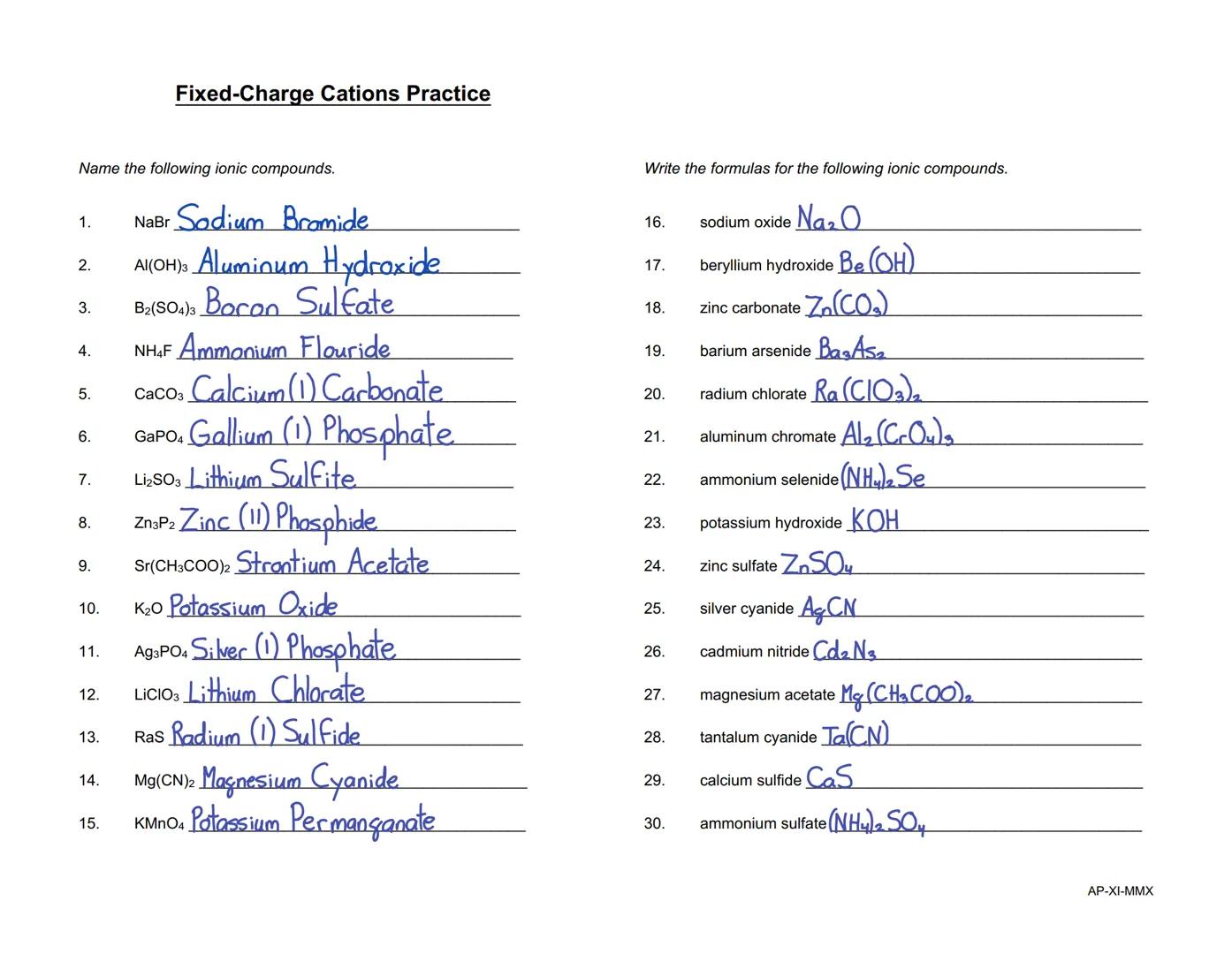
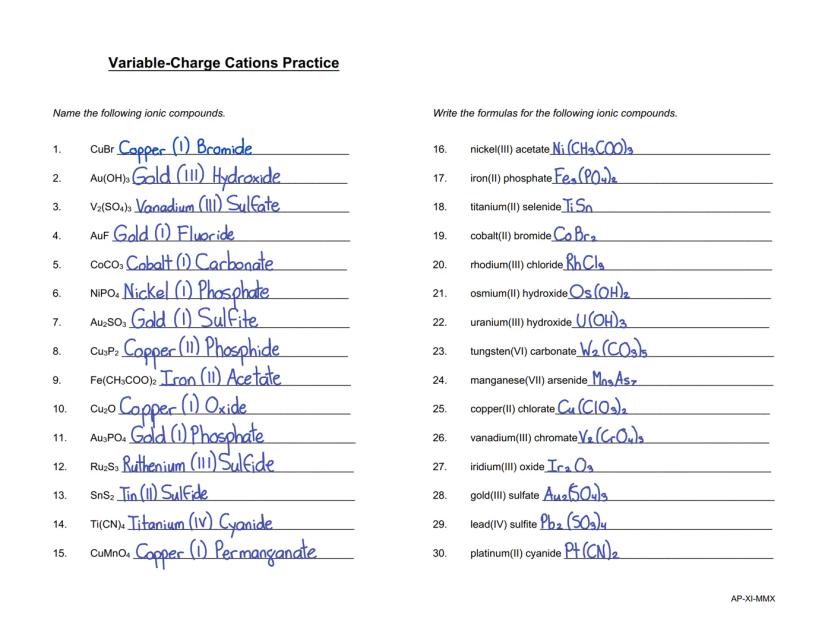
Page 3: Variable-Charge Cations Practice
This page focuses on naming and writing formulas for compounds containing transition metals that can form multiple different ionic charges.
Definition: Variable-charge cations are metal ions that can form different positive charges, requiring Roman numerals to specify the charge.
Example: CuBr is named as copper(I) bromide, where (I) indicates the +1 charge on copper.
Highlight: The exercises emphasize the importance of correctly identifying and noting the charge of transition metal ions.
3
of 8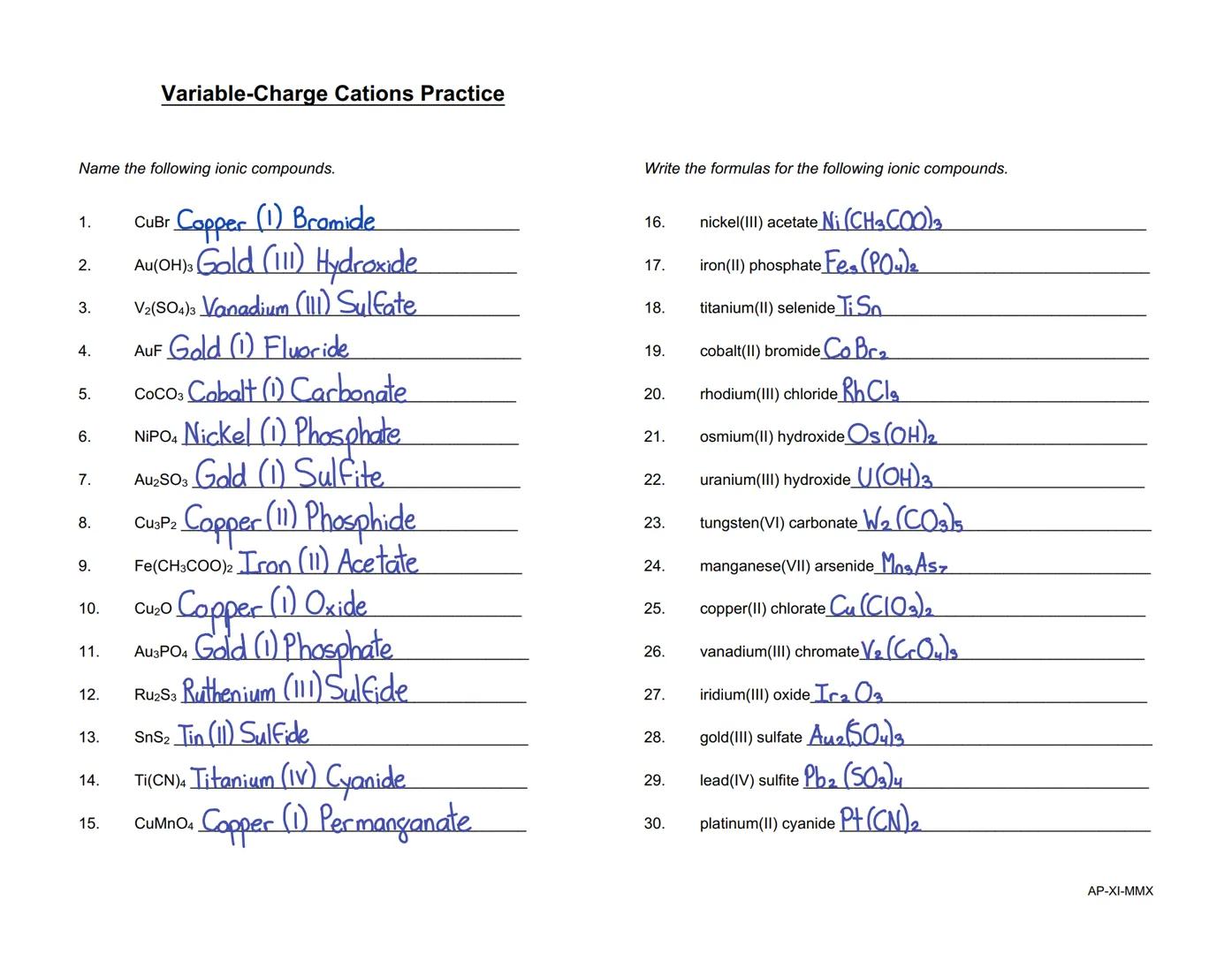
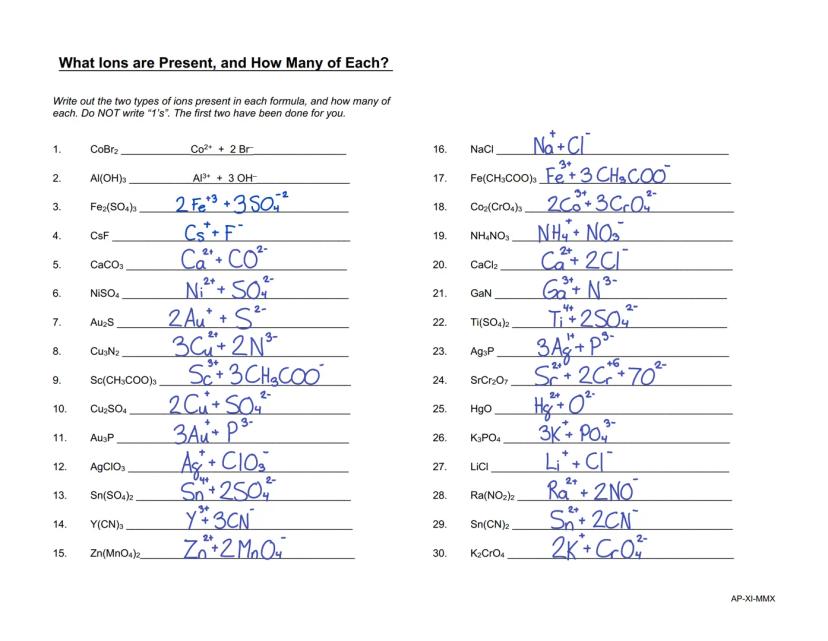
Page 4: Ion Identification Practice
This section teaches how to identify and count ions present in chemical formulas, providing a systematic approach to understanding ionic compounds.
Definition: Ionic compounds consist of positively charged cations and negatively charged anions in ratios that create a neutral compound.
Example: In CoBr₂, there is one Co²⁺ cation and two Br⁻ anions.
Highlight: The practice emphasizes writing ion counts without using "1" and properly balancing charges.
4
of 8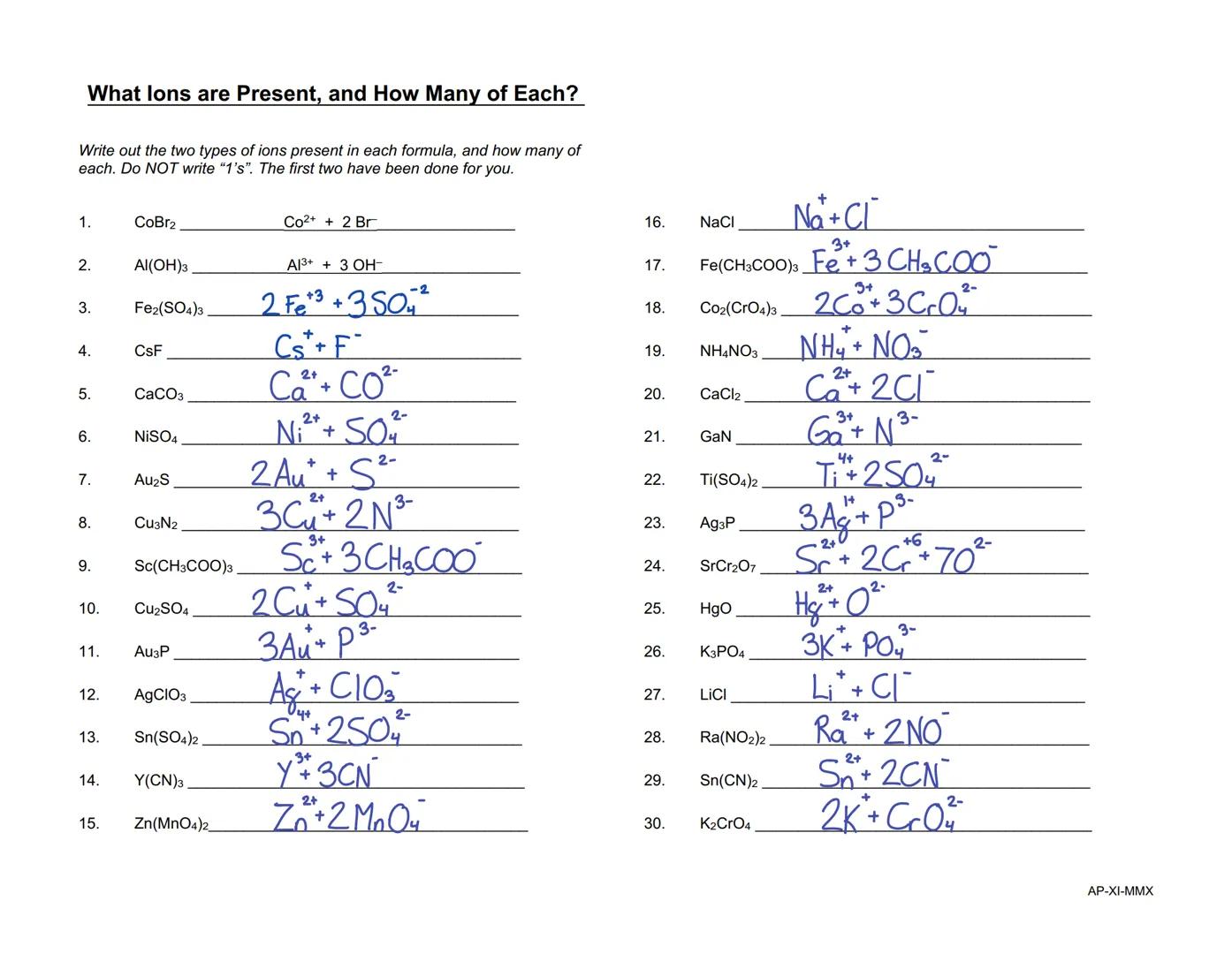
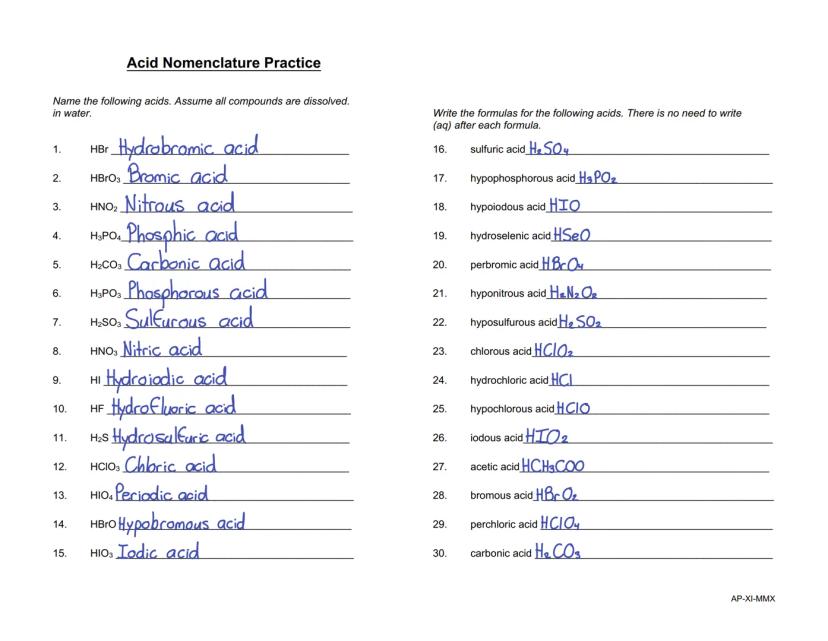
Page 5: Acid Nomenclature Practice
This page covers the systematic naming of acids and writing their chemical formulas.
Definition: Acids are compounds that produce hydrogen ions (H⁺) when dissolved in water.
Example: HBr forms hydrobromic acid in water, while HBrO₃ forms bromic acid.
Vocabulary: The "-ic" suffix indicates the more common oxidation state, while "-ous" indicates the lower oxidation state.
5
of 8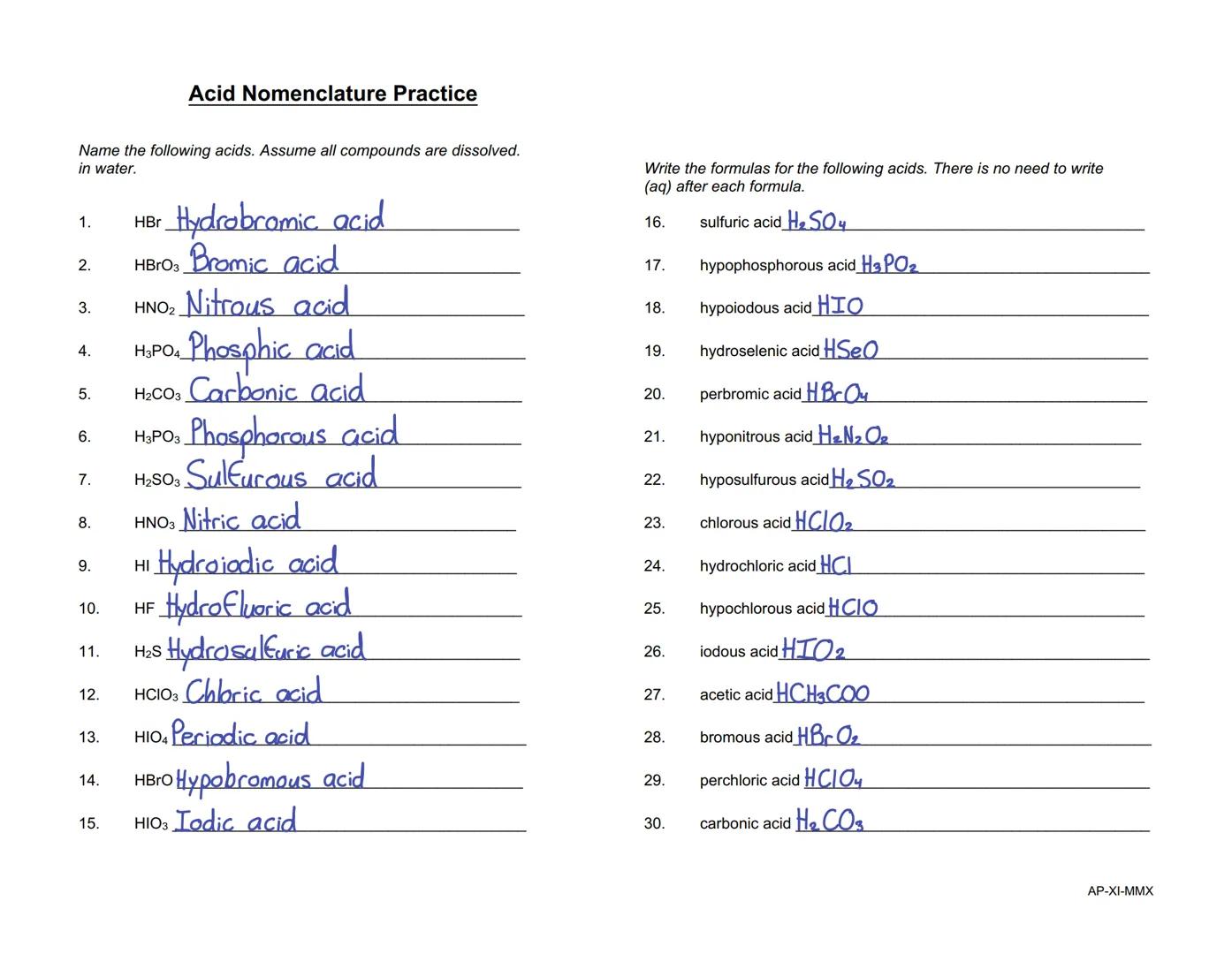
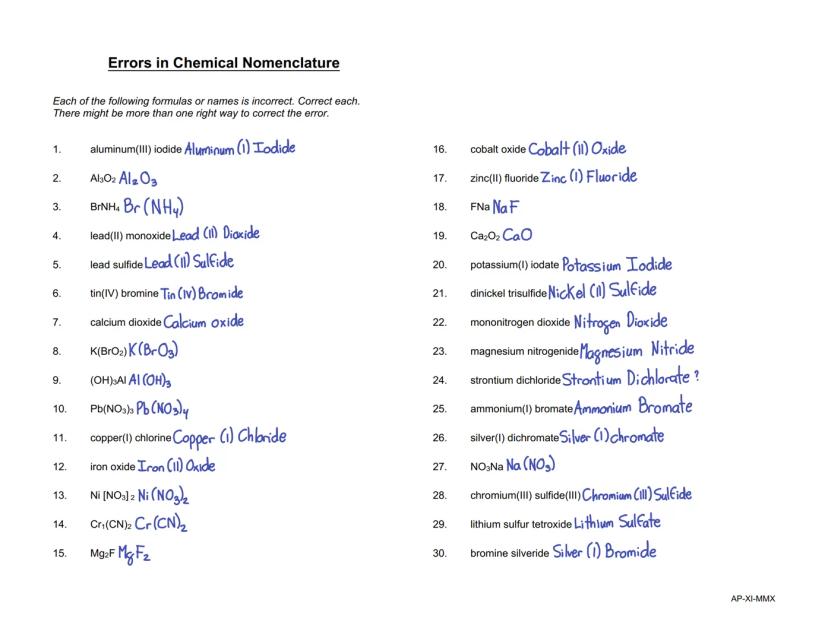
Page 6: Additional Practice
This final section provides mixed practice problems combining various types of chemical nomenclature.
Example: Ca₃N₂ is named calcium nitride, demonstrating ionic compound nomenclature.
Highlight: The problems integrate concepts from previous sections, reinforcing overall understanding of chemical nomenclature.
6
of 8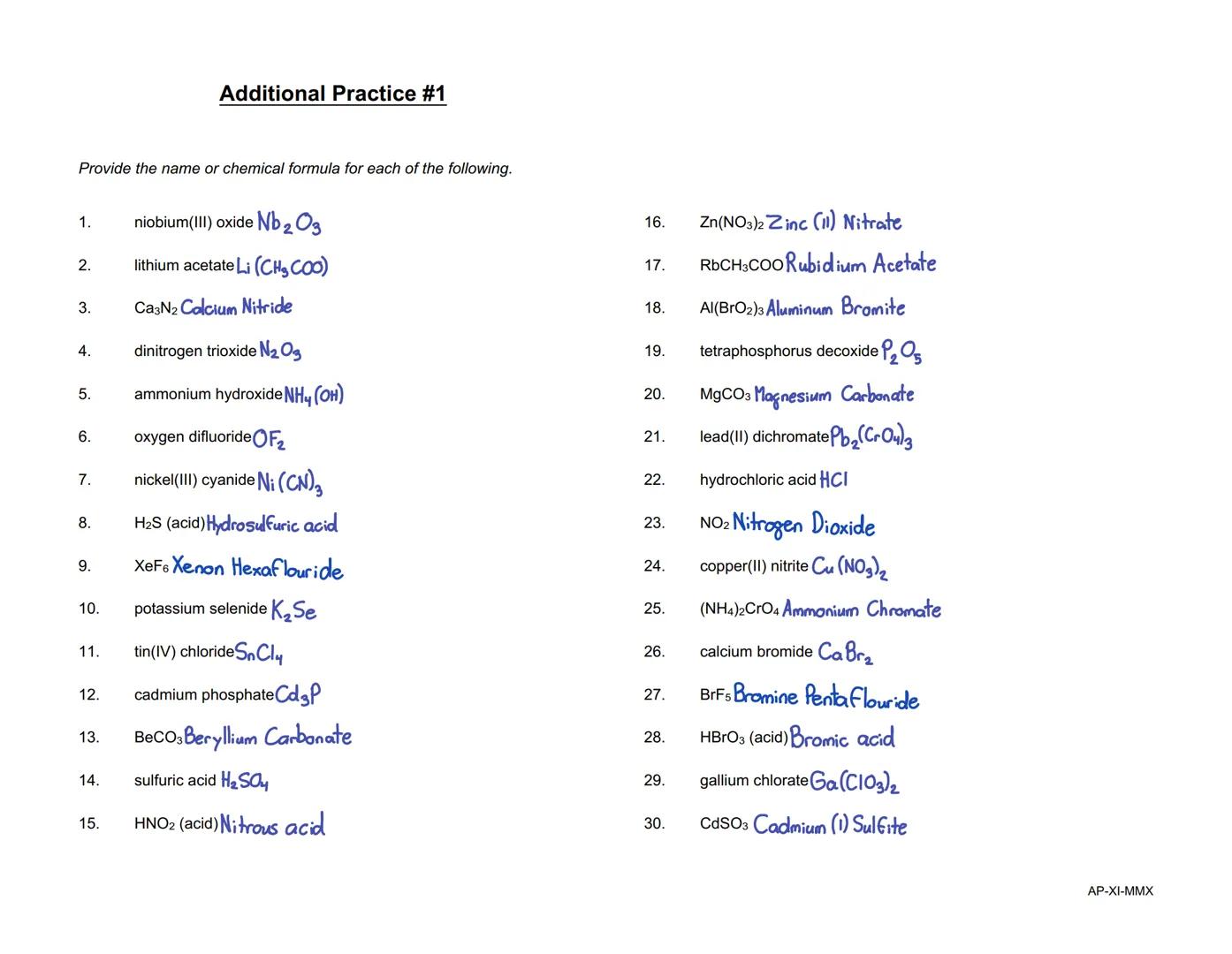
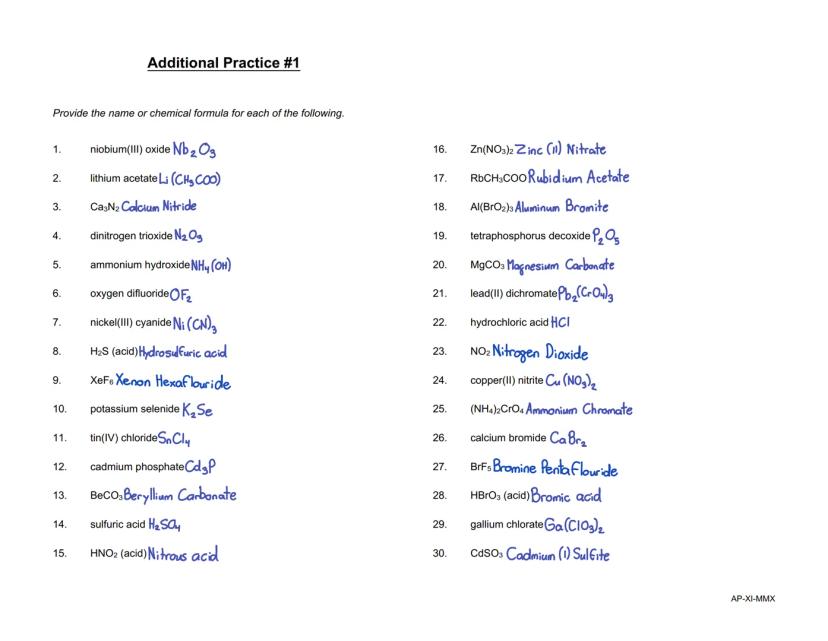
Page 6: Additional Practice #1
This section provides comprehensive practice combining various types of compounds, including ionic compounds, covalent compounds, and acids.
Example: Nb₂O₃ is named as niobium(III) oxide.
Highlight: This section reinforces the importance of distinguishing between different types of compounds when naming them.
7
of 8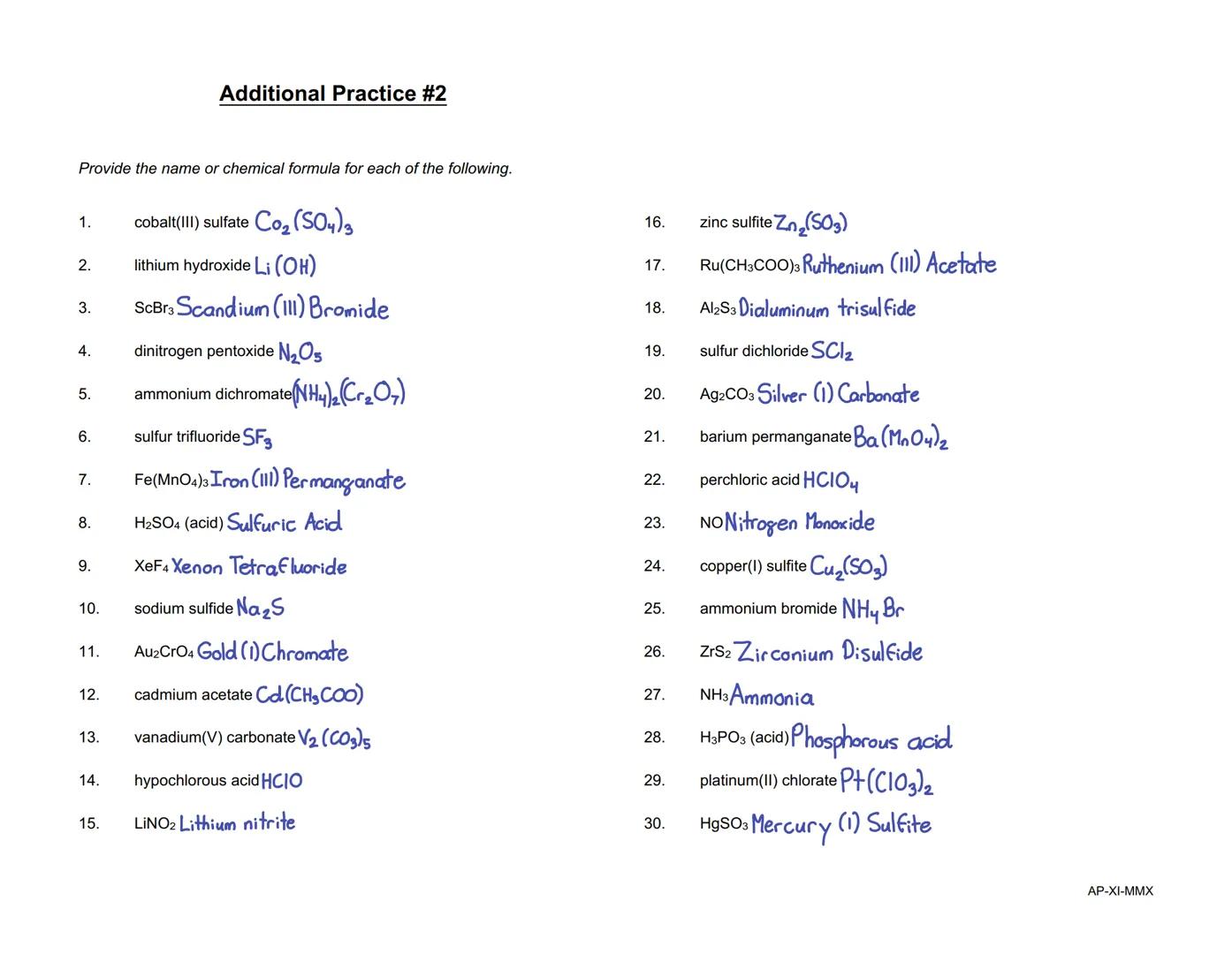
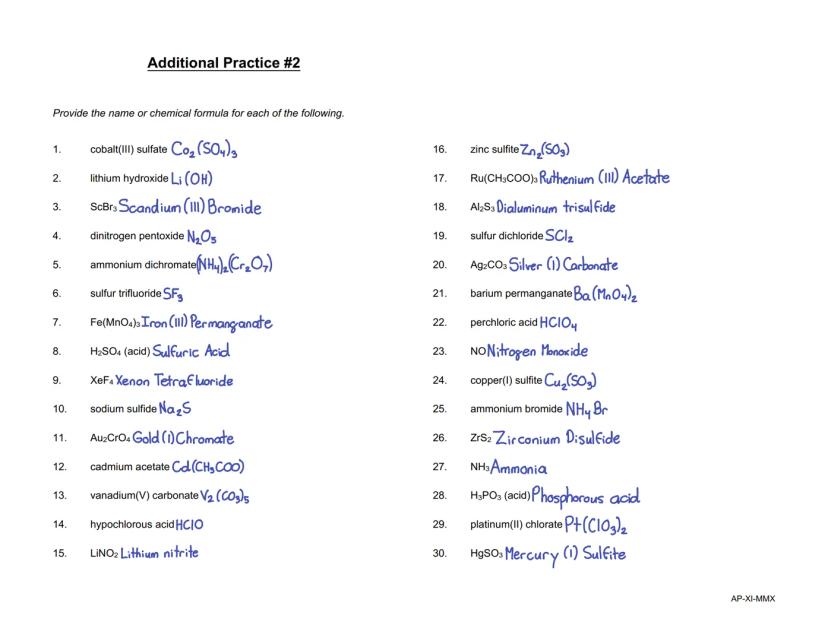
Page 7: Additional Practice #2
Continues with more advanced practice problems, incorporating all previously covered concepts.
Example: Fe(MnO4)₃ is named as Iron(III) Permanganate.
Highlight: Complex ionic compounds often contain polyatomic ions that must be correctly identified for proper naming.
8
of 8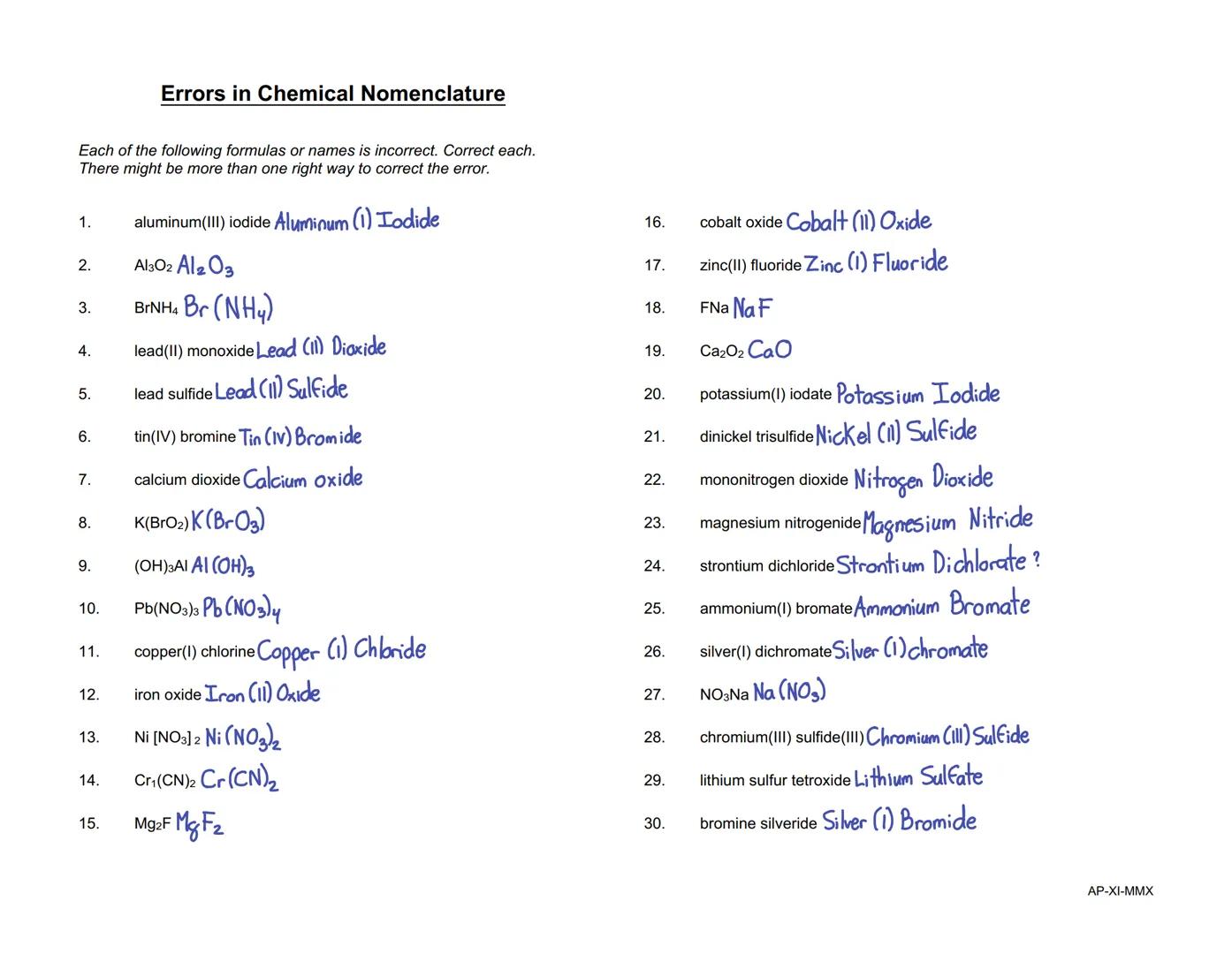
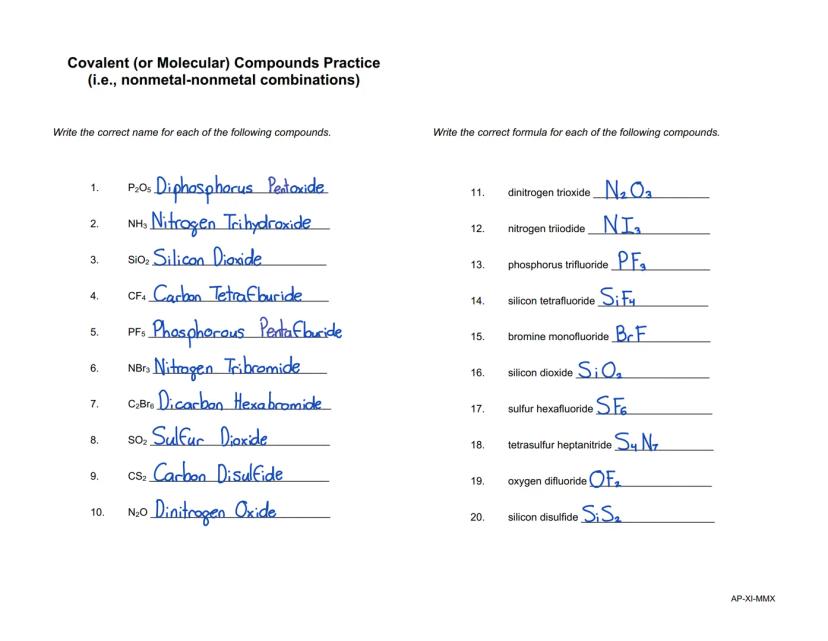
Page 1: Covalent Compounds Practice
This page focuses on the nomenclature of covalent (molecular) compounds formed between nonmetals. The practice exercises are structured to reinforce understanding of systematic naming conventions.
Definition: Covalent compounds are molecules formed by sharing electrons between nonmetal atoms.
Example: P₂O5 is named as diphosphorus pentoxide, where 'di-' indicates two phosphorus atoms and 'pent-' indicates five oxygen atoms.
Highlight: The practice includes both naming compounds from formulas and writing formulas from names, providing comprehensive practice in both directions.
Vocabulary: Prefixes used in naming indicate the number of atoms present.
We thought you’d never ask...
What is the Knowunity AI companion?
Our AI companion is specifically built for the needs of students. Based on the millions of content pieces we have on the platform we can provide truly meaningful and relevant answers to students. But its not only about answers, the companion is even more about guiding students through their daily learning challenges, with personalised study plans, quizzes or content pieces in the chat and 100% personalisation based on the students skills and developments.
Where can I download the Knowunity app?
You can download the app in the Google Play Store and in the Apple App Store.
Is Knowunity really free of charge?
That's right! Enjoy free access to study content, connect with fellow students, and get instant help – all at your fingertips.
Similar Content
Most popular content: Chemical Nomenclature
2Most popular content in AP Chemistry
9I
AP ChemistryIntroduction to Elemental Composition
Practice fundamental concepts of mass percentage and the law of definite proportions to determine the relative mass of elements in a pure substance.
9th7160
I
AP ChemistryIntroduction to Electron Configuration
Practice identifying ground-state electron configurations using the Aufbau principle, Hund's rule, and the Pauli exclusion principle.
9th3800
I
AP ChemistryIntroduction to Moles and Avogadro's Number
Practice converting between mass, moles, and number of particles using Avogadro's constant and the fundamental concept of the mole.
9th1820
AP Chemistryunits 1-9 ap chem
dives pretty deeply into each unit of the ap chem curriculum
10th3197
AP ChemistryReversible Reactions, Chemical Equilibrium, and Equilibrium Constants
Understanding the dynamic nature of reversible reactions and the concept of chemical equilibrium, as well as calculating the equilibrium constant for reactions.
9th621
AP ChemistryIntegrated Rate Law, Reaction Mechanisms, and Multistep Energy Diagrams
Introduction to integrated rate law, formulas for finding orders, example of half-life, steps for reaction completion, how to find rate determining step, identifying parts of a multistep energy diagram
739
AP ChemistryStoichiometry notes
Understand how to solve stoichiometry problems.
10th531
AP ChemistryIntroduction to Analytical Chemistry
This study note contains information on the basics of Analytical Chemistry, its applications, and minor concepts with examples.
650
AP ChemistryWhat is chemistry?
Covers matter, mass, weight, and the classification of matter.
12th490
Most popular content
9O
 AP US History
Origins and Dynamics of the Columbian Exchange
Analyze the ecological and economic motivations behind the initial transfer of goods, people, and diseases between the Old and New Worlds.
9th3,1280
I
AP US HistoryIntroduction to Early Cultural Interactions
Analyze the initial social and religious encounters between Europeans, Africans, and Indigenous peoples in the colonial Americas.
9th2,7730
O
 AP World History
Origins of Ancient River Civilizations
Analyze the environmental factors and technological innovations that led to the rise of early states in Mesopotamia, Egypt, and the Indus Valley.
9th3,1870
M
AP US HistoryMotivations for European Exploration
Analyze the economic, religious, and political factors that drove European powers to the Americas during the 15th and 16th centuries.
9th1,7780
F
 AP Psychology
Foundations of Ethical Guidelines in Research
Practice the core principles of the APA ethical code including informed consent, debriefing, and the role of Institutional Review Boards.
9th1,3360
I
AP US HistoryIntroduction to Native American Societies
Examine the diverse social, political, and economic structures of North American indigenous groups prior to European contact.
9th1,1100
I
 AP Biology
Introduction to Biological Elements of Life
Practice identifying the essential elements including carbon, nitrogen, phosphorus, and sulfur that compose biological macromolecules.
9th1,7390
I
AP US HistoryIntroduction to the Spanish Encomienda System
Explore the fundamental economic and social structures of the Spanish colonial system, focusing on the encomienda and the casta social hierarchy.
9th8890
O
AP World HistoryOrigins and Continuity of the Byzantine Empire
Analyze the political and cultural transitions from the Roman Empire to the Byzantine Empire, focusing on the reign of Justinian I and his code.
9th1,6320
Can't find what you're looking for? Explore other subjects.
Students love us — and so will you.
4.6/5App Store
4.7/5Google Play
The app is very easy to use and well designed. I have found everything I was looking for so far and have been able to learn a lot from the presentations! I will definitely use the app for a class assignment! And of course it also helps a lot as an inspiration.
Stefan SiOS user
This app is really great. There are so many study notes and help [...]. My problem subject is French, for example, and the app has so many options for help. Thanks to this app, I have improved my French. I would recommend it to anyone.
Samantha KlichAndroid user
Wow, I am really amazed. I just tried the app because I've seen it advertised many times and was absolutely stunned. This app is THE HELP you want for school and above all, it offers so many things, such as workouts and fact sheets, which have been VERY helpful to me personally.
AnnaiOS user
AP Chemistry139 views·Updated Jun 14, 2026·8 pagesFun with Naming Compounds: Easy Examples!
Broderick Prendergast@broderickprendergast
A comprehensive guide to chemical nomenclature and compound formulas, focusing on covalent compounds, ionic compounds, and acid nomenclature. This educational resource provides extensive practice naming covalent compounds examples and examples of ionic compound formulas, along with detailed variable-charge cations...
1
of 8
Sign up to see the content. It's free!
- Access to all documents
- Improve your grades
- Join milions of students
Page 2: Fixed-Charge Cations Practice
This section covers ionic compounds containing fixed-charge cations, presenting a comprehensive set of exercises for both naming compounds and writing formulas.
Definition: Fixed-charge cations are metal ions that form only one type of positive ion.
Example: NaBr is named sodium bromide because sodium only forms Na⁺ ions.
Highlight: The practice includes polyatomic ions such as ammonium (NH₄⁺) and complex anions like permanganate (MnO₄⁻).
2
of 8Sign up to see the content. It's free!
- Access to all documents
- Improve your grades
- Join milions of students
Page 3: Variable-Charge Cations Practice
This page focuses on naming and writing formulas for compounds containing transition metals that can form multiple different ionic charges.
Definition: Variable-charge cations are metal ions that can form different positive charges, requiring Roman numerals to specify the charge.
Example: CuBr is named as copper(I) bromide, where (I) indicates the +1 charge on copper.
Highlight: The exercises emphasize the importance of correctly identifying and noting the charge of transition metal ions.
3
of 8Sign up to see the content. It's free!
- Access to all documents
- Improve your grades
- Join milions of students
Page 4: Ion Identification Practice
This section teaches how to identify and count ions present in chemical formulas, providing a systematic approach to understanding ionic compounds.
Definition: Ionic compounds consist of positively charged cations and negatively charged anions in ratios that create a neutral compound.
Example: In CoBr₂, there is one Co²⁺ cation and two Br⁻ anions.
Highlight: The practice emphasizes writing ion counts without using "1" and properly balancing charges.
4
of 8Sign up to see the content. It's free!
- Access to all documents
- Improve your grades
- Join milions of students
Page 5: Acid Nomenclature Practice
This page covers the systematic naming of acids and writing their chemical formulas.
Definition: Acids are compounds that produce hydrogen ions (H⁺) when dissolved in water.
Example: HBr forms hydrobromic acid in water, while HBrO₃ forms bromic acid.
Vocabulary: The "-ic" suffix indicates the more common oxidation state, while "-ous" indicates the lower oxidation state.
5
of 8Sign up to see the content. It's free!
- Access to all documents
- Improve your grades
- Join milions of students
Page 6: Additional Practice
This final section provides mixed practice problems combining various types of chemical nomenclature.
Example: Ca₃N₂ is named calcium nitride, demonstrating ionic compound nomenclature.
Highlight: The problems integrate concepts from previous sections, reinforcing overall understanding of chemical nomenclature.
6
of 8Sign up to see the content. It's free!
- Access to all documents
- Improve your grades
- Join milions of students
Page 6: Additional Practice #1
This section provides comprehensive practice combining various types of compounds, including ionic compounds, covalent compounds, and acids.
Example: Nb₂O₃ is named as niobium(III) oxide.
Highlight: This section reinforces the importance of distinguishing between different types of compounds when naming them.
7
of 8Sign up to see the content. It's free!
- Access to all documents
- Improve your grades
- Join milions of students
Page 7: Additional Practice #2
Continues with more advanced practice problems, incorporating all previously covered concepts.
Example: Fe(MnO4)₃ is named as Iron(III) Permanganate.
Highlight: Complex ionic compounds often contain polyatomic ions that must be correctly identified for proper naming.
8
of 8Sign up to see the content. It's free!
- Access to all documents
- Improve your grades
- Join milions of students
Page 1: Covalent Compounds Practice
This page focuses on the nomenclature of covalent (molecular) compounds formed between nonmetals. The practice exercises are structured to reinforce understanding of systematic naming conventions.
Definition: Covalent compounds are molecules formed by sharing electrons between nonmetal atoms.
Example: P₂O5 is named as diphosphorus pentoxide, where 'di-' indicates two phosphorus atoms and 'pent-' indicates five oxygen atoms.
Highlight: The practice includes both naming compounds from formulas and writing formulas from names, providing comprehensive practice in both directions.
Vocabulary: Prefixes used in naming indicate the number of atoms present.
We thought you’d never ask...
What is the Knowunity AI companion?
Our AI companion is specifically built for the needs of students. Based on the millions of content pieces we have on the platform we can provide truly meaningful and relevant answers to students. But its not only about answers, the companion is even more about guiding students through their daily learning challenges, with personalised study plans, quizzes or content pieces in the chat and 100% personalisation based on the students skills and developments.
Where can I download the Knowunity app?
You can download the app in the Google Play Store and in the Apple App Store.
Is Knowunity really free of charge?
That's right! Enjoy free access to study content, connect with fellow students, and get instant help – all at your fingertips.
Similar Content
Most popular content: Chemical Nomenclature
2Most popular content in AP Chemistry
9I
AP ChemistryIntroduction to Elemental Composition
Practice fundamental concepts of mass percentage and the law of definite proportions to determine the relative mass of elements in a pure substance.
9th7160
I
AP ChemistryIntroduction to Electron Configuration
Practice identifying ground-state electron configurations using the Aufbau principle, Hund's rule, and the Pauli exclusion principle.
9th3800
I
AP ChemistryIntroduction to Moles and Avogadro's Number
Practice converting between mass, moles, and number of particles using Avogadro's constant and the fundamental concept of the mole.
9th1820
AP Chemistryunits 1-9 ap chem
dives pretty deeply into each unit of the ap chem curriculum
10th3197
AP ChemistryReversible Reactions, Chemical Equilibrium, and Equilibrium Constants
Understanding the dynamic nature of reversible reactions and the concept of chemical equilibrium, as well as calculating the equilibrium constant for reactions.
9th621
AP ChemistryIntegrated Rate Law, Reaction Mechanisms, and Multistep Energy Diagrams
Introduction to integrated rate law, formulas for finding orders, example of half-life, steps for reaction completion, how to find rate determining step, identifying parts of a multistep energy diagram
739
AP ChemistryStoichiometry notes
Understand how to solve stoichiometry problems.
10th531
AP ChemistryIntroduction to Analytical Chemistry
This study note contains information on the basics of Analytical Chemistry, its applications, and minor concepts with examples.
650
AP ChemistryWhat is chemistry?
Covers matter, mass, weight, and the classification of matter.
12th490
Most popular content
9O
AP US HistoryOrigins and Dynamics of the Columbian Exchange
Analyze the ecological and economic motivations behind the initial transfer of goods, people, and diseases between the Old and New Worlds.
9th3,1280
I
AP US HistoryIntroduction to Early Cultural Interactions
Analyze the initial social and religious encounters between Europeans, Africans, and Indigenous peoples in the colonial Americas.
9th2,7730
O
AP World HistoryOrigins of Ancient River Civilizations
Analyze the environmental factors and technological innovations that led to the rise of early states in Mesopotamia, Egypt, and the Indus Valley.
9th3,1870
M
AP US HistoryMotivations for European Exploration
Analyze the economic, religious, and political factors that drove European powers to the Americas during the 15th and 16th centuries.
9th1,7780
F
AP PsychologyFoundations of Ethical Guidelines in Research
Practice the core principles of the APA ethical code including informed consent, debriefing, and the role of Institutional Review Boards.
9th1,3360
I
AP US HistoryIntroduction to Native American Societies
Examine the diverse social, political, and economic structures of North American indigenous groups prior to European contact.
9th1,1100
I
AP BiologyIntroduction to Biological Elements of Life
Practice identifying the essential elements including carbon, nitrogen, phosphorus, and sulfur that compose biological macromolecules.
9th1,7390
I
AP US HistoryIntroduction to the Spanish Encomienda System
Explore the fundamental economic and social structures of the Spanish colonial system, focusing on the encomienda and the casta social hierarchy.
9th8890
O
AP World HistoryOrigins and Continuity of the Byzantine Empire
Analyze the political and cultural transitions from the Roman Empire to the Byzantine Empire, focusing on the reign of Justinian I and his code.
9th1,6320
Can't find what you're looking for? Explore other subjects.
Students love us — and so will you.
4.6/5App Store
4.7/5Google Play
The app is very easy to use and well designed. I have found everything I was looking for so far and have been able to learn a lot from the presentations! I will definitely use the app for a class assignment! And of course it also helps a lot as an inspiration.
Stefan SiOS user
This app is really great. There are so many study notes and help [...]. My problem subject is French, for example, and the app has so many options for help. Thanks to this app, I have improved my French. I would recommend it to anyone.
Samantha KlichAndroid user
Wow, I am really amazed. I just tried the app because I've seen it advertised many times and was absolutely stunned. This app is THE HELP you want for school and above all, it offers so many things, such as workouts and fact sheets, which have been VERY helpful to me personally.
AnnaiOS user