
Differential equations are mathematical tools that describe how quantities change...
 AP Calculus AB/BC30 views·Updated Jun 6, 2026·8 pages
Solve Variable Separable and Homogeneous Differential Equations - First Order Problems

Benjamin Arguelles@benjaminarguelles_ysur

1 / 8
1
of 8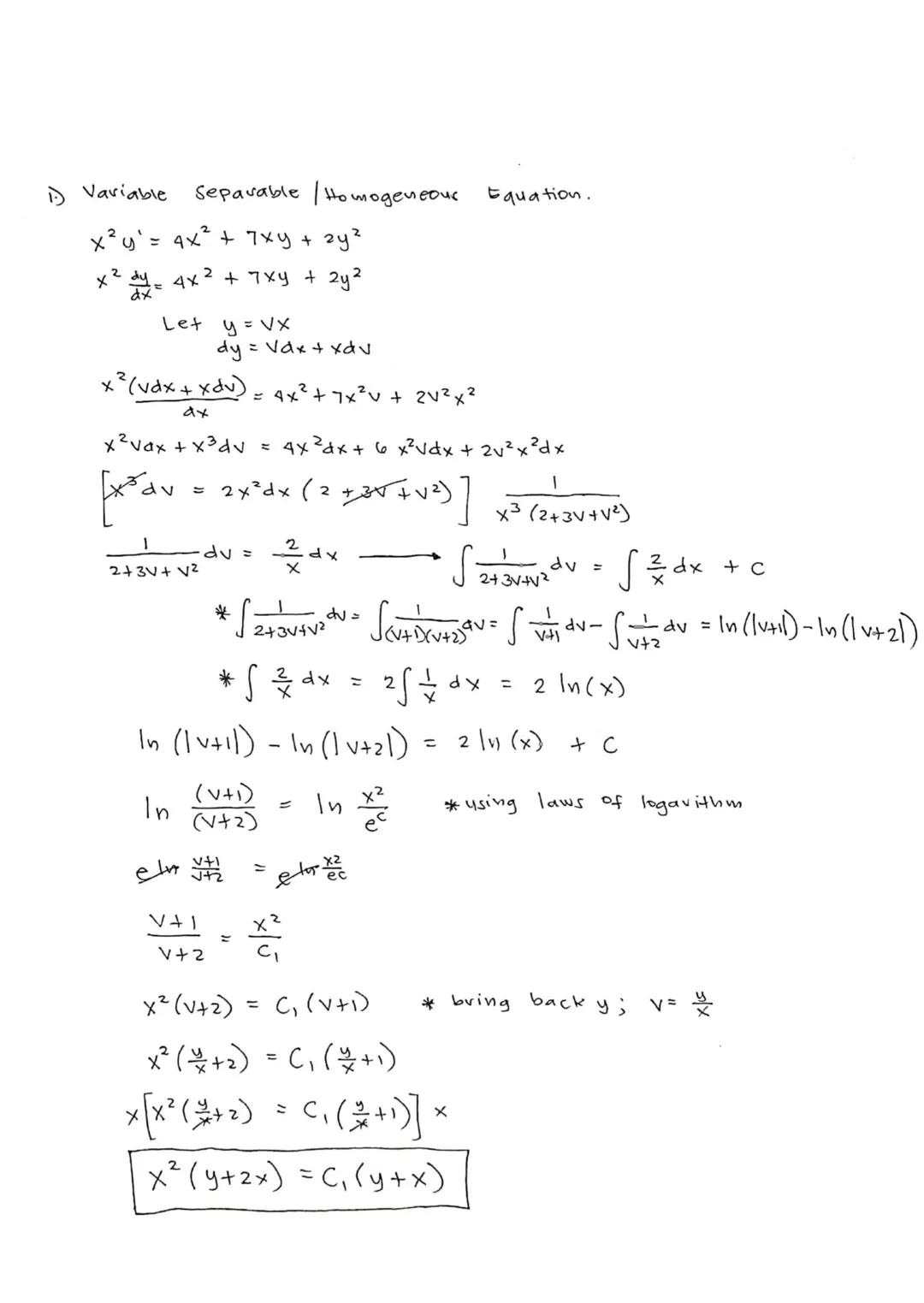
Variable Separable & Homogeneous Equations
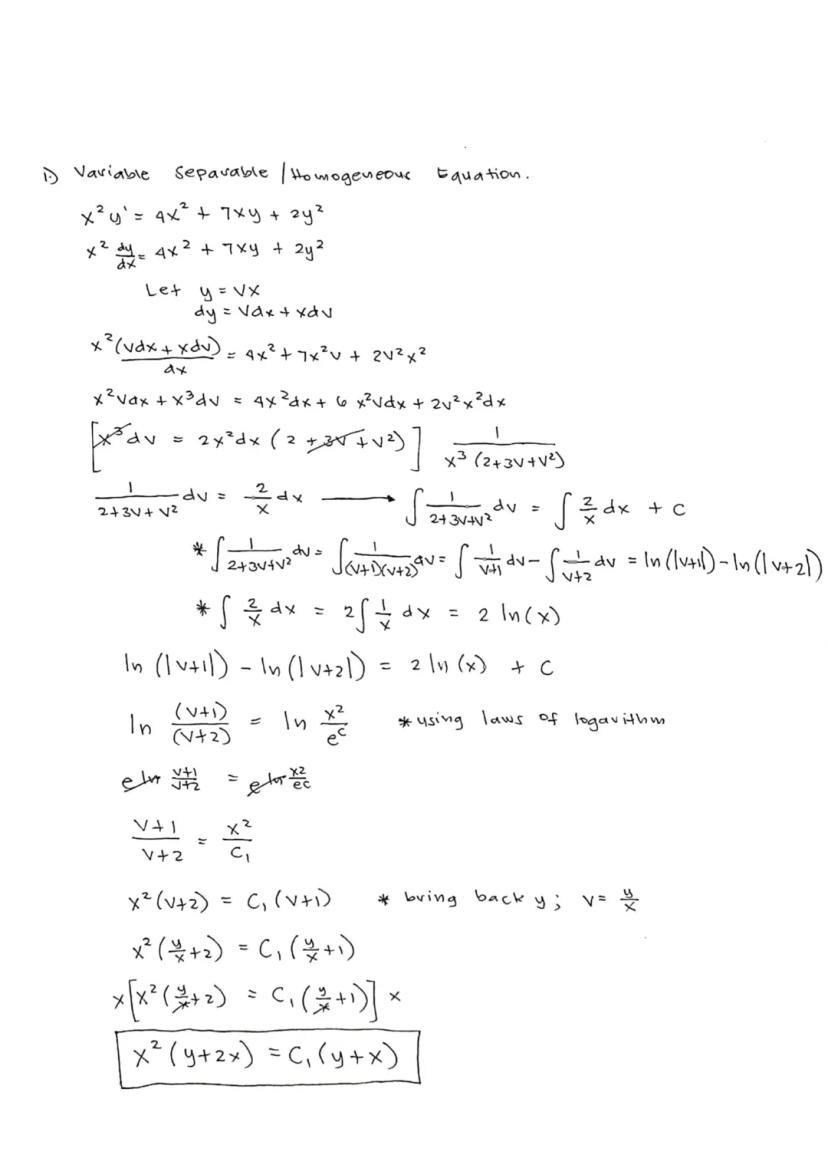
When solving differential equations, we often need to transform complex equations into simpler forms. One powerful approach involves substitution methods.
For homogeneous equations like , we can use the substitution y = vx (where v is a new variable). This transforms our equation by replacing y with vx and dy with vdx + xdv. Through careful algebraic manipulation, we separate the variables v and x.
After separating, we can integrate both sides of the equation. The solution often takes the form of logarithmic expressions that can be simplified using properties of logarithms. Eventually, we substitute back to find the relationship between x and y.
💡 When you see terms with similar degrees (like x²y' and x²), try the substitution y = vx. This often turns messy equations into manageable ones!
2
of 8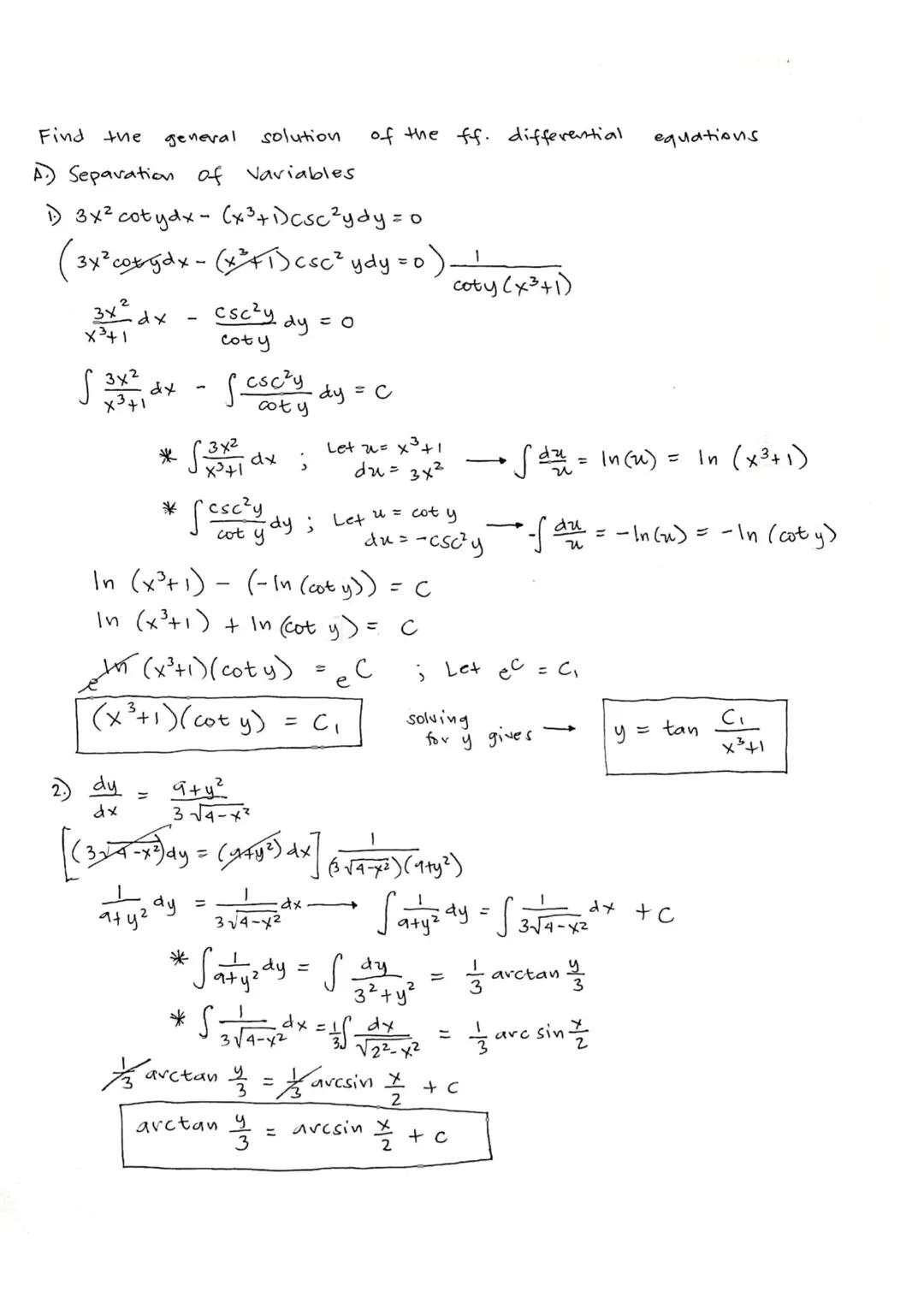
Separating Variables: Step-by-Step Examples
Separable differential equations let us move all terms with one variable to one side, and all terms with the other variable to the other side. Let's see how this works!
For equations like $3x^2cot y dx - csc^2y dy = 0\frac{3x^2}{x^3+1}dx = \frac{csc^2y}{coty}dy$. Then integrate both sides and simplify using substitution techniques when helpful.
The second example, , follows a similar approach. Rearranging gives . When integrating, recognize standard forms like and .
⚡ Look for patterns in integrals! Expressions like and appear frequently and have standard solutions.
3
of 8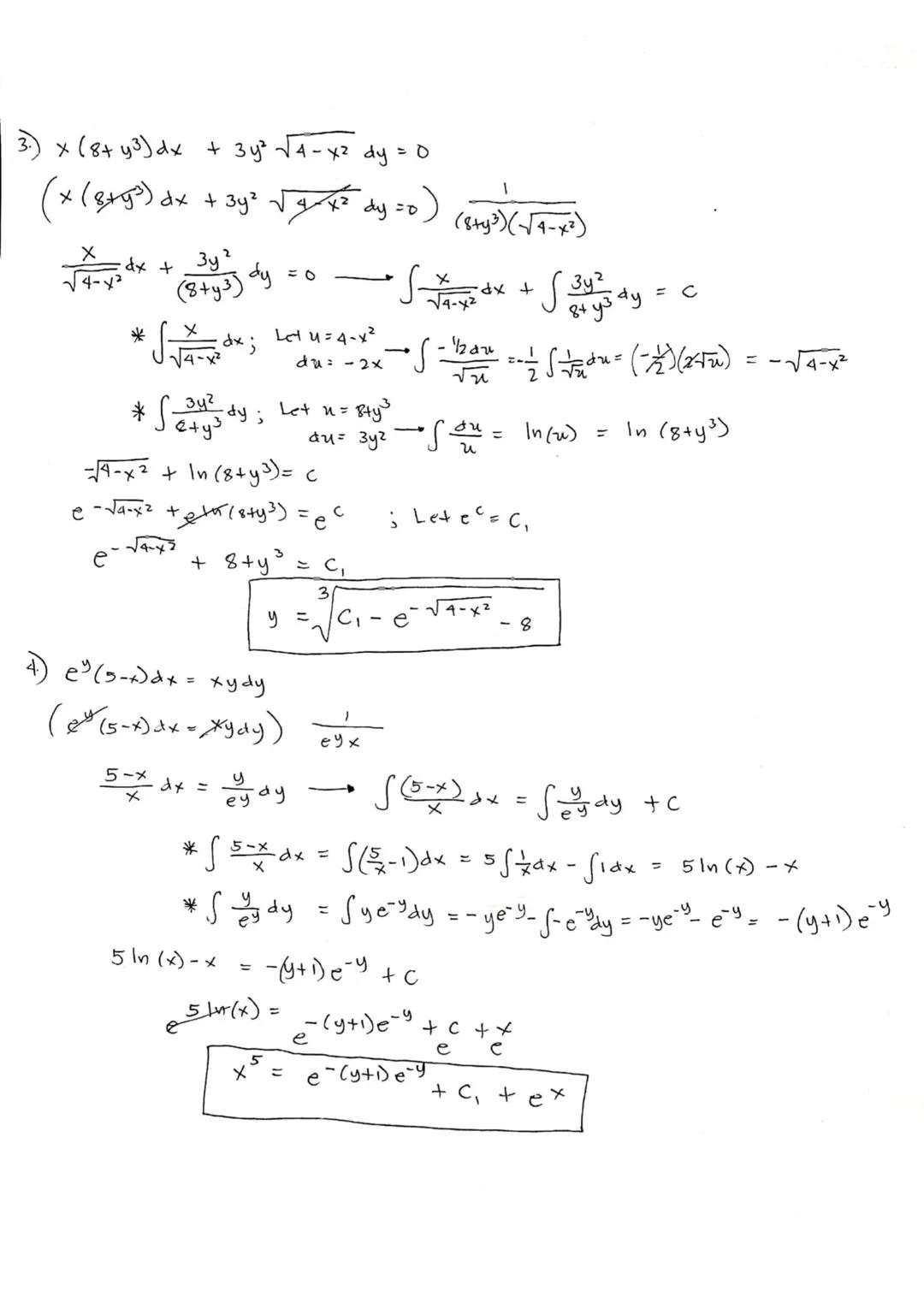
More Separable Equation Examples
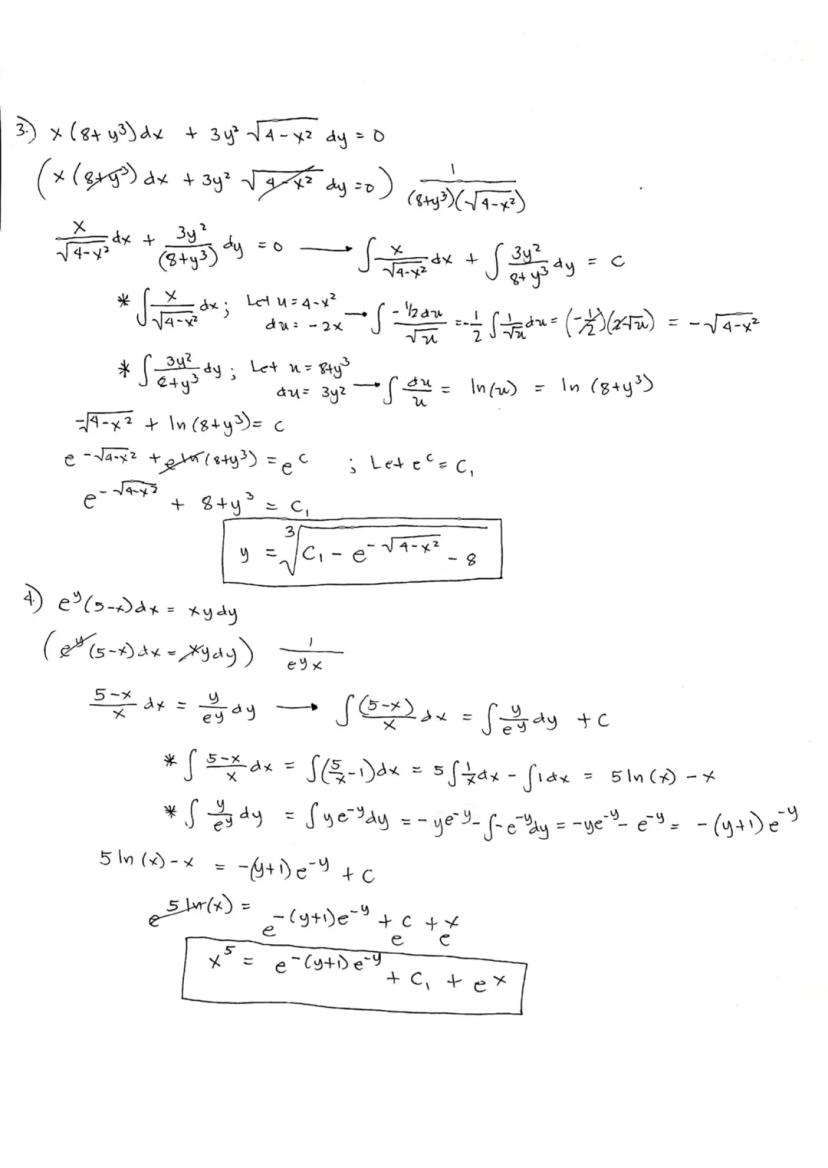
Tackling complex differential equations requires patience and strategic substitutions. Let's continue with more challenging examples.
In the equation , our first step is rearranging to separate variables: . We then integrate each term separately. For integrals like , substituting transforms it into a simpler form.
The equation requires similar separation techniques. After dividing by , we get . When integrating , integration by parts helps us handle the product of y and .
After solving both sides, we combine the results and solve for the relationship between x and y, often yielding implicit solutions that can't be directly expressed as y = f(x).
🔍 When integrating rational expressions like , try partial fraction decomposition to break it into simpler terms.
4
of 8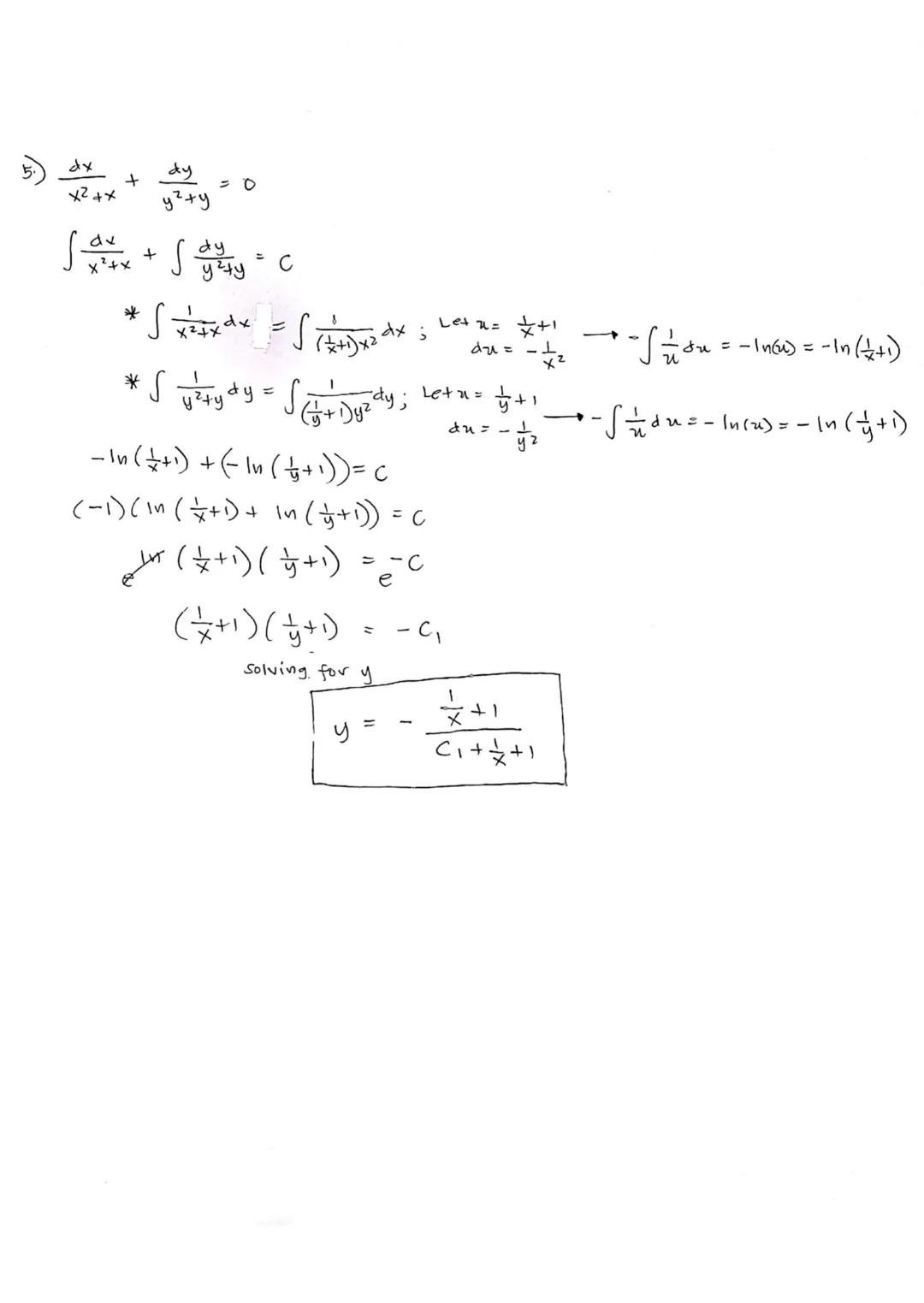
Solving Differential Equations with Partial Fractions
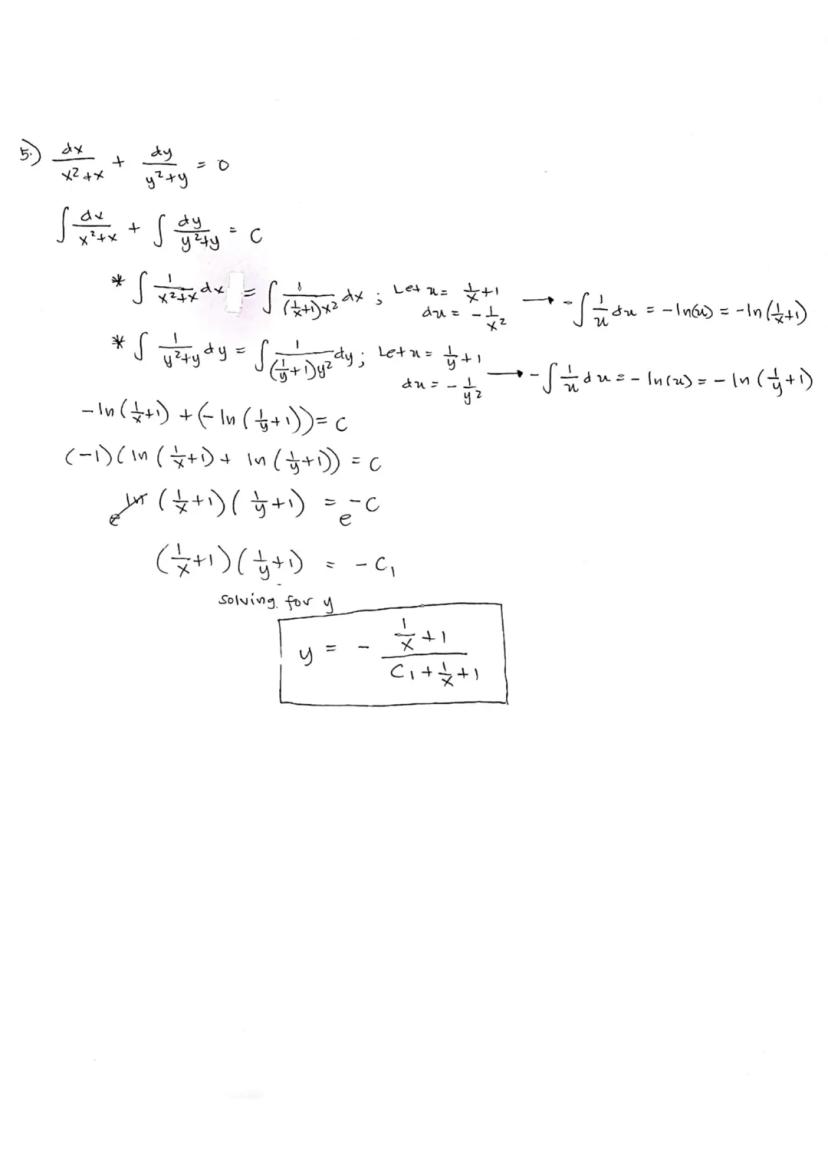
Sometimes differential equations require specific algebraic techniques to solve efficiently. Let's examine a classic case.
For the equation , notice both terms have similar forms. We can rewrite them using partial fraction decomposition: and similarly for the y-term.
After decomposing, we integrate both sides: . These integrate to logarithmic expressions: .
Using logarithm properties, we can simplify to: . After exponentiation and algebraic manipulation, we arrive at the elegant solution , which we can solve for y.
💫 Many differential equations yield solutions with a form of . This pattern appears frequently, so learn to recognize it!
5
of 8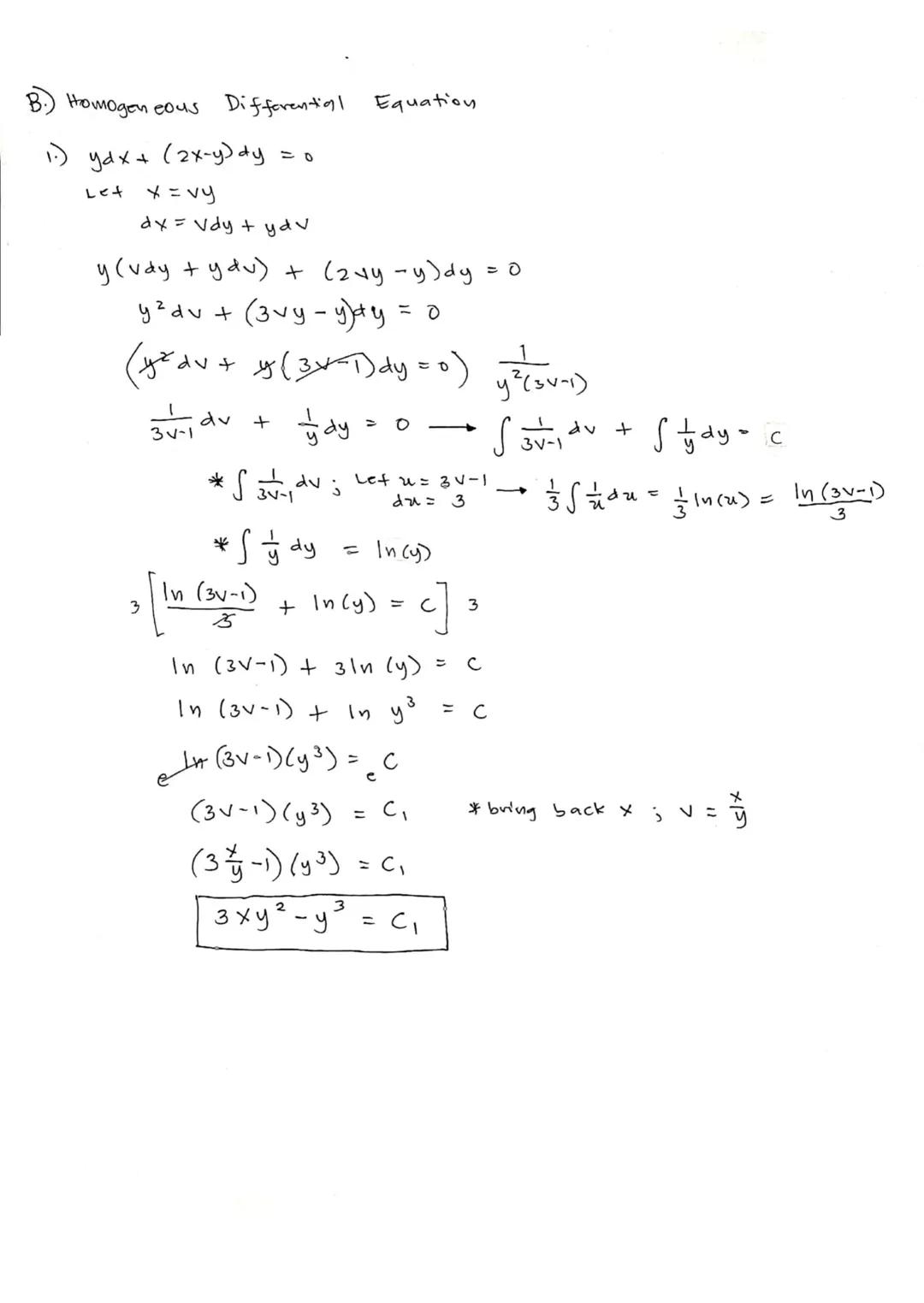
Homogeneous Differential Equations
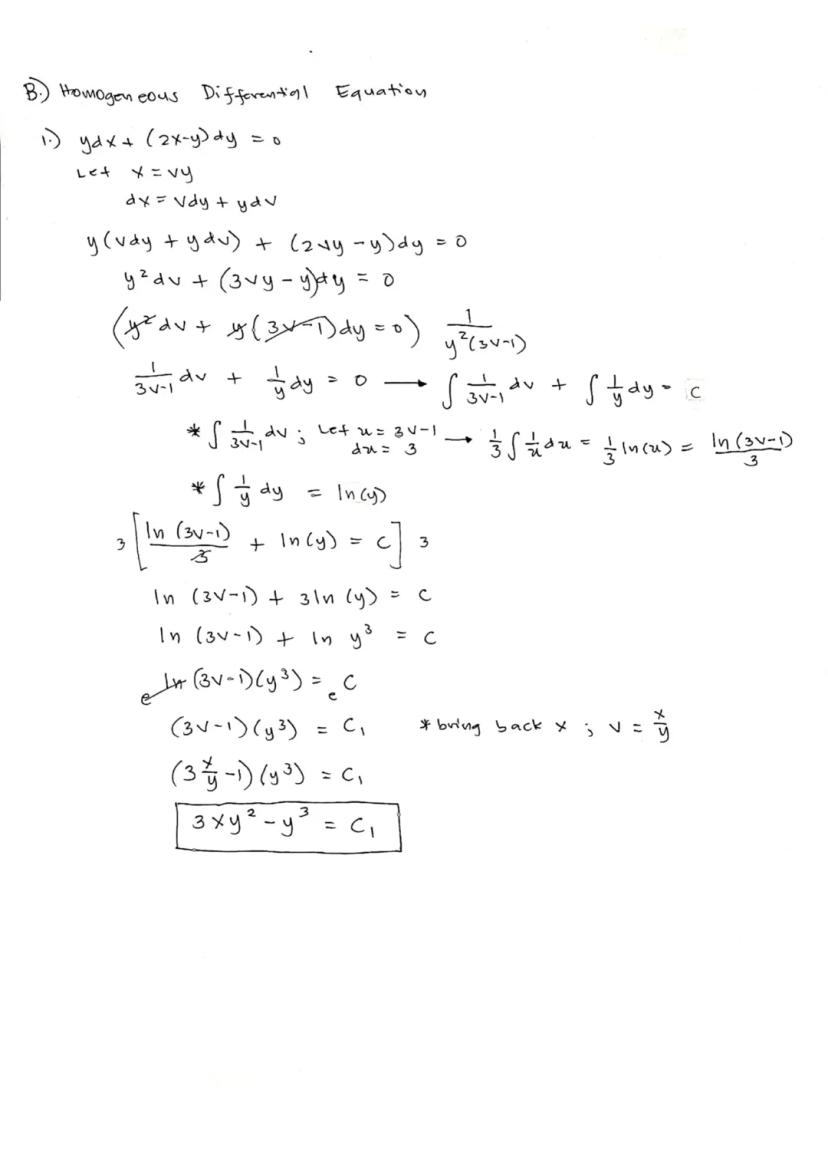
Homogeneous differential equations have a special property: when you replace x with tx and y with ty, the equation remains the same except for a power of t. The substitution y = vx is our key strategy here.
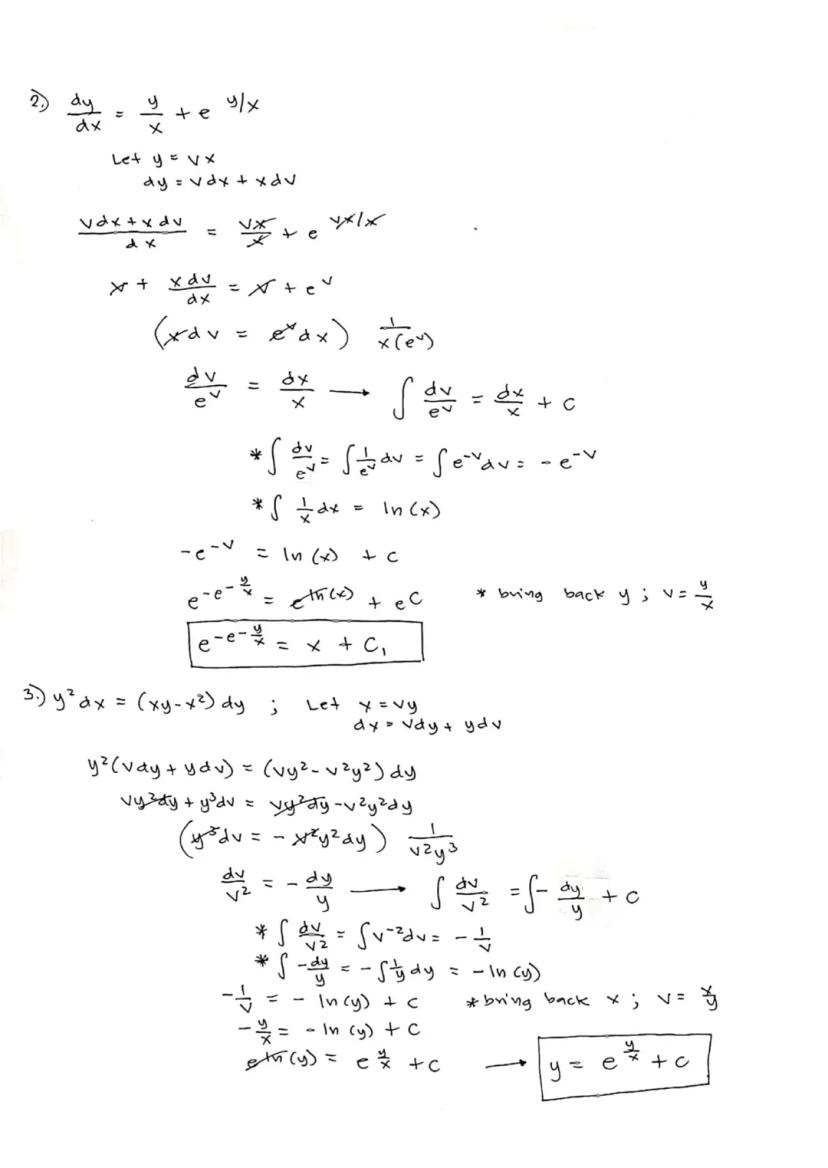
For , we substitute x = vy, which means dx = vdy + ydv. After substitution and rearranging, we get .
Integrating both sides: . We simplify using logarithm properties, eventually getting . Substituting back v = x/y gives us the final solution $3xy^2-y^3 = C_1$.
The beauty of this method is how it transforms a complex equation into a separable one, making it much easier to solve step by step.
🌟 To check if an equation is homogeneous, see if all terms have the same degree when counting x and y together. For example, xy and x² + y² are both degree 2.
6
of 8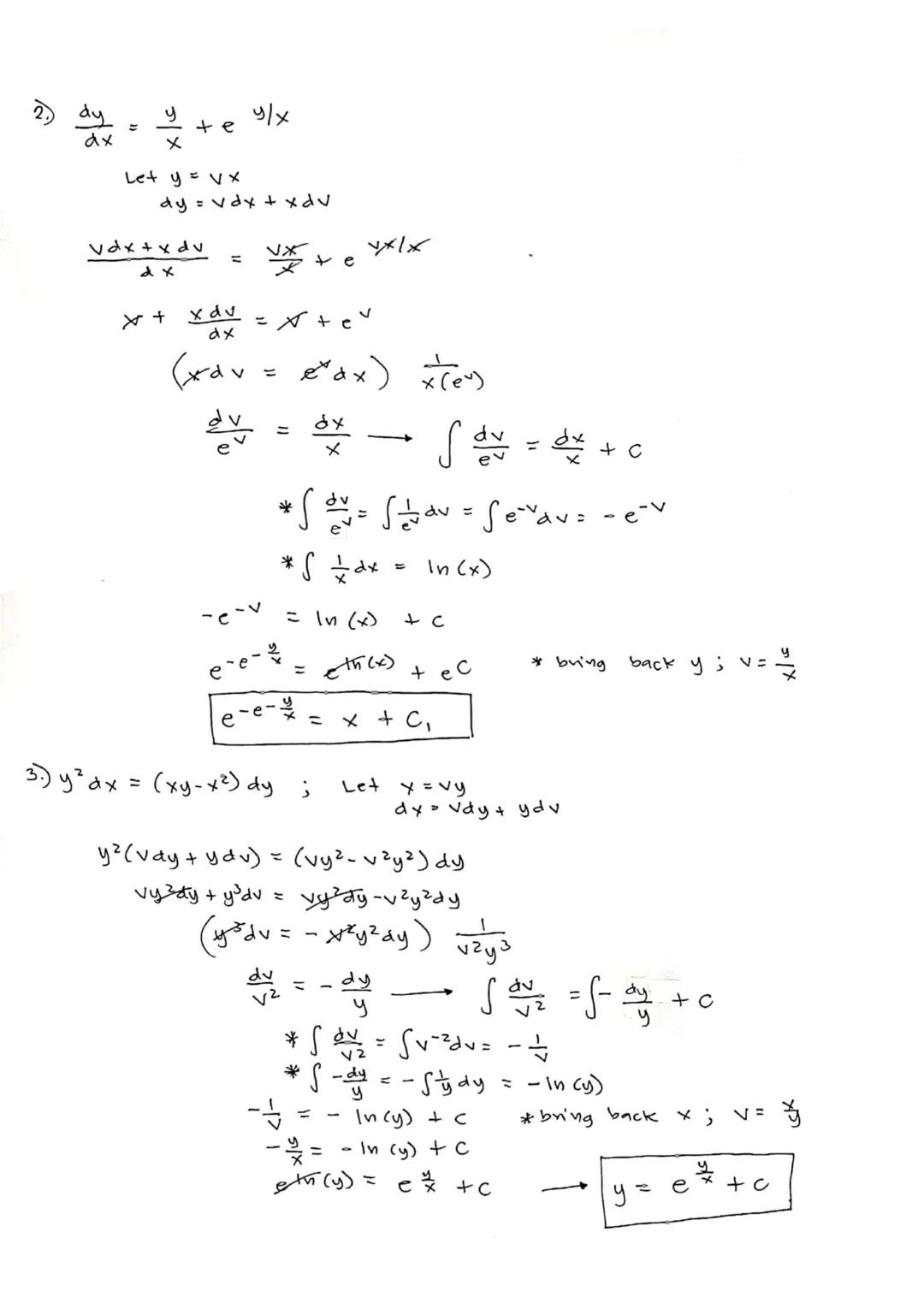
More Homogeneous Equations
Homogeneous equations can look intimidating at first, but our substitution method makes them manageable. Let's tackle a few more examples.
For , we use the substitution y = vx, which gives dy = vdx + xdv. After substituting and simplifying, we get . Integrating both sides yields . Substituting back v = y/x gives us .
For , we use x = vy, leading to . After integration and substitution, our solution becomes .
These solutions may look complex, but they follow from the systematic application of our substitution method and careful integration. The pattern becomes clearer with practice.
🔮 When solving homogeneous equations, after substituting y = vx, watch for terms that can be factored out, making the separation of variables possible.
7
of 8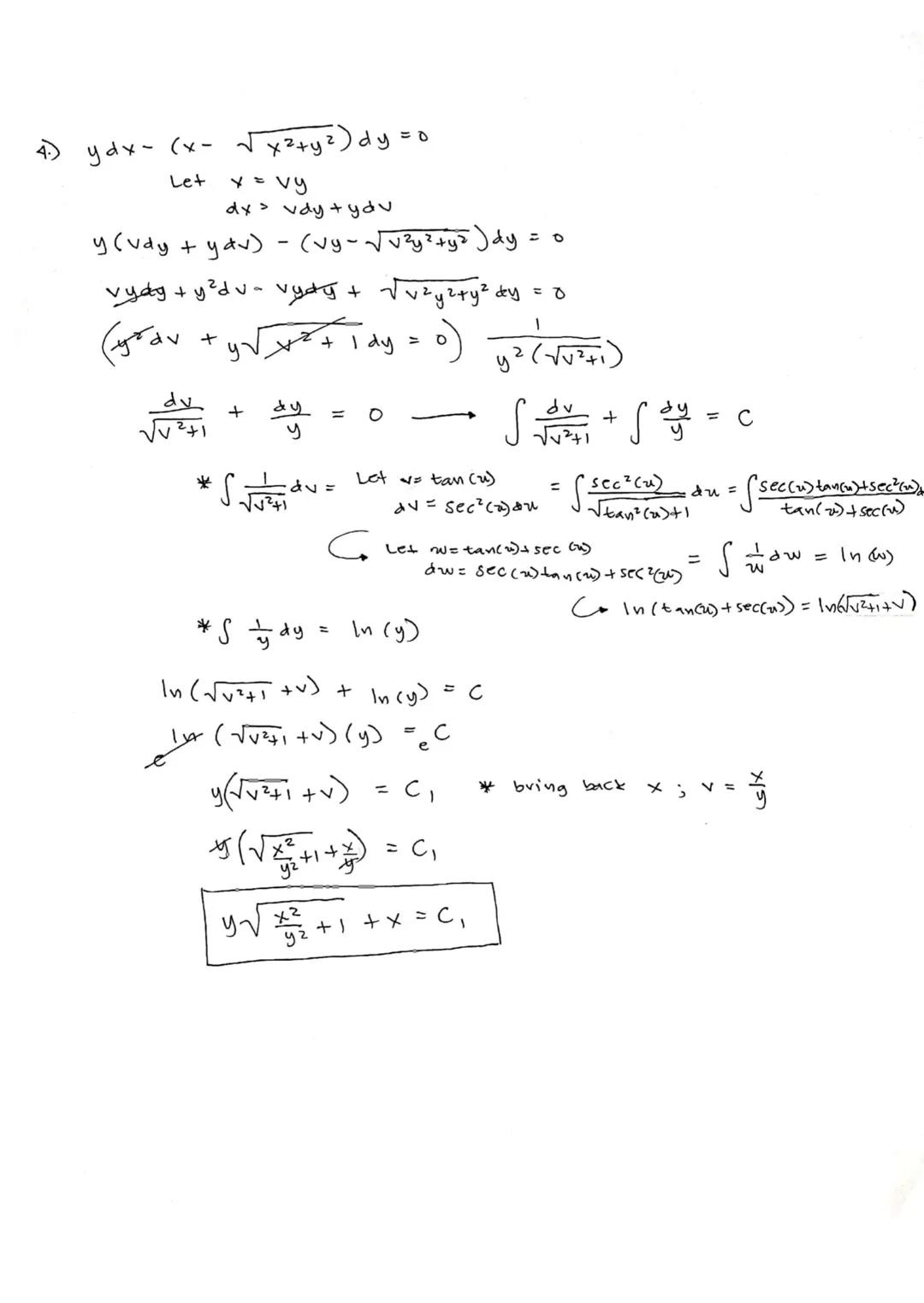
Tackling Complex Homogeneous Equations
Even the most complicated-looking homogeneous equations yield to our substitution approach. Let's see how to handle one with square roots.
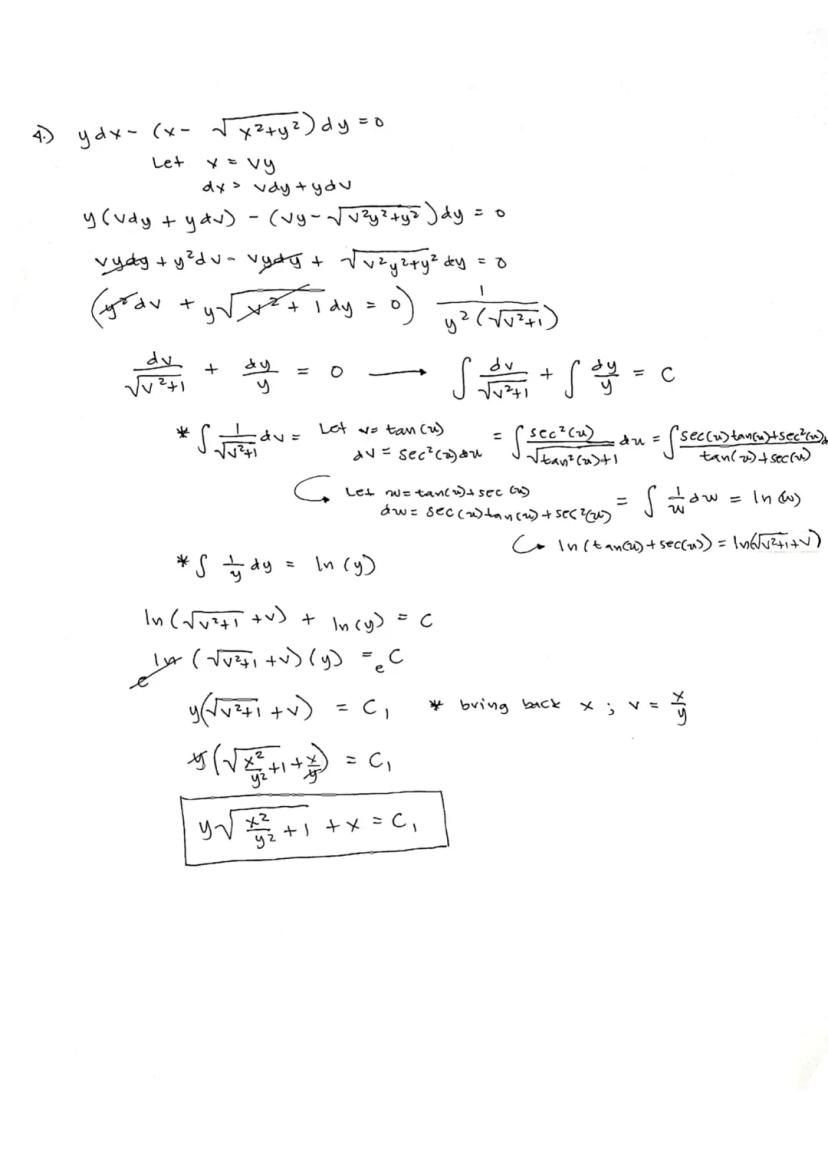
For , we substitute x = vy, transforming it to . This rearranges to .
The integral requires a trigonometric substitution. Setting v = tan(u) transforms it into , which equals . Combined with , we get .
After substituting back v = x/y and simplifying, our final solution is , which can be further simplified to .
📐 Trigonometric substitutions are powerful for integrals containing , , or . Remember that v = tan(u) works well for .
8
of 8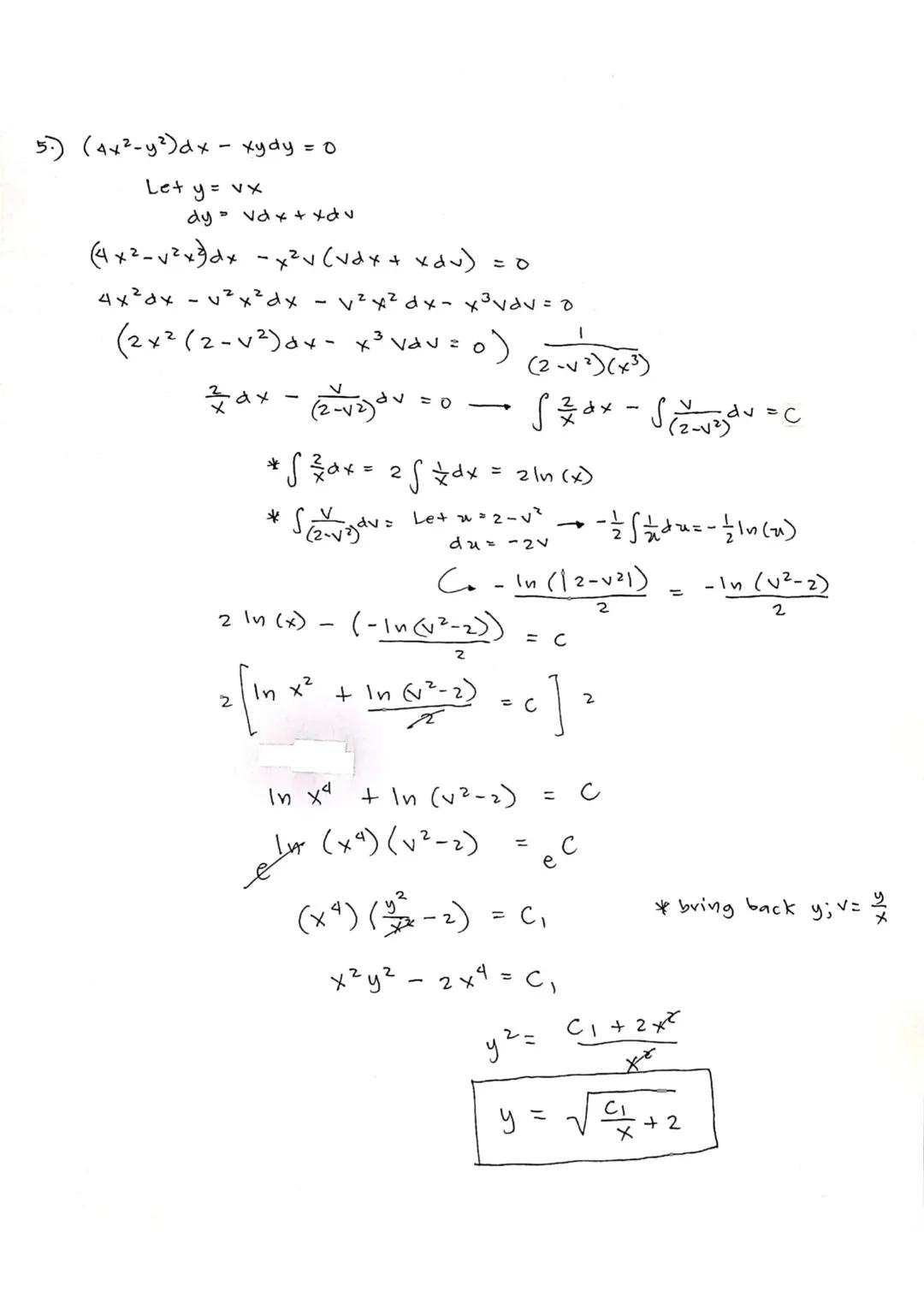
Final Example: Homogeneous Equation with Quadratics
Let's conclude with a differential equation that combines several techniques we've learned.
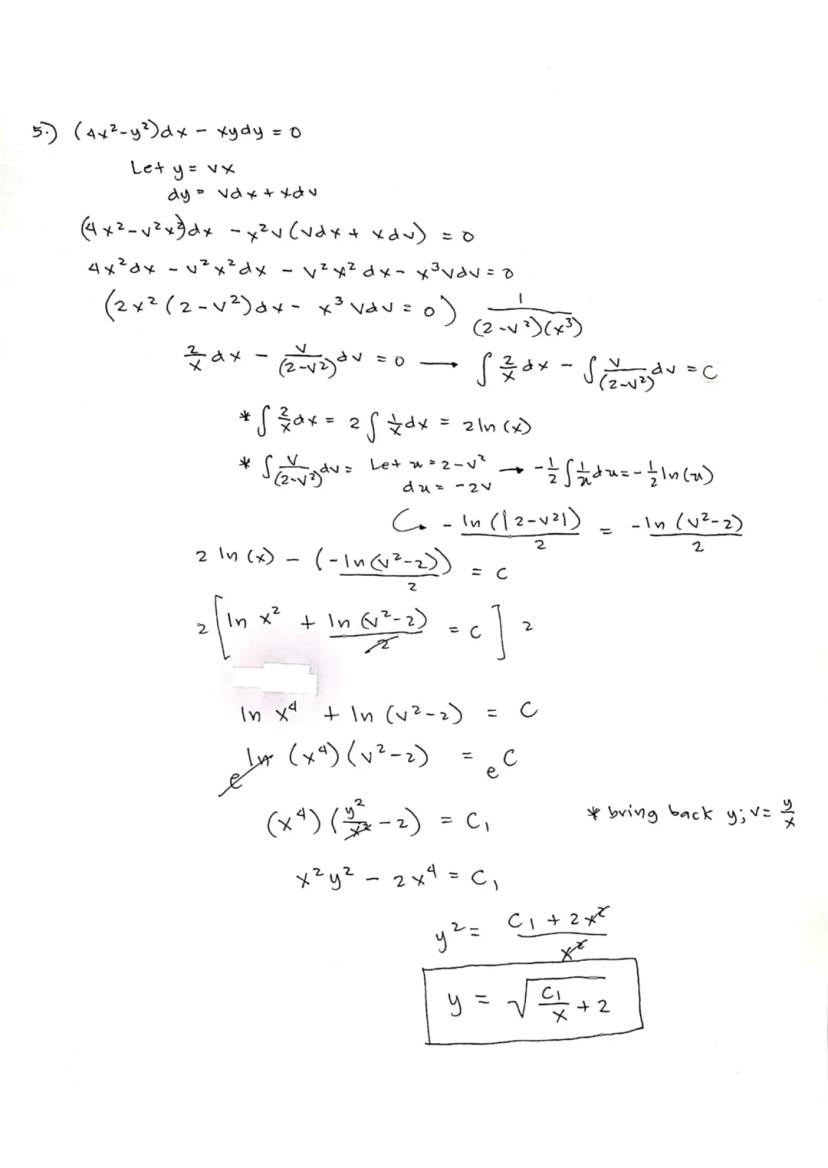
For , we use the substitution y = vx, giving dy = vdx + xdv. After substituting and collecting like terms, we get $2x^2dx - x^3vdv = 0$.
Rearranging to separate variables: . We integrate and for the other term, we use substitution u = 2-v² to get .
Combining results and using logarithm properties leads to , which simplifies to .
Solving for y gives us the explicit solution , showing how our homogeneous equation approach leads to a clear final answer.
🧩 When the final form involves y², you can often get an explicit solution by taking the square root of both sides. Just remember to consider both positive and negative solutions if needed.
We thought you’d never ask...
What is the Knowunity AI companion?
Our AI companion is specifically built for the needs of students. Based on the millions of content pieces we have on the platform we can provide truly meaningful and relevant answers to students. But its not only about answers, the companion is even more about guiding students through their daily learning challenges, with personalised study plans, quizzes or content pieces in the chat and 100% personalisation based on the students skills and developments.
Where can I download the Knowunity app?
You can download the app in the Google Play Store and in the Apple App Store.
Is Knowunity really free of charge?
That's right! Enjoy free access to study content, connect with fellow students, and get instant help – all at your fingertips.
Similar Content
Most popular content in AP Calculus AB/BC
7AP Calculus AB/BCContinuity and One-Sided Limits
Notes on the topic
552
AP Calculus AB/BCDerivative and Integral Review
Concise review for derivatives and integrals in calculus. Includes derivative rules (+ examples) and basic strategies for taking integrals in the first level of calculus (+ examples).
693
AP Calculus AB/BCAP Calculus AB | Integration using U-Substitution (Indefinite Integrals)
This covers how to integrate using the u-substitution method for indefinite integrals.
1012
AP Calculus AB/BCAB Review Integrals, Area, and FTC
Review of the topics
390
AP Calculus AB/BCRelated Rates
Notes on the topic
774
AP Calculus AB/BCAP CALC AB UNIT 4
Understanding the concept of derivative in context, including units, position, velocity, acceleration, related rates, and local linearity. L'HoSpital's Rule also explained.
College1697
AP Calculus AB/BCAP Calculus AB Answer Key
Answer Key
2752
Most popular content
9O
 AP US History
Origins and Dynamics of the Columbian Exchange
Analyze the ecological and economic motivations behind the initial transfer of goods, people, and diseases between the Old and New Worlds.
9th3,1280
I
AP US HistoryIntroduction to Early Cultural Interactions
Analyze the initial social and religious encounters between Europeans, Africans, and Indigenous peoples in the colonial Americas.
9th2,7730
O
 AP World History
Origins of Ancient River Civilizations
Analyze the environmental factors and technological innovations that led to the rise of early states in Mesopotamia, Egypt, and the Indus Valley.
9th3,1870
M
AP US HistoryMotivations for European Exploration
Analyze the economic, religious, and political factors that drove European powers to the Americas during the 15th and 16th centuries.
9th1,7780
F
 AP Psychology
Foundations of Ethical Guidelines in Research
Practice the core principles of the APA ethical code including informed consent, debriefing, and the role of Institutional Review Boards.
9th1,3360
I
AP US HistoryIntroduction to Native American Societies
Examine the diverse social, political, and economic structures of North American indigenous groups prior to European contact.
9th1,1100
I
 AP Biology
Introduction to Biological Elements of Life
Practice identifying the essential elements including carbon, nitrogen, phosphorus, and sulfur that compose biological macromolecules.
9th1,7390
I
AP US HistoryIntroduction to the Spanish Encomienda System
Explore the fundamental economic and social structures of the Spanish colonial system, focusing on the encomienda and the casta social hierarchy.
9th8890
O
AP World HistoryOrigins and Continuity of the Byzantine Empire
Analyze the political and cultural transitions from the Roman Empire to the Byzantine Empire, focusing on the reign of Justinian I and his code.
9th1,6320
Can't find what you're looking for? Explore other subjects.
Students love us — and so will you.
4.6/5App Store
4.7/5Google Play
The app is very easy to use and well designed. I have found everything I was looking for so far and have been able to learn a lot from the presentations! I will definitely use the app for a class assignment! And of course it also helps a lot as an inspiration.
Stefan SiOS user
This app is really great. There are so many study notes and help [...]. My problem subject is French, for example, and the app has so many options for help. Thanks to this app, I have improved my French. I would recommend it to anyone.
Samantha KlichAndroid user
Wow, I am really amazed. I just tried the app because I've seen it advertised many times and was absolutely stunned. This app is THE HELP you want for school and above all, it offers so many things, such as workouts and fact sheets, which have been VERY helpful to me personally.
AnnaiOS user
AP Calculus AB/BC30 views·Updated Jun 6, 2026·8 pagesSolve Variable Separable and Homogeneous Differential Equations - First Order Problems
Benjamin Arguelles@benjaminarguelles_ysur
Differential equations are mathematical tools that describe how quantities change in relation to each other. These equations appear everywhere in science and engineering, from modeling population growth to describing the motion of objects. In this summary, we'll explore two main...
1
of 8
Sign up to see the content. It's free!
- Access to all documents
- Improve your grades
- Join milions of students
Variable Separable & Homogeneous Equations
When solving differential equations, we often need to transform complex equations into simpler forms. One powerful approach involves substitution methods.
For homogeneous equations like , we can use the substitution y = vx (where v is a new variable). This transforms our equation by replacing y with vx and dy with vdx + xdv. Through careful algebraic manipulation, we separate the variables v and x.
After separating, we can integrate both sides of the equation. The solution often takes the form of logarithmic expressions that can be simplified using properties of logarithms. Eventually, we substitute back to find the relationship between x and y.
💡 When you see terms with similar degrees (like x²y' and x²), try the substitution y = vx. This often turns messy equations into manageable ones!
2
of 8Sign up to see the content. It's free!
- Access to all documents
- Improve your grades
- Join milions of students
Separating Variables: Step-by-Step Examples
Separable differential equations let us move all terms with one variable to one side, and all terms with the other variable to the other side. Let's see how this works!
For equations like $3x^2cot y dx - csc^2y dy = 0\frac{3x^2}{x^3+1}dx = \frac{csc^2y}{coty}dy$. Then integrate both sides and simplify using substitution techniques when helpful.
The second example, , follows a similar approach. Rearranging gives . When integrating, recognize standard forms like and .
⚡ Look for patterns in integrals! Expressions like and appear frequently and have standard solutions.
3
of 8Sign up to see the content. It's free!
- Access to all documents
- Improve your grades
- Join milions of students
More Separable Equation Examples
Tackling complex differential equations requires patience and strategic substitutions. Let's continue with more challenging examples.
In the equation , our first step is rearranging to separate variables: . We then integrate each term separately. For integrals like , substituting transforms it into a simpler form.
The equation requires similar separation techniques. After dividing by , we get . When integrating , integration by parts helps us handle the product of y and .
After solving both sides, we combine the results and solve for the relationship between x and y, often yielding implicit solutions that can't be directly expressed as y = f(x).
🔍 When integrating rational expressions like , try partial fraction decomposition to break it into simpler terms.
4
of 8Sign up to see the content. It's free!
- Access to all documents
- Improve your grades
- Join milions of students
Solving Differential Equations with Partial Fractions
Sometimes differential equations require specific algebraic techniques to solve efficiently. Let's examine a classic case.
For the equation , notice both terms have similar forms. We can rewrite them using partial fraction decomposition: and similarly for the y-term.
After decomposing, we integrate both sides: . These integrate to logarithmic expressions: .
Using logarithm properties, we can simplify to: . After exponentiation and algebraic manipulation, we arrive at the elegant solution , which we can solve for y.
💫 Many differential equations yield solutions with a form of . This pattern appears frequently, so learn to recognize it!
5
of 8Sign up to see the content. It's free!
- Access to all documents
- Improve your grades
- Join milions of students
Homogeneous Differential Equations
Homogeneous differential equations have a special property: when you replace x with tx and y with ty, the equation remains the same except for a power of t. The substitution y = vx is our key strategy here.
For , we substitute x = vy, which means dx = vdy + ydv. After substitution and rearranging, we get .
Integrating both sides: . We simplify using logarithm properties, eventually getting . Substituting back v = x/y gives us the final solution $3xy^2-y^3 = C_1$.
The beauty of this method is how it transforms a complex equation into a separable one, making it much easier to solve step by step.
🌟 To check if an equation is homogeneous, see if all terms have the same degree when counting x and y together. For example, xy and x² + y² are both degree 2.
6
of 8Sign up to see the content. It's free!
- Access to all documents
- Improve your grades
- Join milions of students
More Homogeneous Equations
Homogeneous equations can look intimidating at first, but our substitution method makes them manageable. Let's tackle a few more examples.
For , we use the substitution y = vx, which gives dy = vdx + xdv. After substituting and simplifying, we get . Integrating both sides yields . Substituting back v = y/x gives us .
For , we use x = vy, leading to . After integration and substitution, our solution becomes .
These solutions may look complex, but they follow from the systematic application of our substitution method and careful integration. The pattern becomes clearer with practice.
🔮 When solving homogeneous equations, after substituting y = vx, watch for terms that can be factored out, making the separation of variables possible.
7
of 8Sign up to see the content. It's free!
- Access to all documents
- Improve your grades
- Join milions of students
Tackling Complex Homogeneous Equations
Even the most complicated-looking homogeneous equations yield to our substitution approach. Let's see how to handle one with square roots.
For , we substitute x = vy, transforming it to . This rearranges to .
The integral requires a trigonometric substitution. Setting v = tan(u) transforms it into , which equals . Combined with , we get .
After substituting back v = x/y and simplifying, our final solution is , which can be further simplified to .
📐 Trigonometric substitutions are powerful for integrals containing , , or . Remember that v = tan(u) works well for .
8
of 8Sign up to see the content. It's free!
- Access to all documents
- Improve your grades
- Join milions of students
Final Example: Homogeneous Equation with Quadratics
Let's conclude with a differential equation that combines several techniques we've learned.
For , we use the substitution y = vx, giving dy = vdx + xdv. After substituting and collecting like terms, we get $2x^2dx - x^3vdv = 0$.
Rearranging to separate variables: . We integrate and for the other term, we use substitution u = 2-v² to get .
Combining results and using logarithm properties leads to , which simplifies to .
Solving for y gives us the explicit solution , showing how our homogeneous equation approach leads to a clear final answer.
🧩 When the final form involves y², you can often get an explicit solution by taking the square root of both sides. Just remember to consider both positive and negative solutions if needed.
We thought you’d never ask...
What is the Knowunity AI companion?
Our AI companion is specifically built for the needs of students. Based on the millions of content pieces we have on the platform we can provide truly meaningful and relevant answers to students. But its not only about answers, the companion is even more about guiding students through their daily learning challenges, with personalised study plans, quizzes or content pieces in the chat and 100% personalisation based on the students skills and developments.
Where can I download the Knowunity app?
You can download the app in the Google Play Store and in the Apple App Store.
Is Knowunity really free of charge?
That's right! Enjoy free access to study content, connect with fellow students, and get instant help – all at your fingertips.
Similar Content
Most popular content in AP Calculus AB/BC
7AP Calculus AB/BCContinuity and One-Sided Limits
Notes on the topic
552
AP Calculus AB/BCDerivative and Integral Review
Concise review for derivatives and integrals in calculus. Includes derivative rules (+ examples) and basic strategies for taking integrals in the first level of calculus (+ examples).
693
AP Calculus AB/BCAP Calculus AB | Integration using U-Substitution (Indefinite Integrals)
This covers how to integrate using the u-substitution method for indefinite integrals.
1012
AP Calculus AB/BCAB Review Integrals, Area, and FTC
Review of the topics
390
AP Calculus AB/BCRelated Rates
Notes on the topic
774
AP Calculus AB/BCAP CALC AB UNIT 4
Understanding the concept of derivative in context, including units, position, velocity, acceleration, related rates, and local linearity. L'HoSpital's Rule also explained.
College1697
AP Calculus AB/BCAP Calculus AB Answer Key
Answer Key
2752
Most popular content
9O
AP US HistoryOrigins and Dynamics of the Columbian Exchange
Analyze the ecological and economic motivations behind the initial transfer of goods, people, and diseases between the Old and New Worlds.
9th3,1280
I
AP US HistoryIntroduction to Early Cultural Interactions
Analyze the initial social and religious encounters between Europeans, Africans, and Indigenous peoples in the colonial Americas.
9th2,7730
O
AP World HistoryOrigins of Ancient River Civilizations
Analyze the environmental factors and technological innovations that led to the rise of early states in Mesopotamia, Egypt, and the Indus Valley.
9th3,1870
M
AP US HistoryMotivations for European Exploration
Analyze the economic, religious, and political factors that drove European powers to the Americas during the 15th and 16th centuries.
9th1,7780
F
AP PsychologyFoundations of Ethical Guidelines in Research
Practice the core principles of the APA ethical code including informed consent, debriefing, and the role of Institutional Review Boards.
9th1,3360
I
AP US HistoryIntroduction to Native American Societies
Examine the diverse social, political, and economic structures of North American indigenous groups prior to European contact.
9th1,1100
I
AP BiologyIntroduction to Biological Elements of Life
Practice identifying the essential elements including carbon, nitrogen, phosphorus, and sulfur that compose biological macromolecules.
9th1,7390
I
AP US HistoryIntroduction to the Spanish Encomienda System
Explore the fundamental economic and social structures of the Spanish colonial system, focusing on the encomienda and the casta social hierarchy.
9th8890
O
AP World HistoryOrigins and Continuity of the Byzantine Empire
Analyze the political and cultural transitions from the Roman Empire to the Byzantine Empire, focusing on the reign of Justinian I and his code.
9th1,6320
Can't find what you're looking for? Explore other subjects.
Students love us — and so will you.
4.6/5App Store
4.7/5Google Play
The app is very easy to use and well designed. I have found everything I was looking for so far and have been able to learn a lot from the presentations! I will definitely use the app for a class assignment! And of course it also helps a lot as an inspiration.
Stefan SiOS user
This app is really great. There are so many study notes and help [...]. My problem subject is French, for example, and the app has so many options for help. Thanks to this app, I have improved my French. I would recommend it to anyone.
Samantha KlichAndroid user
Wow, I am really amazed. I just tried the app because I've seen it advertised many times and was absolutely stunned. This app is THE HELP you want for school and above all, it offers so many things, such as workouts and fact sheets, which have been VERY helpful to me personally.
AnnaiOS user