

Related rates in calculus is all about finding how different...
 AP Calculus AB/BC115 views·Updated Jun 11, 2026·7 pages
Understanding Related Rates in Math
1 / 7
1
of 7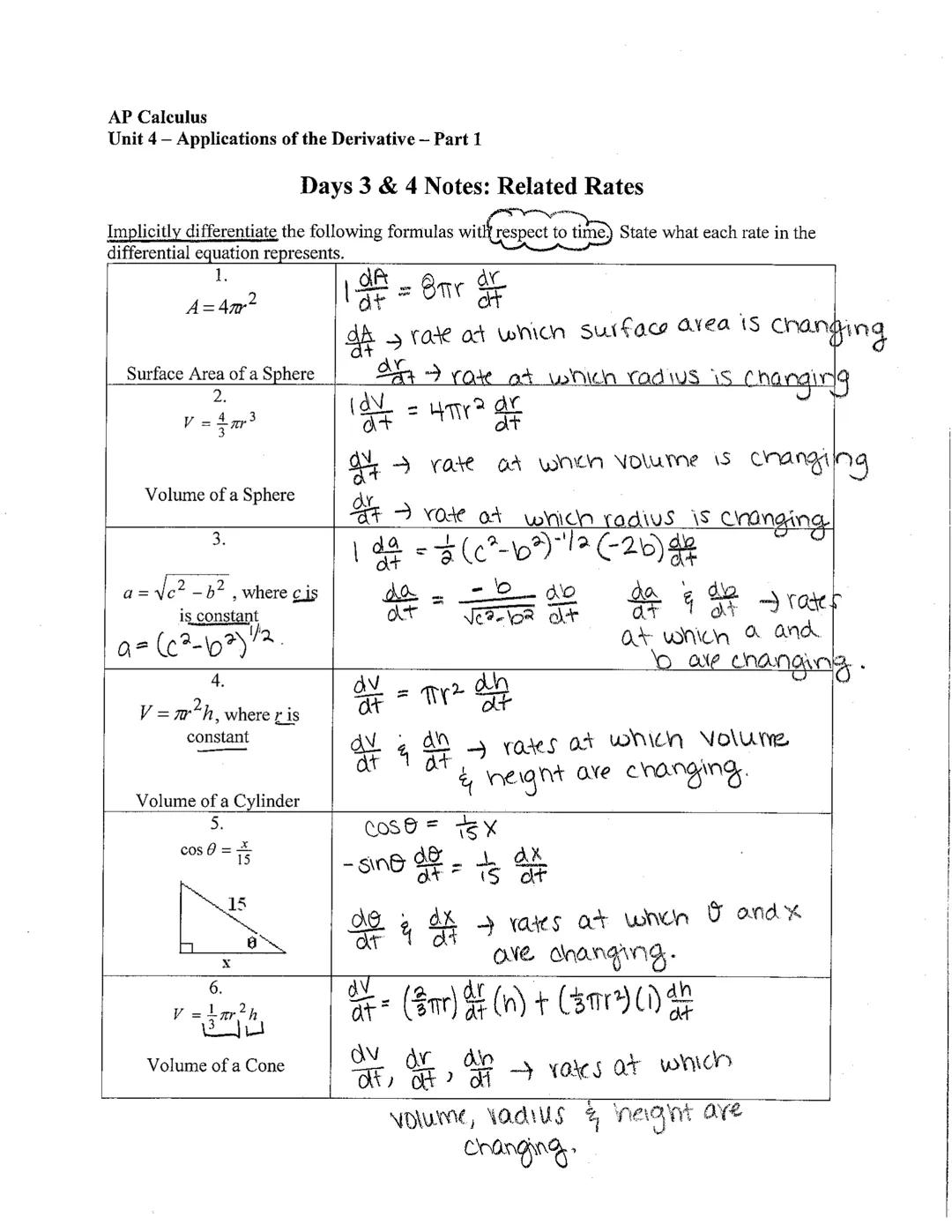
Implicit Differentiation for Related Rates
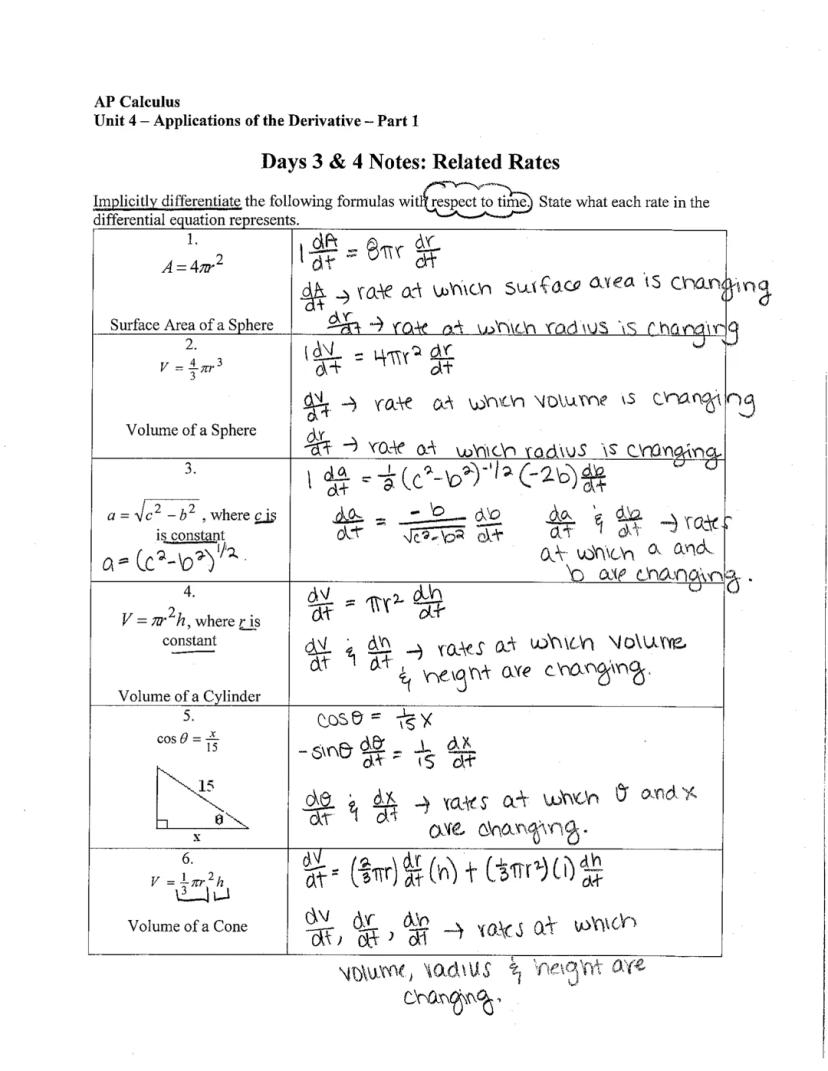
Related rates problems require us to find how one quantity changes when we know how another quantity is changing. The key is to differentiate both sides of an equation with respect to time.
When working with geometric formulas, we need to identify what each derivative represents. For example, in the sphere formula , differentiating gives us where represents the rate at which surface area is changing and is how fast the radius is changing.
Similar differentiation applies to other formulas like volume of a sphere which gives us . For more complex relationships like where is constant, we get .
Remember: Always identify what each rate represents in the physical problem - this helps connect the math to the real-world situation!
2
of 7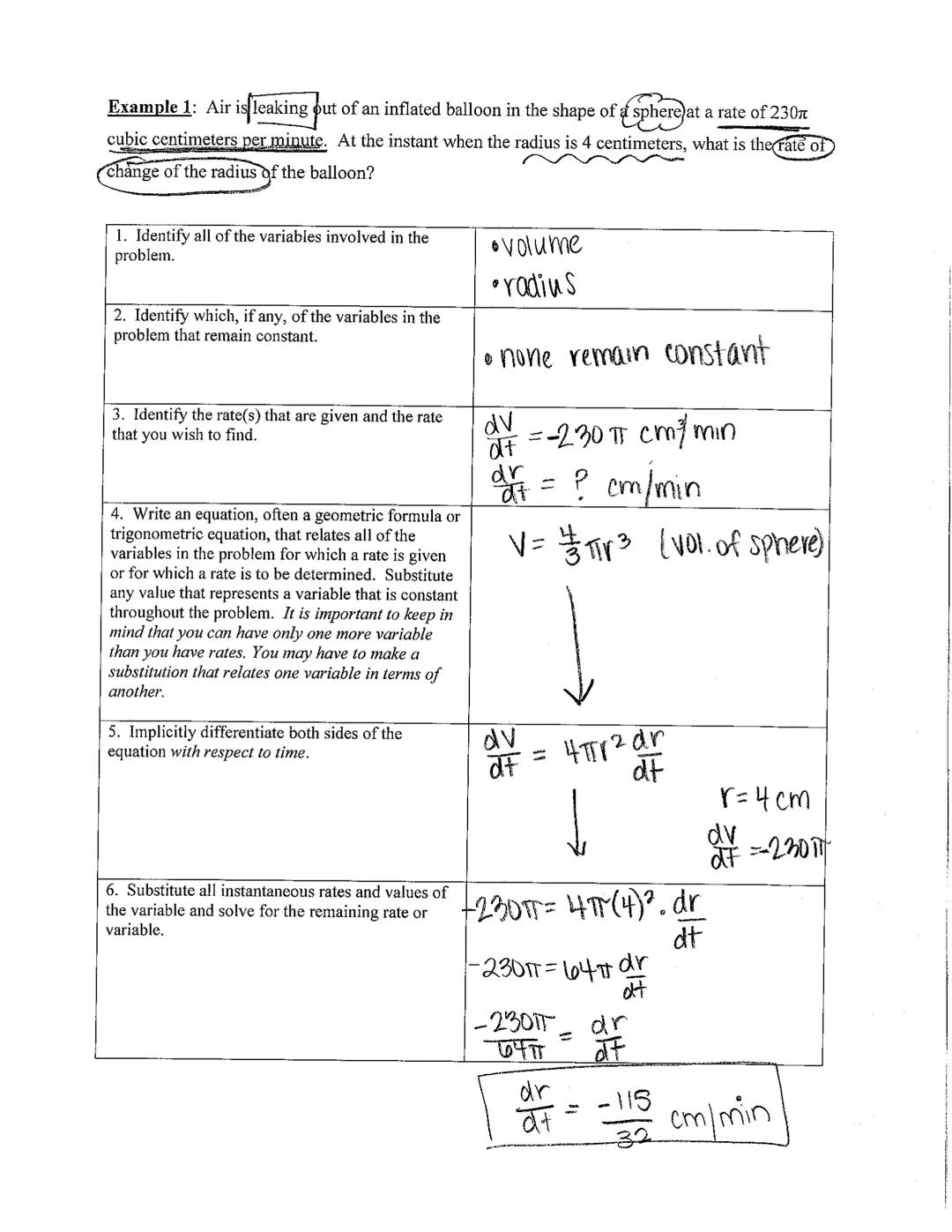
Solving Related Rates Problems
Solving related rates problems follows a consistent step-by-step approach. Let's see how this works with a deflating balloon example.
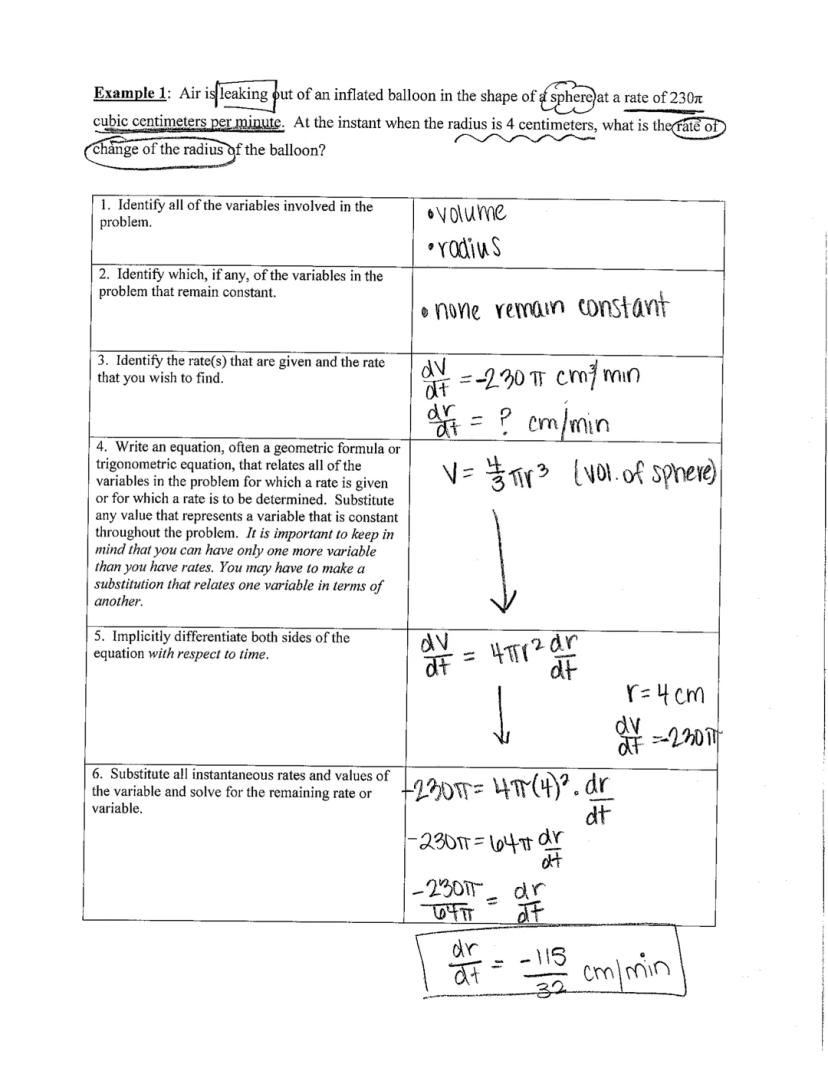
First, identify all variables and rates involved. For a sphere losing air at 230π cm³/min when the radius is 4 cm, we need to find . Start by writing an equation that connects the variables: .
Next, differentiate with respect to time to get . Then substitute what you know: where the negative sign shows the volume is decreasing.
Solving for gives us cm/min. This negative value confirms that the radius is also decreasing as the balloon deflates.
Pro Tip: Always pay attention to signs in your final answer - they tell you whether quantities are increasing or decreasing!
3
of 7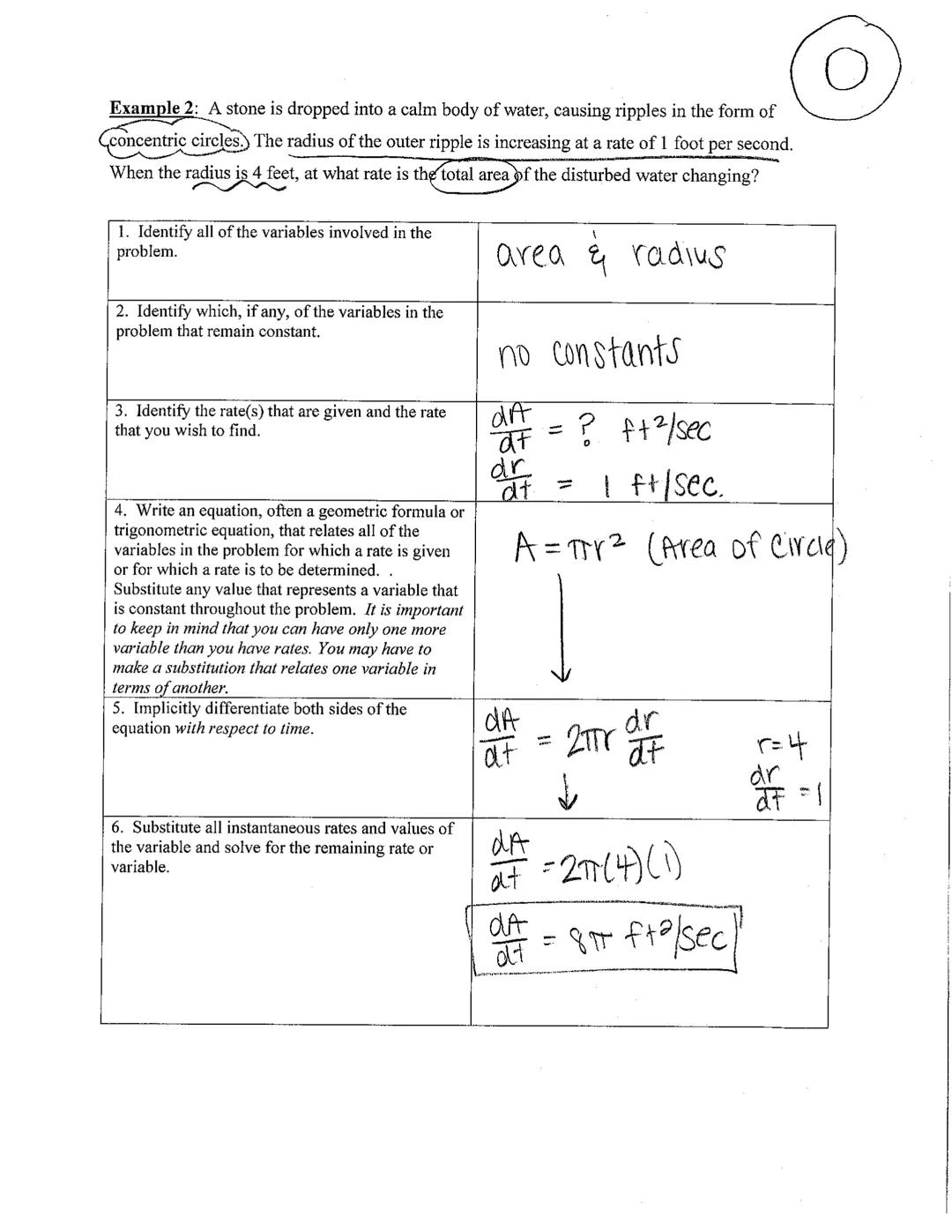
Circular Ripple Problem
When a stone drops into water, it creates expanding circular ripples. These problems connect radius and area rates of change.
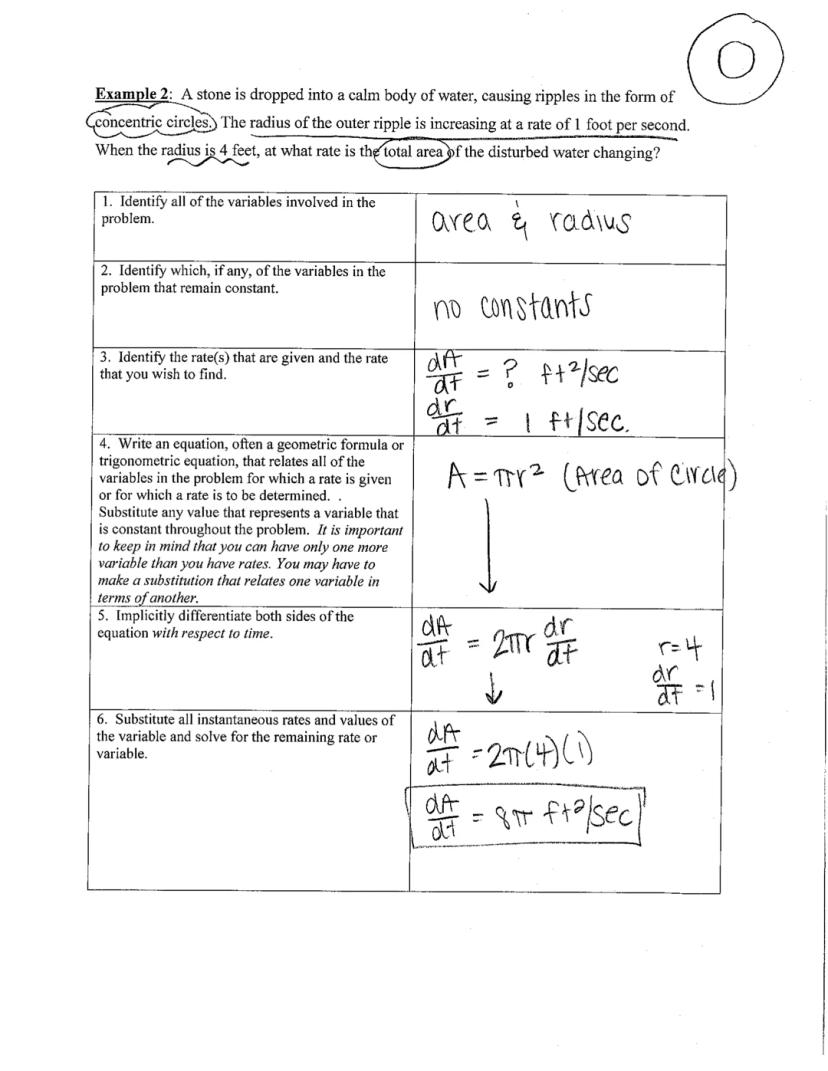
Imagine ripples with a radius increasing at 1 foot per second. When the radius reaches 4 feet, we want to find how fast the disturbed water area is changing. Since the area of a circle is , we differentiate to get .
By plugging in our known values r=4 feet and $\frac{dr}{dt}=1$ foot/second, we calculate square feet per second. This shows the area is increasing at a rate proportional to the radius.
The expanding ripple problem illustrates how the rate of area change depends on both the current radius and how fast that radius is changing. The larger the radius, the faster the area increases, even if the radius expansion rate stays constant.
Think about it: Notice how the rate of area change is much faster than the rate of radius change. This happens because area grows as the square of the radius!
4
of 7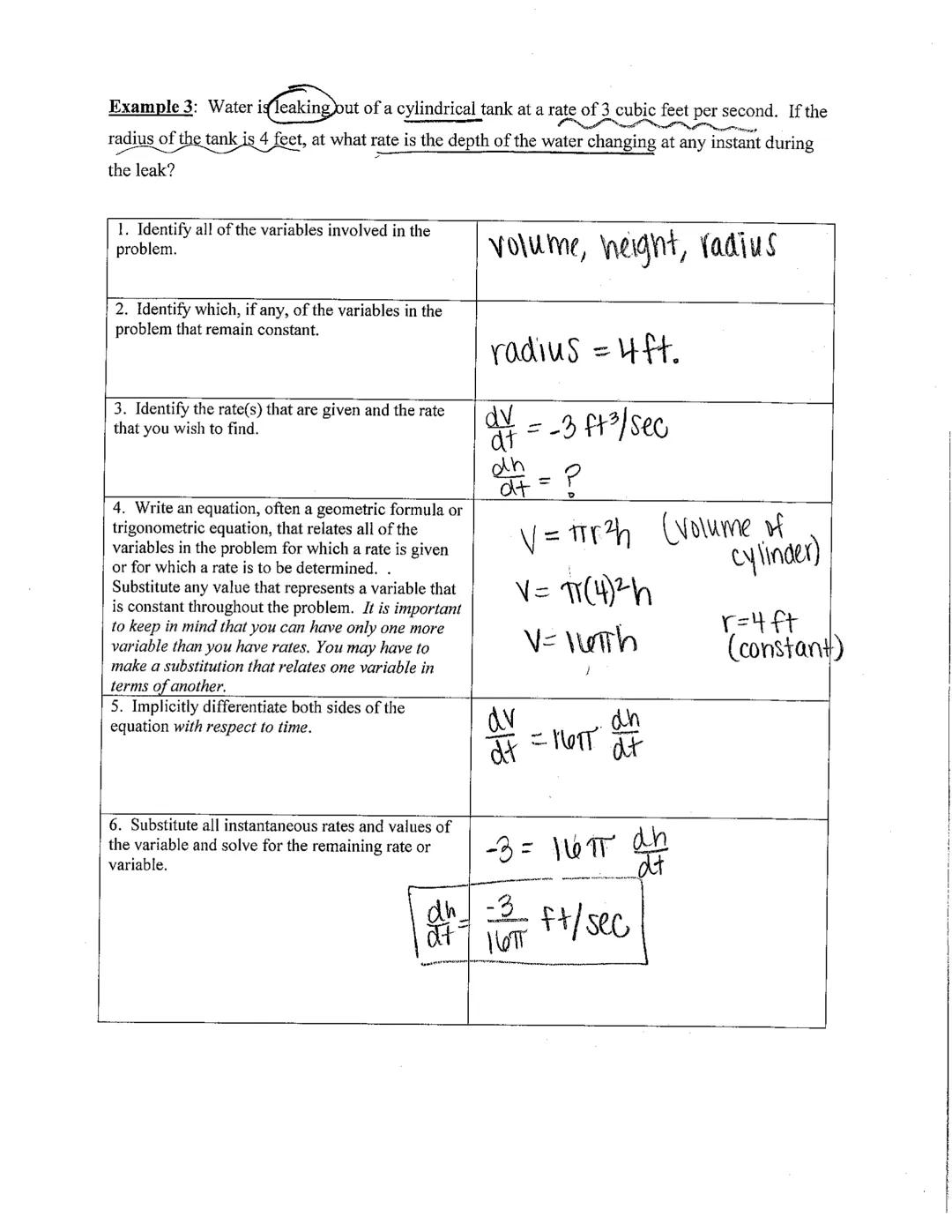
Water Leaking from a Cylinder
When dealing with cylinders, we often need to relate changes in volume to changes in height. These problems appear frequently in real-world situations like draining tanks.
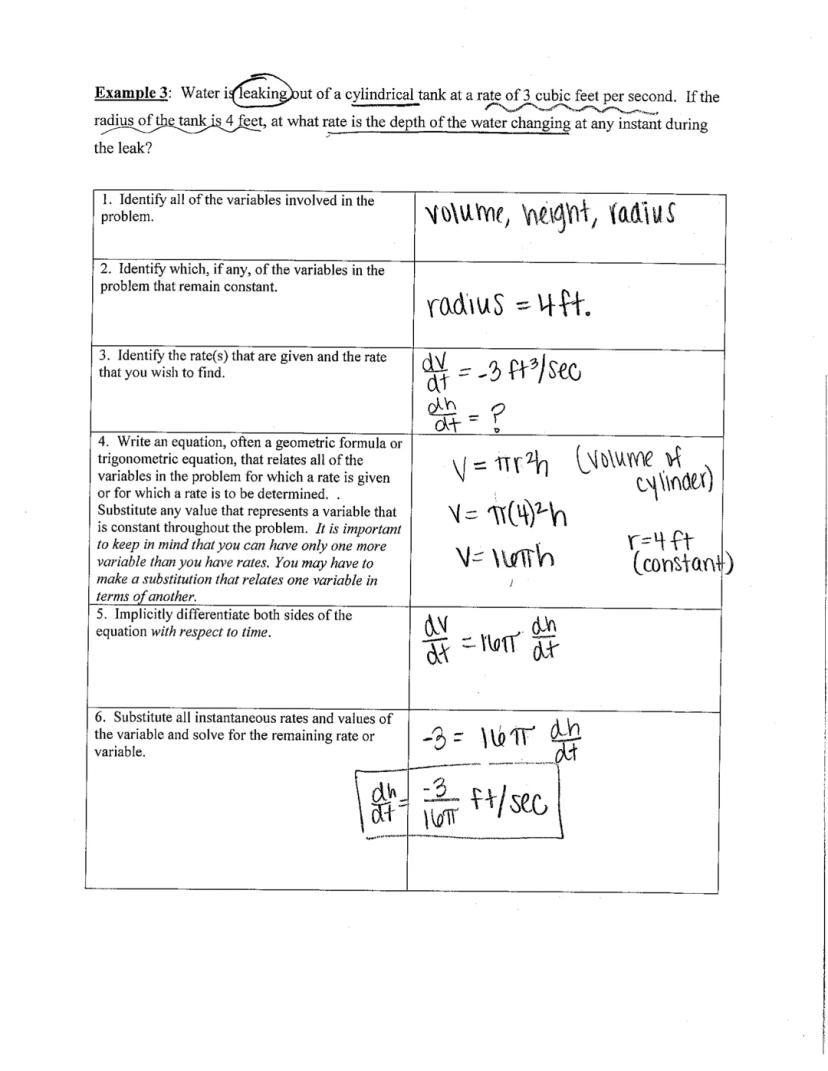
For a cylindrical tank with radius 4 feet leaking water at 3 cubic feet per second, we need to find how quickly the water level is dropping. First, we write the volume formula and substitute the constant radius: .
When we differentiate with respect to time, we get . Since water is leaking out, (negative because volume is decreasing).
Solving for the height change rate: feet per second. The negative value confirms the water level is dropping as the tank empties.
Important insight: The rate at which the height changes depends on the cross-sectional area of the container. For the same volume change, a wider container's height changes more slowly than a narrower one's!
5
of 7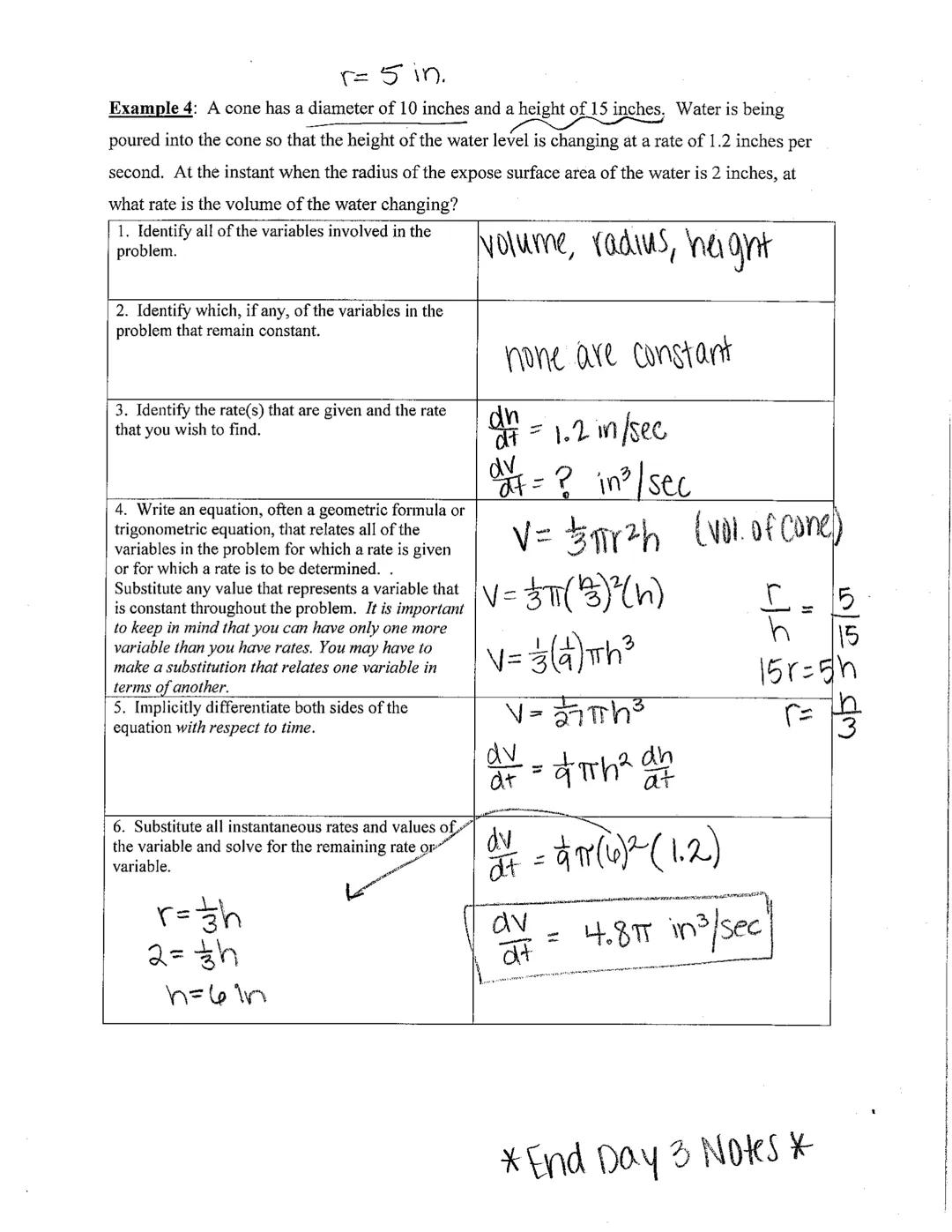
Cone Filling Problem
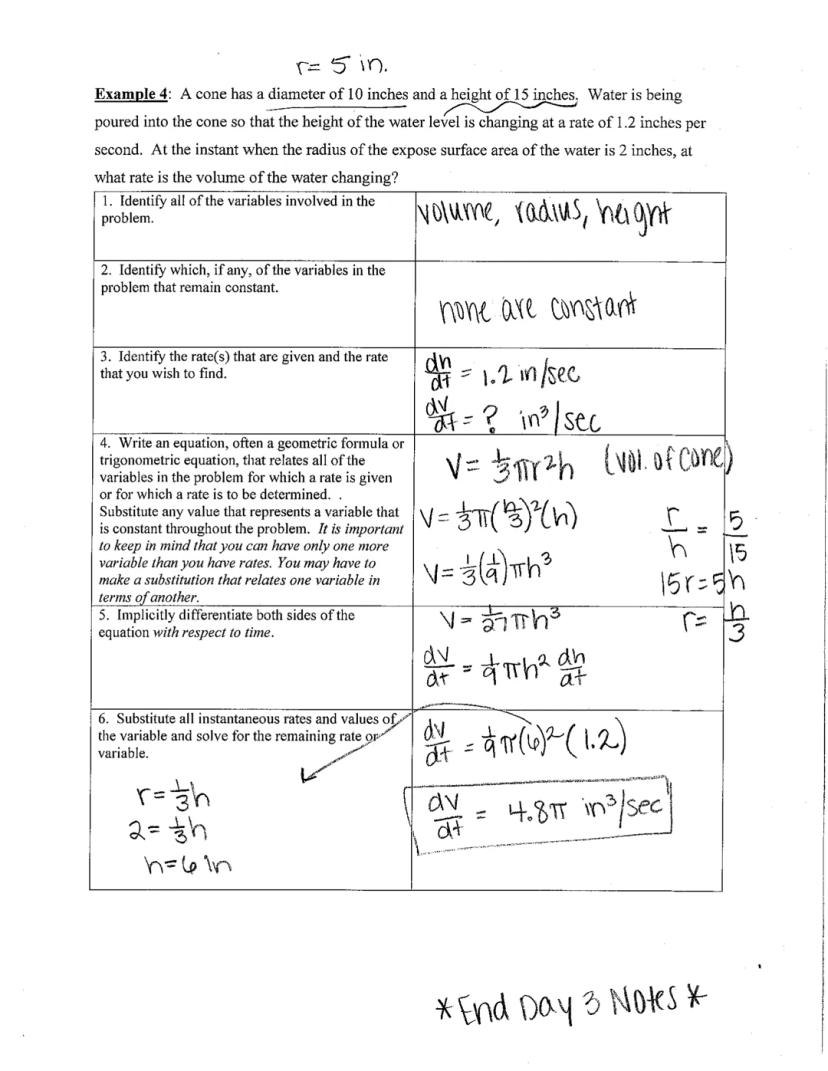
Water being poured into a cone creates a more complex related rates problem because both the radius and height of the water are changing simultaneously.
For a cone with diameter 10 inches and height 15 inches, if water is being added so the height increases at 1.2 inches per second, we need to find the volume change rate when the exposed water surface has radius 2 inches.
The key insight is using similar triangles to relate the radius of the water surface to its height: , so . When inches, the height inches.
Using the cone volume formula and substituting our relationship between and , we get cubic inches per second.
Visualization tip: Imagine watching the water level rise - the exposed surface gets wider as the water gets deeper, causing the volume to increase faster than in a cylinder!
6
of 7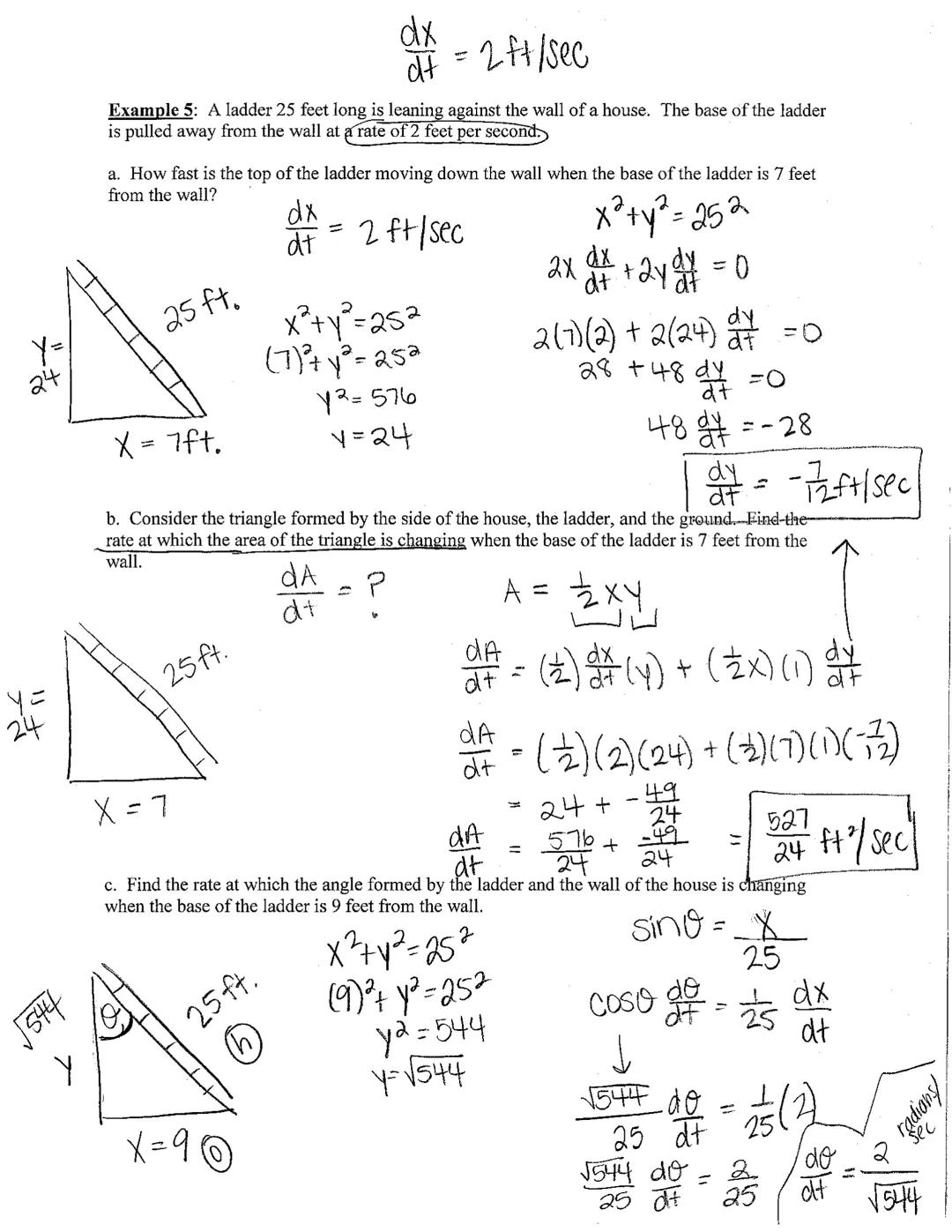
Moving Ladder Problem
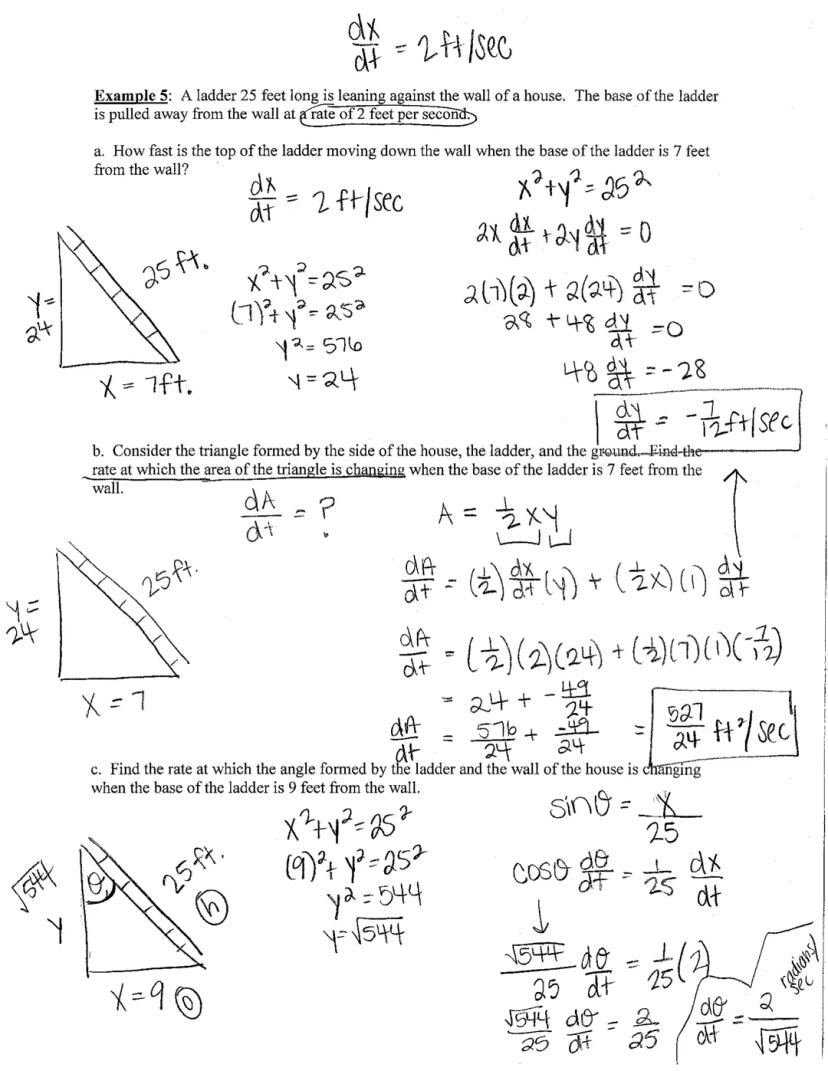
The sliding ladder problem connects linear and angular rates of change using the Pythagorean theorem and implicit differentiation.
Imagine a 25-foot ladder leaning against a wall with its base being pulled away at 2 feet per second. When the base is 7 feet from the wall, we need to find how fast the top is sliding down.
Using the Pythagorean theorem, , where is the base distance and is the height. When , we calculate . Differentiating with respect to time: $2x\frac{dx}{dt} + 2y\frac{dy}{dt} = 0$.
Substituting our values and solving for gives us feet per second. The negative sign shows the top of the ladder is moving downward.
For the triangle area change when , we use and find square feet per second. For the angle change when , we use trigonometry to find radians per second.
Real-world connection: This problem models many situations where objects move along constrained paths, like mechanical linkages in engines!
7
of 7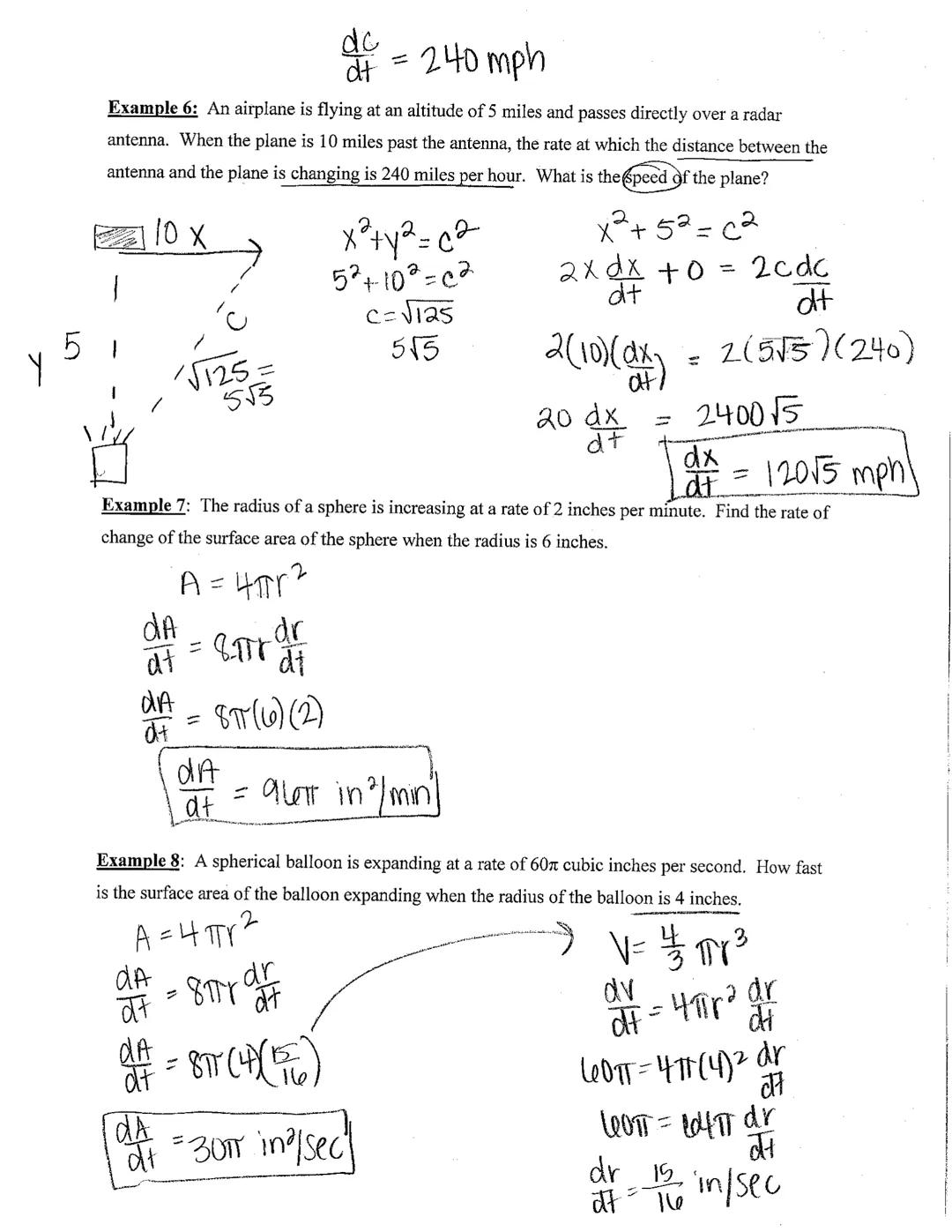
Application Problems with Spheres and Motion
Related rates problems often involve distance, motion, and changing geometric shapes like spheres.
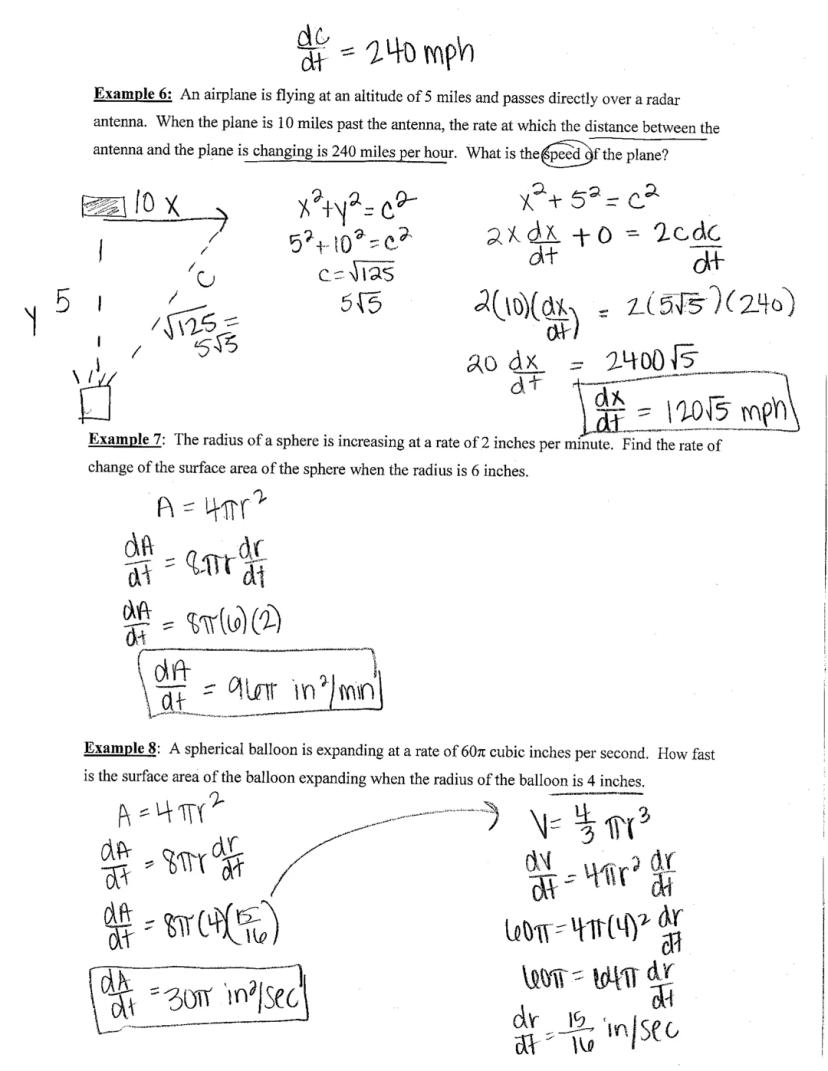
In the airplane problem, radar tracks a plane flying 5 miles high. When it's 10 miles past the antenna, the distance is changing at 240 mph. Using the Pythagorean theorem and implicit differentiation, we find the plane's speed is $120\sqrt{5}$ mph.
For a sphere with radius increasing at 2 inches per minute, we can find how fast the surface area changes when the radius is 6 inches. Using and differentiating, square inches per minute.
Similarly, for a balloon expanding at $60\pi\frac{dr}{dt} = \frac{15}{16}\frac{dA}{dt} = 30\pi$ square inches per second.
Practical application: These calculations are crucial in medical imaging, where doctors track how fast tumors grow, or in engineering, when designing expanding or contracting materials!
We thought you’d never ask...
What is the Knowunity AI companion?
Our AI companion is specifically built for the needs of students. Based on the millions of content pieces we have on the platform we can provide truly meaningful and relevant answers to students. But its not only about answers, the companion is even more about guiding students through their daily learning challenges, with personalised study plans, quizzes or content pieces in the chat and 100% personalisation based on the students skills and developments.
Where can I download the Knowunity app?
You can download the app in the Google Play Store and in the Apple App Store.
Is Knowunity really free of charge?
That's right! Enjoy free access to study content, connect with fellow students, and get instant help – all at your fingertips.
Most popular content: Related Rates
1Most popular content in AP Calculus AB/BC
7AP Calculus AB/BCContinuity and One-Sided Limits
Notes on the topic
552
AP Calculus AB/BCDerivative and Integral Review
Concise review for derivatives and integrals in calculus. Includes derivative rules (+ examples) and basic strategies for taking integrals in the first level of calculus (+ examples).
693
AP Calculus AB/BCAP Calculus AB | Integration using U-Substitution (Indefinite Integrals)
This covers how to integrate using the u-substitution method for indefinite integrals.
1012
AP Calculus AB/BCAB Review Integrals, Area, and FTC
Review of the topics
390
AP Calculus AB/BCRelated Rates
Notes on the topic
774
AP Calculus AB/BCAP CALC AB UNIT 4
Understanding the concept of derivative in context, including units, position, velocity, acceleration, related rates, and local linearity. L'HoSpital's Rule also explained.
College1697
AP Calculus AB/BCAP Calculus AB Answer Key
Answer Key
2752
Most popular content
9O
 AP US History
Origins and Dynamics of the Columbian Exchange
Analyze the ecological and economic motivations behind the initial transfer of goods, people, and diseases between the Old and New Worlds.
9th3,1280
I
AP US HistoryIntroduction to Early Cultural Interactions
Analyze the initial social and religious encounters between Europeans, Africans, and Indigenous peoples in the colonial Americas.
9th2,7730
O
 AP World History
Origins of Ancient River Civilizations
Analyze the environmental factors and technological innovations that led to the rise of early states in Mesopotamia, Egypt, and the Indus Valley.
9th3,1870
M
AP US HistoryMotivations for European Exploration
Analyze the economic, religious, and political factors that drove European powers to the Americas during the 15th and 16th centuries.
9th1,7780
F
 AP Psychology
Foundations of Ethical Guidelines in Research
Practice the core principles of the APA ethical code including informed consent, debriefing, and the role of Institutional Review Boards.
9th1,3360
I
AP US HistoryIntroduction to Native American Societies
Examine the diverse social, political, and economic structures of North American indigenous groups prior to European contact.
9th1,1100
I
 AP Biology
Introduction to Biological Elements of Life
Practice identifying the essential elements including carbon, nitrogen, phosphorus, and sulfur that compose biological macromolecules.
9th1,7390
I
AP US HistoryIntroduction to the Spanish Encomienda System
Explore the fundamental economic and social structures of the Spanish colonial system, focusing on the encomienda and the casta social hierarchy.
9th8890
O
AP World HistoryOrigins and Continuity of the Byzantine Empire
Analyze the political and cultural transitions from the Roman Empire to the Byzantine Empire, focusing on the reign of Justinian I and his code.
9th1,6320
Can't find what you're looking for? Explore other subjects.
Students love us — and so will you.
4.6/5App Store
4.7/5Google Play
The app is very easy to use and well designed. I have found everything I was looking for so far and have been able to learn a lot from the presentations! I will definitely use the app for a class assignment! And of course it also helps a lot as an inspiration.
Stefan SiOS user
This app is really great. There are so many study notes and help [...]. My problem subject is French, for example, and the app has so many options for help. Thanks to this app, I have improved my French. I would recommend it to anyone.
Samantha KlichAndroid user
Wow, I am really amazed. I just tried the app because I've seen it advertised many times and was absolutely stunned. This app is THE HELP you want for school and above all, it offers so many things, such as workouts and fact sheets, which have been VERY helpful to me personally.
AnnaiOS user
AP Calculus AB/BC115 views·Updated Jun 11, 2026·7 pagesUnderstanding Related Rates in Math
Related rates in calculus is all about finding how different quantities change in relation to each other over time. This unit explores how to use implicit differentiation to solve real-world problems where multiple variables are changing simultaneously.
1
of 7
Sign up to see the content. It's free!
- Access to all documents
- Improve your grades
- Join milions of students
Implicit Differentiation for Related Rates
Related rates problems require us to find how one quantity changes when we know how another quantity is changing. The key is to differentiate both sides of an equation with respect to time.
When working with geometric formulas, we need to identify what each derivative represents. For example, in the sphere formula , differentiating gives us where represents the rate at which surface area is changing and is how fast the radius is changing.
Similar differentiation applies to other formulas like volume of a sphere which gives us . For more complex relationships like where is constant, we get .
Remember: Always identify what each rate represents in the physical problem - this helps connect the math to the real-world situation!
2
of 7Sign up to see the content. It's free!
- Access to all documents
- Improve your grades
- Join milions of students
Solving Related Rates Problems
Solving related rates problems follows a consistent step-by-step approach. Let's see how this works with a deflating balloon example.
First, identify all variables and rates involved. For a sphere losing air at 230π cm³/min when the radius is 4 cm, we need to find . Start by writing an equation that connects the variables: .
Next, differentiate with respect to time to get . Then substitute what you know: where the negative sign shows the volume is decreasing.
Solving for gives us cm/min. This negative value confirms that the radius is also decreasing as the balloon deflates.
Pro Tip: Always pay attention to signs in your final answer - they tell you whether quantities are increasing or decreasing!
3
of 7Sign up to see the content. It's free!
- Access to all documents
- Improve your grades
- Join milions of students
Circular Ripple Problem
When a stone drops into water, it creates expanding circular ripples. These problems connect radius and area rates of change.
Imagine ripples with a radius increasing at 1 foot per second. When the radius reaches 4 feet, we want to find how fast the disturbed water area is changing. Since the area of a circle is , we differentiate to get .
By plugging in our known values r=4 feet and $\frac{dr}{dt}=1$ foot/second, we calculate square feet per second. This shows the area is increasing at a rate proportional to the radius.
The expanding ripple problem illustrates how the rate of area change depends on both the current radius and how fast that radius is changing. The larger the radius, the faster the area increases, even if the radius expansion rate stays constant.
Think about it: Notice how the rate of area change is much faster than the rate of radius change. This happens because area grows as the square of the radius!
4
of 7Sign up to see the content. It's free!
- Access to all documents
- Improve your grades
- Join milions of students
Water Leaking from a Cylinder
When dealing with cylinders, we often need to relate changes in volume to changes in height. These problems appear frequently in real-world situations like draining tanks.
For a cylindrical tank with radius 4 feet leaking water at 3 cubic feet per second, we need to find how quickly the water level is dropping. First, we write the volume formula and substitute the constant radius: .
When we differentiate with respect to time, we get . Since water is leaking out, (negative because volume is decreasing).
Solving for the height change rate: feet per second. The negative value confirms the water level is dropping as the tank empties.
Important insight: The rate at which the height changes depends on the cross-sectional area of the container. For the same volume change, a wider container's height changes more slowly than a narrower one's!
5
of 7Sign up to see the content. It's free!
- Access to all documents
- Improve your grades
- Join milions of students
Cone Filling Problem
Water being poured into a cone creates a more complex related rates problem because both the radius and height of the water are changing simultaneously.
For a cone with diameter 10 inches and height 15 inches, if water is being added so the height increases at 1.2 inches per second, we need to find the volume change rate when the exposed water surface has radius 2 inches.
The key insight is using similar triangles to relate the radius of the water surface to its height: , so . When inches, the height inches.
Using the cone volume formula and substituting our relationship between and , we get cubic inches per second.
Visualization tip: Imagine watching the water level rise - the exposed surface gets wider as the water gets deeper, causing the volume to increase faster than in a cylinder!
6
of 7Sign up to see the content. It's free!
- Access to all documents
- Improve your grades
- Join milions of students
Moving Ladder Problem
The sliding ladder problem connects linear and angular rates of change using the Pythagorean theorem and implicit differentiation.
Imagine a 25-foot ladder leaning against a wall with its base being pulled away at 2 feet per second. When the base is 7 feet from the wall, we need to find how fast the top is sliding down.
Using the Pythagorean theorem, , where is the base distance and is the height. When , we calculate . Differentiating with respect to time: $2x\frac{dx}{dt} + 2y\frac{dy}{dt} = 0$.
Substituting our values and solving for gives us feet per second. The negative sign shows the top of the ladder is moving downward.
For the triangle area change when , we use and find square feet per second. For the angle change when , we use trigonometry to find radians per second.
Real-world connection: This problem models many situations where objects move along constrained paths, like mechanical linkages in engines!
7
of 7Sign up to see the content. It's free!
- Access to all documents
- Improve your grades
- Join milions of students
Application Problems with Spheres and Motion
Related rates problems often involve distance, motion, and changing geometric shapes like spheres.
In the airplane problem, radar tracks a plane flying 5 miles high. When it's 10 miles past the antenna, the distance is changing at 240 mph. Using the Pythagorean theorem and implicit differentiation, we find the plane's speed is $120\sqrt{5}$ mph.
For a sphere with radius increasing at 2 inches per minute, we can find how fast the surface area changes when the radius is 6 inches. Using and differentiating, square inches per minute.
Similarly, for a balloon expanding at $60\pi\frac{dr}{dt} = \frac{15}{16}\frac{dA}{dt} = 30\pi$ square inches per second.
Practical application: These calculations are crucial in medical imaging, where doctors track how fast tumors grow, or in engineering, when designing expanding or contracting materials!
We thought you’d never ask...
What is the Knowunity AI companion?
Our AI companion is specifically built for the needs of students. Based on the millions of content pieces we have on the platform we can provide truly meaningful and relevant answers to students. But its not only about answers, the companion is even more about guiding students through their daily learning challenges, with personalised study plans, quizzes or content pieces in the chat and 100% personalisation based on the students skills and developments.
Where can I download the Knowunity app?
You can download the app in the Google Play Store and in the Apple App Store.
Is Knowunity really free of charge?
That's right! Enjoy free access to study content, connect with fellow students, and get instant help – all at your fingertips.
Most popular content: Related Rates
1Most popular content in AP Calculus AB/BC
7AP Calculus AB/BCContinuity and One-Sided Limits
Notes on the topic
552
AP Calculus AB/BCDerivative and Integral Review
Concise review for derivatives and integrals in calculus. Includes derivative rules (+ examples) and basic strategies for taking integrals in the first level of calculus (+ examples).
693
AP Calculus AB/BCAP Calculus AB | Integration using U-Substitution (Indefinite Integrals)
This covers how to integrate using the u-substitution method for indefinite integrals.
1012
AP Calculus AB/BCAB Review Integrals, Area, and FTC
Review of the topics
390
AP Calculus AB/BCRelated Rates
Notes on the topic
774
AP Calculus AB/BCAP CALC AB UNIT 4
Understanding the concept of derivative in context, including units, position, velocity, acceleration, related rates, and local linearity. L'HoSpital's Rule also explained.
College1697
AP Calculus AB/BCAP Calculus AB Answer Key
Answer Key
2752
Most popular content
9O
AP US HistoryOrigins and Dynamics of the Columbian Exchange
Analyze the ecological and economic motivations behind the initial transfer of goods, people, and diseases between the Old and New Worlds.
9th3,1280
I
AP US HistoryIntroduction to Early Cultural Interactions
Analyze the initial social and religious encounters between Europeans, Africans, and Indigenous peoples in the colonial Americas.
9th2,7730
O
AP World HistoryOrigins of Ancient River Civilizations
Analyze the environmental factors and technological innovations that led to the rise of early states in Mesopotamia, Egypt, and the Indus Valley.
9th3,1870
M
AP US HistoryMotivations for European Exploration
Analyze the economic, religious, and political factors that drove European powers to the Americas during the 15th and 16th centuries.
9th1,7780
F
AP PsychologyFoundations of Ethical Guidelines in Research
Practice the core principles of the APA ethical code including informed consent, debriefing, and the role of Institutional Review Boards.
9th1,3360
I
AP US HistoryIntroduction to Native American Societies
Examine the diverse social, political, and economic structures of North American indigenous groups prior to European contact.
9th1,1100
I
AP BiologyIntroduction to Biological Elements of Life
Practice identifying the essential elements including carbon, nitrogen, phosphorus, and sulfur that compose biological macromolecules.
9th1,7390
I
AP US HistoryIntroduction to the Spanish Encomienda System
Explore the fundamental economic and social structures of the Spanish colonial system, focusing on the encomienda and the casta social hierarchy.
9th8890
O
AP World HistoryOrigins and Continuity of the Byzantine Empire
Analyze the political and cultural transitions from the Roman Empire to the Byzantine Empire, focusing on the reign of Justinian I and his code.
9th1,6320
Can't find what you're looking for? Explore other subjects.
Students love us — and so will you.
4.6/5App Store
4.7/5Google Play
The app is very easy to use and well designed. I have found everything I was looking for so far and have been able to learn a lot from the presentations! I will definitely use the app for a class assignment! And of course it also helps a lot as an inspiration.
Stefan SiOS user
This app is really great. There are so many study notes and help [...]. My problem subject is French, for example, and the app has so many options for help. Thanks to this app, I have improved my French. I would recommend it to anyone.
Samantha KlichAndroid user
Wow, I am really amazed. I just tried the app because I've seen it advertised many times and was absolutely stunned. This app is THE HELP you want for school and above all, it offers so many things, such as workouts and fact sheets, which have been VERY helpful to me personally.
AnnaiOS user