
Calculus starts with understanding limits and continuity - the foundation...
 AP Calculus AB/BC36 views·Updated Jun 6, 2026·3 pages
Understanding Limits and Continuity

priscilla@cilla

1 / 3
1
of 3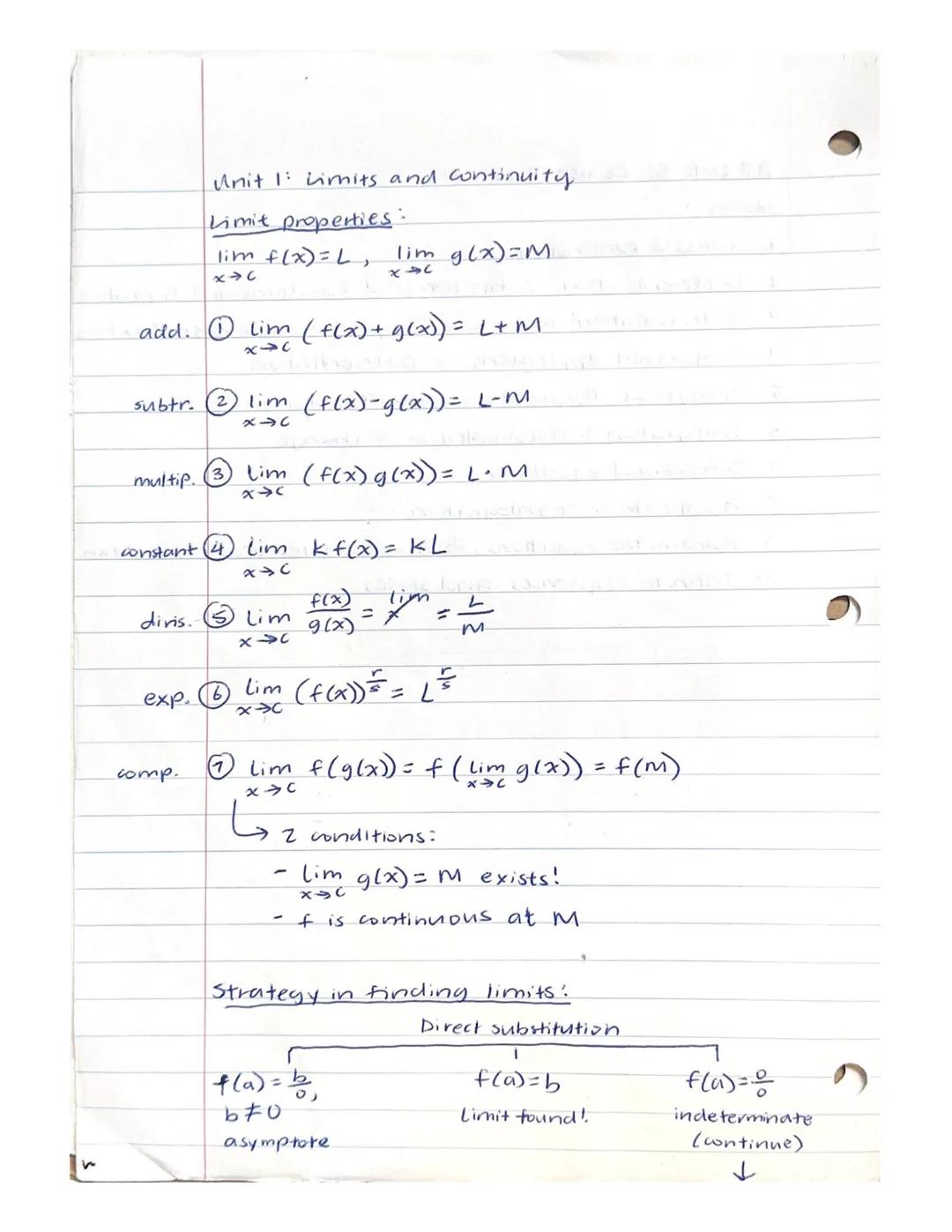
Limit Properties and Finding Strategies
Limits describe what happens to a function as its input approaches a specific value. The key limit properties you need to know include addition, subtraction, multiplication, division, exponentiation, and composition. For example, the limit of a sum equals the sum of the limits, and the limit of a product equals the product of the limits.
When finding limits, always start with direct substitution. If substitution gives you an actual value, you're done! If you get ∞/0, that indicates an asymptote. But if you get the indeterminate form 0/0, you'll need to try other techniques.
The indeterminate form 0/0 doesn't mean the limit doesn't exist - it just means you need more work to find it. This is where special techniques come into play.
Quick Tip: When you encounter 0/0, think of it as a signal to try factoring, conjugates, or trig identities - not as a final answer!
2
of 3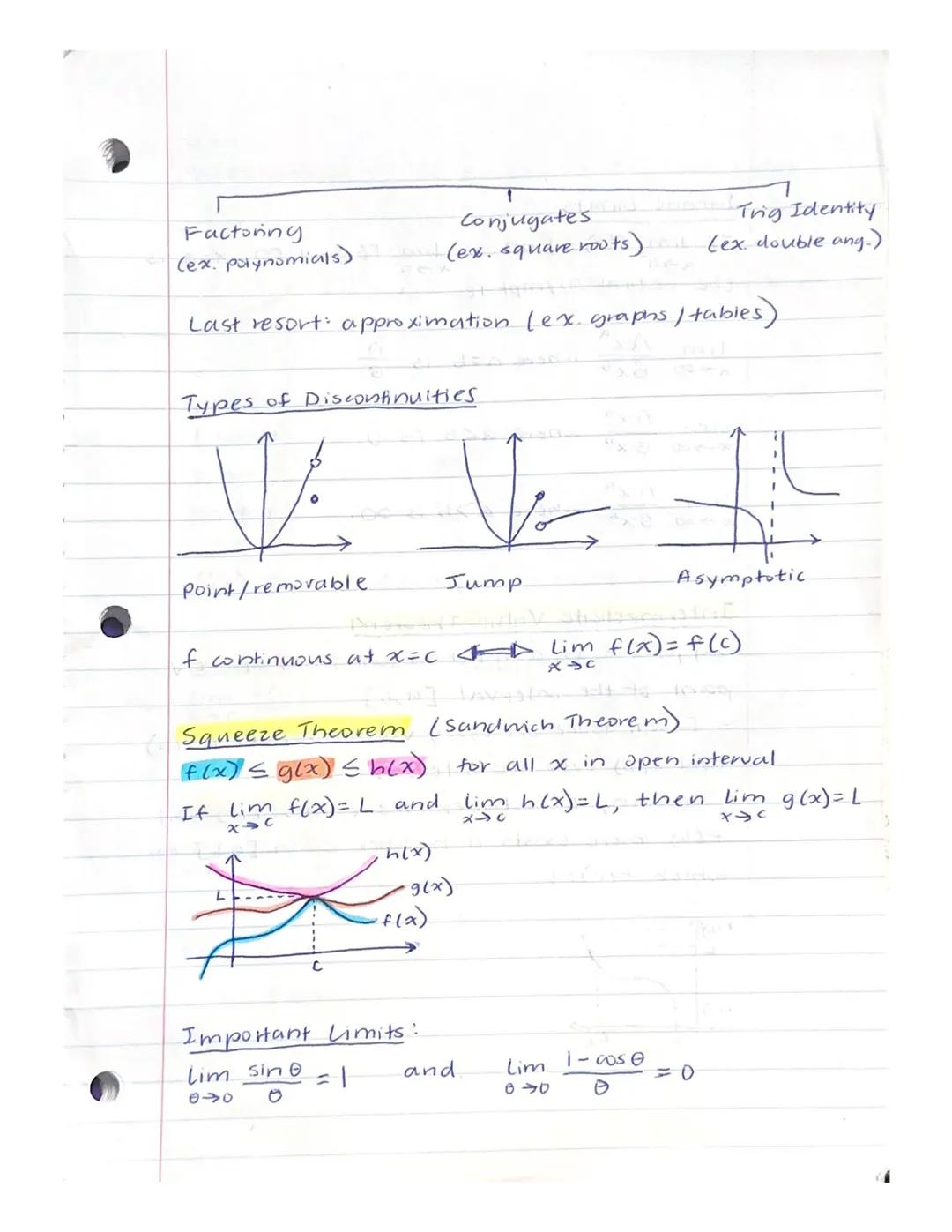
Continuity and Special Techniques
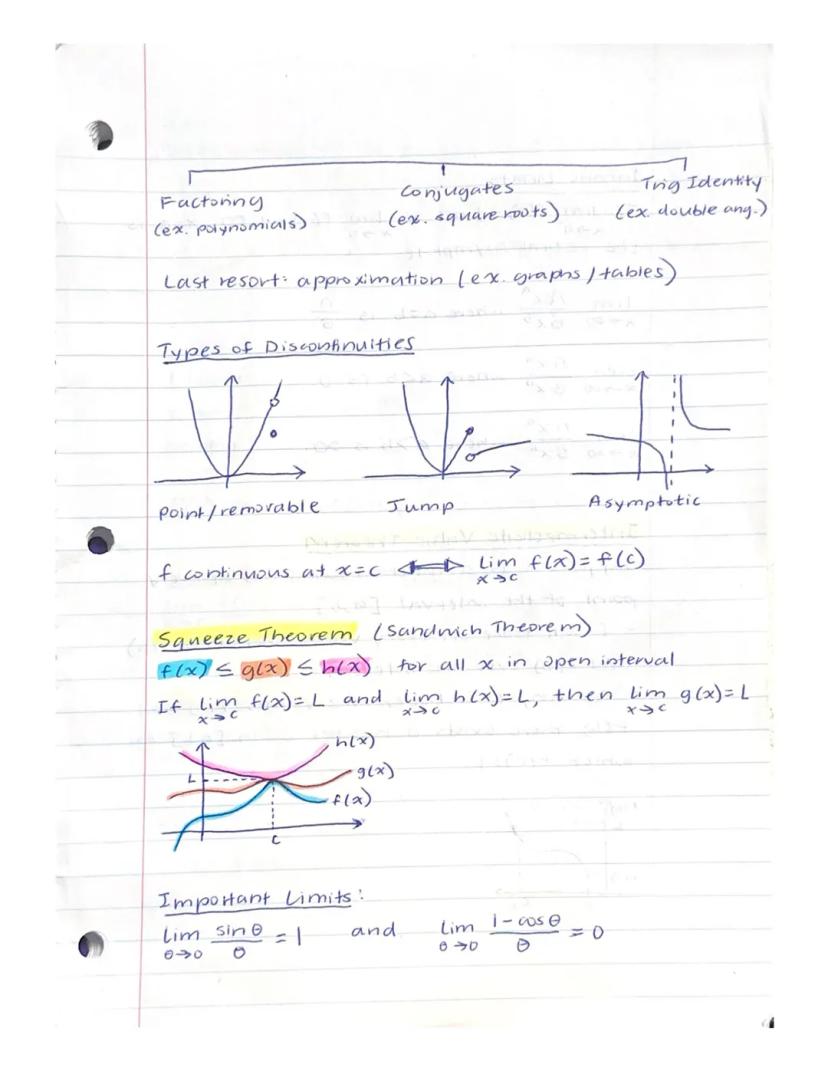
When stuck with indeterminate forms, try factoring polynomials, using conjugates for square roots, applying trig identities, or as a last resort, creating tables or graphs to approximate the limit. Each technique works best for specific types of expressions.
Functions can have three main types of discontinuities: removable (point) discontinuities that can be "fixed," jump discontinuities where the function suddenly changes value, and asymptotic discontinuities where the function grows infinitely large. A function is continuous at a point if the limit at that point equals the function's value.
The Squeeze Theorem is a powerful tool when direct methods fail. If a function g(x) is "squeezed" between two functions f(x) and h(x) that both approach the same limit L, then g(x) must also approach L.
Remember these crucial limits: sin(θ)/θ → 1 and /θ → 0 as θ approaches 0. These special limits appear frequently in calculus problems.
3
of 3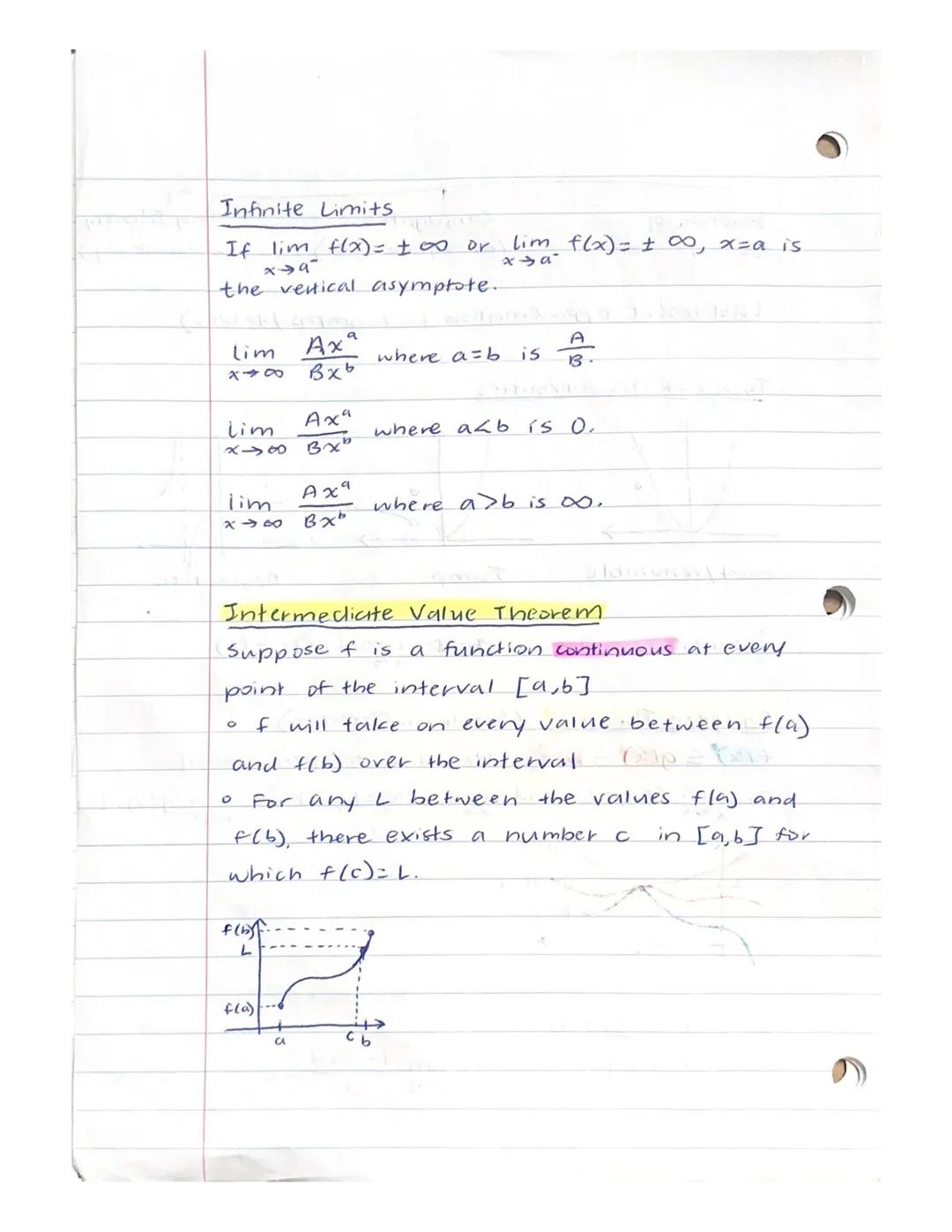
Infinite Limits and Intermediate Value Theorem
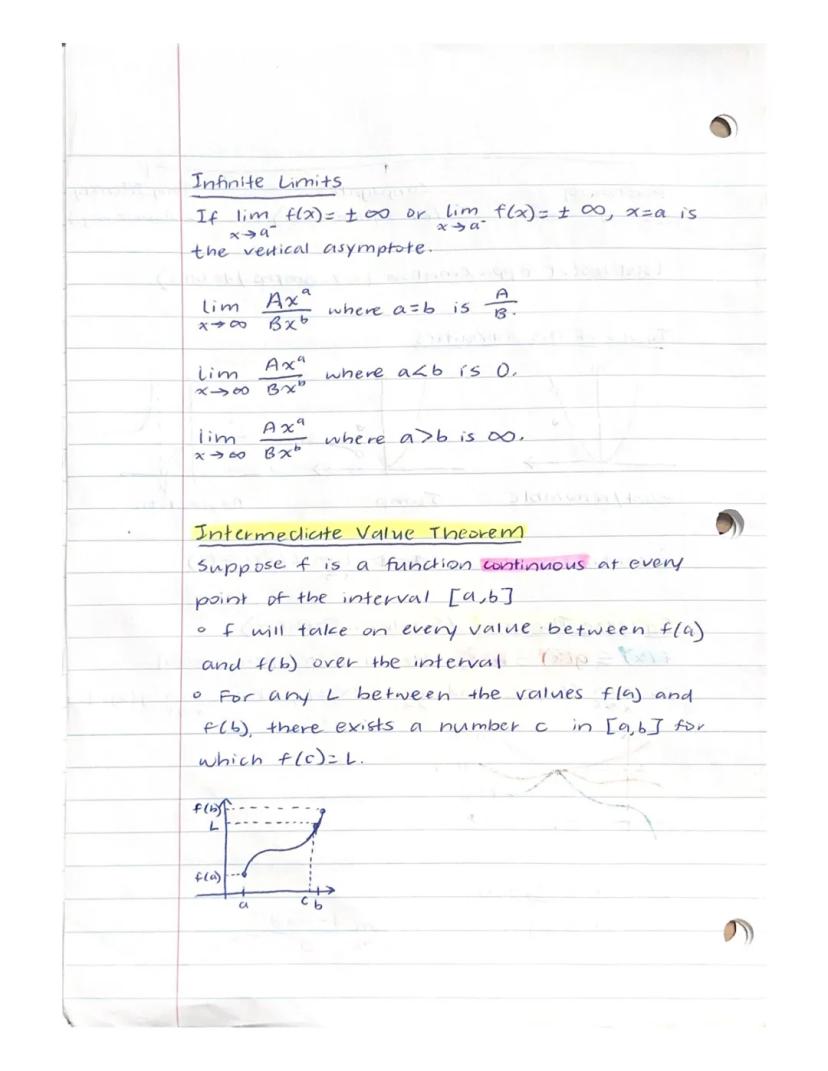
When a limit approaches infinity as x approaches some value a, we have a vertical asymptote at x = a. For rational functions with polynomials, you can determine the limit by comparing the highest powers of x in the numerator and denominator.
For limits of the form Axᵃ/Bxᵇ as x approaches infinity, the result depends on comparing exponents a and b: if a = b, the limit equals A/B; if a < b, the limit is 0; if a > b, the limit is infinity. This technique helps evaluate many complicated limits involving polynomials.
The Intermediate Value Theorem guarantees that continuous functions don't skip values. If a function is continuous on an interval [a,b], then it takes on every value between f(a) and f(b). This powerful theorem helps us prove that certain equations have solutions.
Why This Matters: The Intermediate Value Theorem explains why you can't drive from sea level to a mountain without passing through every elevation in between - continuous functions can't "teleport" past values!
We thought you’d never ask...
What is the Knowunity AI companion?
Our AI companion is specifically built for the needs of students. Based on the millions of content pieces we have on the platform we can provide truly meaningful and relevant answers to students. But its not only about answers, the companion is even more about guiding students through their daily learning challenges, with personalised study plans, quizzes or content pieces in the chat and 100% personalisation based on the students skills and developments.
Where can I download the Knowunity app?
You can download the app in the Google Play Store and in the Apple App Store.
Is Knowunity really free of charge?
That's right! Enjoy free access to study content, connect with fellow students, and get instant help – all at your fingertips.
Most popular content: Continuity
1Most popular content in AP Calculus AB/BC
7AP Calculus AB/BCContinuity and One-Sided Limits
Notes on the topic
552
AP Calculus AB/BCDerivative and Integral Review
Concise review for derivatives and integrals in calculus. Includes derivative rules (+ examples) and basic strategies for taking integrals in the first level of calculus (+ examples).
693
AP Calculus AB/BCAP Calculus AB | Integration using U-Substitution (Indefinite Integrals)
This covers how to integrate using the u-substitution method for indefinite integrals.
1012
AP Calculus AB/BCAB Review Integrals, Area, and FTC
Review of the topics
390
AP Calculus AB/BCRelated Rates
Notes on the topic
774
AP Calculus AB/BCAP CALC AB UNIT 4
Understanding the concept of derivative in context, including units, position, velocity, acceleration, related rates, and local linearity. L'HoSpital's Rule also explained.
College1697
AP Calculus AB/BCAP Calculus AB Answer Key
Answer Key
2752
Most popular content
9O
 AP US History
Origins and Dynamics of the Columbian Exchange
Analyze the ecological and economic motivations behind the initial transfer of goods, people, and diseases between the Old and New Worlds.
9th3,1280
I
AP US HistoryIntroduction to Early Cultural Interactions
Analyze the initial social and religious encounters between Europeans, Africans, and Indigenous peoples in the colonial Americas.
9th2,7730
O
 AP World History
Origins of Ancient River Civilizations
Analyze the environmental factors and technological innovations that led to the rise of early states in Mesopotamia, Egypt, and the Indus Valley.
9th3,1870
M
AP US HistoryMotivations for European Exploration
Analyze the economic, religious, and political factors that drove European powers to the Americas during the 15th and 16th centuries.
9th1,7780
F
 AP Psychology
Foundations of Ethical Guidelines in Research
Practice the core principles of the APA ethical code including informed consent, debriefing, and the role of Institutional Review Boards.
9th1,3360
I
AP US HistoryIntroduction to Native American Societies
Examine the diverse social, political, and economic structures of North American indigenous groups prior to European contact.
9th1,1100
I
 AP Biology
Introduction to Biological Elements of Life
Practice identifying the essential elements including carbon, nitrogen, phosphorus, and sulfur that compose biological macromolecules.
9th1,7390
I
AP US HistoryIntroduction to the Spanish Encomienda System
Explore the fundamental economic and social structures of the Spanish colonial system, focusing on the encomienda and the casta social hierarchy.
9th8890
O
AP World HistoryOrigins and Continuity of the Byzantine Empire
Analyze the political and cultural transitions from the Roman Empire to the Byzantine Empire, focusing on the reign of Justinian I and his code.
9th1,6320
Can't find what you're looking for? Explore other subjects.
Students love us — and so will you.
4.6/5App Store
4.7/5Google Play
The app is very easy to use and well designed. I have found everything I was looking for so far and have been able to learn a lot from the presentations! I will definitely use the app for a class assignment! And of course it also helps a lot as an inspiration.
Stefan SiOS user
This app is really great. There are so many study notes and help [...]. My problem subject is French, for example, and the app has so many options for help. Thanks to this app, I have improved my French. I would recommend it to anyone.
Samantha KlichAndroid user
Wow, I am really amazed. I just tried the app because I've seen it advertised many times and was absolutely stunned. This app is THE HELP you want for school and above all, it offers so many things, such as workouts and fact sheets, which have been VERY helpful to me personally.
AnnaiOS user
AP Calculus AB/BC36 views·Updated Jun 6, 2026·3 pagesUnderstanding Limits and Continuity
priscilla@cilla
Calculus starts with understanding limits and continuity - the foundation for everything that follows. These concepts help us analyze what happens when functions approach certain values and determine where functions behave smoothly without breaks or jumps.
1
of 3
Sign up to see the content. It's free!
- Access to all documents
- Improve your grades
- Join milions of students
Limit Properties and Finding Strategies
Limits describe what happens to a function as its input approaches a specific value. The key limit properties you need to know include addition, subtraction, multiplication, division, exponentiation, and composition. For example, the limit of a sum equals the sum of the limits, and the limit of a product equals the product of the limits.
When finding limits, always start with direct substitution. If substitution gives you an actual value, you're done! If you get ∞/0, that indicates an asymptote. But if you get the indeterminate form 0/0, you'll need to try other techniques.
The indeterminate form 0/0 doesn't mean the limit doesn't exist - it just means you need more work to find it. This is where special techniques come into play.
Quick Tip: When you encounter 0/0, think of it as a signal to try factoring, conjugates, or trig identities - not as a final answer!
2
of 3Sign up to see the content. It's free!
- Access to all documents
- Improve your grades
- Join milions of students
Continuity and Special Techniques
When stuck with indeterminate forms, try factoring polynomials, using conjugates for square roots, applying trig identities, or as a last resort, creating tables or graphs to approximate the limit. Each technique works best for specific types of expressions.
Functions can have three main types of discontinuities: removable (point) discontinuities that can be "fixed," jump discontinuities where the function suddenly changes value, and asymptotic discontinuities where the function grows infinitely large. A function is continuous at a point if the limit at that point equals the function's value.
The Squeeze Theorem is a powerful tool when direct methods fail. If a function g(x) is "squeezed" between two functions f(x) and h(x) that both approach the same limit L, then g(x) must also approach L.
Remember these crucial limits: sin(θ)/θ → 1 and /θ → 0 as θ approaches 0. These special limits appear frequently in calculus problems.
3
of 3Sign up to see the content. It's free!
- Access to all documents
- Improve your grades
- Join milions of students
Infinite Limits and Intermediate Value Theorem
When a limit approaches infinity as x approaches some value a, we have a vertical asymptote at x = a. For rational functions with polynomials, you can determine the limit by comparing the highest powers of x in the numerator and denominator.
For limits of the form Axᵃ/Bxᵇ as x approaches infinity, the result depends on comparing exponents a and b: if a = b, the limit equals A/B; if a < b, the limit is 0; if a > b, the limit is infinity. This technique helps evaluate many complicated limits involving polynomials.
The Intermediate Value Theorem guarantees that continuous functions don't skip values. If a function is continuous on an interval [a,b], then it takes on every value between f(a) and f(b). This powerful theorem helps us prove that certain equations have solutions.
Why This Matters: The Intermediate Value Theorem explains why you can't drive from sea level to a mountain without passing through every elevation in between - continuous functions can't "teleport" past values!
We thought you’d never ask...
What is the Knowunity AI companion?
Our AI companion is specifically built for the needs of students. Based on the millions of content pieces we have on the platform we can provide truly meaningful and relevant answers to students. But its not only about answers, the companion is even more about guiding students through their daily learning challenges, with personalised study plans, quizzes or content pieces in the chat and 100% personalisation based on the students skills and developments.
Where can I download the Knowunity app?
You can download the app in the Google Play Store and in the Apple App Store.
Is Knowunity really free of charge?
That's right! Enjoy free access to study content, connect with fellow students, and get instant help – all at your fingertips.
Most popular content: Continuity
1Most popular content in AP Calculus AB/BC
7AP Calculus AB/BCContinuity and One-Sided Limits
Notes on the topic
552
AP Calculus AB/BCDerivative and Integral Review
Concise review for derivatives and integrals in calculus. Includes derivative rules (+ examples) and basic strategies for taking integrals in the first level of calculus (+ examples).
693
AP Calculus AB/BCAP Calculus AB | Integration using U-Substitution (Indefinite Integrals)
This covers how to integrate using the u-substitution method for indefinite integrals.
1012
AP Calculus AB/BCAB Review Integrals, Area, and FTC
Review of the topics
390
AP Calculus AB/BCRelated Rates
Notes on the topic
774
AP Calculus AB/BCAP CALC AB UNIT 4
Understanding the concept of derivative in context, including units, position, velocity, acceleration, related rates, and local linearity. L'HoSpital's Rule also explained.
College1697
AP Calculus AB/BCAP Calculus AB Answer Key
Answer Key
2752
Most popular content
9O
AP US HistoryOrigins and Dynamics of the Columbian Exchange
Analyze the ecological and economic motivations behind the initial transfer of goods, people, and diseases between the Old and New Worlds.
9th3,1280
I
AP US HistoryIntroduction to Early Cultural Interactions
Analyze the initial social and religious encounters between Europeans, Africans, and Indigenous peoples in the colonial Americas.
9th2,7730
O
AP World HistoryOrigins of Ancient River Civilizations
Analyze the environmental factors and technological innovations that led to the rise of early states in Mesopotamia, Egypt, and the Indus Valley.
9th3,1870
M
AP US HistoryMotivations for European Exploration
Analyze the economic, religious, and political factors that drove European powers to the Americas during the 15th and 16th centuries.
9th1,7780
F
AP PsychologyFoundations of Ethical Guidelines in Research
Practice the core principles of the APA ethical code including informed consent, debriefing, and the role of Institutional Review Boards.
9th1,3360
I
AP US HistoryIntroduction to Native American Societies
Examine the diverse social, political, and economic structures of North American indigenous groups prior to European contact.
9th1,1100
I
AP BiologyIntroduction to Biological Elements of Life
Practice identifying the essential elements including carbon, nitrogen, phosphorus, and sulfur that compose biological macromolecules.
9th1,7390
I
AP US HistoryIntroduction to the Spanish Encomienda System
Explore the fundamental economic and social structures of the Spanish colonial system, focusing on the encomienda and the casta social hierarchy.
9th8890
O
AP World HistoryOrigins and Continuity of the Byzantine Empire
Analyze the political and cultural transitions from the Roman Empire to the Byzantine Empire, focusing on the reign of Justinian I and his code.
9th1,6320
Can't find what you're looking for? Explore other subjects.
Students love us — and so will you.
4.6/5App Store
4.7/5Google Play
The app is very easy to use and well designed. I have found everything I was looking for so far and have been able to learn a lot from the presentations! I will definitely use the app for a class assignment! And of course it also helps a lot as an inspiration.
Stefan SiOS user
This app is really great. There are so many study notes and help [...]. My problem subject is French, for example, and the app has so many options for help. Thanks to this app, I have improved my French. I would recommend it to anyone.
Samantha KlichAndroid user
Wow, I am really amazed. I just tried the app because I've seen it advertised many times and was absolutely stunned. This app is THE HELP you want for school and above all, it offers so many things, such as workouts and fact sheets, which have been VERY helpful to me personally.
AnnaiOS user