
Meiosis is the special type of cell division that creates...
 AP Biology241 views·Updated Jun 16, 2026·2 pages
AP Biology Notes: Unit 5 Complete Guide
M
Madisen Lieberman@madisenlieberman_lqja
1
of 2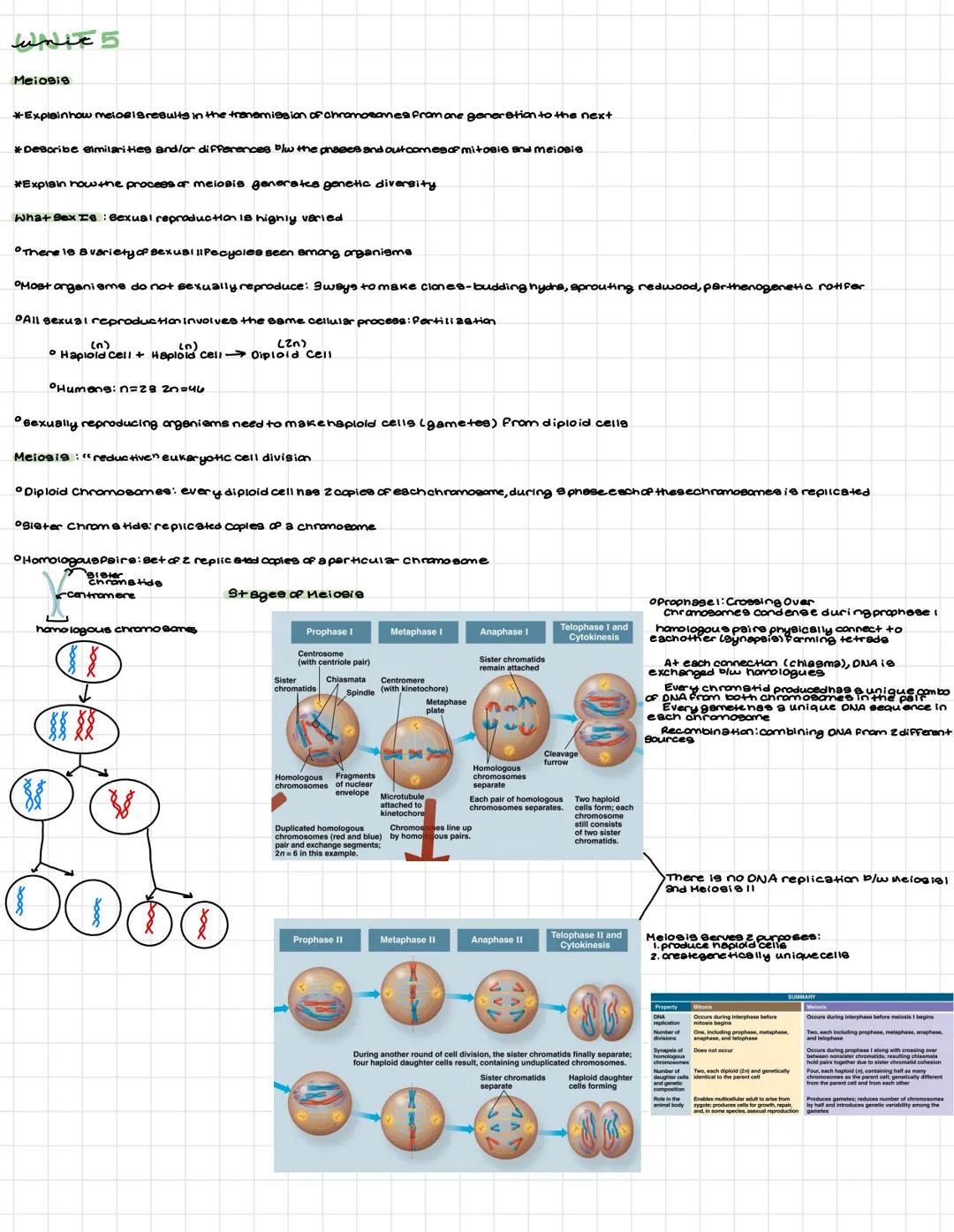
Meiosis: Creating Genetic Variety
Ever wonder why you don't look exactly like your siblings? Meiosis is the answer! Unlike mitosis (which creates identical cells), meiosis creates genetic diversity through a specialized two-stage division process.
In meiosis, a diploid cell (with two sets of chromosomes) divides to produce haploid cells with just one set. The magic begins in Prophase I when homologous chromosomes pair up and exchange DNA segments in a process called crossing over. This DNA exchange creates unique genetic combinations in every gamete produced.
The stages follow a specific sequence: Prophase I (crossing over), Metaphase I (homologous pairs line up), Anaphase I (homologous chromosomes separate), and Telophase I with cytokinesis. Then a second division occurs (Prophase II through Telophase II) where the sister chromatids finally separate, resulting in four haploid cells.
💡 Remember this key difference: In mitosis, chromosomes duplicate once and divide once. In meiosis, chromosomes duplicate once but divide twice!
Sexual reproduction isn't the only way organisms reproduce. Many create clones through processes like budding, sprouting, or parthenogenesis. But sexual reproduction creates genetic variety that helps species adapt and evolve.
2
of 2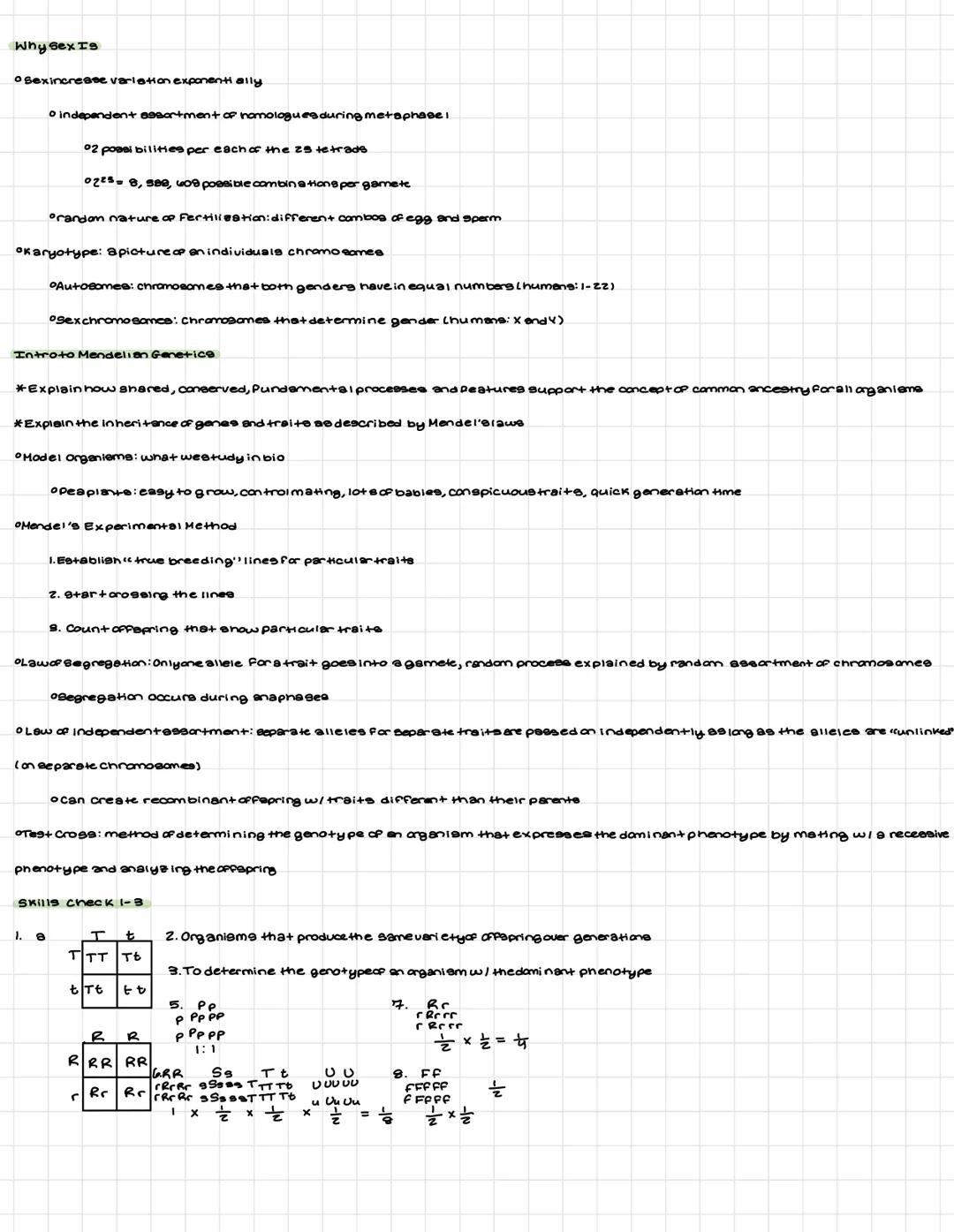
The Power of Genetic Variation
Why bother with sex? It's all about creating variety! Sexual reproduction dramatically increases genetic diversity through three key mechanisms:
First, independent assortment of chromosomes during metaphase I creates 2^23 possible combinations in human gametes—that's over 8 million possibilities per egg or sperm! Then, the random nature of fertilization multiplies these possibilities when egg and sperm combine.
Second, crossing over ensures each chromosome itself contains a unique mixture of genetic material. This means no two gametes are exactly alike, even from the same person.
Mendel's Genetic Principles
Gregor Mendel figured out the basics of inheritance by studying pea plants—perfect model organisms because they're easy to grow, produce lots of offspring quickly, and have easily observable traits.
Mendel's Law of Segregation states that only one allele for a trait enters each gamete—exactly what happens during anaphase of meiosis! His Law of Independent Assortment explains that alleles for different traits on separate chromosomes are inherited independently.
🧪 Test crosses are genetic detective work! By mating an organism showing a dominant trait with one showing recessive traits, scientists can determine the unknown genotype by analyzing the offspring.
When working with Punnett squares to predict inheritance patterns, remember that meiosis determines which alleles go into each gamete, creating the probability-based outcomes we can calculate.
We thought you’d never ask...
What is the Knowunity AI companion?
Our AI companion is specifically built for the needs of students. Based on the millions of content pieces we have on the platform we can provide truly meaningful and relevant answers to students. But its not only about answers, the companion is even more about guiding students through their daily learning challenges, with personalised study plans, quizzes or content pieces in the chat and 100% personalisation based on the students skills and developments.
Where can I download the Knowunity app?
You can download the app in the Google Play Store and in the Apple App Store.
Is Knowunity really free of charge?
That's right! Enjoy free access to study content, connect with fellow students, and get instant help – all at your fingertips.
Similar Content
 Biology
Most popular content in AP Biology
9I
AP BiologyIntroduction to Biological Elements of Life
Practice identifying the essential elements including carbon, nitrogen, phosphorus, and sulfur that compose biological macromolecules.
9th1,7390
I
AP BiologyIntroduction to Water Polarity and Bonding
Practice identifying partial charges and the chemical basis of hydrogen bond formation between polar water molecules.
9th8520
I
AP BiologyIntroduction to Biological Macromolecules
Practice identifying the four classes of biological macromolecules and the dehydration synthesis reactions that form their covalent bonds.
9th5890
I
AP BiologyIntroduction to Biological Macromolecules
Practice identifying the monomers and chemical compositions of carbohydrates, lipids, proteins, and nucleic acids in biological systems.
9th4460
I
AP BiologyIntroduction to Cell Compartmentalization
Practice identifying how membrane-bound organelles increase surface area and facilitate specialized chemical reactions in eukaryotic cells.
9th3370
C
AP BiologyComponents of the Plasma Membrane
Practice identifying the molecular structure of phospholipids, proteins, cholesterol, and carbohydrates within the fluid mosaic model.
9th2720
I
AP BiologyIntroduction to Evidence of Evolution
Practice identifying fundamental concepts of common ancestry, including homologous structures, vestigial traits, and the fossil record.
9th2010
AP BiologyBio 1000 Chapter 2 The Molecules of Cells
Cell Make up
College55211
F
AP BiologyFundamentals of Cell Size and Surface Area
Practice calculating surface area-to-volume ratios and defining how these geometric constraints limit the maximum size of a functional biological cell.
9th1550
Most popular content
9O
 AP US History
Origins and Dynamics of the Columbian Exchange
Analyze the ecological and economic motivations behind the initial transfer of goods, people, and diseases between the Old and New Worlds.
9th3,1280
I
AP US HistoryIntroduction to Early Cultural Interactions
Analyze the initial social and religious encounters between Europeans, Africans, and Indigenous peoples in the colonial Americas.
9th2,7730
O
 AP World History
Origins of Ancient River Civilizations
Analyze the environmental factors and technological innovations that led to the rise of early states in Mesopotamia, Egypt, and the Indus Valley.
9th3,1870
M
AP US HistoryMotivations for European Exploration
Analyze the economic, religious, and political factors that drove European powers to the Americas during the 15th and 16th centuries.
9th1,7780
F
 AP Psychology
Foundations of Ethical Guidelines in Research
Practice the core principles of the APA ethical code including informed consent, debriefing, and the role of Institutional Review Boards.
9th1,3360
I
AP US HistoryIntroduction to Native American Societies
Examine the diverse social, political, and economic structures of North American indigenous groups prior to European contact.
9th1,1100
I
AP BiologyIntroduction to Biological Elements of Life
Practice identifying the essential elements including carbon, nitrogen, phosphorus, and sulfur that compose biological macromolecules.
9th1,7390
I
AP US HistoryIntroduction to the Spanish Encomienda System
Explore the fundamental economic and social structures of the Spanish colonial system, focusing on the encomienda and the casta social hierarchy.
9th8890
O
AP World HistoryOrigins and Continuity of the Byzantine Empire
Analyze the political and cultural transitions from the Roman Empire to the Byzantine Empire, focusing on the reign of Justinian I and his code.
9th1,6320
Can't find what you're looking for? Explore other subjects.
Students love us — and so will you.
4.6/5App Store
4.7/5Google Play
The app is very easy to use and well designed. I have found everything I was looking for so far and have been able to learn a lot from the presentations! I will definitely use the app for a class assignment! And of course it also helps a lot as an inspiration.
Stefan SiOS user
This app is really great. There are so many study notes and help [...]. My problem subject is French, for example, and the app has so many options for help. Thanks to this app, I have improved my French. I would recommend it to anyone.
Samantha KlichAndroid user
Wow, I am really amazed. I just tried the app because I've seen it advertised many times and was absolutely stunned. This app is THE HELP you want for school and above all, it offers so many things, such as workouts and fact sheets, which have been VERY helpful to me personally.
AnnaiOS user
AP Biology241 views·Updated Jun 16, 2026·2 pagesAP Biology Notes: Unit 5 Complete Guide
M
Madisen Lieberman@madisenlieberman_lqja
Meiosis is the special type of cell division that creates genetic diversity and enables sexual reproduction. It's how organisms produce unique haploid gametes (like eggs and sperm) that combine during fertilization to form a new individual with traits from both...
1
of 2
Sign up to see the content. It's free!
- Access to all documents
- Improve your grades
- Join milions of students
Meiosis: Creating Genetic Variety
Ever wonder why you don't look exactly like your siblings? Meiosis is the answer! Unlike mitosis (which creates identical cells), meiosis creates genetic diversity through a specialized two-stage division process.
In meiosis, a diploid cell (with two sets of chromosomes) divides to produce haploid cells with just one set. The magic begins in Prophase I when homologous chromosomes pair up and exchange DNA segments in a process called crossing over. This DNA exchange creates unique genetic combinations in every gamete produced.
The stages follow a specific sequence: Prophase I (crossing over), Metaphase I (homologous pairs line up), Anaphase I (homologous chromosomes separate), and Telophase I with cytokinesis. Then a second division occurs (Prophase II through Telophase II) where the sister chromatids finally separate, resulting in four haploid cells.
💡 Remember this key difference: In mitosis, chromosomes duplicate once and divide once. In meiosis, chromosomes duplicate once but divide twice!
Sexual reproduction isn't the only way organisms reproduce. Many create clones through processes like budding, sprouting, or parthenogenesis. But sexual reproduction creates genetic variety that helps species adapt and evolve.
2
of 2Sign up to see the content. It's free!
- Access to all documents
- Improve your grades
- Join milions of students
The Power of Genetic Variation
Why bother with sex? It's all about creating variety! Sexual reproduction dramatically increases genetic diversity through three key mechanisms:
First, independent assortment of chromosomes during metaphase I creates 2^23 possible combinations in human gametes—that's over 8 million possibilities per egg or sperm! Then, the random nature of fertilization multiplies these possibilities when egg and sperm combine.
Second, crossing over ensures each chromosome itself contains a unique mixture of genetic material. This means no two gametes are exactly alike, even from the same person.
Mendel's Genetic Principles
Gregor Mendel figured out the basics of inheritance by studying pea plants—perfect model organisms because they're easy to grow, produce lots of offspring quickly, and have easily observable traits.
Mendel's Law of Segregation states that only one allele for a trait enters each gamete—exactly what happens during anaphase of meiosis! His Law of Independent Assortment explains that alleles for different traits on separate chromosomes are inherited independently.
🧪 Test crosses are genetic detective work! By mating an organism showing a dominant trait with one showing recessive traits, scientists can determine the unknown genotype by analyzing the offspring.
When working with Punnett squares to predict inheritance patterns, remember that meiosis determines which alleles go into each gamete, creating the probability-based outcomes we can calculate.
We thought you’d never ask...
What is the Knowunity AI companion?
Our AI companion is specifically built for the needs of students. Based on the millions of content pieces we have on the platform we can provide truly meaningful and relevant answers to students. But its not only about answers, the companion is even more about guiding students through their daily learning challenges, with personalised study plans, quizzes or content pieces in the chat and 100% personalisation based on the students skills and developments.
Where can I download the Knowunity app?
You can download the app in the Google Play Store and in the Apple App Store.
Is Knowunity really free of charge?
That's right! Enjoy free access to study content, connect with fellow students, and get instant help – all at your fingertips.
Similar Content
Most popular content in AP Biology
9I
AP BiologyIntroduction to Biological Elements of Life
Practice identifying the essential elements including carbon, nitrogen, phosphorus, and sulfur that compose biological macromolecules.
9th1,7390
I
AP BiologyIntroduction to Water Polarity and Bonding
Practice identifying partial charges and the chemical basis of hydrogen bond formation between polar water molecules.
9th8520
I
AP BiologyIntroduction to Biological Macromolecules
Practice identifying the four classes of biological macromolecules and the dehydration synthesis reactions that form their covalent bonds.
9th5890
I
AP BiologyIntroduction to Biological Macromolecules
Practice identifying the monomers and chemical compositions of carbohydrates, lipids, proteins, and nucleic acids in biological systems.
9th4460
I
AP BiologyIntroduction to Cell Compartmentalization
Practice identifying how membrane-bound organelles increase surface area and facilitate specialized chemical reactions in eukaryotic cells.
9th3370
C
AP BiologyComponents of the Plasma Membrane
Practice identifying the molecular structure of phospholipids, proteins, cholesterol, and carbohydrates within the fluid mosaic model.
9th2720
I
AP BiologyIntroduction to Evidence of Evolution
Practice identifying fundamental concepts of common ancestry, including homologous structures, vestigial traits, and the fossil record.
9th2010
AP BiologyBio 1000 Chapter 2 The Molecules of Cells
Cell Make up
College55211
F
AP BiologyFundamentals of Cell Size and Surface Area
Practice calculating surface area-to-volume ratios and defining how these geometric constraints limit the maximum size of a functional biological cell.
9th1550
Most popular content
9O
AP US HistoryOrigins and Dynamics of the Columbian Exchange
Analyze the ecological and economic motivations behind the initial transfer of goods, people, and diseases between the Old and New Worlds.
9th3,1280
I
AP US HistoryIntroduction to Early Cultural Interactions
Analyze the initial social and religious encounters between Europeans, Africans, and Indigenous peoples in the colonial Americas.
9th2,7730
O
AP World HistoryOrigins of Ancient River Civilizations
Analyze the environmental factors and technological innovations that led to the rise of early states in Mesopotamia, Egypt, and the Indus Valley.
9th3,1870
M
AP US HistoryMotivations for European Exploration
Analyze the economic, religious, and political factors that drove European powers to the Americas during the 15th and 16th centuries.
9th1,7780
F
AP PsychologyFoundations of Ethical Guidelines in Research
Practice the core principles of the APA ethical code including informed consent, debriefing, and the role of Institutional Review Boards.
9th1,3360
I
AP US HistoryIntroduction to Native American Societies
Examine the diverse social, political, and economic structures of North American indigenous groups prior to European contact.
9th1,1100
I
AP BiologyIntroduction to Biological Elements of Life
Practice identifying the essential elements including carbon, nitrogen, phosphorus, and sulfur that compose biological macromolecules.
9th1,7390
I
AP US HistoryIntroduction to the Spanish Encomienda System
Explore the fundamental economic and social structures of the Spanish colonial system, focusing on the encomienda and the casta social hierarchy.
9th8890
O
AP World HistoryOrigins and Continuity of the Byzantine Empire
Analyze the political and cultural transitions from the Roman Empire to the Byzantine Empire, focusing on the reign of Justinian I and his code.
9th1,6320
Can't find what you're looking for? Explore other subjects.
Students love us — and so will you.
4.6/5App Store
4.7/5Google Play
The app is very easy to use and well designed. I have found everything I was looking for so far and have been able to learn a lot from the presentations! I will definitely use the app for a class assignment! And of course it also helps a lot as an inspiration.
Stefan SiOS user
This app is really great. There are so many study notes and help [...]. My problem subject is French, for example, and the app has so many options for help. Thanks to this app, I have improved my French. I would recommend it to anyone.
Samantha KlichAndroid user
Wow, I am really amazed. I just tried the app because I've seen it advertised many times and was absolutely stunned. This app is THE HELP you want for school and above all, it offers so many things, such as workouts and fact sheets, which have been VERY helpful to me personally.
AnnaiOS user