

Mitosis is a crucial process of cell division resulting in...
 AP Biology99 views·Updated Jun 19, 2026·3 pages
Stages of Mitosis: Easy Guide for Kids
1 / 3
1
of 3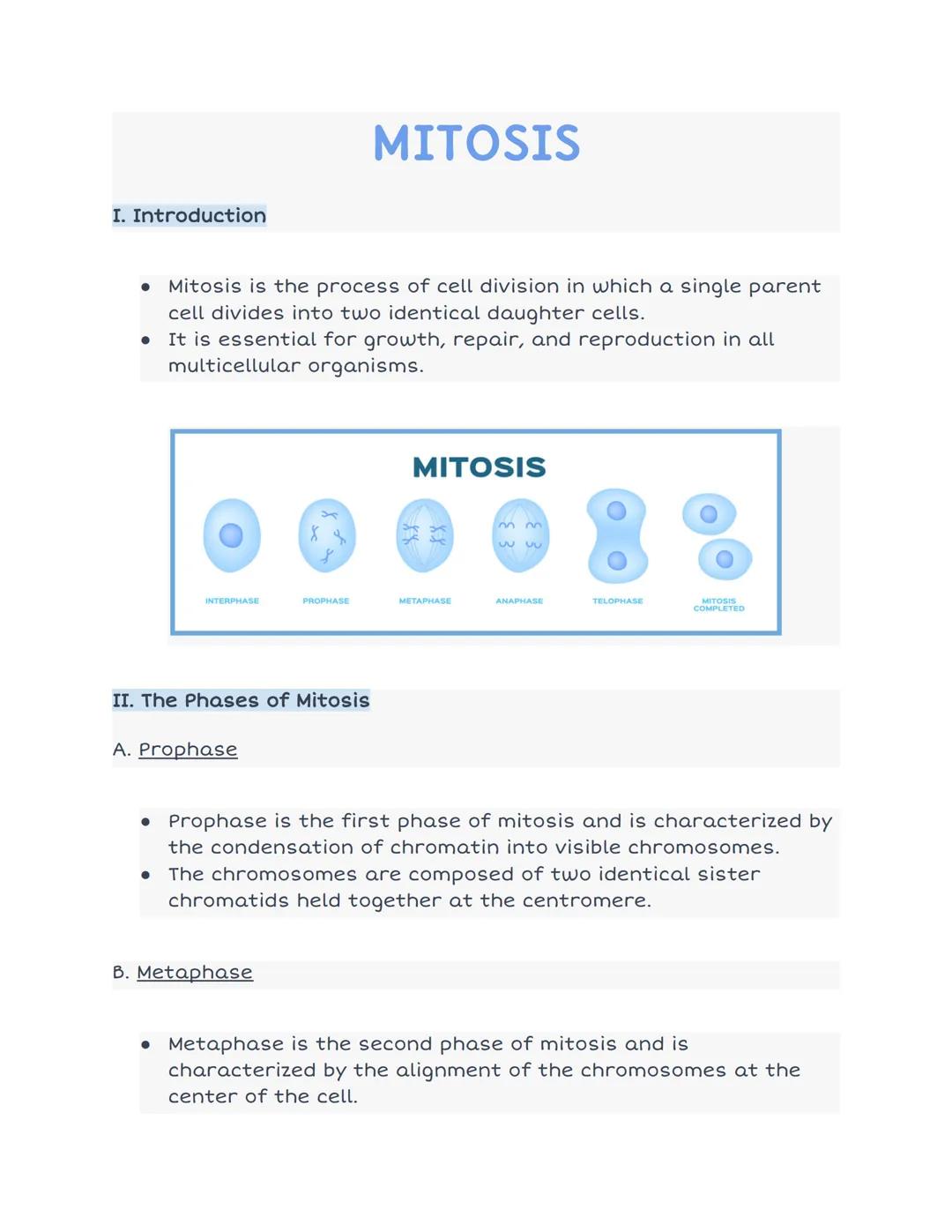
Anaphase and Telophase
Anaphase
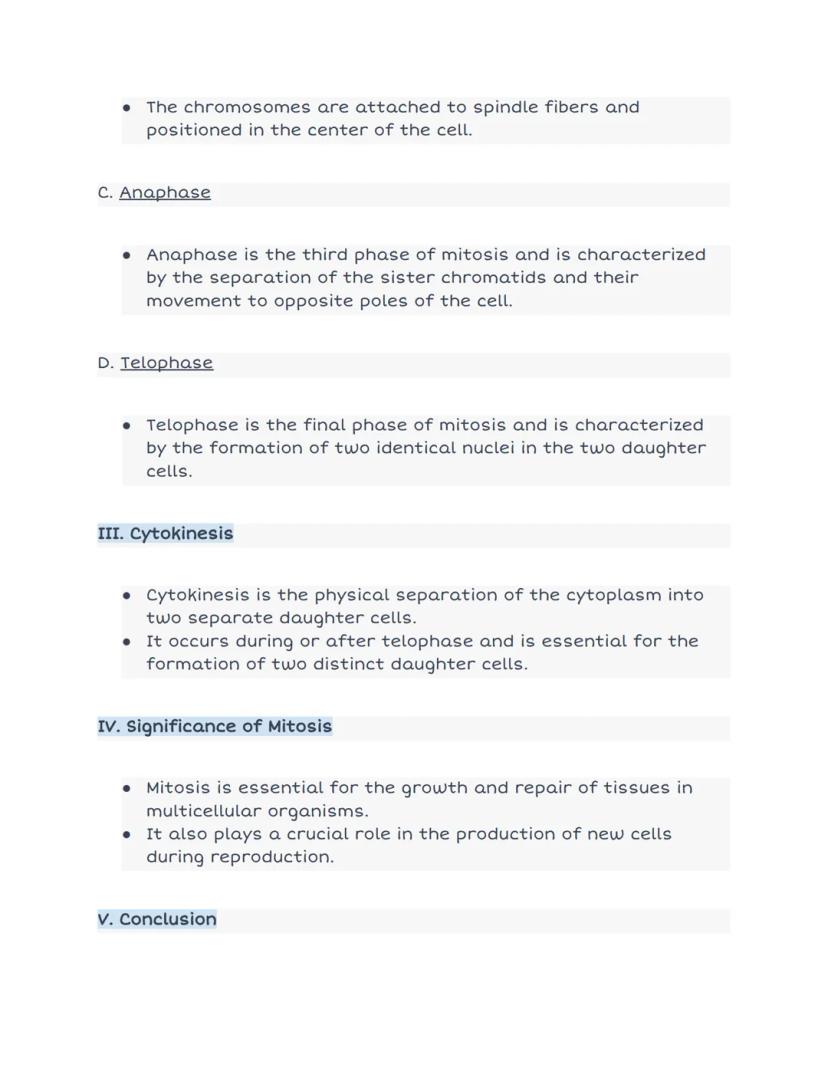
Anaphase of mitosis is the third phase of mitosis. This stage is characterized by the separation of sister chromatids and their movement to opposite poles of the cell. The spindle fibers contract, pulling the chromatids apart.
Highlight: Anaphase is often considered the shortest but most dramatic phase of mitosis due to the visible movement of chromosomes.
Telophase
Telophase of mitosis is the final phase of mitosis. During this stage, two identical nuclei form in the two daughter cells. The chromosomes begin to decondense, and the nuclear envelope reforms around each set of chromosomes.
Vocabulary: Nuclear envelope - The double membrane surrounding the nucleus in eukaryotic cells.
Cytokinesis
Cytokinesis is the physical separation of the cytoplasm into two separate daughter cells. It typically occurs during or after telophase and is essential for the formation of two distinct daughter cells.
Definition: Cytokinesis is the process that divides the cell's cytoplasm to complete cell division.
Highlight: While cytokinesis is often associated with mitosis, it is technically not part of mitosis itself but rather the final step in cell division.
2
of 3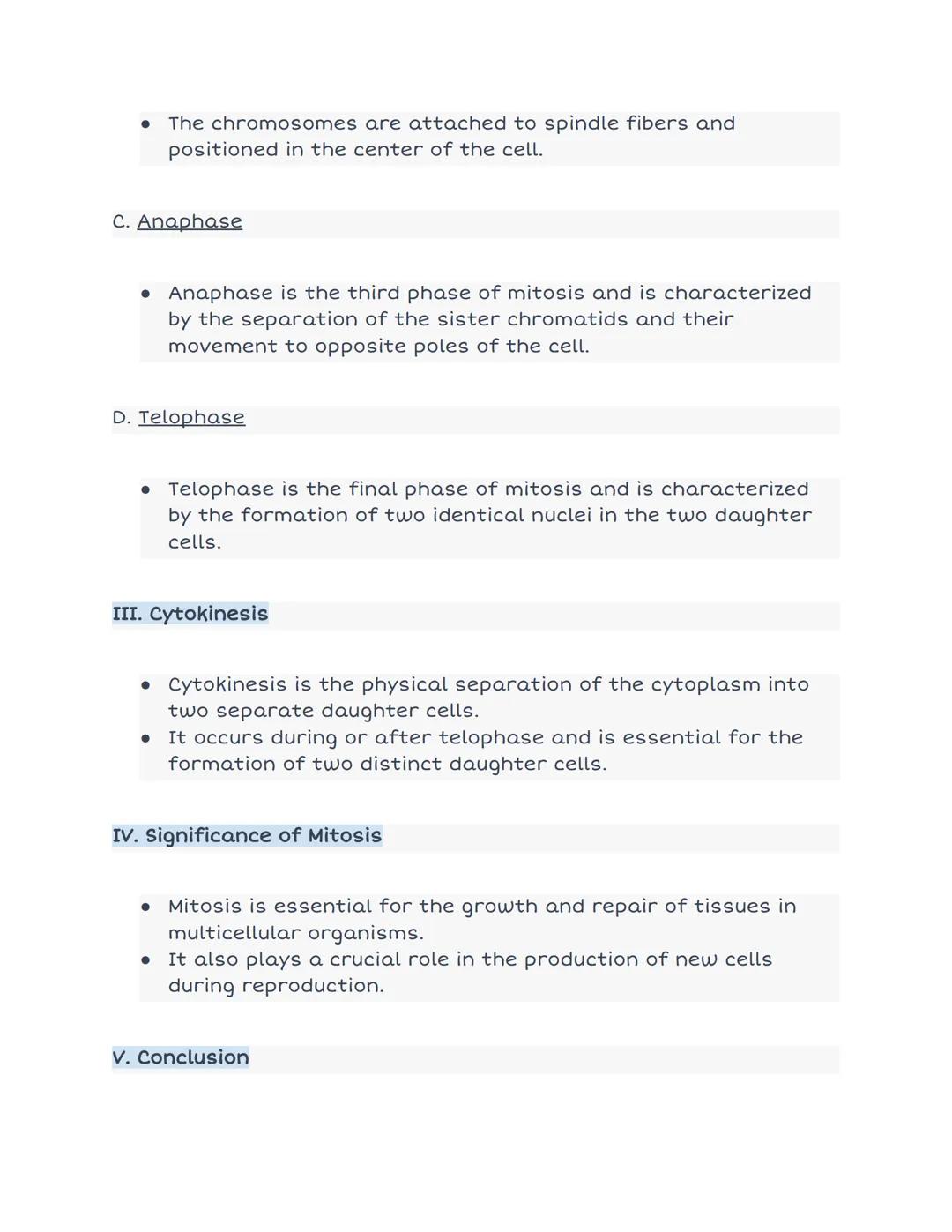
Significance of Mitosis
The importance of mitosis in cell growth and repair cannot be overstated. It plays a crucial role in various biological processes:
- Tissue Growth: Mitosis allows for the production of new cells, enabling organisms to grow and develop.
- Tissue Repair: When tissues are damaged, mitosis helps replace dead or injured cells.
- Reproduction: In some organisms, mitosis is involved in asexual reproduction.
- Cell Replacement: It replaces cells that have a limited lifespan, such as skin cells.
- Genetic Stability: Mitosis ensures that each new cell receives an identical set of chromosomes.
Example: In humans, skin cells undergo mitosis regularly to replace dead cells and maintain the protective barrier of our skin.
Conclusion
Mitosis is a complex yet precisely orchestrated process of cell division. It occurs in four main phases - prophase, metaphase, anaphase, and telophase - followed by cytokinesis. This process is fundamental to the growth, repair, and reproduction of multicellular organisms.
Quote: "Mitosis is essential for growth, repair, and reproduction in multicellular organisms."
Understanding the stages of mitosis and the process of cytokinesis is crucial for comprehending how organisms grow, heal, and maintain themselves at a cellular level. This knowledge forms the foundation for more advanced studies in biology and medicine.
3
of 3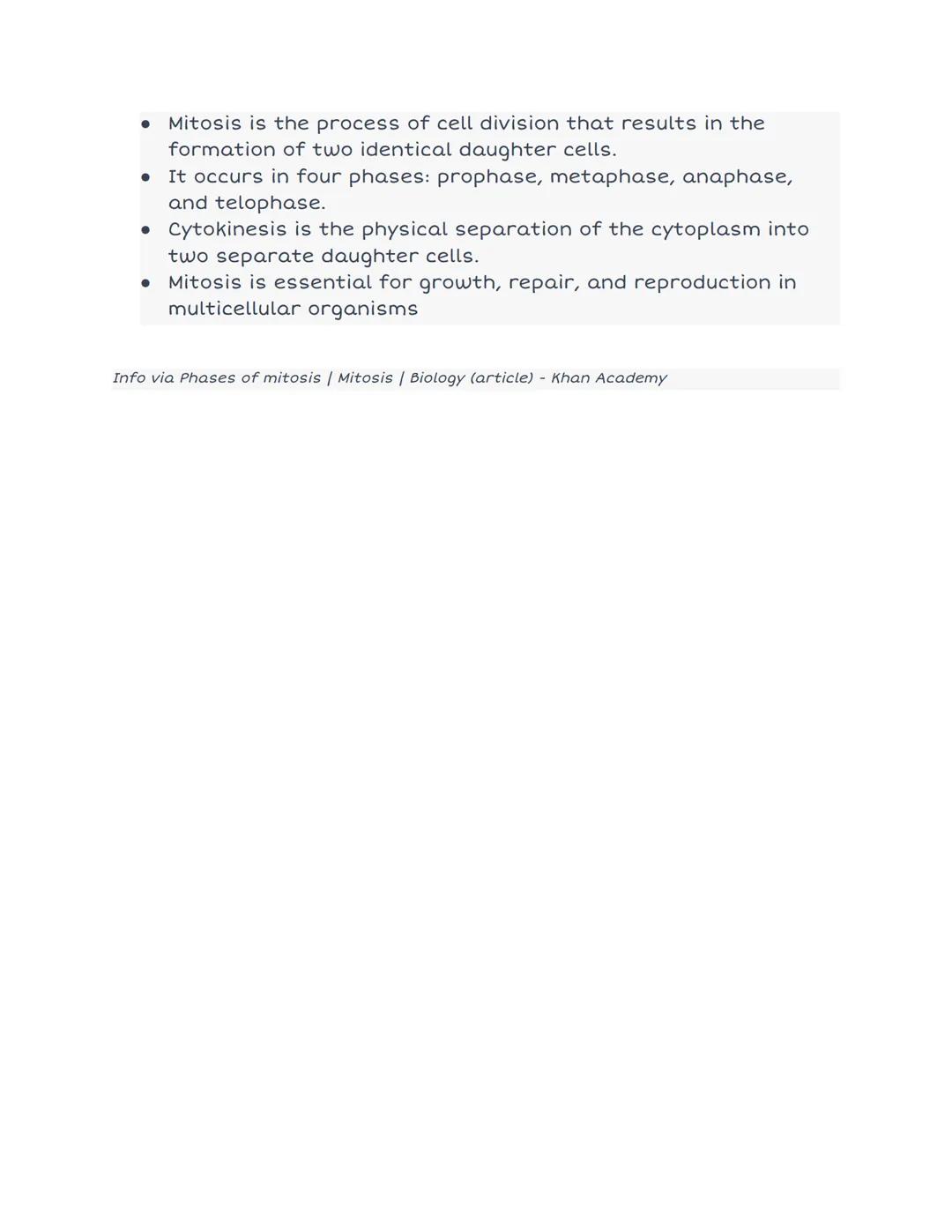
Introduction to Mitosis
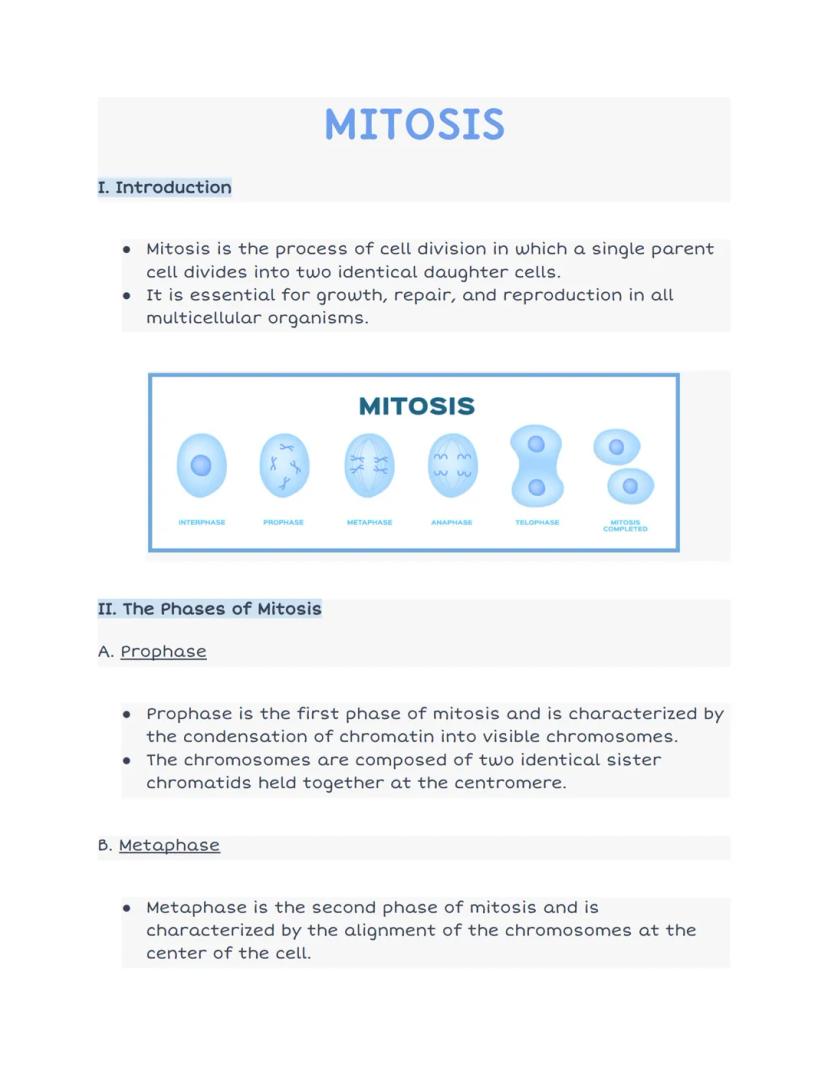
Mitosis is a fundamental process of cell division where a single parent cell divides into two identical daughter cells. This process is crucial for growth, repair, and reproduction in all multicellular organisms.
The stages of mitosis begin with interphase, followed by four main phases: prophase, metaphase, anaphase, and telophase. Each stage plays a specific role in ensuring accurate cell division.
Definition: Mitosis is the process of cell division resulting in two genetically identical daughter cells.
Highlight: Mitosis is essential for growth, repair, and reproduction in multicellular organisms.
Prophase
Prophase mitosis is the first phase of mitosis. During this stage, chromatin condenses into visible chromosomes. These chromosomes are composed of two identical sister chromatids held together at the centromere.
Vocabulary: Chromatin - The loosely structured form of DNA and proteins in the nucleus when the cell is not dividing.
Metaphase
Metaphase of mitosis is the second phase. In this stage, chromosomes align at the center of the cell. They attach to spindle fibers and position themselves in the middle of the cell, forming what's known as the metaphase plate.
Example: Imagine the chromosomes lining up like soldiers at attention along the cell's equator.
We thought you’d never ask...
What is the Knowunity AI companion?
Our AI companion is specifically built for the needs of students. Based on the millions of content pieces we have on the platform we can provide truly meaningful and relevant answers to students. But its not only about answers, the companion is even more about guiding students through their daily learning challenges, with personalised study plans, quizzes or content pieces in the chat and 100% personalisation based on the students skills and developments.
Where can I download the Knowunity app?
You can download the app in the Google Play Store and in the Apple App Store.
Is Knowunity really free of charge?
That's right! Enjoy free access to study content, connect with fellow students, and get instant help – all at your fingertips.
Similar Content
Most popular content in AP Biology
9I
AP BiologyIntroduction to Biological Elements of Life
Practice identifying the essential elements including carbon, nitrogen, phosphorus, and sulfur that compose biological macromolecules.
9th1,7390
I
AP BiologyIntroduction to Water Polarity and Bonding
Practice identifying partial charges and the chemical basis of hydrogen bond formation between polar water molecules.
9th8520
I
AP BiologyIntroduction to Biological Macromolecules
Practice identifying the four classes of biological macromolecules and the dehydration synthesis reactions that form their covalent bonds.
9th5890
I
AP BiologyIntroduction to Biological Macromolecules
Practice identifying the monomers and chemical compositions of carbohydrates, lipids, proteins, and nucleic acids in biological systems.
9th4460
I
AP BiologyIntroduction to Cell Compartmentalization
Practice identifying how membrane-bound organelles increase surface area and facilitate specialized chemical reactions in eukaryotic cells.
9th3370
C
AP BiologyComponents of the Plasma Membrane
Practice identifying the molecular structure of phospholipids, proteins, cholesterol, and carbohydrates within the fluid mosaic model.
9th2720
I
AP BiologyIntroduction to Evidence of Evolution
Practice identifying fundamental concepts of common ancestry, including homologous structures, vestigial traits, and the fossil record.
9th2010
AP BiologyBio 1000 Chapter 2 The Molecules of Cells
Cell Make up
College55211
F
AP BiologyFundamentals of Cell Size and Surface Area
Practice calculating surface area-to-volume ratios and defining how these geometric constraints limit the maximum size of a functional biological cell.
9th1550
Most popular content
9O
 AP US History
Origins and Dynamics of the Columbian Exchange
Analyze the ecological and economic motivations behind the initial transfer of goods, people, and diseases between the Old and New Worlds.
9th3,1280
I
AP US HistoryIntroduction to Early Cultural Interactions
Analyze the initial social and religious encounters between Europeans, Africans, and Indigenous peoples in the colonial Americas.
9th2,7730
O
 AP World History
Origins of Ancient River Civilizations
Analyze the environmental factors and technological innovations that led to the rise of early states in Mesopotamia, Egypt, and the Indus Valley.
9th3,1870
M
AP US HistoryMotivations for European Exploration
Analyze the economic, religious, and political factors that drove European powers to the Americas during the 15th and 16th centuries.
9th1,7780
F
 AP Psychology
Foundations of Ethical Guidelines in Research
Practice the core principles of the APA ethical code including informed consent, debriefing, and the role of Institutional Review Boards.
9th1,3360
I
AP US HistoryIntroduction to Native American Societies
Examine the diverse social, political, and economic structures of North American indigenous groups prior to European contact.
9th1,1100
I
AP BiologyIntroduction to Biological Elements of Life
Practice identifying the essential elements including carbon, nitrogen, phosphorus, and sulfur that compose biological macromolecules.
9th1,7390
I
AP US HistoryIntroduction to the Spanish Encomienda System
Explore the fundamental economic and social structures of the Spanish colonial system, focusing on the encomienda and the casta social hierarchy.
9th8890
O
AP World HistoryOrigins and Continuity of the Byzantine Empire
Analyze the political and cultural transitions from the Roman Empire to the Byzantine Empire, focusing on the reign of Justinian I and his code.
9th1,6320
Can't find what you're looking for? Explore other subjects.
Students love us — and so will you.
4.6/5App Store
4.7/5Google Play
The app is very easy to use and well designed. I have found everything I was looking for so far and have been able to learn a lot from the presentations! I will definitely use the app for a class assignment! And of course it also helps a lot as an inspiration.
Stefan SiOS user
This app is really great. There are so many study notes and help [...]. My problem subject is French, for example, and the app has so many options for help. Thanks to this app, I have improved my French. I would recommend it to anyone.
Samantha KlichAndroid user
Wow, I am really amazed. I just tried the app because I've seen it advertised many times and was absolutely stunned. This app is THE HELP you want for school and above all, it offers so many things, such as workouts and fact sheets, which have been VERY helpful to me personally.
AnnaiOS user
AP Biology99 views·Updated Jun 19, 2026·3 pagesStages of Mitosis: Easy Guide for Kids
Mitosis is a crucial process of cell division resulting in two identical daughter cells. It consists of four main stages of mitosis: prophase, metaphase, anaphase, and telophase, followed by cytokinesis. This process is fundamental for growth, repair, and reproduction...
1
of 3
Sign up to see the content. It's free!
- Access to all documents
- Improve your grades
- Join milions of students
Anaphase and Telophase
Anaphase
Anaphase of mitosis is the third phase of mitosis. This stage is characterized by the separation of sister chromatids and their movement to opposite poles of the cell. The spindle fibers contract, pulling the chromatids apart.
Highlight: Anaphase is often considered the shortest but most dramatic phase of mitosis due to the visible movement of chromosomes.
Telophase
Telophase of mitosis is the final phase of mitosis. During this stage, two identical nuclei form in the two daughter cells. The chromosomes begin to decondense, and the nuclear envelope reforms around each set of chromosomes.
Vocabulary: Nuclear envelope - The double membrane surrounding the nucleus in eukaryotic cells.
Cytokinesis
Cytokinesis is the physical separation of the cytoplasm into two separate daughter cells. It typically occurs during or after telophase and is essential for the formation of two distinct daughter cells.
Definition: Cytokinesis is the process that divides the cell's cytoplasm to complete cell division.
Highlight: While cytokinesis is often associated with mitosis, it is technically not part of mitosis itself but rather the final step in cell division.
2
of 3Sign up to see the content. It's free!
- Access to all documents
- Improve your grades
- Join milions of students
Significance of Mitosis
The importance of mitosis in cell growth and repair cannot be overstated. It plays a crucial role in various biological processes:
- Tissue Growth: Mitosis allows for the production of new cells, enabling organisms to grow and develop.
- Tissue Repair: When tissues are damaged, mitosis helps replace dead or injured cells.
- Reproduction: In some organisms, mitosis is involved in asexual reproduction.
- Cell Replacement: It replaces cells that have a limited lifespan, such as skin cells.
- Genetic Stability: Mitosis ensures that each new cell receives an identical set of chromosomes.
Example: In humans, skin cells undergo mitosis regularly to replace dead cells and maintain the protective barrier of our skin.
Conclusion
Mitosis is a complex yet precisely orchestrated process of cell division. It occurs in four main phases - prophase, metaphase, anaphase, and telophase - followed by cytokinesis. This process is fundamental to the growth, repair, and reproduction of multicellular organisms.
Quote: "Mitosis is essential for growth, repair, and reproduction in multicellular organisms."
Understanding the stages of mitosis and the process of cytokinesis is crucial for comprehending how organisms grow, heal, and maintain themselves at a cellular level. This knowledge forms the foundation for more advanced studies in biology and medicine.
3
of 3Sign up to see the content. It's free!
- Access to all documents
- Improve your grades
- Join milions of students
Introduction to Mitosis
Mitosis is a fundamental process of cell division where a single parent cell divides into two identical daughter cells. This process is crucial for growth, repair, and reproduction in all multicellular organisms.
The stages of mitosis begin with interphase, followed by four main phases: prophase, metaphase, anaphase, and telophase. Each stage plays a specific role in ensuring accurate cell division.
Definition: Mitosis is the process of cell division resulting in two genetically identical daughter cells.
Highlight: Mitosis is essential for growth, repair, and reproduction in multicellular organisms.
Prophase
Prophase mitosis is the first phase of mitosis. During this stage, chromatin condenses into visible chromosomes. These chromosomes are composed of two identical sister chromatids held together at the centromere.
Vocabulary: Chromatin - The loosely structured form of DNA and proteins in the nucleus when the cell is not dividing.
Metaphase
Metaphase of mitosis is the second phase. In this stage, chromosomes align at the center of the cell. They attach to spindle fibers and position themselves in the middle of the cell, forming what's known as the metaphase plate.
Example: Imagine the chromosomes lining up like soldiers at attention along the cell's equator.
We thought you’d never ask...
What is the Knowunity AI companion?
Our AI companion is specifically built for the needs of students. Based on the millions of content pieces we have on the platform we can provide truly meaningful and relevant answers to students. But its not only about answers, the companion is even more about guiding students through their daily learning challenges, with personalised study plans, quizzes or content pieces in the chat and 100% personalisation based on the students skills and developments.
Where can I download the Knowunity app?
You can download the app in the Google Play Store and in the Apple App Store.
Is Knowunity really free of charge?
That's right! Enjoy free access to study content, connect with fellow students, and get instant help – all at your fingertips.
Similar Content
Most popular content in AP Biology
9I
AP BiologyIntroduction to Biological Elements of Life
Practice identifying the essential elements including carbon, nitrogen, phosphorus, and sulfur that compose biological macromolecules.
9th1,7390
I
AP BiologyIntroduction to Water Polarity and Bonding
Practice identifying partial charges and the chemical basis of hydrogen bond formation between polar water molecules.
9th8520
I
AP BiologyIntroduction to Biological Macromolecules
Practice identifying the four classes of biological macromolecules and the dehydration synthesis reactions that form their covalent bonds.
9th5890
I
AP BiologyIntroduction to Biological Macromolecules
Practice identifying the monomers and chemical compositions of carbohydrates, lipids, proteins, and nucleic acids in biological systems.
9th4460
I
AP BiologyIntroduction to Cell Compartmentalization
Practice identifying how membrane-bound organelles increase surface area and facilitate specialized chemical reactions in eukaryotic cells.
9th3370
C
AP BiologyComponents of the Plasma Membrane
Practice identifying the molecular structure of phospholipids, proteins, cholesterol, and carbohydrates within the fluid mosaic model.
9th2720
I
AP BiologyIntroduction to Evidence of Evolution
Practice identifying fundamental concepts of common ancestry, including homologous structures, vestigial traits, and the fossil record.
9th2010
AP BiologyBio 1000 Chapter 2 The Molecules of Cells
Cell Make up
College55211
F
AP BiologyFundamentals of Cell Size and Surface Area
Practice calculating surface area-to-volume ratios and defining how these geometric constraints limit the maximum size of a functional biological cell.
9th1550
Most popular content
9O
AP US HistoryOrigins and Dynamics of the Columbian Exchange
Analyze the ecological and economic motivations behind the initial transfer of goods, people, and diseases between the Old and New Worlds.
9th3,1280
I
AP US HistoryIntroduction to Early Cultural Interactions
Analyze the initial social and religious encounters between Europeans, Africans, and Indigenous peoples in the colonial Americas.
9th2,7730
O
AP World HistoryOrigins of Ancient River Civilizations
Analyze the environmental factors and technological innovations that led to the rise of early states in Mesopotamia, Egypt, and the Indus Valley.
9th3,1870
M
AP US HistoryMotivations for European Exploration
Analyze the economic, religious, and political factors that drove European powers to the Americas during the 15th and 16th centuries.
9th1,7780
F
AP PsychologyFoundations of Ethical Guidelines in Research
Practice the core principles of the APA ethical code including informed consent, debriefing, and the role of Institutional Review Boards.
9th1,3360
I
AP US HistoryIntroduction to Native American Societies
Examine the diverse social, political, and economic structures of North American indigenous groups prior to European contact.
9th1,1100
I
AP BiologyIntroduction to Biological Elements of Life
Practice identifying the essential elements including carbon, nitrogen, phosphorus, and sulfur that compose biological macromolecules.
9th1,7390
I
AP US HistoryIntroduction to the Spanish Encomienda System
Explore the fundamental economic and social structures of the Spanish colonial system, focusing on the encomienda and the casta social hierarchy.
9th8890
O
AP World HistoryOrigins and Continuity of the Byzantine Empire
Analyze the political and cultural transitions from the Roman Empire to the Byzantine Empire, focusing on the reign of Justinian I and his code.
9th1,6320
Can't find what you're looking for? Explore other subjects.
Students love us — and so will you.
4.6/5App Store
4.7/5Google Play
The app is very easy to use and well designed. I have found everything I was looking for so far and have been able to learn a lot from the presentations! I will definitely use the app for a class assignment! And of course it also helps a lot as an inspiration.
Stefan SiOS user
This app is really great. There are so many study notes and help [...]. My problem subject is French, for example, and the app has so many options for help. Thanks to this app, I have improved my French. I would recommend it to anyone.
Samantha KlichAndroid user
Wow, I am really amazed. I just tried the app because I've seen it advertised many times and was absolutely stunned. This app is THE HELP you want for school and above all, it offers so many things, such as workouts and fact sheets, which have been VERY helpful to me personally.
AnnaiOS user