
Genetics, the study of how traits are inherited, has evolved...
 AP Biology31 views·Updated Jun 7, 2026·2 pages
A Journey Through the History of Genetics
A
Aaron Jackson@aaronjackson_kbwj
1
of 2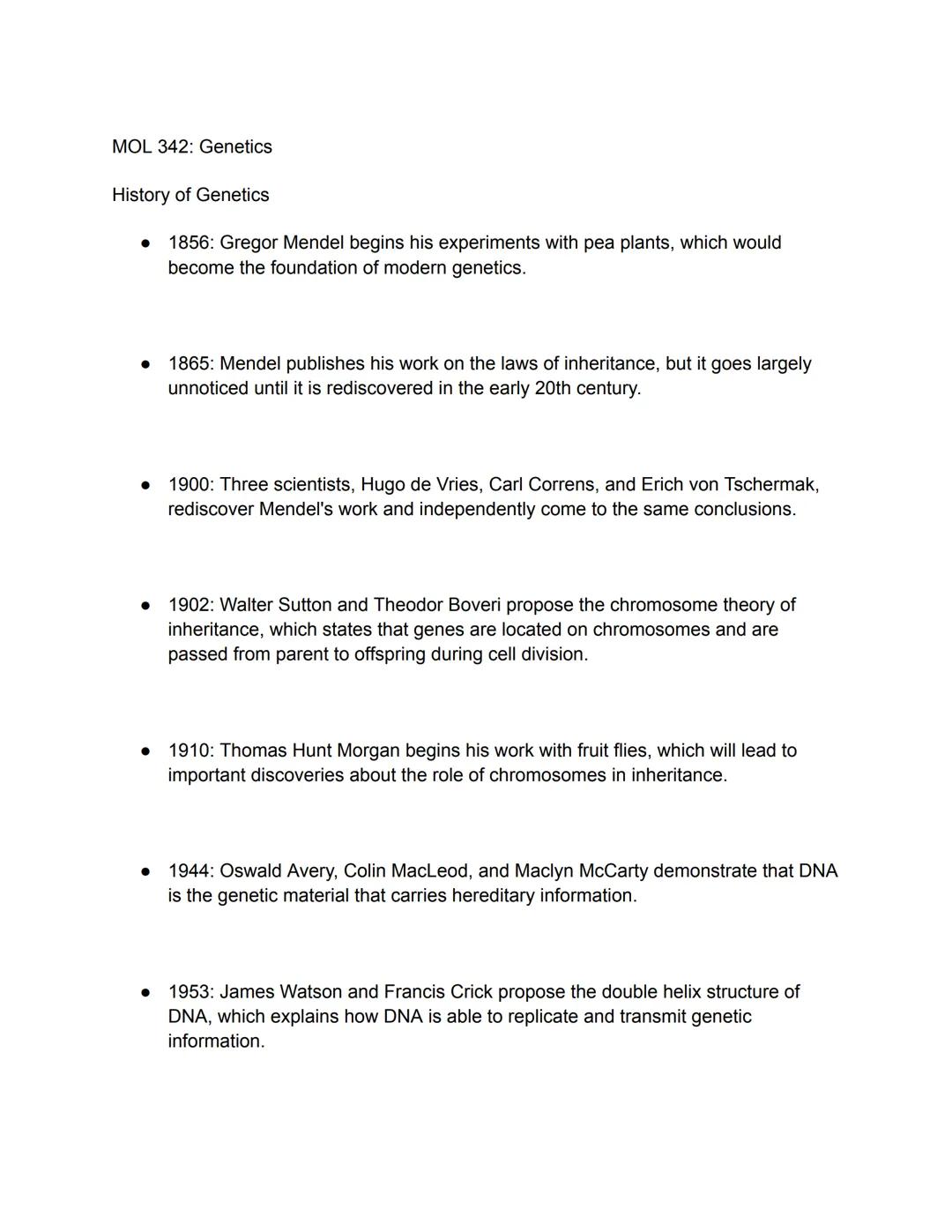
The Birth of Genetics (1856-1944)
It all started in 1856 when Gregor Mendel began experimenting with pea plants, establishing what would become the foundation of modern genetics. Though Mendel published his groundbreaking laws of inheritance in 1865, his work went largely unnoticed until 1900, when three scientists independently rediscovered his findings.
The early 1900s saw rapid advancement in genetic understanding. Walter Sutton and Theodor Boveri proposed the chromosome theory of inheritance in 1902, suggesting genes reside on chromosomes that pass from parent to offspring. Thomas Hunt Morgan's research with fruit flies starting in 1910 provided crucial evidence about chromosomes' role in inheritance.
A pivotal moment came in 1944 when Oswald Avery and colleagues demonstrated that DNA is the genetic material carrying hereditary information. This discovery set the stage for Watson and Crick's revolutionary 1953 proposal of DNA's double helix structure, which explained how genetic information could be replicated and transmitted.
Fun Fact: Mendel's work was so ahead of its time that it took 35 years for the scientific community to recognize its importance!
2
of 2
Modern Genetics Revolution
The late 20th century saw genetics transform from theoretical science to practical application. Frederick Sanger's development of DNA sequencing in 1977 revolutionized how we study genes, allowing scientists to read genetic code for the first time. By 1983, Kary Mullis had invented the polymerase chain reaction (PCR), which amplifies specific DNA sequences and remains essential in genetic research today.
Ambitious large-scale projects soon followed. The Human Genome Project launched in 1990 with the massive goal of sequencing our entire genome—a feat completed in 2003. This achievement opened doors to personalized medicine and deeper understanding of human diseases. By 2005, scientists had even drafted the first Neanderthal genome, providing unprecedented insights into human evolution.
The field continues advancing at breakneck speed. In 2020, the CRISPR-Cas9 gene editing technology received the Nobel Prize in Chemistry, recognizing its revolutionary potential. This precise "genetic scissors" tool allows scientists to modify DNA with incredible accuracy, promising new treatments for genetic diseases.
Think About It: From pea plants to gene editing, the tools of genetics have evolved dramatically, but the fundamental questions remain the same: how are traits inherited, and how can we use this knowledge to improve lives?
We thought you’d never ask...
What is the Knowunity AI companion?
Our AI companion is specifically built for the needs of students. Based on the millions of content pieces we have on the platform we can provide truly meaningful and relevant answers to students. But its not only about answers, the companion is even more about guiding students through their daily learning challenges, with personalised study plans, quizzes or content pieces in the chat and 100% personalisation based on the students skills and developments.
Where can I download the Knowunity app?
You can download the app in the Google Play Store and in the Apple App Store.
Is Knowunity really free of charge?
That's right! Enjoy free access to study content, connect with fellow students, and get instant help – all at your fingertips.
Similar Content
 Biology
Most popular content in AP Biology
9I
AP BiologyIntroduction to Biological Elements of Life
Practice identifying the essential elements including carbon, nitrogen, phosphorus, and sulfur that compose biological macromolecules.
9th1,7390
I
AP BiologyIntroduction to Water Polarity and Bonding
Practice identifying partial charges and the chemical basis of hydrogen bond formation between polar water molecules.
9th8520
I
AP BiologyIntroduction to Biological Macromolecules
Practice identifying the four classes of biological macromolecules and the dehydration synthesis reactions that form their covalent bonds.
9th5890
I
AP BiologyIntroduction to Biological Macromolecules
Practice identifying the monomers and chemical compositions of carbohydrates, lipids, proteins, and nucleic acids in biological systems.
9th4460
I
AP BiologyIntroduction to Cell Compartmentalization
Practice identifying how membrane-bound organelles increase surface area and facilitate specialized chemical reactions in eukaryotic cells.
9th3370
C
AP BiologyComponents of the Plasma Membrane
Practice identifying the molecular structure of phospholipids, proteins, cholesterol, and carbohydrates within the fluid mosaic model.
9th2720
I
AP BiologyIntroduction to Evidence of Evolution
Practice identifying fundamental concepts of common ancestry, including homologous structures, vestigial traits, and the fossil record.
9th2010
AP BiologyBio 1000 Chapter 2 The Molecules of Cells
Cell Make up
College55211
F
AP BiologyFundamentals of Cell Size and Surface Area
Practice calculating surface area-to-volume ratios and defining how these geometric constraints limit the maximum size of a functional biological cell.
9th1550
Most popular content
9O
 AP US History
Origins and Dynamics of the Columbian Exchange
Analyze the ecological and economic motivations behind the initial transfer of goods, people, and diseases between the Old and New Worlds.
9th3,1280
I
AP US HistoryIntroduction to Early Cultural Interactions
Analyze the initial social and religious encounters between Europeans, Africans, and Indigenous peoples in the colonial Americas.
9th2,7730
O
 AP World History
Origins of Ancient River Civilizations
Analyze the environmental factors and technological innovations that led to the rise of early states in Mesopotamia, Egypt, and the Indus Valley.
9th3,1870
M
AP US HistoryMotivations for European Exploration
Analyze the economic, religious, and political factors that drove European powers to the Americas during the 15th and 16th centuries.
9th1,7780
F
 AP Psychology
Foundations of Ethical Guidelines in Research
Practice the core principles of the APA ethical code including informed consent, debriefing, and the role of Institutional Review Boards.
9th1,3360
I
AP US HistoryIntroduction to Native American Societies
Examine the diverse social, political, and economic structures of North American indigenous groups prior to European contact.
9th1,1100
I
AP BiologyIntroduction to Biological Elements of Life
Practice identifying the essential elements including carbon, nitrogen, phosphorus, and sulfur that compose biological macromolecules.
9th1,7390
I
AP US HistoryIntroduction to the Spanish Encomienda System
Explore the fundamental economic and social structures of the Spanish colonial system, focusing on the encomienda and the casta social hierarchy.
9th8890
O
AP World HistoryOrigins and Continuity of the Byzantine Empire
Analyze the political and cultural transitions from the Roman Empire to the Byzantine Empire, focusing on the reign of Justinian I and his code.
9th1,6320
Can't find what you're looking for? Explore other subjects.
Students love us — and so will you.
4.6/5App Store
4.7/5Google Play
The app is very easy to use and well designed. I have found everything I was looking for so far and have been able to learn a lot from the presentations! I will definitely use the app for a class assignment! And of course it also helps a lot as an inspiration.
Stefan SiOS user
This app is really great. There are so many study notes and help [...]. My problem subject is French, for example, and the app has so many options for help. Thanks to this app, I have improved my French. I would recommend it to anyone.
Samantha KlichAndroid user
Wow, I am really amazed. I just tried the app because I've seen it advertised many times and was absolutely stunned. This app is THE HELP you want for school and above all, it offers so many things, such as workouts and fact sheets, which have been VERY helpful to me personally.
AnnaiOS user
AP Biology31 views·Updated Jun 7, 2026·2 pagesA Journey Through the History of Genetics
A
Aaron Jackson@aaronjackson_kbwj
Genetics, the study of how traits are inherited, has evolved dramatically from humble beginnings with pea plants to today's revolutionary gene editing technologies. This fascinating scientific journey spans over 150 years and has fundamentally changed our understanding of life itself.
1
of 2
Sign up to see the content. It's free!
- Access to all documents
- Improve your grades
- Join milions of students
The Birth of Genetics (1856-1944)
It all started in 1856 when Gregor Mendel began experimenting with pea plants, establishing what would become the foundation of modern genetics. Though Mendel published his groundbreaking laws of inheritance in 1865, his work went largely unnoticed until 1900, when three scientists independently rediscovered his findings.
The early 1900s saw rapid advancement in genetic understanding. Walter Sutton and Theodor Boveri proposed the chromosome theory of inheritance in 1902, suggesting genes reside on chromosomes that pass from parent to offspring. Thomas Hunt Morgan's research with fruit flies starting in 1910 provided crucial evidence about chromosomes' role in inheritance.
A pivotal moment came in 1944 when Oswald Avery and colleagues demonstrated that DNA is the genetic material carrying hereditary information. This discovery set the stage for Watson and Crick's revolutionary 1953 proposal of DNA's double helix structure, which explained how genetic information could be replicated and transmitted.
Fun Fact: Mendel's work was so ahead of its time that it took 35 years for the scientific community to recognize its importance!
2
of 2Sign up to see the content. It's free!
- Access to all documents
- Improve your grades
- Join milions of students
Modern Genetics Revolution
The late 20th century saw genetics transform from theoretical science to practical application. Frederick Sanger's development of DNA sequencing in 1977 revolutionized how we study genes, allowing scientists to read genetic code for the first time. By 1983, Kary Mullis had invented the polymerase chain reaction (PCR), which amplifies specific DNA sequences and remains essential in genetic research today.
Ambitious large-scale projects soon followed. The Human Genome Project launched in 1990 with the massive goal of sequencing our entire genome—a feat completed in 2003. This achievement opened doors to personalized medicine and deeper understanding of human diseases. By 2005, scientists had even drafted the first Neanderthal genome, providing unprecedented insights into human evolution.
The field continues advancing at breakneck speed. In 2020, the CRISPR-Cas9 gene editing technology received the Nobel Prize in Chemistry, recognizing its revolutionary potential. This precise "genetic scissors" tool allows scientists to modify DNA with incredible accuracy, promising new treatments for genetic diseases.
Think About It: From pea plants to gene editing, the tools of genetics have evolved dramatically, but the fundamental questions remain the same: how are traits inherited, and how can we use this knowledge to improve lives?
We thought you’d never ask...
What is the Knowunity AI companion?
Our AI companion is specifically built for the needs of students. Based on the millions of content pieces we have on the platform we can provide truly meaningful and relevant answers to students. But its not only about answers, the companion is even more about guiding students through their daily learning challenges, with personalised study plans, quizzes or content pieces in the chat and 100% personalisation based on the students skills and developments.
Where can I download the Knowunity app?
You can download the app in the Google Play Store and in the Apple App Store.
Is Knowunity really free of charge?
That's right! Enjoy free access to study content, connect with fellow students, and get instant help – all at your fingertips.
Similar Content
Most popular content in AP Biology
9I
AP BiologyIntroduction to Biological Elements of Life
Practice identifying the essential elements including carbon, nitrogen, phosphorus, and sulfur that compose biological macromolecules.
9th1,7390
I
AP BiologyIntroduction to Water Polarity and Bonding
Practice identifying partial charges and the chemical basis of hydrogen bond formation between polar water molecules.
9th8520
I
AP BiologyIntroduction to Biological Macromolecules
Practice identifying the four classes of biological macromolecules and the dehydration synthesis reactions that form their covalent bonds.
9th5890
I
AP BiologyIntroduction to Biological Macromolecules
Practice identifying the monomers and chemical compositions of carbohydrates, lipids, proteins, and nucleic acids in biological systems.
9th4460
I
AP BiologyIntroduction to Cell Compartmentalization
Practice identifying how membrane-bound organelles increase surface area and facilitate specialized chemical reactions in eukaryotic cells.
9th3370
C
AP BiologyComponents of the Plasma Membrane
Practice identifying the molecular structure of phospholipids, proteins, cholesterol, and carbohydrates within the fluid mosaic model.
9th2720
I
AP BiologyIntroduction to Evidence of Evolution
Practice identifying fundamental concepts of common ancestry, including homologous structures, vestigial traits, and the fossil record.
9th2010
AP BiologyBio 1000 Chapter 2 The Molecules of Cells
Cell Make up
College55211
F
AP BiologyFundamentals of Cell Size and Surface Area
Practice calculating surface area-to-volume ratios and defining how these geometric constraints limit the maximum size of a functional biological cell.
9th1550
Most popular content
9O
AP US HistoryOrigins and Dynamics of the Columbian Exchange
Analyze the ecological and economic motivations behind the initial transfer of goods, people, and diseases between the Old and New Worlds.
9th3,1280
I
AP US HistoryIntroduction to Early Cultural Interactions
Analyze the initial social and religious encounters between Europeans, Africans, and Indigenous peoples in the colonial Americas.
9th2,7730
O
AP World HistoryOrigins of Ancient River Civilizations
Analyze the environmental factors and technological innovations that led to the rise of early states in Mesopotamia, Egypt, and the Indus Valley.
9th3,1870
M
AP US HistoryMotivations for European Exploration
Analyze the economic, religious, and political factors that drove European powers to the Americas during the 15th and 16th centuries.
9th1,7780
F
AP PsychologyFoundations of Ethical Guidelines in Research
Practice the core principles of the APA ethical code including informed consent, debriefing, and the role of Institutional Review Boards.
9th1,3360
I
AP US HistoryIntroduction to Native American Societies
Examine the diverse social, political, and economic structures of North American indigenous groups prior to European contact.
9th1,1100
I
AP BiologyIntroduction to Biological Elements of Life
Practice identifying the essential elements including carbon, nitrogen, phosphorus, and sulfur that compose biological macromolecules.
9th1,7390
I
AP US HistoryIntroduction to the Spanish Encomienda System
Explore the fundamental economic and social structures of the Spanish colonial system, focusing on the encomienda and the casta social hierarchy.
9th8890
O
AP World HistoryOrigins and Continuity of the Byzantine Empire
Analyze the political and cultural transitions from the Roman Empire to the Byzantine Empire, focusing on the reign of Justinian I and his code.
9th1,6320
Can't find what you're looking for? Explore other subjects.
Students love us — and so will you.
4.6/5App Store
4.7/5Google Play
The app is very easy to use and well designed. I have found everything I was looking for so far and have been able to learn a lot from the presentations! I will definitely use the app for a class assignment! And of course it also helps a lot as an inspiration.
Stefan SiOS user
This app is really great. There are so many study notes and help [...]. My problem subject is French, for example, and the app has so many options for help. Thanks to this app, I have improved my French. I would recommend it to anyone.
Samantha KlichAndroid user
Wow, I am really amazed. I just tried the app because I've seen it advertised many times and was absolutely stunned. This app is THE HELP you want for school and above all, it offers so many things, such as workouts and fact sheets, which have been VERY helpful to me personally.
AnnaiOS user