

The origin of life on Earth is one of science's...
 AP Biology79 views·Updated Jun 19, 2026·5 pages
Exploring the Origin of Life on Earth: AP Bio Topic 7.13

1 / 5
1
of 5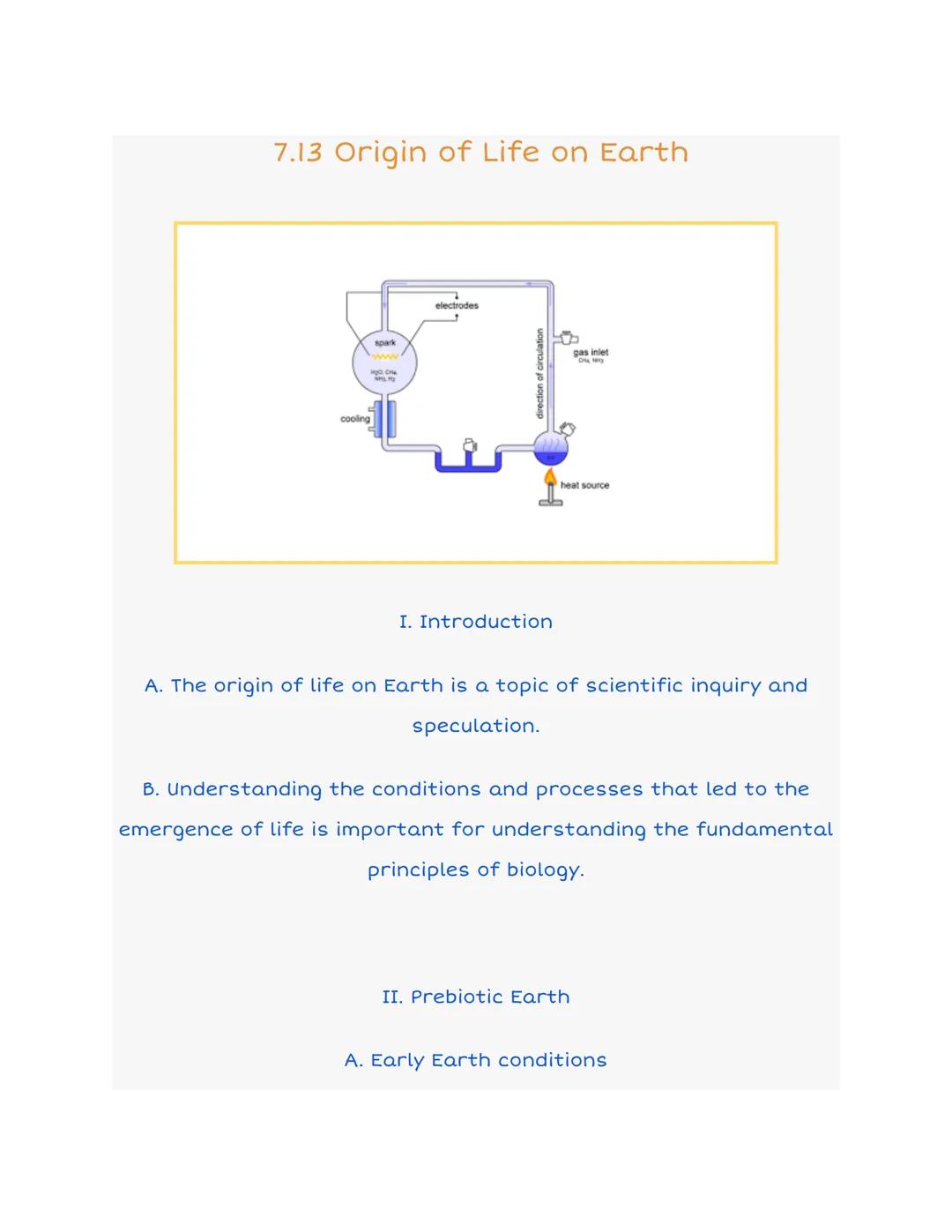
Origin of Life on Earth
Life's beginning on Earth involves complex scientific research that combines biology, chemistry, and geology. Scientists study this topic to understand the fundamental principles that make life possible in the first place.
The early Earth was nothing like our modern world. Instead of oxygen-rich air, our planet had a "reducing atmosphere" lacking free oxygen. Imagine a primitive landscape with constant volcanic eruptions, frequent lightning strikes, and intense ultraviolet radiation from the sun.
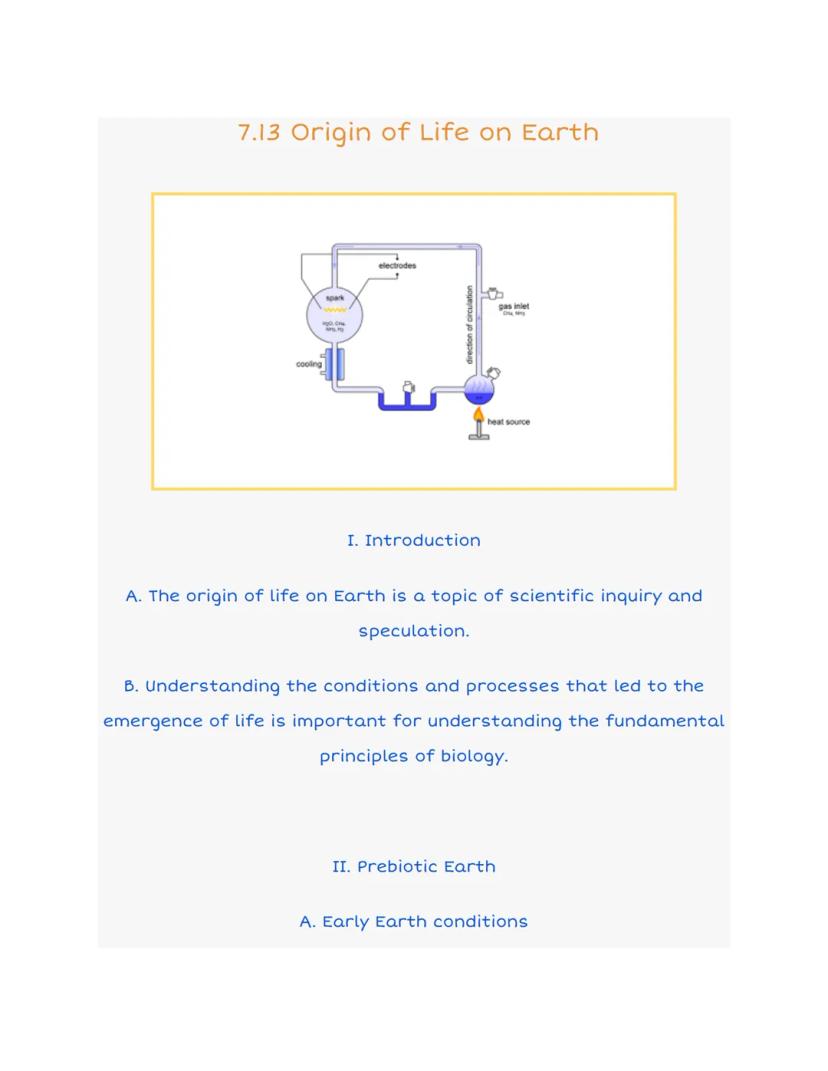
Think About It: The famous apparatus shown in this image is the Miller-Urey experiment setup, which simulated early Earth conditions in a laboratory. This groundbreaking experiment showed that the building blocks of life could form naturally under the right conditions!
2
of 5
Early Earth and Prebiotic Chemistry
Our planet formed about 4.6 billion years ago, but the first evidence of life didn't appear until around 3.5 billion years ago. During that billion-year gap, Earth was developing the conditions necessary for life to emerge.
The Miller-Urey experiment in 1953 was a game-changer in understanding life's origins. Stanley Miller and Harold Urey created a sealed apparatus containing water, methane, ammonia, and hydrogen (simulating early Earth conditions), then added electrical sparks to mimic lightning. Amazingly, after just a week, they discovered amino acids had formed – the basic building blocks of proteins!
Following this breakthrough, numerous experiments have demonstrated that many essential biological molecules can form naturally under similar conditions. These include not just amino acids but also nucleotides and lipids (cell membrane components).
Cool Fact: You're made of the same types of molecules that can form spontaneously under the right conditions - you're connected to chemistry that's as old as Earth itself!
3
of 5
Origin of Organic Compounds
Amino acids are the building blocks that link together to form proteins, which do most of the work in your cells. The Miller-Urey experiment proved these crucial molecules could form spontaneously in Earth's early environment through simple chemical reactions.
Nucleotides, the building blocks of DNA and RNA, can also form under prebiotic conditions. These complex molecules consist of three parts: a sugar, a phosphate group, and a nitrogenous base. Scientists have demonstrated ways all these components could have formed naturally on early Earth.
Lipids, which make up cell membranes, likely emerged from fatty acids and glycerol that formed in prebiotic conditions. What makes lipids special is their ability to spontaneously form bilayers in water – creating enclosed spaces that could have become the first primitive cells.
Why This Matters: Understanding how these organic compounds formed naturally helps explain how life could emerge without any outside intervention – just chemistry following its natural course under the right conditions!
4
of 5
Emergence of Protocells
Protocells represent a crucial step between non-living chemistry and the first true cells. These simple structures were likely lipid bubbles capable of enclosing genetic material and performing basic metabolic functions. They weren't alive as we define it today, but they had some life-like properties.
The RNA world hypothesis suggests early life was based entirely on RNA rather than DNA. This makes sense because RNA can both store genetic information (like DNA) and catalyze chemical reactions (like proteins). This dual function makes RNA a perfect molecule for early life before more complex systems evolved.
Scientific evidence supporting these theories comes from both laboratory experiments and geological studies. Researchers can create protocell-like structures in the lab and find evidence of early life forms in ancient rocks, helping piece together how life began.
Mind-Blowing Idea: The boundary between non-living chemistry and living organisms isn't a sharp line but a gradual transition that happened over millions of years!
5
of 5
Future Research and Implications
Understanding life's origins isn't just about looking backward – it has profound implications for the future. The more we learn about how life began on Earth, the better we can identify where life might exist elsewhere in the universe.
Scientists continue to refine theories about life's origins by conducting new experiments that simulate early Earth conditions. These studies help us identify the specific pathways and environments that make the transition from chemistry to biology possible.
When we understand exactly what conditions allowed life to emerge on Earth, we'll have a much better idea of where to look for life on other planets and moons. This knowledge directly informs our search for extraterrestrial life in our solar system and beyond.
Think Bigger: The next time you look at the night sky, remember that the same chemical principles that created life on Earth might be creating life on countless other worlds throughout the universe!
We thought you’d never ask...
What is the Knowunity AI companion?
Our AI companion is specifically built for the needs of students. Based on the millions of content pieces we have on the platform we can provide truly meaningful and relevant answers to students. But its not only about answers, the companion is even more about guiding students through their daily learning challenges, with personalised study plans, quizzes or content pieces in the chat and 100% personalisation based on the students skills and developments.
Where can I download the Knowunity app?
You can download the app in the Google Play Store and in the Apple App Store.
Is Knowunity really free of charge?
That's right! Enjoy free access to study content, connect with fellow students, and get instant help – all at your fingertips.
Most popular content: Origin of Life
1Most popular content in AP Biology
9I
AP BiologyIntroduction to Biological Elements of Life
Practice identifying the essential elements including carbon, nitrogen, phosphorus, and sulfur that compose biological macromolecules.
9th1,7390
I
AP BiologyIntroduction to Water Polarity and Bonding
Practice identifying partial charges and the chemical basis of hydrogen bond formation between polar water molecules.
9th8520
I
AP BiologyIntroduction to Biological Macromolecules
Practice identifying the four classes of biological macromolecules and the dehydration synthesis reactions that form their covalent bonds.
9th5890
I
AP BiologyIntroduction to Biological Macromolecules
Practice identifying the monomers and chemical compositions of carbohydrates, lipids, proteins, and nucleic acids in biological systems.
9th4460
I
AP BiologyIntroduction to Cell Compartmentalization
Practice identifying how membrane-bound organelles increase surface area and facilitate specialized chemical reactions in eukaryotic cells.
9th3370
C
AP BiologyComponents of the Plasma Membrane
Practice identifying the molecular structure of phospholipids, proteins, cholesterol, and carbohydrates within the fluid mosaic model.
9th2720
I
AP BiologyIntroduction to Evidence of Evolution
Practice identifying fundamental concepts of common ancestry, including homologous structures, vestigial traits, and the fossil record.
9th2010
AP BiologyBio 1000 Chapter 2 The Molecules of Cells
Cell Make up
College55211
F
AP BiologyFundamentals of Cell Size and Surface Area
Practice calculating surface area-to-volume ratios and defining how these geometric constraints limit the maximum size of a functional biological cell.
9th1550
Most popular content
9O
 AP US History
Origins and Dynamics of the Columbian Exchange
Analyze the ecological and economic motivations behind the initial transfer of goods, people, and diseases between the Old and New Worlds.
9th3,1280
I
AP US HistoryIntroduction to Early Cultural Interactions
Analyze the initial social and religious encounters between Europeans, Africans, and Indigenous peoples in the colonial Americas.
9th2,7730
O
 AP World History
Origins of Ancient River Civilizations
Analyze the environmental factors and technological innovations that led to the rise of early states in Mesopotamia, Egypt, and the Indus Valley.
9th3,1870
M
AP US HistoryMotivations for European Exploration
Analyze the economic, religious, and political factors that drove European powers to the Americas during the 15th and 16th centuries.
9th1,7780
F
 AP Psychology
Foundations of Ethical Guidelines in Research
Practice the core principles of the APA ethical code including informed consent, debriefing, and the role of Institutional Review Boards.
9th1,3360
I
AP US HistoryIntroduction to Native American Societies
Examine the diverse social, political, and economic structures of North American indigenous groups prior to European contact.
9th1,1100
I
AP BiologyIntroduction to Biological Elements of Life
Practice identifying the essential elements including carbon, nitrogen, phosphorus, and sulfur that compose biological macromolecules.
9th1,7390
I
AP US HistoryIntroduction to the Spanish Encomienda System
Explore the fundamental economic and social structures of the Spanish colonial system, focusing on the encomienda and the casta social hierarchy.
9th8890
O
AP World HistoryOrigins and Continuity of the Byzantine Empire
Analyze the political and cultural transitions from the Roman Empire to the Byzantine Empire, focusing on the reign of Justinian I and his code.
9th1,6320
Can't find what you're looking for? Explore other subjects.
Students love us — and so will you.
4.6/5App Store
4.7/5Google Play
The app is very easy to use and well designed. I have found everything I was looking for so far and have been able to learn a lot from the presentations! I will definitely use the app for a class assignment! And of course it also helps a lot as an inspiration.
Stefan SiOS user
This app is really great. There are so many study notes and help [...]. My problem subject is French, for example, and the app has so many options for help. Thanks to this app, I have improved my French. I would recommend it to anyone.
Samantha KlichAndroid user
Wow, I am really amazed. I just tried the app because I've seen it advertised many times and was absolutely stunned. This app is THE HELP you want for school and above all, it offers so many things, such as workouts and fact sheets, which have been VERY helpful to me personally.
AnnaiOS user
AP Biology79 views·Updated Jun 19, 2026·5 pagesExploring the Origin of Life on Earth: AP Bio Topic 7.13
The origin of life on Earth is one of science's greatest mysteries, exploring how non-living chemicals transformed into the first living organisms. This fascinating journey happened roughly a billion years after Earth formed, under conditions dramatically different from today's world.
1
of 5
Sign up to see the content. It's free!
- Access to all documents
- Improve your grades
- Join milions of students
Origin of Life on Earth
Life's beginning on Earth involves complex scientific research that combines biology, chemistry, and geology. Scientists study this topic to understand the fundamental principles that make life possible in the first place.
The early Earth was nothing like our modern world. Instead of oxygen-rich air, our planet had a "reducing atmosphere" lacking free oxygen. Imagine a primitive landscape with constant volcanic eruptions, frequent lightning strikes, and intense ultraviolet radiation from the sun.
Think About It: The famous apparatus shown in this image is the Miller-Urey experiment setup, which simulated early Earth conditions in a laboratory. This groundbreaking experiment showed that the building blocks of life could form naturally under the right conditions!
2
of 5Sign up to see the content. It's free!
- Access to all documents
- Improve your grades
- Join milions of students
Early Earth and Prebiotic Chemistry
Our planet formed about 4.6 billion years ago, but the first evidence of life didn't appear until around 3.5 billion years ago. During that billion-year gap, Earth was developing the conditions necessary for life to emerge.
The Miller-Urey experiment in 1953 was a game-changer in understanding life's origins. Stanley Miller and Harold Urey created a sealed apparatus containing water, methane, ammonia, and hydrogen (simulating early Earth conditions), then added electrical sparks to mimic lightning. Amazingly, after just a week, they discovered amino acids had formed – the basic building blocks of proteins!
Following this breakthrough, numerous experiments have demonstrated that many essential biological molecules can form naturally under similar conditions. These include not just amino acids but also nucleotides and lipids (cell membrane components).
Cool Fact: You're made of the same types of molecules that can form spontaneously under the right conditions - you're connected to chemistry that's as old as Earth itself!
3
of 5Sign up to see the content. It's free!
- Access to all documents
- Improve your grades
- Join milions of students
Origin of Organic Compounds
Amino acids are the building blocks that link together to form proteins, which do most of the work in your cells. The Miller-Urey experiment proved these crucial molecules could form spontaneously in Earth's early environment through simple chemical reactions.
Nucleotides, the building blocks of DNA and RNA, can also form under prebiotic conditions. These complex molecules consist of three parts: a sugar, a phosphate group, and a nitrogenous base. Scientists have demonstrated ways all these components could have formed naturally on early Earth.
Lipids, which make up cell membranes, likely emerged from fatty acids and glycerol that formed in prebiotic conditions. What makes lipids special is their ability to spontaneously form bilayers in water – creating enclosed spaces that could have become the first primitive cells.
Why This Matters: Understanding how these organic compounds formed naturally helps explain how life could emerge without any outside intervention – just chemistry following its natural course under the right conditions!
4
of 5Sign up to see the content. It's free!
- Access to all documents
- Improve your grades
- Join milions of students
Emergence of Protocells
Protocells represent a crucial step between non-living chemistry and the first true cells. These simple structures were likely lipid bubbles capable of enclosing genetic material and performing basic metabolic functions. They weren't alive as we define it today, but they had some life-like properties.
The RNA world hypothesis suggests early life was based entirely on RNA rather than DNA. This makes sense because RNA can both store genetic information (like DNA) and catalyze chemical reactions (like proteins). This dual function makes RNA a perfect molecule for early life before more complex systems evolved.
Scientific evidence supporting these theories comes from both laboratory experiments and geological studies. Researchers can create protocell-like structures in the lab and find evidence of early life forms in ancient rocks, helping piece together how life began.
Mind-Blowing Idea: The boundary between non-living chemistry and living organisms isn't a sharp line but a gradual transition that happened over millions of years!
5
of 5Sign up to see the content. It's free!
- Access to all documents
- Improve your grades
- Join milions of students
Future Research and Implications
Understanding life's origins isn't just about looking backward – it has profound implications for the future. The more we learn about how life began on Earth, the better we can identify where life might exist elsewhere in the universe.
Scientists continue to refine theories about life's origins by conducting new experiments that simulate early Earth conditions. These studies help us identify the specific pathways and environments that make the transition from chemistry to biology possible.
When we understand exactly what conditions allowed life to emerge on Earth, we'll have a much better idea of where to look for life on other planets and moons. This knowledge directly informs our search for extraterrestrial life in our solar system and beyond.
Think Bigger: The next time you look at the night sky, remember that the same chemical principles that created life on Earth might be creating life on countless other worlds throughout the universe!
We thought you’d never ask...
What is the Knowunity AI companion?
Our AI companion is specifically built for the needs of students. Based on the millions of content pieces we have on the platform we can provide truly meaningful and relevant answers to students. But its not only about answers, the companion is even more about guiding students through their daily learning challenges, with personalised study plans, quizzes or content pieces in the chat and 100% personalisation based on the students skills and developments.
Where can I download the Knowunity app?
You can download the app in the Google Play Store and in the Apple App Store.
Is Knowunity really free of charge?
That's right! Enjoy free access to study content, connect with fellow students, and get instant help – all at your fingertips.
Most popular content: Origin of Life
1Most popular content in AP Biology
9I
AP BiologyIntroduction to Biological Elements of Life
Practice identifying the essential elements including carbon, nitrogen, phosphorus, and sulfur that compose biological macromolecules.
9th1,7390
I
AP BiologyIntroduction to Water Polarity and Bonding
Practice identifying partial charges and the chemical basis of hydrogen bond formation between polar water molecules.
9th8520
I
AP BiologyIntroduction to Biological Macromolecules
Practice identifying the four classes of biological macromolecules and the dehydration synthesis reactions that form their covalent bonds.
9th5890
I
AP BiologyIntroduction to Biological Macromolecules
Practice identifying the monomers and chemical compositions of carbohydrates, lipids, proteins, and nucleic acids in biological systems.
9th4460
I
AP BiologyIntroduction to Cell Compartmentalization
Practice identifying how membrane-bound organelles increase surface area and facilitate specialized chemical reactions in eukaryotic cells.
9th3370
C
AP BiologyComponents of the Plasma Membrane
Practice identifying the molecular structure of phospholipids, proteins, cholesterol, and carbohydrates within the fluid mosaic model.
9th2720
I
AP BiologyIntroduction to Evidence of Evolution
Practice identifying fundamental concepts of common ancestry, including homologous structures, vestigial traits, and the fossil record.
9th2010
AP BiologyBio 1000 Chapter 2 The Molecules of Cells
Cell Make up
College55211
F
AP BiologyFundamentals of Cell Size and Surface Area
Practice calculating surface area-to-volume ratios and defining how these geometric constraints limit the maximum size of a functional biological cell.
9th1550
Most popular content
9O
AP US HistoryOrigins and Dynamics of the Columbian Exchange
Analyze the ecological and economic motivations behind the initial transfer of goods, people, and diseases between the Old and New Worlds.
9th3,1280
I
AP US HistoryIntroduction to Early Cultural Interactions
Analyze the initial social and religious encounters between Europeans, Africans, and Indigenous peoples in the colonial Americas.
9th2,7730
O
AP World HistoryOrigins of Ancient River Civilizations
Analyze the environmental factors and technological innovations that led to the rise of early states in Mesopotamia, Egypt, and the Indus Valley.
9th3,1870
M
AP US HistoryMotivations for European Exploration
Analyze the economic, religious, and political factors that drove European powers to the Americas during the 15th and 16th centuries.
9th1,7780
F
AP PsychologyFoundations of Ethical Guidelines in Research
Practice the core principles of the APA ethical code including informed consent, debriefing, and the role of Institutional Review Boards.
9th1,3360
I
AP US HistoryIntroduction to Native American Societies
Examine the diverse social, political, and economic structures of North American indigenous groups prior to European contact.
9th1,1100
I
AP BiologyIntroduction to Biological Elements of Life
Practice identifying the essential elements including carbon, nitrogen, phosphorus, and sulfur that compose biological macromolecules.
9th1,7390
I
AP US HistoryIntroduction to the Spanish Encomienda System
Explore the fundamental economic and social structures of the Spanish colonial system, focusing on the encomienda and the casta social hierarchy.
9th8890
O
AP World HistoryOrigins and Continuity of the Byzantine Empire
Analyze the political and cultural transitions from the Roman Empire to the Byzantine Empire, focusing on the reign of Justinian I and his code.
9th1,6320
Can't find what you're looking for? Explore other subjects.
Students love us — and so will you.
4.6/5App Store
4.7/5Google Play
The app is very easy to use and well designed. I have found everything I was looking for so far and have been able to learn a lot from the presentations! I will definitely use the app for a class assignment! And of course it also helps a lot as an inspiration.
Stefan SiOS user
This app is really great. There are so many study notes and help [...]. My problem subject is French, for example, and the app has so many options for help. Thanks to this app, I have improved my French. I would recommend it to anyone.
Samantha KlichAndroid user
Wow, I am really amazed. I just tried the app because I've seen it advertised many times and was absolutely stunned. This app is THE HELP you want for school and above all, it offers so many things, such as workouts and fact sheets, which have been VERY helpful to me personally.
AnnaiOS user