

Mutations are changes in an organism's DNA sequence that can...
 AP Biology42 views·Updated Jun 11, 2026·6 pages
Understanding 6.7: Genetic Mutations Explained
1 / 6
1
of 6
Introduction to Mutations
Mutations are permanent changes in the DNA sequence of an organism's genome. Think of DNA as a precise instruction manual - when even small errors occur in this code, the results can vary widely. Some mutations happen randomly during DNA replication, while others are caused by external factors like UV radiation or chemical exposure.
What makes mutations fascinating is their unpredictable impact. Some might have zero effect on an organism, while others could cause significant changes to physical traits or cellular functions.
Quick Fact: Every person carries about 60 new mutations that their parents didn't have! Most of these have no noticeable effect on your health or appearance.
2
of 6
Types of Mutations: Point Mutations
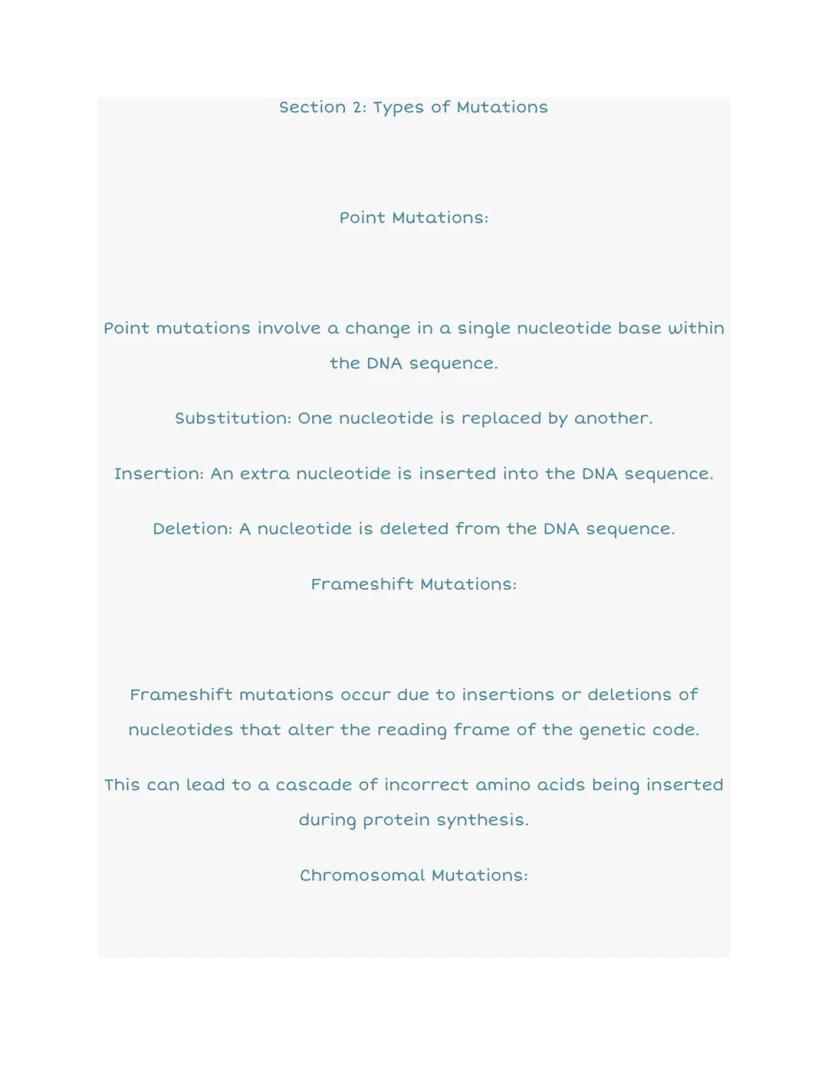
Point mutations are the simplest type of genetic change, involving just a single nucleotide in your DNA. Think of it like changing one letter in a word - sometimes the meaning stays the same, other times it changes completely!
There are three main types of point mutations. Substitution occurs when one nucleotide is swapped for another (like changing "cat" to "bat"). Insertion happens when an extra nucleotide is added into the sequence. Deletion is when a nucleotide is removed entirely from the DNA sequence.
When insertions or deletions occur, they can cause frameshift mutations. Since DNA is read in groups of three nucleotides, adding or removing nucleotides shifts the entire reading frame - like removing a space between words, turning "the cat ate" into "theca tate."
Remember: The genetic code is read in three-letter "words" called codons. Disrupting this reading frame can completely alter the message.
3
of 6
Types of Mutations: Chromosomal Mutations
Chromosomal mutations are much larger changes that affect whole sections of chromosomes. These are like editing entire paragraphs or pages of the genetic instruction manual.
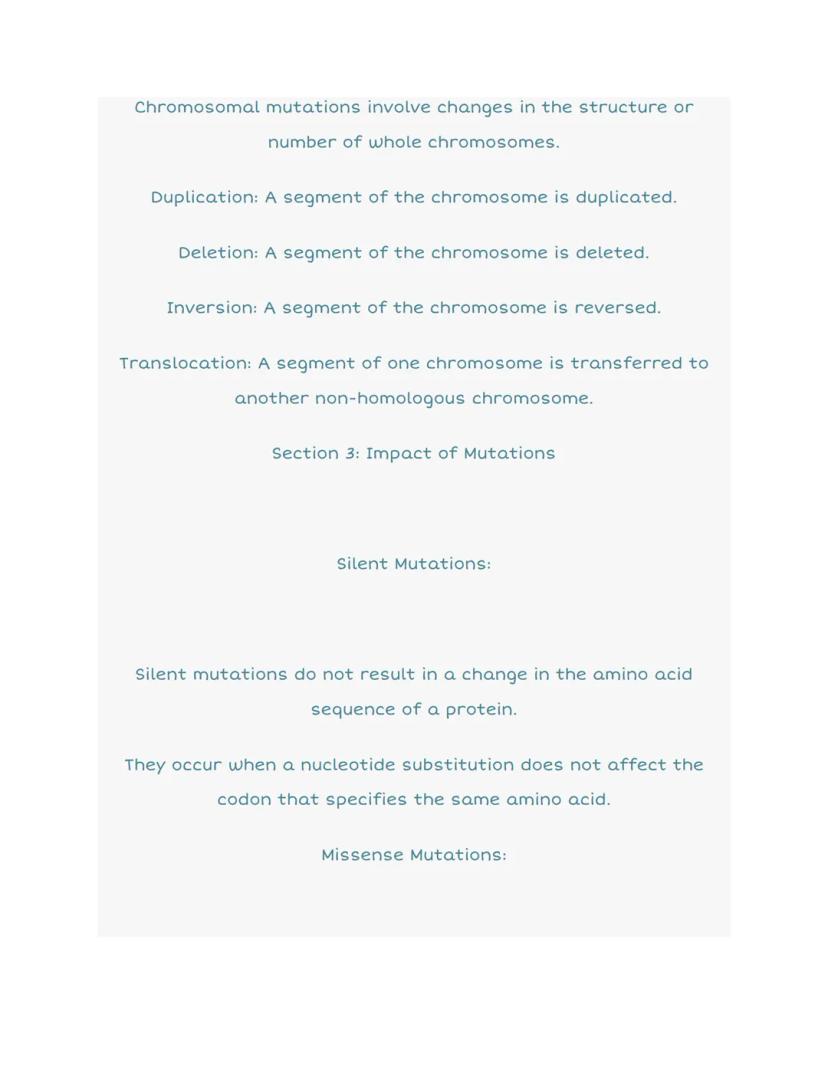
There are several types of chromosomal changes to know. Duplication occurs when a DNA segment appears twice. Deletion removes a chromosome segment entirely. Inversion flips a section of chromosome backward. Translocation happens when a piece of one chromosome breaks off and attaches to a different chromosome.
These large-scale changes often affect multiple genes at once, which can have more dramatic consequences than point mutations.
Study Tip: Think of chromosomal mutations as "macro" changes compared to the "micro" changes of point mutations - they involve much larger portions of DNA.
4
of 6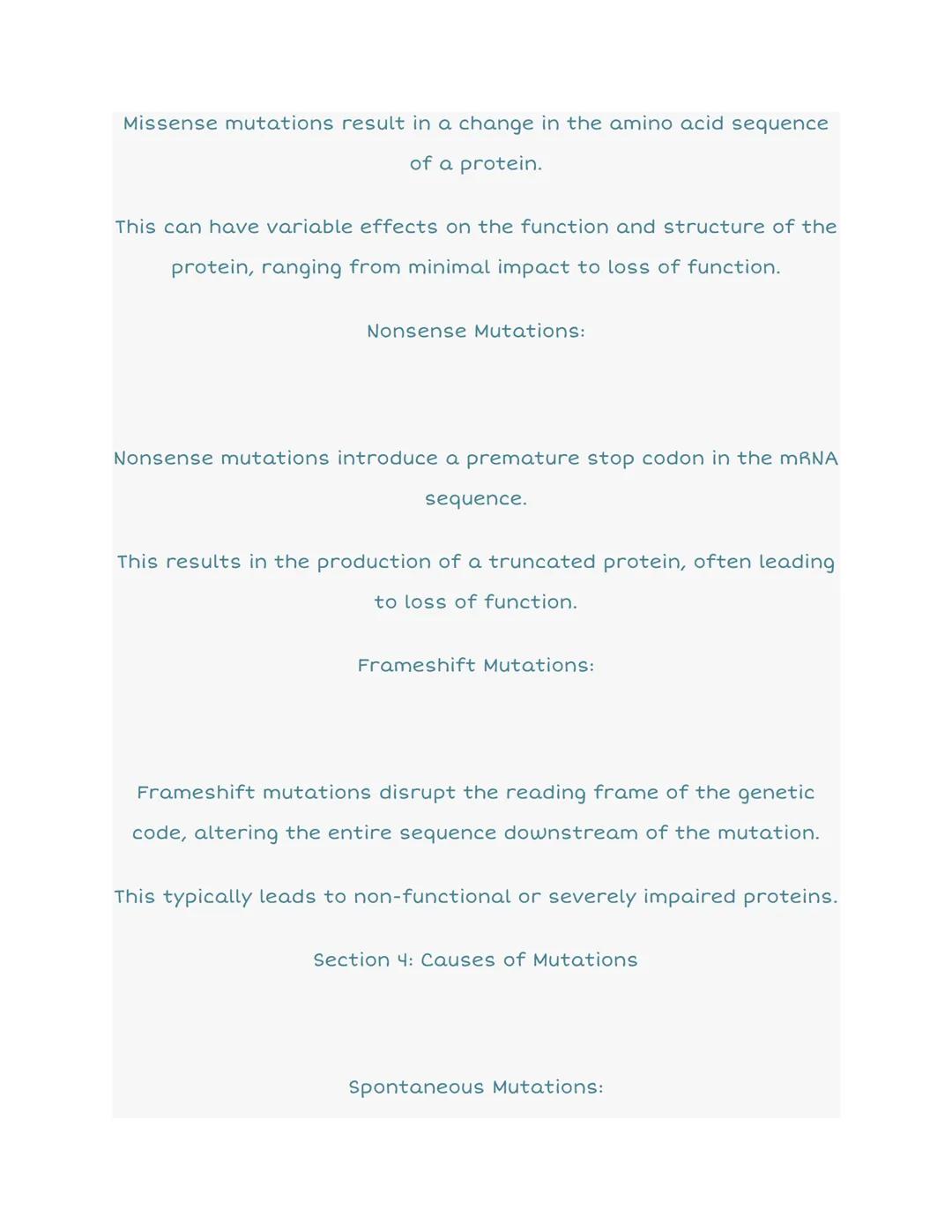
Impact of Mutations
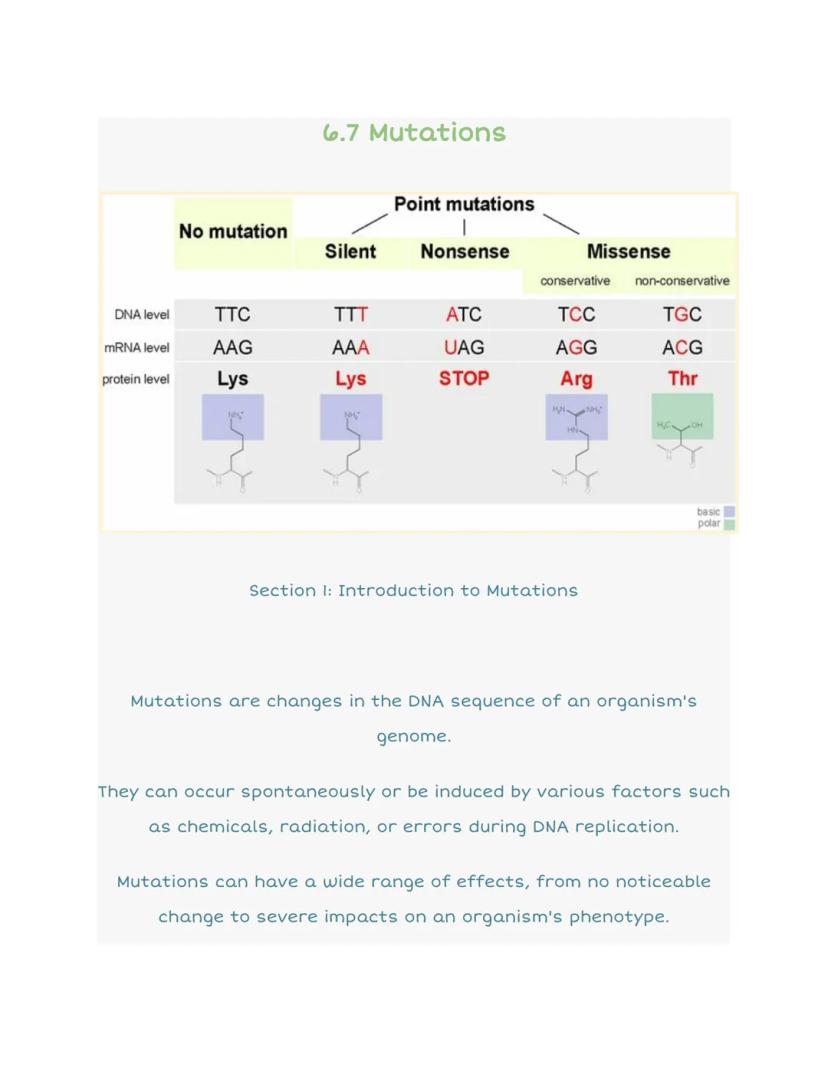
Not all mutations create noticeable changes. Silent mutations change a DNA nucleotide but still produce the same amino acid, so the protein functions normally. It's like changing "color" to "colour" - different spelling, same meaning!
Missense mutations substitute one amino acid for another in the protein. Some missense mutations have minimal effects (conservative), while others dramatically alter protein function .
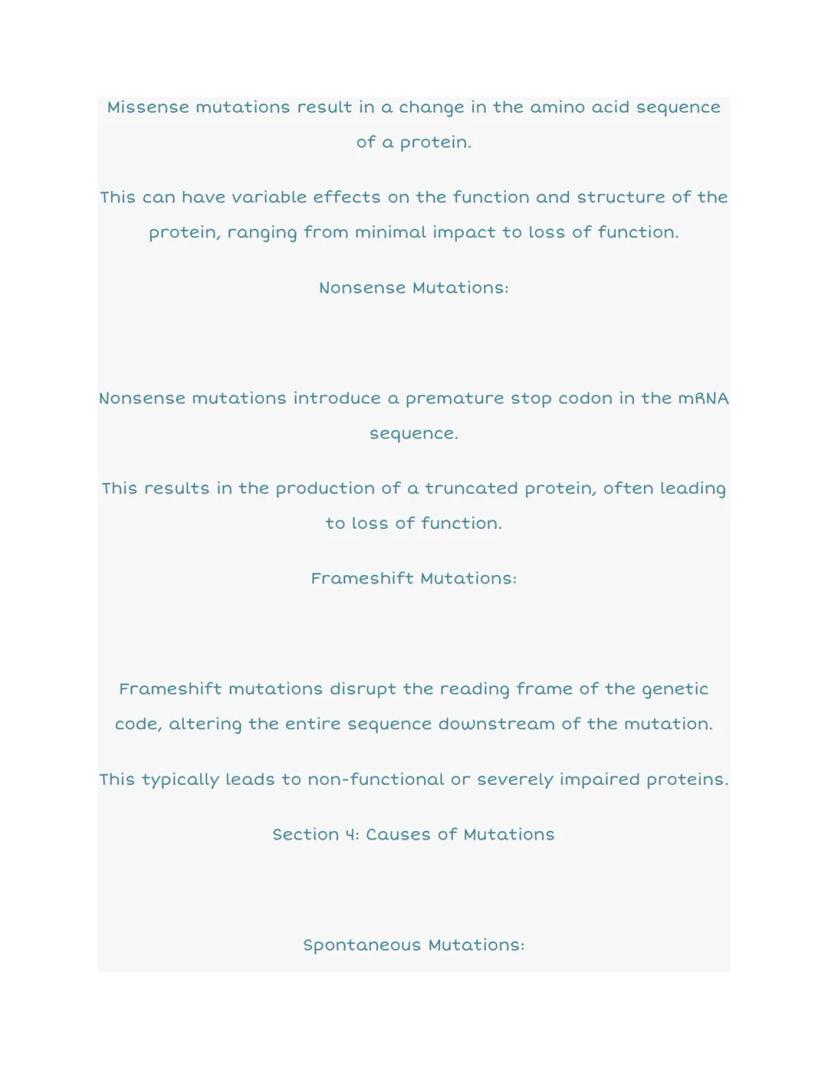
Nonsense mutations introduce a premature "STOP" signal in the genetic code. This creates a shortened, often non-functional protein - like cutting a sentence short before the main point.
Frameshift mutations are typically the most severe. By shifting the DNA reading frame, they change every amino acid after the mutation point, usually producing completely non-functional proteins.
Critical Concept: The impact of a mutation depends largely on where it occurs. A mutation in a non-coding region might have no effect, while the same mutation in a critical gene could be catastrophic.
5
of 6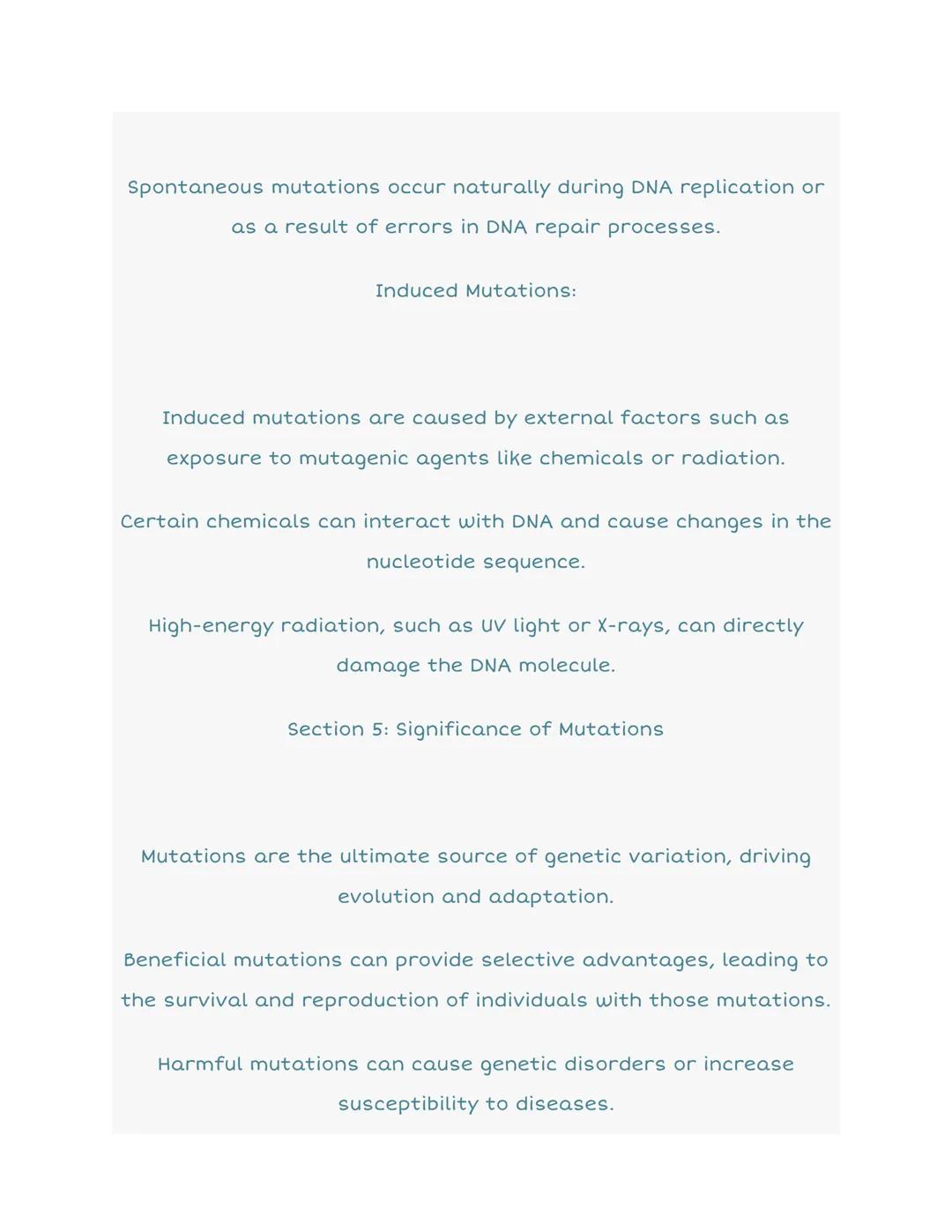
Causes of Mutations
Mutations arise from two main sources. Spontaneous mutations happen naturally during DNA replication. Your cells copy billions of DNA base pairs when they divide, and occasionally make random errors - it's like typos appearing naturally when copying a long document.
Induced mutations come from environmental exposure. Certain chemicals can attach to DNA and alter its structure. Various types of radiation - like UV rays from the sun or X-rays - can break DNA strands or cause abnormal bonds between nucleotides.
Mutations are actually essential for life as we know it. These genetic changes create the variation needed for evolution and adaptation to changing environments. Without mutations, all organisms would remain genetically identical, making species less resilient to environmental changes.
Fascinating Fact: While many mutations are harmful, beneficial mutations have given us everything from lactose tolerance in adults to the ability to live at high altitudes. These adaptations spread through populations over many generations.
6
of 6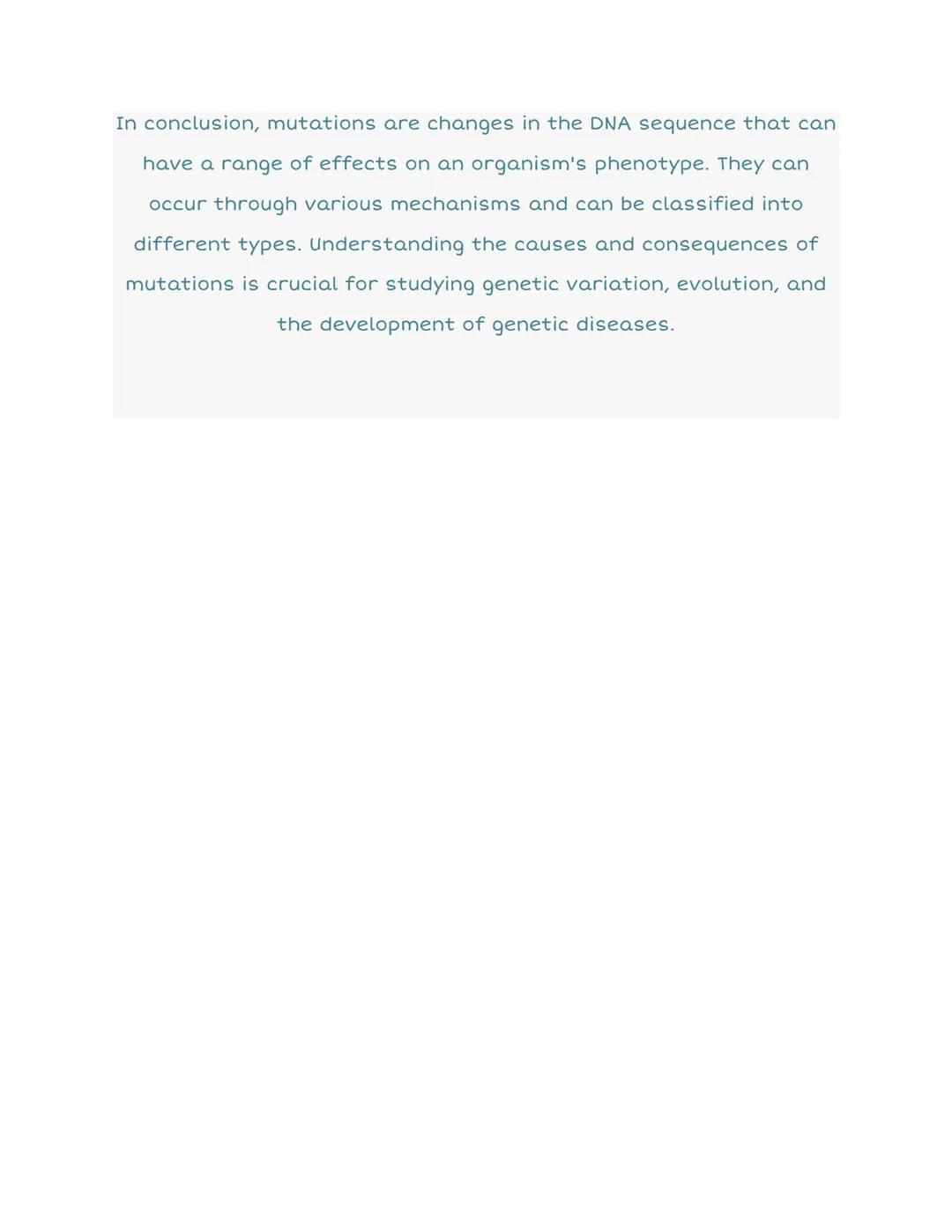
Significance of Mutations
Mutations play a crucial role in both evolution and disease. They're the raw material that drives evolutionary change - when a beneficial mutation arises and helps an organism survive better, natural selection favors it and spreads it through the population.
In medicine, understanding mutations helps us diagnose and treat genetic disorders. Many diseases like cystic fibrosis, sickle cell anemia, and certain cancers result from specific mutations. By identifying these genetic changes, researchers can develop targeted therapies.
Scientists can also induce mutations deliberately in laboratory settings to study gene function or create organisms with desired traits. This process has applications in agriculture, medicine, and biotechnology.
Big Picture: Every trait that makes you unique - from eye color to personality characteristics - is influenced by the specific combination of mutations that have accumulated in your family line over thousands of generations!
We thought you’d never ask...
What is the Knowunity AI companion?
Our AI companion is specifically built for the needs of students. Based on the millions of content pieces we have on the platform we can provide truly meaningful and relevant answers to students. But its not only about answers, the companion is even more about guiding students through their daily learning challenges, with personalised study plans, quizzes or content pieces in the chat and 100% personalisation based on the students skills and developments.
Where can I download the Knowunity app?
You can download the app in the Google Play Store and in the Apple App Store.
Is Knowunity really free of charge?
That's right! Enjoy free access to study content, connect with fellow students, and get instant help – all at your fingertips.
Similar Content
Most popular content in AP Biology
9I
AP BiologyIntroduction to Biological Elements of Life
Practice identifying the essential elements including carbon, nitrogen, phosphorus, and sulfur that compose biological macromolecules.
9th1,7390
I
AP BiologyIntroduction to Water Polarity and Bonding
Practice identifying partial charges and the chemical basis of hydrogen bond formation between polar water molecules.
9th8520
I
AP BiologyIntroduction to Biological Macromolecules
Practice identifying the four classes of biological macromolecules and the dehydration synthesis reactions that form their covalent bonds.
9th5890
I
AP BiologyIntroduction to Biological Macromolecules
Practice identifying the monomers and chemical compositions of carbohydrates, lipids, proteins, and nucleic acids in biological systems.
9th4460
I
AP BiologyIntroduction to Cell Compartmentalization
Practice identifying how membrane-bound organelles increase surface area and facilitate specialized chemical reactions in eukaryotic cells.
9th3370
C
AP BiologyComponents of the Plasma Membrane
Practice identifying the molecular structure of phospholipids, proteins, cholesterol, and carbohydrates within the fluid mosaic model.
9th2720
I
AP BiologyIntroduction to Evidence of Evolution
Practice identifying fundamental concepts of common ancestry, including homologous structures, vestigial traits, and the fossil record.
9th2010
AP BiologyBio 1000 Chapter 2 The Molecules of Cells
Cell Make up
College55211
F
AP BiologyFundamentals of Cell Size and Surface Area
Practice calculating surface area-to-volume ratios and defining how these geometric constraints limit the maximum size of a functional biological cell.
9th1550
Most popular content
9O
 AP US History
Origins and Dynamics of the Columbian Exchange
Analyze the ecological and economic motivations behind the initial transfer of goods, people, and diseases between the Old and New Worlds.
9th3,1280
I
AP US HistoryIntroduction to Early Cultural Interactions
Analyze the initial social and religious encounters between Europeans, Africans, and Indigenous peoples in the colonial Americas.
9th2,7730
O
 AP World History
Origins of Ancient River Civilizations
Analyze the environmental factors and technological innovations that led to the rise of early states in Mesopotamia, Egypt, and the Indus Valley.
9th3,1870
M
AP US HistoryMotivations for European Exploration
Analyze the economic, religious, and political factors that drove European powers to the Americas during the 15th and 16th centuries.
9th1,7780
F
 AP Psychology
Foundations of Ethical Guidelines in Research
Practice the core principles of the APA ethical code including informed consent, debriefing, and the role of Institutional Review Boards.
9th1,3360
I
AP US HistoryIntroduction to Native American Societies
Examine the diverse social, political, and economic structures of North American indigenous groups prior to European contact.
9th1,1100
I
AP BiologyIntroduction to Biological Elements of Life
Practice identifying the essential elements including carbon, nitrogen, phosphorus, and sulfur that compose biological macromolecules.
9th1,7390
I
AP US HistoryIntroduction to the Spanish Encomienda System
Explore the fundamental economic and social structures of the Spanish colonial system, focusing on the encomienda and the casta social hierarchy.
9th8890
O
AP World HistoryOrigins and Continuity of the Byzantine Empire
Analyze the political and cultural transitions from the Roman Empire to the Byzantine Empire, focusing on the reign of Justinian I and his code.
9th1,6320
Can't find what you're looking for? Explore other subjects.
Students love us — and so will you.
4.6/5App Store
4.7/5Google Play
The app is very easy to use and well designed. I have found everything I was looking for so far and have been able to learn a lot from the presentations! I will definitely use the app for a class assignment! And of course it also helps a lot as an inspiration.
Stefan SiOS user
This app is really great. There are so many study notes and help [...]. My problem subject is French, for example, and the app has so many options for help. Thanks to this app, I have improved my French. I would recommend it to anyone.
Samantha KlichAndroid user
Wow, I am really amazed. I just tried the app because I've seen it advertised many times and was absolutely stunned. This app is THE HELP you want for school and above all, it offers so many things, such as workouts and fact sheets, which have been VERY helpful to me personally.
AnnaiOS user
AP Biology42 views·Updated Jun 11, 2026·6 pagesUnderstanding 6.7: Genetic Mutations Explained
Mutations are changes in an organism's DNA sequence that can dramatically impact how cells function. These genetic alterations occur either spontaneously or through exposure to environmental factors like chemicals and radiation. Understanding mutations helps explain everything from evolution to genetic...
1
of 6
Sign up to see the content. It's free!
- Access to all documents
- Improve your grades
- Join milions of students
Introduction to Mutations
Mutations are permanent changes in the DNA sequence of an organism's genome. Think of DNA as a precise instruction manual - when even small errors occur in this code, the results can vary widely. Some mutations happen randomly during DNA replication, while others are caused by external factors like UV radiation or chemical exposure.
What makes mutations fascinating is their unpredictable impact. Some might have zero effect on an organism, while others could cause significant changes to physical traits or cellular functions.
Quick Fact: Every person carries about 60 new mutations that their parents didn't have! Most of these have no noticeable effect on your health or appearance.
2
of 6Sign up to see the content. It's free!
- Access to all documents
- Improve your grades
- Join milions of students
Types of Mutations: Point Mutations
Point mutations are the simplest type of genetic change, involving just a single nucleotide in your DNA. Think of it like changing one letter in a word - sometimes the meaning stays the same, other times it changes completely!
There are three main types of point mutations. Substitution occurs when one nucleotide is swapped for another (like changing "cat" to "bat"). Insertion happens when an extra nucleotide is added into the sequence. Deletion is when a nucleotide is removed entirely from the DNA sequence.
When insertions or deletions occur, they can cause frameshift mutations. Since DNA is read in groups of three nucleotides, adding or removing nucleotides shifts the entire reading frame - like removing a space between words, turning "the cat ate" into "theca tate."
Remember: The genetic code is read in three-letter "words" called codons. Disrupting this reading frame can completely alter the message.
3
of 6Sign up to see the content. It's free!
- Access to all documents
- Improve your grades
- Join milions of students
Types of Mutations: Chromosomal Mutations
Chromosomal mutations are much larger changes that affect whole sections of chromosomes. These are like editing entire paragraphs or pages of the genetic instruction manual.
There are several types of chromosomal changes to know. Duplication occurs when a DNA segment appears twice. Deletion removes a chromosome segment entirely. Inversion flips a section of chromosome backward. Translocation happens when a piece of one chromosome breaks off and attaches to a different chromosome.
These large-scale changes often affect multiple genes at once, which can have more dramatic consequences than point mutations.
Study Tip: Think of chromosomal mutations as "macro" changes compared to the "micro" changes of point mutations - they involve much larger portions of DNA.
4
of 6Sign up to see the content. It's free!
- Access to all documents
- Improve your grades
- Join milions of students
Impact of Mutations
Not all mutations create noticeable changes. Silent mutations change a DNA nucleotide but still produce the same amino acid, so the protein functions normally. It's like changing "color" to "colour" - different spelling, same meaning!
Missense mutations substitute one amino acid for another in the protein. Some missense mutations have minimal effects (conservative), while others dramatically alter protein function .
Nonsense mutations introduce a premature "STOP" signal in the genetic code. This creates a shortened, often non-functional protein - like cutting a sentence short before the main point.
Frameshift mutations are typically the most severe. By shifting the DNA reading frame, they change every amino acid after the mutation point, usually producing completely non-functional proteins.
Critical Concept: The impact of a mutation depends largely on where it occurs. A mutation in a non-coding region might have no effect, while the same mutation in a critical gene could be catastrophic.
5
of 6Sign up to see the content. It's free!
- Access to all documents
- Improve your grades
- Join milions of students
Causes of Mutations
Mutations arise from two main sources. Spontaneous mutations happen naturally during DNA replication. Your cells copy billions of DNA base pairs when they divide, and occasionally make random errors - it's like typos appearing naturally when copying a long document.
Induced mutations come from environmental exposure. Certain chemicals can attach to DNA and alter its structure. Various types of radiation - like UV rays from the sun or X-rays - can break DNA strands or cause abnormal bonds between nucleotides.
Mutations are actually essential for life as we know it. These genetic changes create the variation needed for evolution and adaptation to changing environments. Without mutations, all organisms would remain genetically identical, making species less resilient to environmental changes.
Fascinating Fact: While many mutations are harmful, beneficial mutations have given us everything from lactose tolerance in adults to the ability to live at high altitudes. These adaptations spread through populations over many generations.
6
of 6Sign up to see the content. It's free!
- Access to all documents
- Improve your grades
- Join milions of students
Significance of Mutations
Mutations play a crucial role in both evolution and disease. They're the raw material that drives evolutionary change - when a beneficial mutation arises and helps an organism survive better, natural selection favors it and spreads it through the population.
In medicine, understanding mutations helps us diagnose and treat genetic disorders. Many diseases like cystic fibrosis, sickle cell anemia, and certain cancers result from specific mutations. By identifying these genetic changes, researchers can develop targeted therapies.
Scientists can also induce mutations deliberately in laboratory settings to study gene function or create organisms with desired traits. This process has applications in agriculture, medicine, and biotechnology.
Big Picture: Every trait that makes you unique - from eye color to personality characteristics - is influenced by the specific combination of mutations that have accumulated in your family line over thousands of generations!
We thought you’d never ask...
What is the Knowunity AI companion?
Our AI companion is specifically built for the needs of students. Based on the millions of content pieces we have on the platform we can provide truly meaningful and relevant answers to students. But its not only about answers, the companion is even more about guiding students through their daily learning challenges, with personalised study plans, quizzes or content pieces in the chat and 100% personalisation based on the students skills and developments.
Where can I download the Knowunity app?
You can download the app in the Google Play Store and in the Apple App Store.
Is Knowunity really free of charge?
That's right! Enjoy free access to study content, connect with fellow students, and get instant help – all at your fingertips.
Similar Content
Most popular content in AP Biology
9I
AP BiologyIntroduction to Biological Elements of Life
Practice identifying the essential elements including carbon, nitrogen, phosphorus, and sulfur that compose biological macromolecules.
9th1,7390
I
AP BiologyIntroduction to Water Polarity and Bonding
Practice identifying partial charges and the chemical basis of hydrogen bond formation between polar water molecules.
9th8520
I
AP BiologyIntroduction to Biological Macromolecules
Practice identifying the four classes of biological macromolecules and the dehydration synthesis reactions that form their covalent bonds.
9th5890
I
AP BiologyIntroduction to Biological Macromolecules
Practice identifying the monomers and chemical compositions of carbohydrates, lipids, proteins, and nucleic acids in biological systems.
9th4460
I
AP BiologyIntroduction to Cell Compartmentalization
Practice identifying how membrane-bound organelles increase surface area and facilitate specialized chemical reactions in eukaryotic cells.
9th3370
C
AP BiologyComponents of the Plasma Membrane
Practice identifying the molecular structure of phospholipids, proteins, cholesterol, and carbohydrates within the fluid mosaic model.
9th2720
I
AP BiologyIntroduction to Evidence of Evolution
Practice identifying fundamental concepts of common ancestry, including homologous structures, vestigial traits, and the fossil record.
9th2010
AP BiologyBio 1000 Chapter 2 The Molecules of Cells
Cell Make up
College55211
F
AP BiologyFundamentals of Cell Size and Surface Area
Practice calculating surface area-to-volume ratios and defining how these geometric constraints limit the maximum size of a functional biological cell.
9th1550
Most popular content
9O
AP US HistoryOrigins and Dynamics of the Columbian Exchange
Analyze the ecological and economic motivations behind the initial transfer of goods, people, and diseases between the Old and New Worlds.
9th3,1280
I
AP US HistoryIntroduction to Early Cultural Interactions
Analyze the initial social and religious encounters between Europeans, Africans, and Indigenous peoples in the colonial Americas.
9th2,7730
O
AP World HistoryOrigins of Ancient River Civilizations
Analyze the environmental factors and technological innovations that led to the rise of early states in Mesopotamia, Egypt, and the Indus Valley.
9th3,1870
M
AP US HistoryMotivations for European Exploration
Analyze the economic, religious, and political factors that drove European powers to the Americas during the 15th and 16th centuries.
9th1,7780
F
AP PsychologyFoundations of Ethical Guidelines in Research
Practice the core principles of the APA ethical code including informed consent, debriefing, and the role of Institutional Review Boards.
9th1,3360
I
AP US HistoryIntroduction to Native American Societies
Examine the diverse social, political, and economic structures of North American indigenous groups prior to European contact.
9th1,1100
I
AP BiologyIntroduction to Biological Elements of Life
Practice identifying the essential elements including carbon, nitrogen, phosphorus, and sulfur that compose biological macromolecules.
9th1,7390
I
AP US HistoryIntroduction to the Spanish Encomienda System
Explore the fundamental economic and social structures of the Spanish colonial system, focusing on the encomienda and the casta social hierarchy.
9th8890
O
AP World HistoryOrigins and Continuity of the Byzantine Empire
Analyze the political and cultural transitions from the Roman Empire to the Byzantine Empire, focusing on the reign of Justinian I and his code.
9th1,6320
Can't find what you're looking for? Explore other subjects.
Students love us — and so will you.
4.6/5App Store
4.7/5Google Play
The app is very easy to use and well designed. I have found everything I was looking for so far and have been able to learn a lot from the presentations! I will definitely use the app for a class assignment! And of course it also helps a lot as an inspiration.
Stefan SiOS user
This app is really great. There are so many study notes and help [...]. My problem subject is French, for example, and the app has so many options for help. Thanks to this app, I have improved my French. I would recommend it to anyone.
Samantha KlichAndroid user
Wow, I am really amazed. I just tried the app because I've seen it advertised many times and was absolutely stunned. This app is THE HELP you want for school and above all, it offers so many things, such as workouts and fact sheets, which have been VERY helpful to me personally.
AnnaiOS user