
Functions are a fundamental concept in mathematics that describe relationships...
 Algebra 2125 views·Updated Jun 9, 2026·4 pages
Understanding Functions: Domain, Range, and Relationships

Trevor@trevk


1 / 4
1
of 4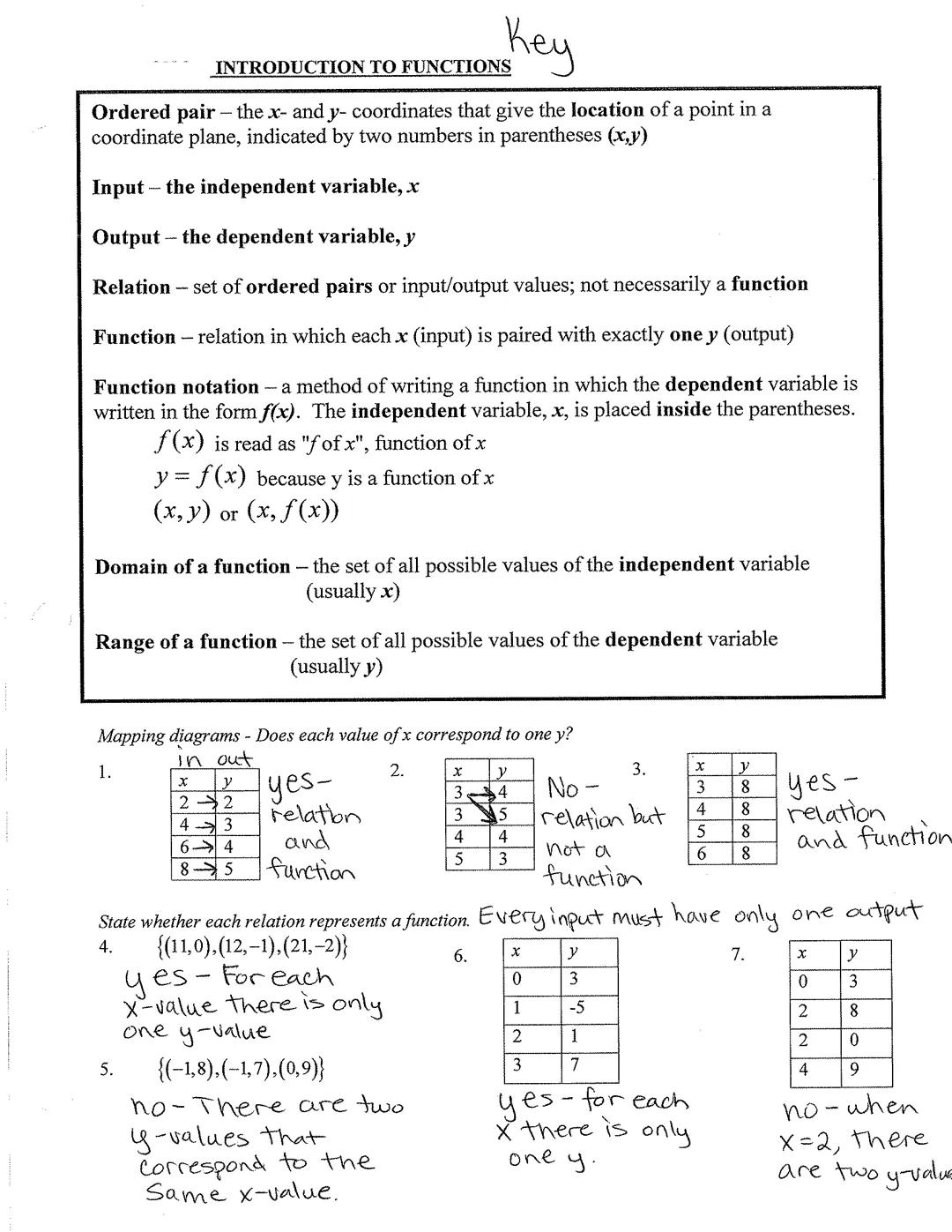
Introduction to Functions
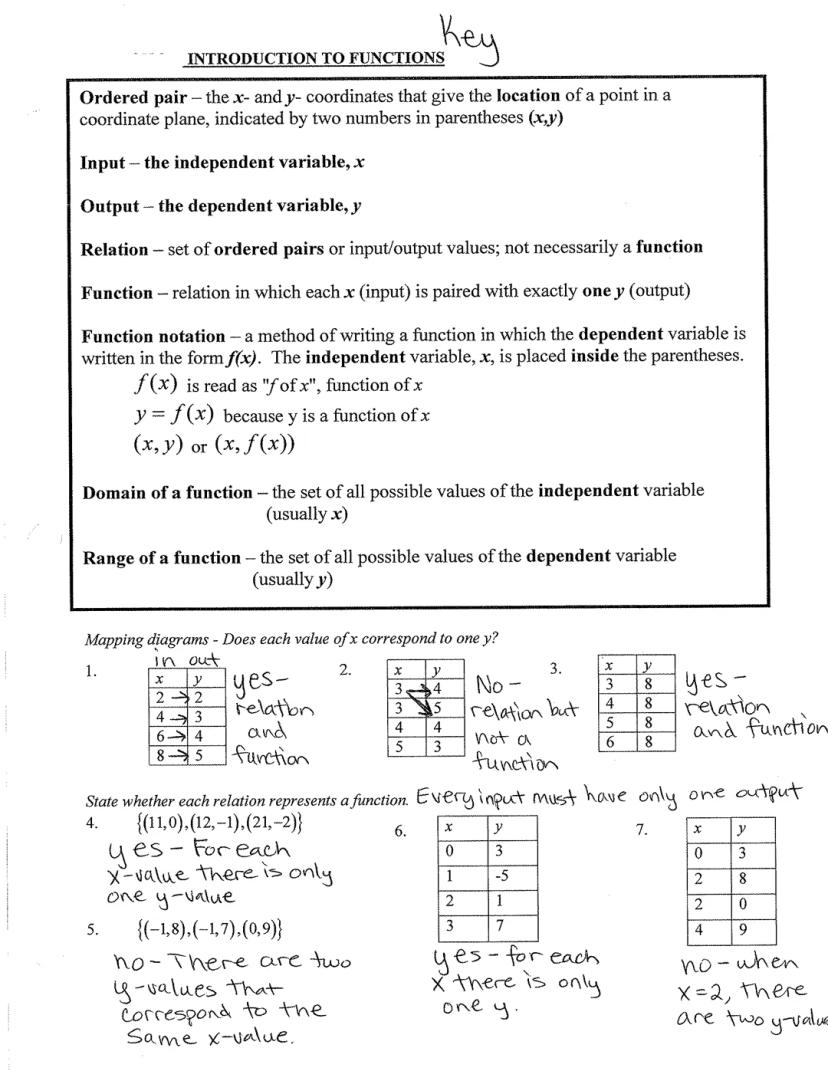
Functions are special types of relationships where each input value corresponds to exactly one output value. Think of a function as a machine: you put in a value (input), and get exactly one value back (output).
A relation is simply a set of ordered pairs (x,y), where x is the input and y is the output. Not all relations are functions though! A relation becomes a function only when each x-value is paired with exactly one y-value. If an x-value has multiple y-values, the relation is not a function.
When working with functions, we often use function notation written as f(x), which is read as "f of x." This notation helps us identify the dependent variable (output) in terms of the independent variable (input).
Quick Check: To determine if a relation is a function, ask yourself: "Does each x-value have exactly one y-value?" If you see any x-value with multiple outputs, it's not a function!
The domain of a function is the set of all possible input values , while the range is the set of all possible output values . These help us understand what values can go into and come out of our function.
2
of 4
Evaluating Functions
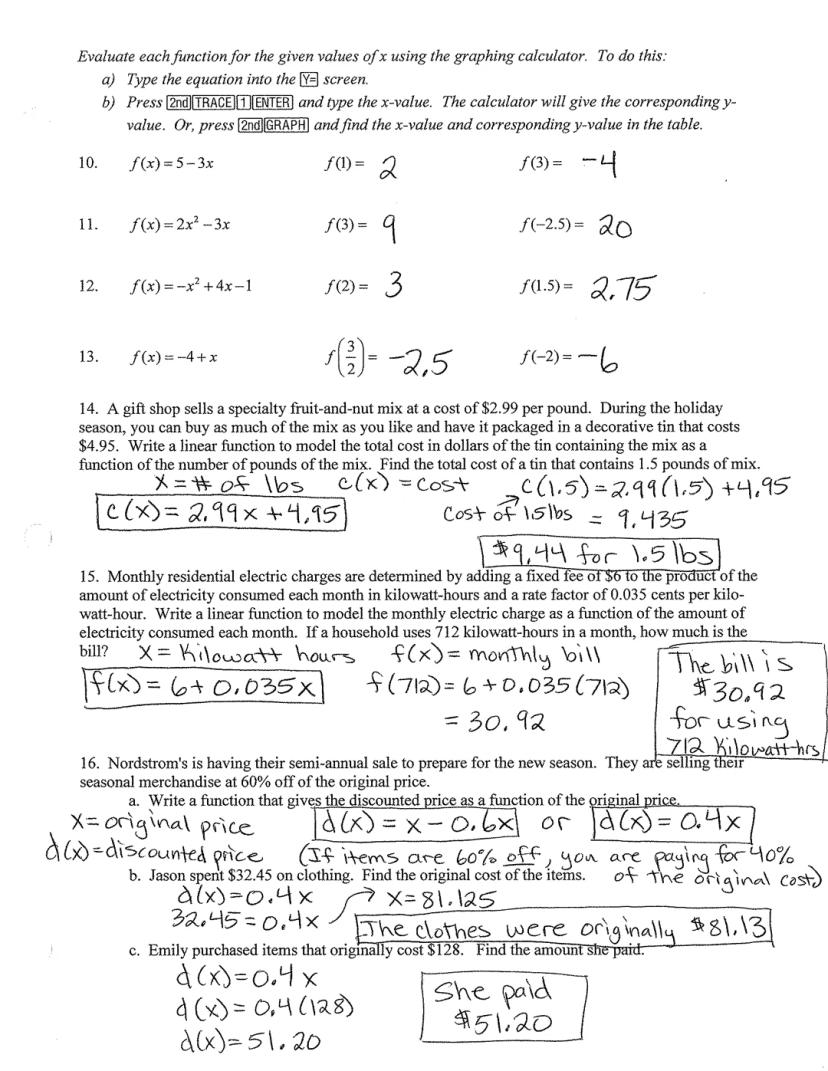
Functions let you calculate output values when you know the inputs. To evaluate a function, simply substitute the given input value for x in the function rule.
For example, with f(x) = 3x - 4, finding f(2) means replacing x with 2: f(2) = 3(2) - 4 = 6 - 4 = 2. This process works for any function, whether it's linear, quadratic, or more complex.
Real-world relationships can be analyzed to determine if they're functions. A key question to ask: "Can each input have multiple outputs?" If yes, it's not a function. For example, a person can have multiple phone numbers, so the relationship between people and phone numbers isn't a function.
Remember: When deciding if a real-world situation represents a function, think about whether each input value (like a person) can correspond to more than one output value (like multiple phone numbers).
Functions are powerful tools for modeling practical situations. They help us understand how changes in one variable affect another, making them essential for describing everything from phone bills to population growth.
3
of 4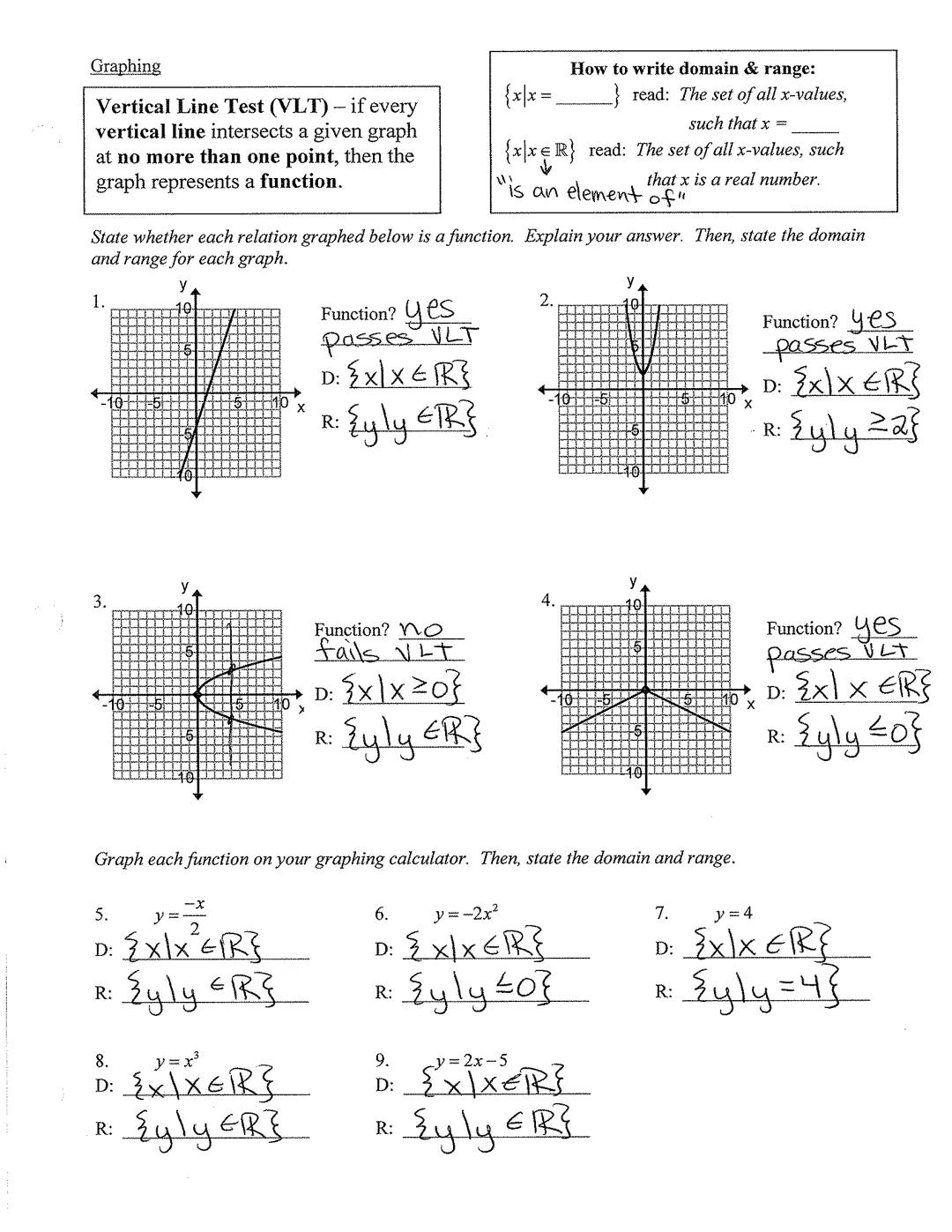
Graphing Functions
Graphs give us a visual way to understand functions. The Vertical Line Test is your best friend when determining if a graph represents a function: if any vertical line intersects the graph more than once, it's not a function.
When describing domains and ranges, we use set notation. For example, {x|x ∈ ℝ} means "the set of all x-values such that x is a real number" - basically saying x can be any real number. The domain tells us what x-values we can use, while the range shows what y-values we can get.
Different function types have characteristic shapes and domains/ranges:
- Linear functions typically have domain and range of all real numbers
- Quadratic functions have specific ranges depending on their orientation
- Constant functions have ranges consisting of just one value
Pro Tip: Your graphing calculator is a powerful tool for visualizing functions and understanding their domains and ranges. Always use it to check your work when graphing complex functions!
Recognizing function types by their graphs helps you quickly determine their key characteristics without having to analyze every point individually. With practice, you'll identify patterns at a glance.
4
of 4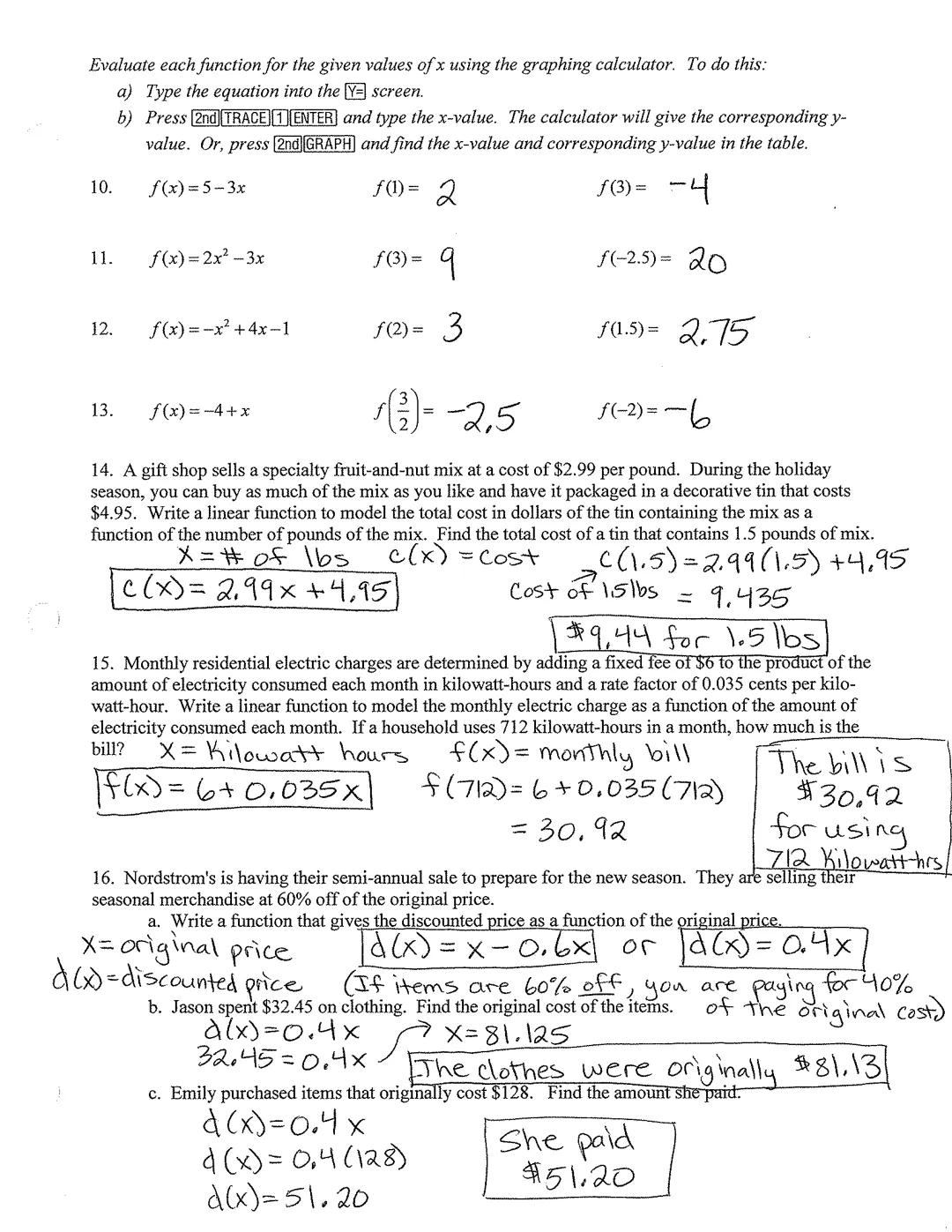
Applications of Functions
Graphing calculators are amazing tools for evaluating functions. Just enter the function, input your x-value, and the calculator gives you the corresponding y-value. This saves time and reduces calculation errors when working with complex expressions.
Real-world situations can often be modeled with functions. For example, a gift shop selling specialty mix at $2.99 per pound plus $4.95 for the tin can be represented as c(x) = 2.99x + 4.95, where x is the number of pounds. This lets you calculate costs for any amount.
Linear functions are especially useful for modeling everyday situations like:
- Utility bills (fixed fee plus usage charge)
- Sale prices (percentage off original price)
- Transportation costs
Make It Real: Try creating function models for everyday situations, like the cost of streaming services or the distance a car travels over time. This practice helps math concepts stick!
When solving real-world problems, identifying what the variables represent is crucial. Always label your variables clearly and include proper units in your answers. This ensures your solutions make practical sense in the real world.
We thought you’d never ask...
What is the Knowunity AI companion?
Our AI companion is specifically built for the needs of students. Based on the millions of content pieces we have on the platform we can provide truly meaningful and relevant answers to students. But its not only about answers, the companion is even more about guiding students through their daily learning challenges, with personalised study plans, quizzes or content pieces in the chat and 100% personalisation based on the students skills and developments.
Where can I download the Knowunity app?
You can download the app in the Google Play Store and in the Apple App Store.
Is Knowunity really free of charge?
That's right! Enjoy free access to study content, connect with fellow students, and get instant help – all at your fingertips.
Similar Content
Most popular content in Algebra 2
9Algebra 2Special Right Triangles
Examples of two of the most common special right triangles.
11th2002
Algebra 21.2 - Intro to Sets
Sets, subsets, set builder notation
10th342
Algebra 2Midterm Study Guide: Review of the First Half of the Course
Simple review notes and examples for the first half of the algebra 2 course! Not all classes teach the content in the same order, but this study guide should have most of the more basic concepts from algebra 2!
9th1,205120
 Algebra 1
Linear Function: Solving Linear Equations in 1 Variable
Study note on linear equations with one variable, rules on linear equations, examples on simple linear equations, algebra 2, algebra 1
9th3321
Algebra 2Absolute value functions
Steps to to solve absolute value functions
980
Algebra 2Set and Interval Notation
Learn how to complete a table, graph solution sets, and state domain and range using interval notation in inequality notation.
10th1032
Algebra 2Trig Identities
Algebra 2, trig identities
2139
Algebra 2math 3 final exam study guide
covers all content learned in tj math 3 (algebra 2)
10th1,660180
Algebra 2Unit 6 Study Guide
Study Guide for inverse and radical functions test
1923
Most popular content
9O
 AP US History
Origins and Dynamics of the Columbian Exchange
Analyze the ecological and economic motivations behind the initial transfer of goods, people, and diseases between the Old and New Worlds.
9th3,1280
I
AP US HistoryIntroduction to Early Cultural Interactions
Analyze the initial social and religious encounters between Europeans, Africans, and Indigenous peoples in the colonial Americas.
9th2,7730
O
 AP World History
Origins of Ancient River Civilizations
Analyze the environmental factors and technological innovations that led to the rise of early states in Mesopotamia, Egypt, and the Indus Valley.
9th3,1870
M
AP US HistoryMotivations for European Exploration
Analyze the economic, religious, and political factors that drove European powers to the Americas during the 15th and 16th centuries.
9th1,7780
F
 AP Psychology
Foundations of Ethical Guidelines in Research
Practice the core principles of the APA ethical code including informed consent, debriefing, and the role of Institutional Review Boards.
9th1,3360
I
AP US HistoryIntroduction to Native American Societies
Examine the diverse social, political, and economic structures of North American indigenous groups prior to European contact.
9th1,1100
I
 AP Biology
Introduction to Biological Elements of Life
Practice identifying the essential elements including carbon, nitrogen, phosphorus, and sulfur that compose biological macromolecules.
9th1,7390
I
AP US HistoryIntroduction to the Spanish Encomienda System
Explore the fundamental economic and social structures of the Spanish colonial system, focusing on the encomienda and the casta social hierarchy.
9th8890
O
AP World HistoryOrigins and Continuity of the Byzantine Empire
Analyze the political and cultural transitions from the Roman Empire to the Byzantine Empire, focusing on the reign of Justinian I and his code.
9th1,6320
Can't find what you're looking for? Explore other subjects.
Students love us — and so will you.
4.6/5App Store
4.7/5Google Play
The app is very easy to use and well designed. I have found everything I was looking for so far and have been able to learn a lot from the presentations! I will definitely use the app for a class assignment! And of course it also helps a lot as an inspiration.
Stefan SiOS user
This app is really great. There are so many study notes and help [...]. My problem subject is French, for example, and the app has so many options for help. Thanks to this app, I have improved my French. I would recommend it to anyone.
Samantha KlichAndroid user
Wow, I am really amazed. I just tried the app because I've seen it advertised many times and was absolutely stunned. This app is THE HELP you want for school and above all, it offers so many things, such as workouts and fact sheets, which have been VERY helpful to me personally.
AnnaiOS user
Algebra 2125 views·Updated Jun 9, 2026·4 pagesUnderstanding Functions: Domain, Range, and Relationships
Trevor@trevk
Functions are a fundamental concept in mathematics that describe relationships where each input produces exactly one output. They're essential for modeling real-world situations and form the foundation of higher math concepts you'll encounter in algebra and beyond.
1
of 4
Sign up to see the content. It's free!
- Access to all documents
- Improve your grades
- Join milions of students
Introduction to Functions
Functions are special types of relationships where each input value corresponds to exactly one output value. Think of a function as a machine: you put in a value (input), and get exactly one value back (output).
A relation is simply a set of ordered pairs (x,y), where x is the input and y is the output. Not all relations are functions though! A relation becomes a function only when each x-value is paired with exactly one y-value. If an x-value has multiple y-values, the relation is not a function.
When working with functions, we often use function notation written as f(x), which is read as "f of x." This notation helps us identify the dependent variable (output) in terms of the independent variable (input).
Quick Check: To determine if a relation is a function, ask yourself: "Does each x-value have exactly one y-value?" If you see any x-value with multiple outputs, it's not a function!
The domain of a function is the set of all possible input values , while the range is the set of all possible output values . These help us understand what values can go into and come out of our function.
2
of 4Sign up to see the content. It's free!
- Access to all documents
- Improve your grades
- Join milions of students
Evaluating Functions
Functions let you calculate output values when you know the inputs. To evaluate a function, simply substitute the given input value for x in the function rule.
For example, with f(x) = 3x - 4, finding f(2) means replacing x with 2: f(2) = 3(2) - 4 = 6 - 4 = 2. This process works for any function, whether it's linear, quadratic, or more complex.
Real-world relationships can be analyzed to determine if they're functions. A key question to ask: "Can each input have multiple outputs?" If yes, it's not a function. For example, a person can have multiple phone numbers, so the relationship between people and phone numbers isn't a function.
Remember: When deciding if a real-world situation represents a function, think about whether each input value (like a person) can correspond to more than one output value (like multiple phone numbers).
Functions are powerful tools for modeling practical situations. They help us understand how changes in one variable affect another, making them essential for describing everything from phone bills to population growth.
3
of 4Sign up to see the content. It's free!
- Access to all documents
- Improve your grades
- Join milions of students
Graphing Functions
Graphs give us a visual way to understand functions. The Vertical Line Test is your best friend when determining if a graph represents a function: if any vertical line intersects the graph more than once, it's not a function.
When describing domains and ranges, we use set notation. For example, {x|x ∈ ℝ} means "the set of all x-values such that x is a real number" - basically saying x can be any real number. The domain tells us what x-values we can use, while the range shows what y-values we can get.
Different function types have characteristic shapes and domains/ranges:
- Linear functions typically have domain and range of all real numbers
- Quadratic functions have specific ranges depending on their orientation
- Constant functions have ranges consisting of just one value
Pro Tip: Your graphing calculator is a powerful tool for visualizing functions and understanding their domains and ranges. Always use it to check your work when graphing complex functions!
Recognizing function types by their graphs helps you quickly determine their key characteristics without having to analyze every point individually. With practice, you'll identify patterns at a glance.
4
of 4Sign up to see the content. It's free!
- Access to all documents
- Improve your grades
- Join milions of students
Applications of Functions
Graphing calculators are amazing tools for evaluating functions. Just enter the function, input your x-value, and the calculator gives you the corresponding y-value. This saves time and reduces calculation errors when working with complex expressions.
Real-world situations can often be modeled with functions. For example, a gift shop selling specialty mix at $2.99 per pound plus $4.95 for the tin can be represented as c(x) = 2.99x + 4.95, where x is the number of pounds. This lets you calculate costs for any amount.
Linear functions are especially useful for modeling everyday situations like:
- Utility bills (fixed fee plus usage charge)
- Sale prices (percentage off original price)
- Transportation costs
Make It Real: Try creating function models for everyday situations, like the cost of streaming services or the distance a car travels over time. This practice helps math concepts stick!
When solving real-world problems, identifying what the variables represent is crucial. Always label your variables clearly and include proper units in your answers. This ensures your solutions make practical sense in the real world.
We thought you’d never ask...
What is the Knowunity AI companion?
Our AI companion is specifically built for the needs of students. Based on the millions of content pieces we have on the platform we can provide truly meaningful and relevant answers to students. But its not only about answers, the companion is even more about guiding students through their daily learning challenges, with personalised study plans, quizzes or content pieces in the chat and 100% personalisation based on the students skills and developments.
Where can I download the Knowunity app?
You can download the app in the Google Play Store and in the Apple App Store.
Is Knowunity really free of charge?
That's right! Enjoy free access to study content, connect with fellow students, and get instant help – all at your fingertips.
Similar Content
Most popular content in Algebra 2
9Algebra 2Special Right Triangles
Examples of two of the most common special right triangles.
11th2002
Algebra 21.2 - Intro to Sets
Sets, subsets, set builder notation
10th342
Algebra 2Midterm Study Guide: Review of the First Half of the Course
Simple review notes and examples for the first half of the algebra 2 course! Not all classes teach the content in the same order, but this study guide should have most of the more basic concepts from algebra 2!
9th1,205120
Algebra 1Linear Function: Solving Linear Equations in 1 Variable
Study note on linear equations with one variable, rules on linear equations, examples on simple linear equations, algebra 2, algebra 1
9th3321
Algebra 2Absolute value functions
Steps to to solve absolute value functions
980
Algebra 2Set and Interval Notation
Learn how to complete a table, graph solution sets, and state domain and range using interval notation in inequality notation.
10th1032
Algebra 2Trig Identities
Algebra 2, trig identities
2139
Algebra 2math 3 final exam study guide
covers all content learned in tj math 3 (algebra 2)
10th1,660180
Algebra 2Unit 6 Study Guide
Study Guide for inverse and radical functions test
1923
Most popular content
9O
AP US HistoryOrigins and Dynamics of the Columbian Exchange
Analyze the ecological and economic motivations behind the initial transfer of goods, people, and diseases between the Old and New Worlds.
9th3,1280
I
AP US HistoryIntroduction to Early Cultural Interactions
Analyze the initial social and religious encounters between Europeans, Africans, and Indigenous peoples in the colonial Americas.
9th2,7730
O
AP World HistoryOrigins of Ancient River Civilizations
Analyze the environmental factors and technological innovations that led to the rise of early states in Mesopotamia, Egypt, and the Indus Valley.
9th3,1870
M
AP US HistoryMotivations for European Exploration
Analyze the economic, religious, and political factors that drove European powers to the Americas during the 15th and 16th centuries.
9th1,7780
F
AP PsychologyFoundations of Ethical Guidelines in Research
Practice the core principles of the APA ethical code including informed consent, debriefing, and the role of Institutional Review Boards.
9th1,3360
I
AP US HistoryIntroduction to Native American Societies
Examine the diverse social, political, and economic structures of North American indigenous groups prior to European contact.
9th1,1100
I
AP BiologyIntroduction to Biological Elements of Life
Practice identifying the essential elements including carbon, nitrogen, phosphorus, and sulfur that compose biological macromolecules.
9th1,7390
I
AP US HistoryIntroduction to the Spanish Encomienda System
Explore the fundamental economic and social structures of the Spanish colonial system, focusing on the encomienda and the casta social hierarchy.
9th8890
O
AP World HistoryOrigins and Continuity of the Byzantine Empire
Analyze the political and cultural transitions from the Roman Empire to the Byzantine Empire, focusing on the reign of Justinian I and his code.
9th1,6320
Can't find what you're looking for? Explore other subjects.
Students love us — and so will you.
4.6/5App Store
4.7/5Google Play
The app is very easy to use and well designed. I have found everything I was looking for so far and have been able to learn a lot from the presentations! I will definitely use the app for a class assignment! And of course it also helps a lot as an inspiration.
Stefan SiOS user
This app is really great. There are so many study notes and help [...]. My problem subject is French, for example, and the app has so many options for help. Thanks to this app, I have improved my French. I would recommend it to anyone.
Samantha KlichAndroid user
Wow, I am really amazed. I just tried the app because I've seen it advertised many times and was absolutely stunned. This app is THE HELP you want for school and above all, it offers so many things, such as workouts and fact sheets, which have been VERY helpful to me personally.
AnnaiOS user