
Algebra is all about using numbers, variables, and operations to...
 Algebra 293 views·Updated Jun 12, 2026·6 pages
Algebra 2 Chapter 1 Notes: Understanding Equations and Inequalities

Ali@alisonborowski


1 / 6
1
of 6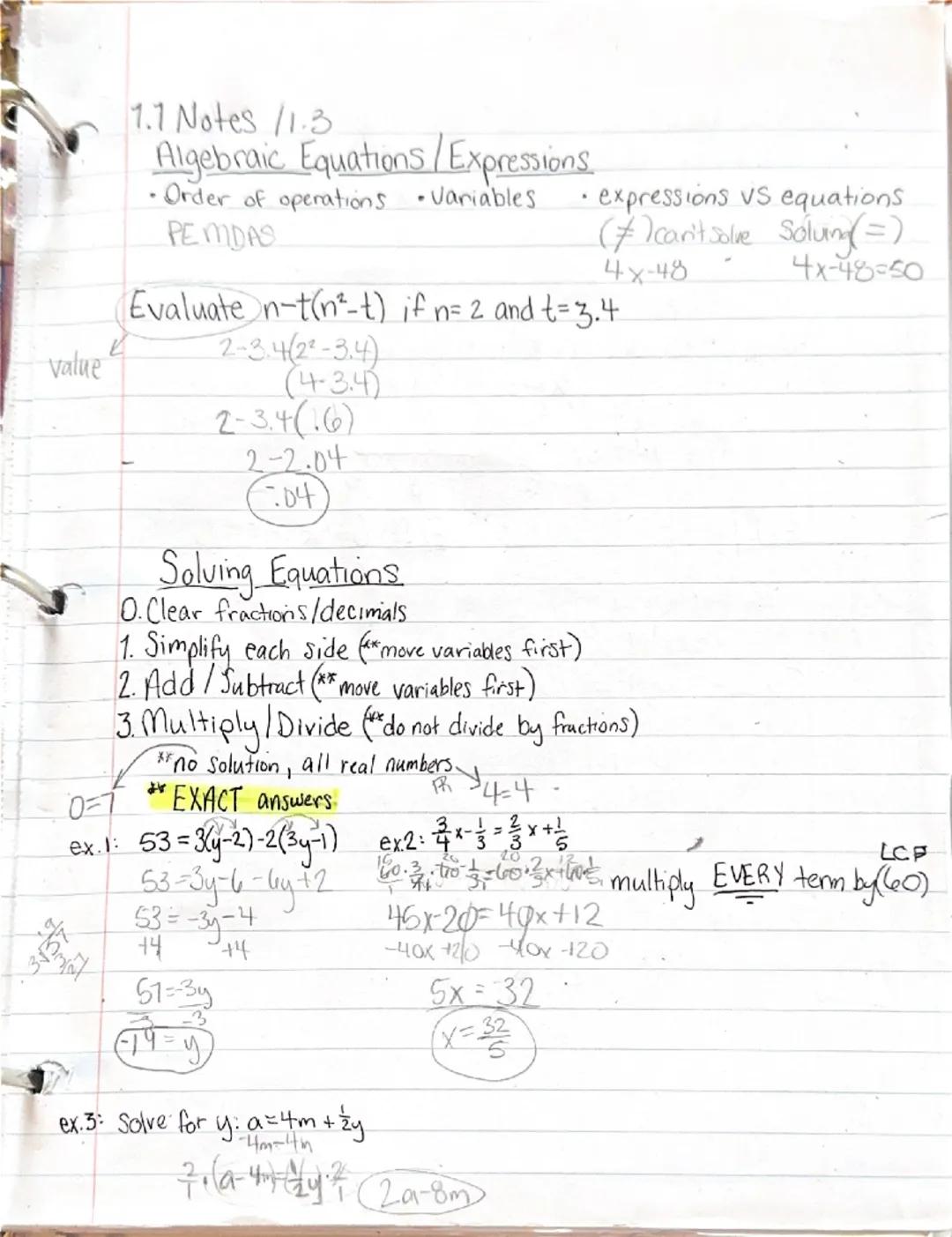
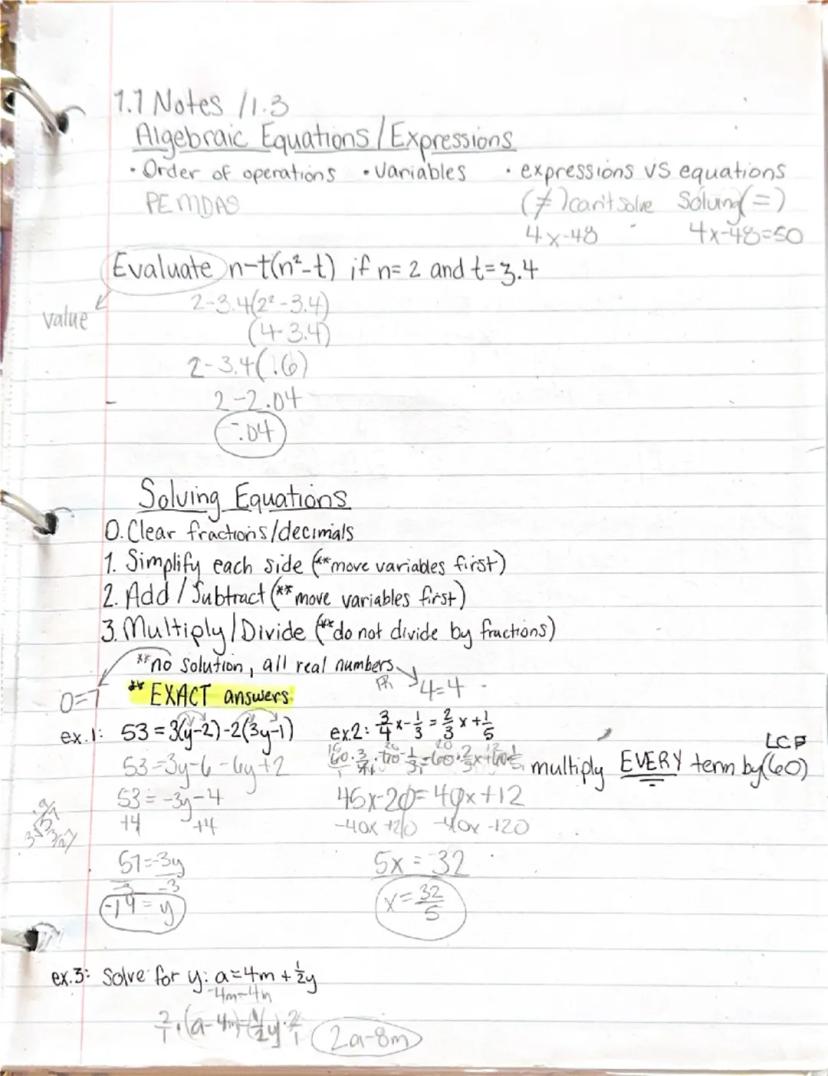
Algebraic Equations and Expressions
Ever wonder what makes equations different from expressions? It's simple - equations have equals signs and can be solved, while expressions just need to be evaluated. Remember to always follow PEMDAS when working with either.
When solving equations, follow these key steps:
- Clear any fractions or decimals first
- Simplify each side (focus on moving variables)
- Add or subtract terms to isolate variables
- Multiply or divide as needed (avoid dividing by fractions)
For example, solving 53 = 3 - 2 requires distributing first: 53 = 3y-6-6y+2, then simplifying to 53 = -3y-4. Adding 4 to both sides gives 57 = -3y, which means y = -57/-3 = 19.
Pro Tip: Always check your answers by substituting them back into the original equation to verify you've found the correct solution!
2
of 6
Solving Absolute Value Equations
Absolute value equations might look intimidating, but they're actually straightforward once you understand the technique. Remember that absolute value represents distance from zero, so it's always positive or zero.
The key strategy is to get the absolute value expression by itself first. Then, since |x| = 5 means x = 5 OR x = -5, you'll need to write two separate equations to solve. For example, with |y+3| = 8, you'd write:
- y + 3 = 8
- y + 3 = -8
Be careful with negative signs outside the absolute value. In -2|6-4t| = -16, first isolate the absolute value by dividing both sides by -2, giving you |6-4t| = 8. Then solve both possibilities.
Remember: When your absolute value equals a negative number , there's no solution because absolute value can never be negative!
3
of 6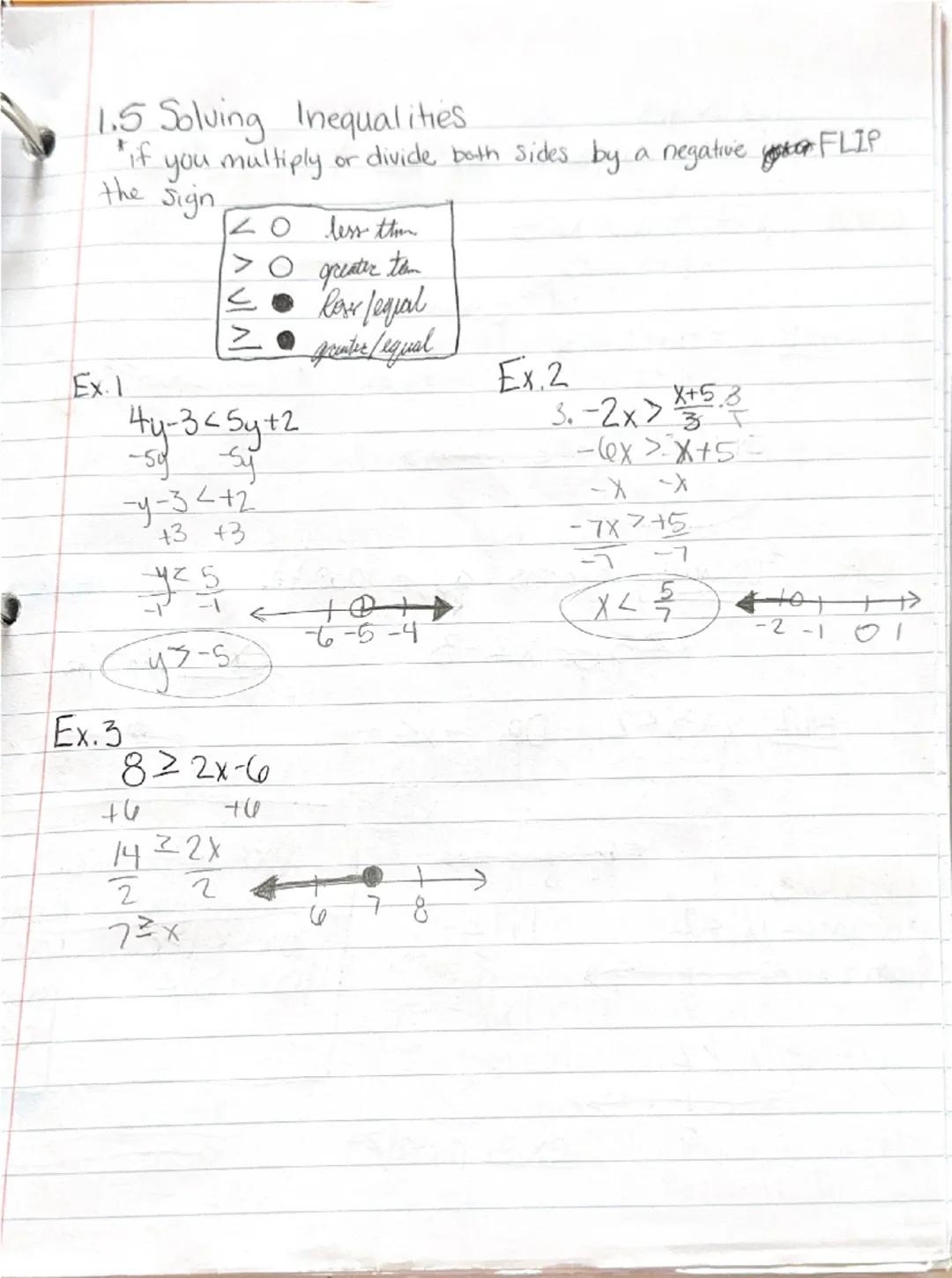
Solving Inequalities
Inequalities are like equations with attitude - they tell you when values are greater than, less than, or equal to each other. The most important rule to remember is that when you multiply or divide by a negative number, you must flip the inequality symbol.
To solve an inequality like 4y - 3 < 5y + 2, start by getting variables on one side: 4y - 5y < 2 + 3, which simplifies to -y < 5. Multiply both sides by -1 (and flip the symbol!) to get y > -5.
For fractions in inequalities, multiply both sides by the LCD (least common denominator) to clear the fractions. In the example 3-2x > /3, multiply everything by 3 to get 9-6x > x+5, then solve as normal.
Visual Tip: Always draw your solution on a number line to double-check your work. The direction of your arrow should match your inequality symbol!
4
of 6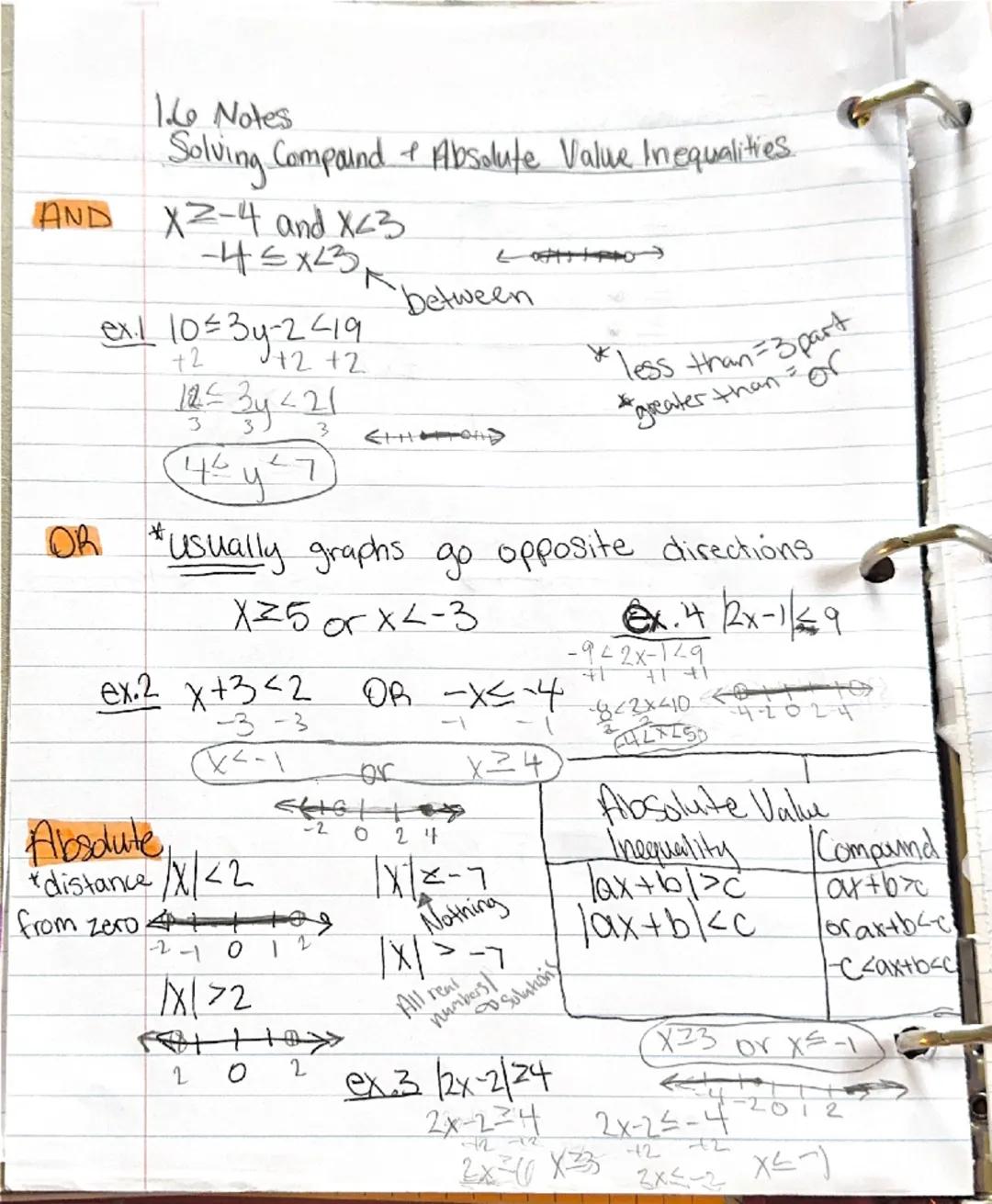
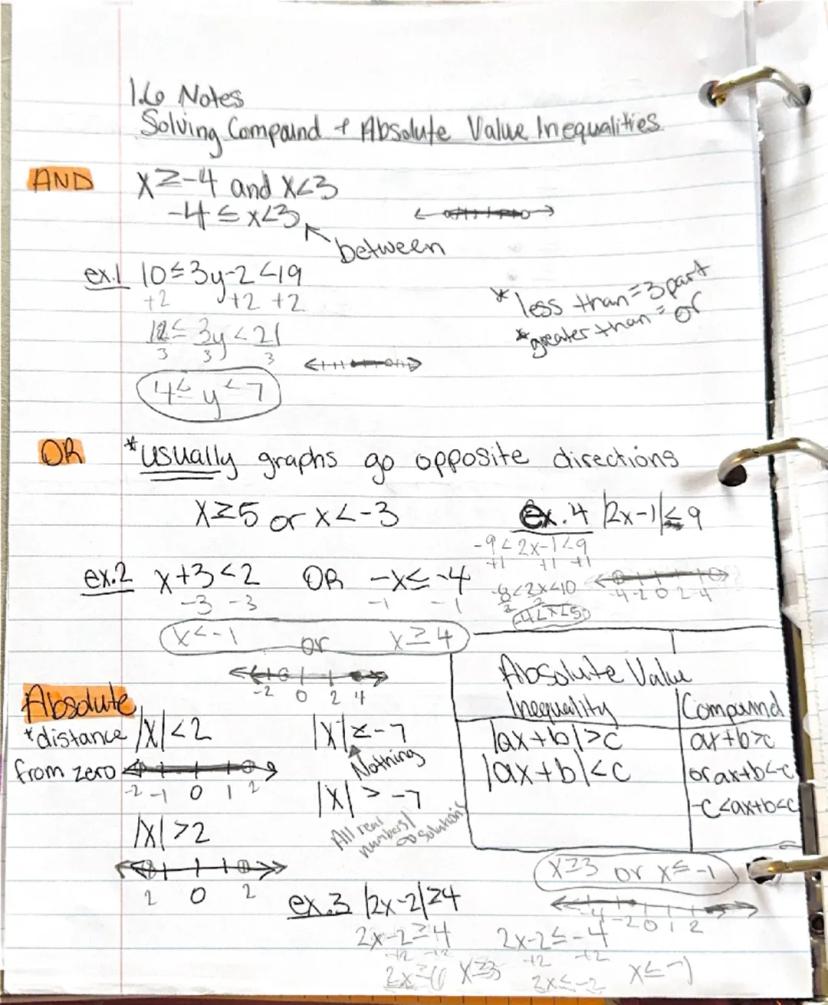
Compound and Absolute Value Inequalities
Compound inequalities involve two conditions that must be satisfied at the same time. When you see "AND" conditions like -4 ≤ x < 3, this means x must be in between both values .
"OR" conditions are different - they're satisfied when either condition is true. For example, x ≥ 5 OR x ≤ -3 means x can be either greater than/equal to 5 OR less than/equal to -3. On a number line, OR graphs typically point in opposite directions.
Absolute value inequalities follow special patterns:
- |ax + b| < c becomes -c < ax + b < c
- |ax + b| ≥ c becomes ax + b ≥ c OR ax + b ≤ -c (values outside the range)
For example, |2x - 1| ≤ 9 means -9 ≤ 2x - 1 ≤ 9, which becomes -4 ≤ x ≤ 5 after solving.
Quick Check: For absolute value inequalities, remember that |x| < c creates an interval, while |x| > c creates two separate regions on the number line.
5
of 6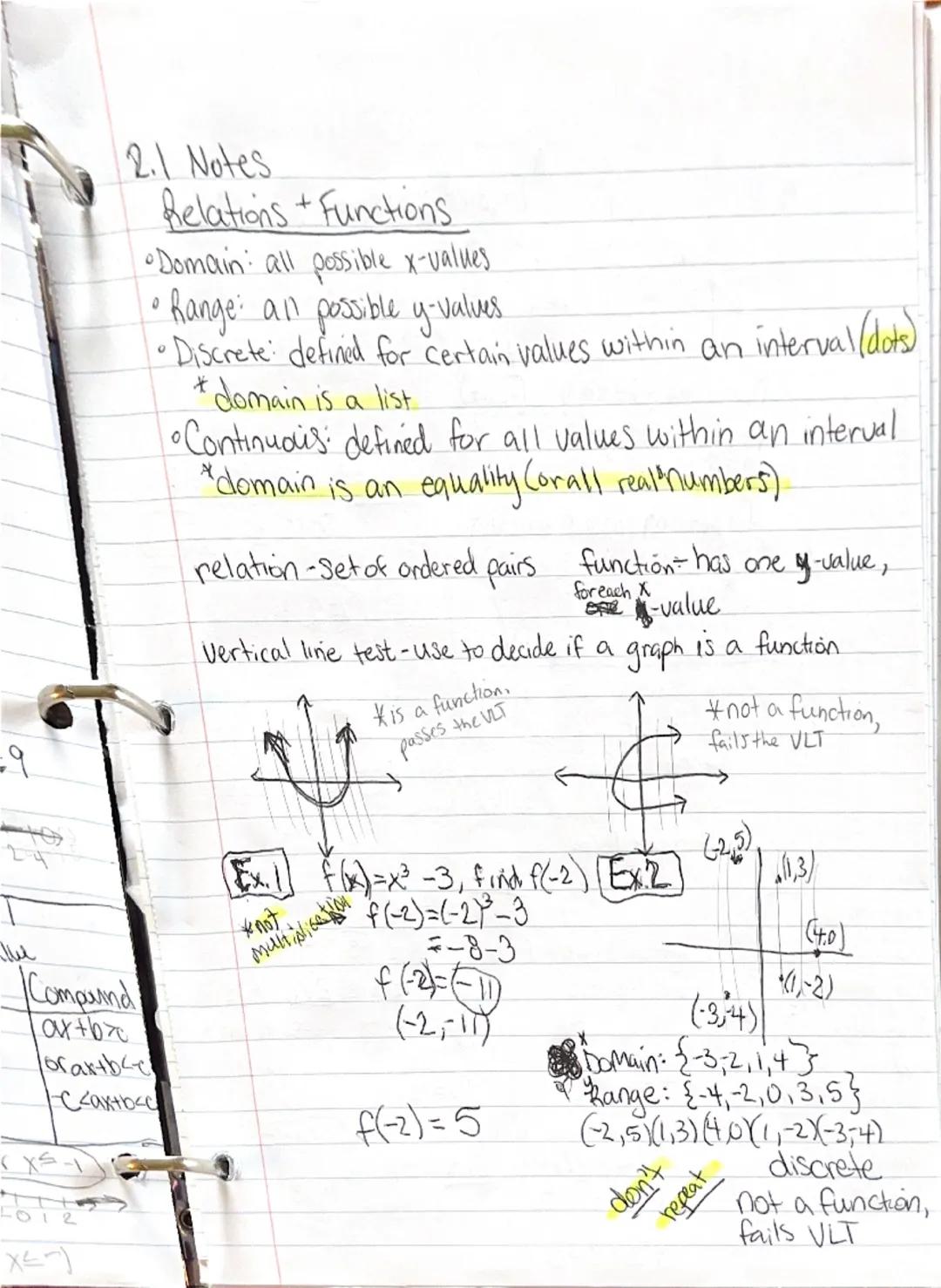
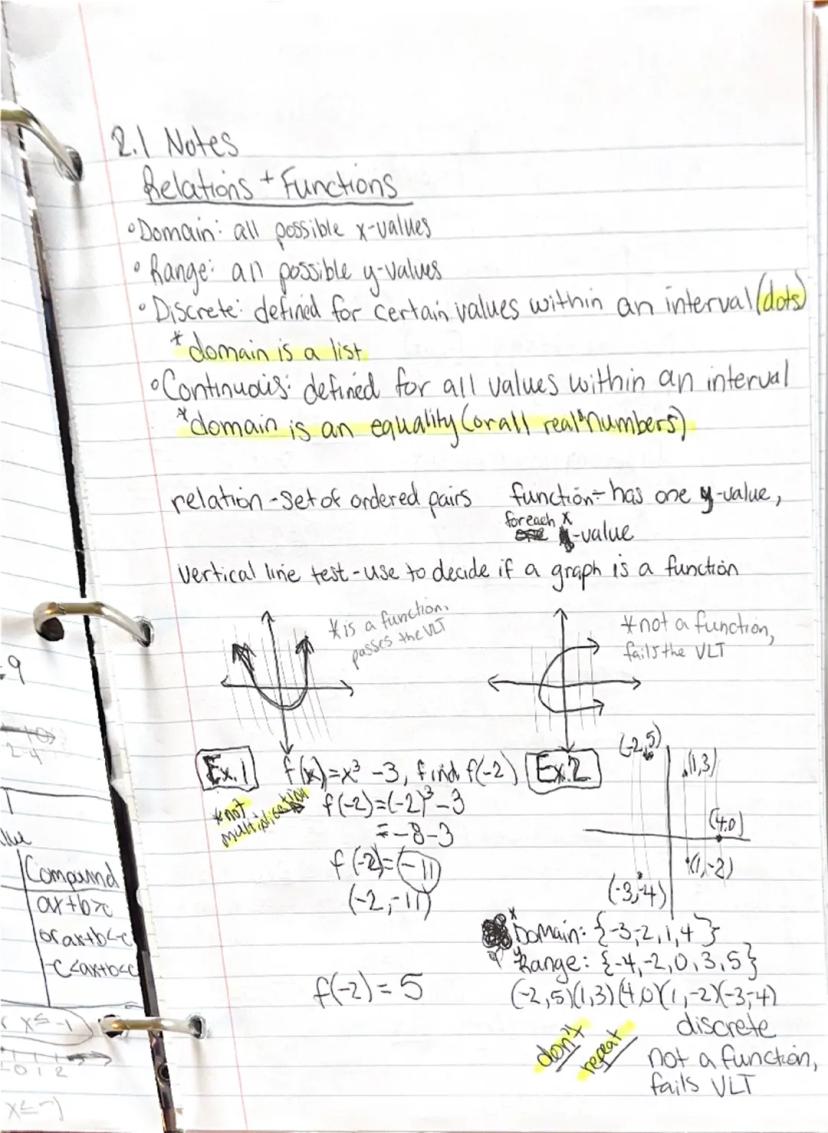
Relations and Functions
Functions are special relationships where each x-value has exactly one y-value. Think of them as machines that take an input and produce exactly one output. Relations are more general - they're just sets of ordered pairs.
The domain is all possible x-values for your function, while the range contains all possible y-values. Functions can be:
- Discrete: Defined only for certain specific values (shown as dots on a graph)
- Continuous: Defined for all values within an interval (shown as unbroken lines)
How can you tell if a relation is a function? Use the vertical line test! If any vertical line crosses your graph more than once, it's not a function because that would mean one x-value has multiple y-values.
When evaluating a function like f(x) = x² - 3 at x = -2, simply substitute: f(-2) = (-2)² - 3 = 4 - 3 = 1. This gives you the ordered pair (-2, 1).
Function Check: If you see the same x-value paired with different y-values in a relation, it automatically fails the function test - no graphing required!
6
of 6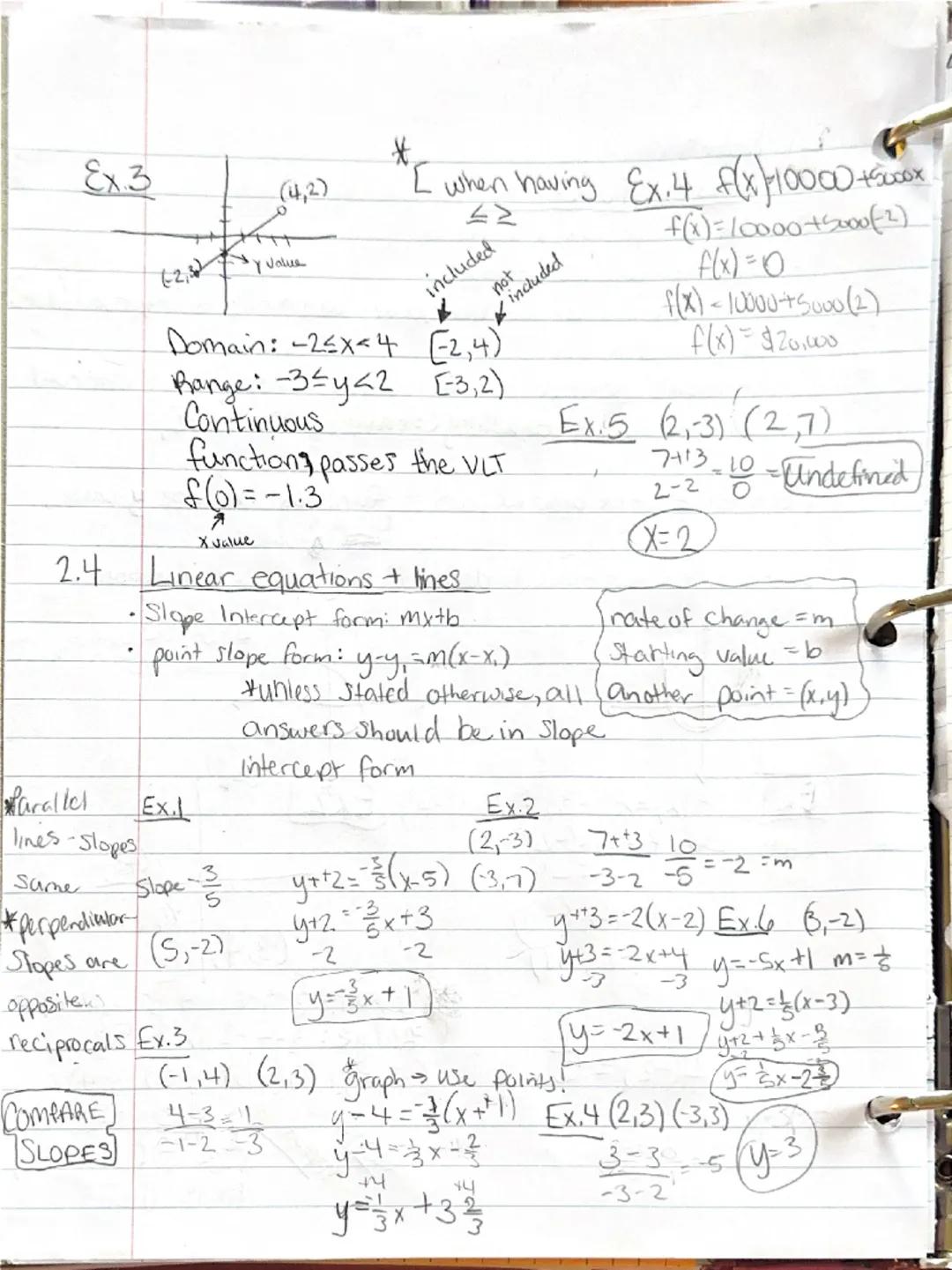
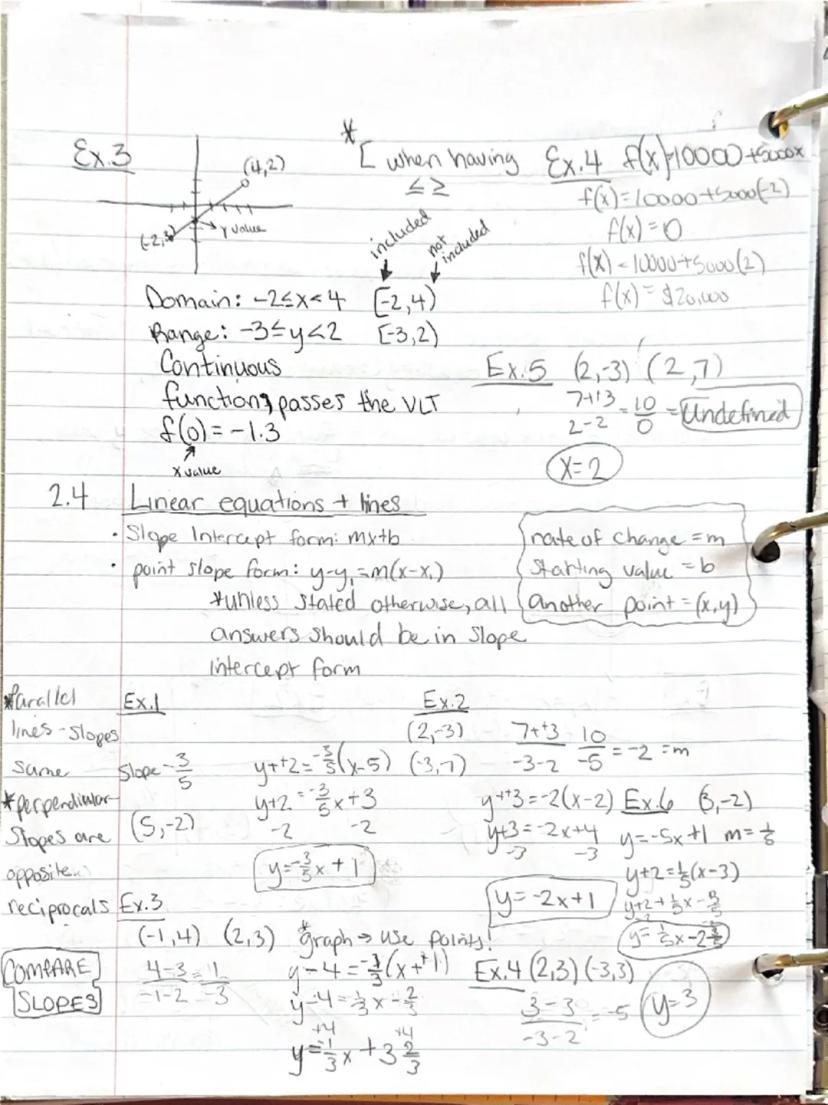
Linear Equations and Lines
Linear equations create straight lines on a graph and can be written in different forms. The most common is slope-intercept form , where m represents the slope (rate of change) and b is the y-intercept .
To find the slope between two points, use the formula m = /. Be careful with vertical lines - their slope is undefined because the denominator would be zero! These are written as x = (some number).
When working with lines, remember:
- Parallel lines have the same slope
- Perpendicular lines have slopes that are negative reciprocals of each other
To write an equation using point-slope form, use y - y₁ = m, where (x₁, y₁) is a point on the line and m is the slope. For example, with point (5, -2) and slope 3, you'd write y + 2 = 3, which simplifies to y = 3x - 17.
Application Alert: In real-world problems, the slope often represents the rate of change (like cost per hour), while the y-intercept represents the starting value (like an initial fee).
We thought you’d never ask...
What is the Knowunity AI companion?
Our AI companion is specifically built for the needs of students. Based on the millions of content pieces we have on the platform we can provide truly meaningful and relevant answers to students. But its not only about answers, the companion is even more about guiding students through their daily learning challenges, with personalised study plans, quizzes or content pieces in the chat and 100% personalisation based on the students skills and developments.
Where can I download the Knowunity app?
You can download the app in the Google Play Store and in the Apple App Store.
Is Knowunity really free of charge?
That's right! Enjoy free access to study content, connect with fellow students, and get instant help – all at your fingertips.
Most popular content in Algebra 2
9Algebra 2Special Right Triangles
Examples of two of the most common special right triangles.
11th2002
Algebra 21.2 - Intro to Sets
Sets, subsets, set builder notation
10th342
Algebra 2Midterm Study Guide: Review of the First Half of the Course
Simple review notes and examples for the first half of the algebra 2 course! Not all classes teach the content in the same order, but this study guide should have most of the more basic concepts from algebra 2!
9th1,205120
 Algebra 1
Linear Function: Solving Linear Equations in 1 Variable
Study note on linear equations with one variable, rules on linear equations, examples on simple linear equations, algebra 2, algebra 1
9th3321
Algebra 2Absolute value functions
Steps to to solve absolute value functions
980
Algebra 2Set and Interval Notation
Learn how to complete a table, graph solution sets, and state domain and range using interval notation in inequality notation.
10th1032
Algebra 2Trig Identities
Algebra 2, trig identities
2139
Algebra 2math 3 final exam study guide
covers all content learned in tj math 3 (algebra 2)
10th1,660180
Algebra 2Unit 6 Study Guide
Study Guide for inverse and radical functions test
1923
Most popular content
9O
 AP US History
Origins and Dynamics of the Columbian Exchange
Analyze the ecological and economic motivations behind the initial transfer of goods, people, and diseases between the Old and New Worlds.
9th3,1280
I
AP US HistoryIntroduction to Early Cultural Interactions
Analyze the initial social and religious encounters between Europeans, Africans, and Indigenous peoples in the colonial Americas.
9th2,7730
O
 AP World History
Origins of Ancient River Civilizations
Analyze the environmental factors and technological innovations that led to the rise of early states in Mesopotamia, Egypt, and the Indus Valley.
9th3,1870
M
AP US HistoryMotivations for European Exploration
Analyze the economic, religious, and political factors that drove European powers to the Americas during the 15th and 16th centuries.
9th1,7780
F
 AP Psychology
Foundations of Ethical Guidelines in Research
Practice the core principles of the APA ethical code including informed consent, debriefing, and the role of Institutional Review Boards.
9th1,3360
I
AP US HistoryIntroduction to Native American Societies
Examine the diverse social, political, and economic structures of North American indigenous groups prior to European contact.
9th1,1100
I
 AP Biology
Introduction to Biological Elements of Life
Practice identifying the essential elements including carbon, nitrogen, phosphorus, and sulfur that compose biological macromolecules.
9th1,7390
I
AP US HistoryIntroduction to the Spanish Encomienda System
Explore the fundamental economic and social structures of the Spanish colonial system, focusing on the encomienda and the casta social hierarchy.
9th8890
O
AP World HistoryOrigins and Continuity of the Byzantine Empire
Analyze the political and cultural transitions from the Roman Empire to the Byzantine Empire, focusing on the reign of Justinian I and his code.
9th1,6320
Can't find what you're looking for? Explore other subjects.
Students love us — and so will you.
4.6/5App Store
4.7/5Google Play
The app is very easy to use and well designed. I have found everything I was looking for so far and have been able to learn a lot from the presentations! I will definitely use the app for a class assignment! And of course it also helps a lot as an inspiration.
Stefan SiOS user
This app is really great. There are so many study notes and help [...]. My problem subject is French, for example, and the app has so many options for help. Thanks to this app, I have improved my French. I would recommend it to anyone.
Samantha KlichAndroid user
Wow, I am really amazed. I just tried the app because I've seen it advertised many times and was absolutely stunned. This app is THE HELP you want for school and above all, it offers so many things, such as workouts and fact sheets, which have been VERY helpful to me personally.
AnnaiOS user
Algebra 293 views·Updated Jun 12, 2026·6 pagesAlgebra 2 Chapter 1 Notes: Understanding Equations and Inequalities
Ali@alisonborowski
Algebra is all about using numbers, variables, and operations to solve problems. These notes cover essential concepts from algebraic equations to functions, giving you the tools to solve a variety of mathematical challenges.
1
of 6
Sign up to see the content. It's free!
- Access to all documents
- Improve your grades
- Join milions of students
Algebraic Equations and Expressions
Ever wonder what makes equations different from expressions? It's simple - equations have equals signs and can be solved, while expressions just need to be evaluated. Remember to always follow PEMDAS when working with either.
When solving equations, follow these key steps:
- Clear any fractions or decimals first
- Simplify each side (focus on moving variables)
- Add or subtract terms to isolate variables
- Multiply or divide as needed (avoid dividing by fractions)
For example, solving 53 = 3 - 2 requires distributing first: 53 = 3y-6-6y+2, then simplifying to 53 = -3y-4. Adding 4 to both sides gives 57 = -3y, which means y = -57/-3 = 19.
Pro Tip: Always check your answers by substituting them back into the original equation to verify you've found the correct solution!
2
of 6Sign up to see the content. It's free!
- Access to all documents
- Improve your grades
- Join milions of students
Solving Absolute Value Equations
Absolute value equations might look intimidating, but they're actually straightforward once you understand the technique. Remember that absolute value represents distance from zero, so it's always positive or zero.
The key strategy is to get the absolute value expression by itself first. Then, since |x| = 5 means x = 5 OR x = -5, you'll need to write two separate equations to solve. For example, with |y+3| = 8, you'd write:
- y + 3 = 8
- y + 3 = -8
Be careful with negative signs outside the absolute value. In -2|6-4t| = -16, first isolate the absolute value by dividing both sides by -2, giving you |6-4t| = 8. Then solve both possibilities.
Remember: When your absolute value equals a negative number , there's no solution because absolute value can never be negative!
3
of 6Sign up to see the content. It's free!
- Access to all documents
- Improve your grades
- Join milions of students
Solving Inequalities
Inequalities are like equations with attitude - they tell you when values are greater than, less than, or equal to each other. The most important rule to remember is that when you multiply or divide by a negative number, you must flip the inequality symbol.
To solve an inequality like 4y - 3 < 5y + 2, start by getting variables on one side: 4y - 5y < 2 + 3, which simplifies to -y < 5. Multiply both sides by -1 (and flip the symbol!) to get y > -5.
For fractions in inequalities, multiply both sides by the LCD (least common denominator) to clear the fractions. In the example 3-2x > /3, multiply everything by 3 to get 9-6x > x+5, then solve as normal.
Visual Tip: Always draw your solution on a number line to double-check your work. The direction of your arrow should match your inequality symbol!
4
of 6Sign up to see the content. It's free!
- Access to all documents
- Improve your grades
- Join milions of students
Compound and Absolute Value Inequalities
Compound inequalities involve two conditions that must be satisfied at the same time. When you see "AND" conditions like -4 ≤ x < 3, this means x must be in between both values .
"OR" conditions are different - they're satisfied when either condition is true. For example, x ≥ 5 OR x ≤ -3 means x can be either greater than/equal to 5 OR less than/equal to -3. On a number line, OR graphs typically point in opposite directions.
Absolute value inequalities follow special patterns:
- |ax + b| < c becomes -c < ax + b < c
- |ax + b| ≥ c becomes ax + b ≥ c OR ax + b ≤ -c (values outside the range)
For example, |2x - 1| ≤ 9 means -9 ≤ 2x - 1 ≤ 9, which becomes -4 ≤ x ≤ 5 after solving.
Quick Check: For absolute value inequalities, remember that |x| < c creates an interval, while |x| > c creates two separate regions on the number line.
5
of 6Sign up to see the content. It's free!
- Access to all documents
- Improve your grades
- Join milions of students
Relations and Functions
Functions are special relationships where each x-value has exactly one y-value. Think of them as machines that take an input and produce exactly one output. Relations are more general - they're just sets of ordered pairs.
The domain is all possible x-values for your function, while the range contains all possible y-values. Functions can be:
- Discrete: Defined only for certain specific values (shown as dots on a graph)
- Continuous: Defined for all values within an interval (shown as unbroken lines)
How can you tell if a relation is a function? Use the vertical line test! If any vertical line crosses your graph more than once, it's not a function because that would mean one x-value has multiple y-values.
When evaluating a function like f(x) = x² - 3 at x = -2, simply substitute: f(-2) = (-2)² - 3 = 4 - 3 = 1. This gives you the ordered pair (-2, 1).
Function Check: If you see the same x-value paired with different y-values in a relation, it automatically fails the function test - no graphing required!
6
of 6Sign up to see the content. It's free!
- Access to all documents
- Improve your grades
- Join milions of students
Linear Equations and Lines
Linear equations create straight lines on a graph and can be written in different forms. The most common is slope-intercept form , where m represents the slope (rate of change) and b is the y-intercept .
To find the slope between two points, use the formula m = /. Be careful with vertical lines - their slope is undefined because the denominator would be zero! These are written as x = (some number).
When working with lines, remember:
- Parallel lines have the same slope
- Perpendicular lines have slopes that are negative reciprocals of each other
To write an equation using point-slope form, use y - y₁ = m, where (x₁, y₁) is a point on the line and m is the slope. For example, with point (5, -2) and slope 3, you'd write y + 2 = 3, which simplifies to y = 3x - 17.
Application Alert: In real-world problems, the slope often represents the rate of change (like cost per hour), while the y-intercept represents the starting value (like an initial fee).
We thought you’d never ask...
What is the Knowunity AI companion?
Our AI companion is specifically built for the needs of students. Based on the millions of content pieces we have on the platform we can provide truly meaningful and relevant answers to students. But its not only about answers, the companion is even more about guiding students through their daily learning challenges, with personalised study plans, quizzes or content pieces in the chat and 100% personalisation based on the students skills and developments.
Where can I download the Knowunity app?
You can download the app in the Google Play Store and in the Apple App Store.
Is Knowunity really free of charge?
That's right! Enjoy free access to study content, connect with fellow students, and get instant help – all at your fingertips.
Most popular content in Algebra 2
9Algebra 2Special Right Triangles
Examples of two of the most common special right triangles.
11th2002
Algebra 21.2 - Intro to Sets
Sets, subsets, set builder notation
10th342
Algebra 2Midterm Study Guide: Review of the First Half of the Course
Simple review notes and examples for the first half of the algebra 2 course! Not all classes teach the content in the same order, but this study guide should have most of the more basic concepts from algebra 2!
9th1,205120
Algebra 1Linear Function: Solving Linear Equations in 1 Variable
Study note on linear equations with one variable, rules on linear equations, examples on simple linear equations, algebra 2, algebra 1
9th3321
Algebra 2Absolute value functions
Steps to to solve absolute value functions
980
Algebra 2Set and Interval Notation
Learn how to complete a table, graph solution sets, and state domain and range using interval notation in inequality notation.
10th1032
Algebra 2Trig Identities
Algebra 2, trig identities
2139
Algebra 2math 3 final exam study guide
covers all content learned in tj math 3 (algebra 2)
10th1,660180
Algebra 2Unit 6 Study Guide
Study Guide for inverse and radical functions test
1923
Most popular content
9O
AP US HistoryOrigins and Dynamics of the Columbian Exchange
Analyze the ecological and economic motivations behind the initial transfer of goods, people, and diseases between the Old and New Worlds.
9th3,1280
I
AP US HistoryIntroduction to Early Cultural Interactions
Analyze the initial social and religious encounters between Europeans, Africans, and Indigenous peoples in the colonial Americas.
9th2,7730
O
AP World HistoryOrigins of Ancient River Civilizations
Analyze the environmental factors and technological innovations that led to the rise of early states in Mesopotamia, Egypt, and the Indus Valley.
9th3,1870
M
AP US HistoryMotivations for European Exploration
Analyze the economic, religious, and political factors that drove European powers to the Americas during the 15th and 16th centuries.
9th1,7780
F
AP PsychologyFoundations of Ethical Guidelines in Research
Practice the core principles of the APA ethical code including informed consent, debriefing, and the role of Institutional Review Boards.
9th1,3360
I
AP US HistoryIntroduction to Native American Societies
Examine the diverse social, political, and economic structures of North American indigenous groups prior to European contact.
9th1,1100
I
AP BiologyIntroduction to Biological Elements of Life
Practice identifying the essential elements including carbon, nitrogen, phosphorus, and sulfur that compose biological macromolecules.
9th1,7390
I
AP US HistoryIntroduction to the Spanish Encomienda System
Explore the fundamental economic and social structures of the Spanish colonial system, focusing on the encomienda and the casta social hierarchy.
9th8890
O
AP World HistoryOrigins and Continuity of the Byzantine Empire
Analyze the political and cultural transitions from the Roman Empire to the Byzantine Empire, focusing on the reign of Justinian I and his code.
9th1,6320
Can't find what you're looking for? Explore other subjects.
Students love us — and so will you.
4.6/5App Store
4.7/5Google Play
The app is very easy to use and well designed. I have found everything I was looking for so far and have been able to learn a lot from the presentations! I will definitely use the app for a class assignment! And of course it also helps a lot as an inspiration.
Stefan SiOS user
This app is really great. There are so many study notes and help [...]. My problem subject is French, for example, and the app has so many options for help. Thanks to this app, I have improved my French. I would recommend it to anyone.
Samantha KlichAndroid user
Wow, I am really amazed. I just tried the app because I've seen it advertised many times and was absolutely stunned. This app is THE HELP you want for school and above all, it offers so many things, such as workouts and fact sheets, which have been VERY helpful to me personally.
AnnaiOS user