
Central angles and arc measures form the backbone of circle...
 Algebra 1148 views·Updated Jun 9, 2026·2 pages
Understanding Central Angles and Arc Measures

Eithar Omer@eitharomer
1
of 2
Central Angles and Arc Measures
A central angle has its vertex at the center of a circle with its sides formed by radii. The sum of all central angles in any circle is always 360°. When you see a central angle, remember that it creates an arc on the circle.
The measure of an arc equals the measure of its central angle. For example, if angle ABC is 84°, then the arc AC it creates also measures 84°. If you need to find a complementary arc (the rest of the circle), just subtract from 360° - like arc ADC = 360° - 84° = 276°.
Working with central angles means recognizing patterns. When given angle measures, you can determine arc measures directly, and vice versa. For multi-part problems, remember to account for the entire 360° of the circle when calculating unknown angles.
Quick Tip: When solving for an unknown variable in central angle problems, set up an equation based on the fact that all angles in a circle sum to 360°. This gives you a clear starting point for any problem!
For example, in problems with algebraic expressions like ° and °, you'll need to set up equations using the 360° total. Solving these equations reveals the value of x, which then helps you find all remaining angle and arc measures.
2
of 2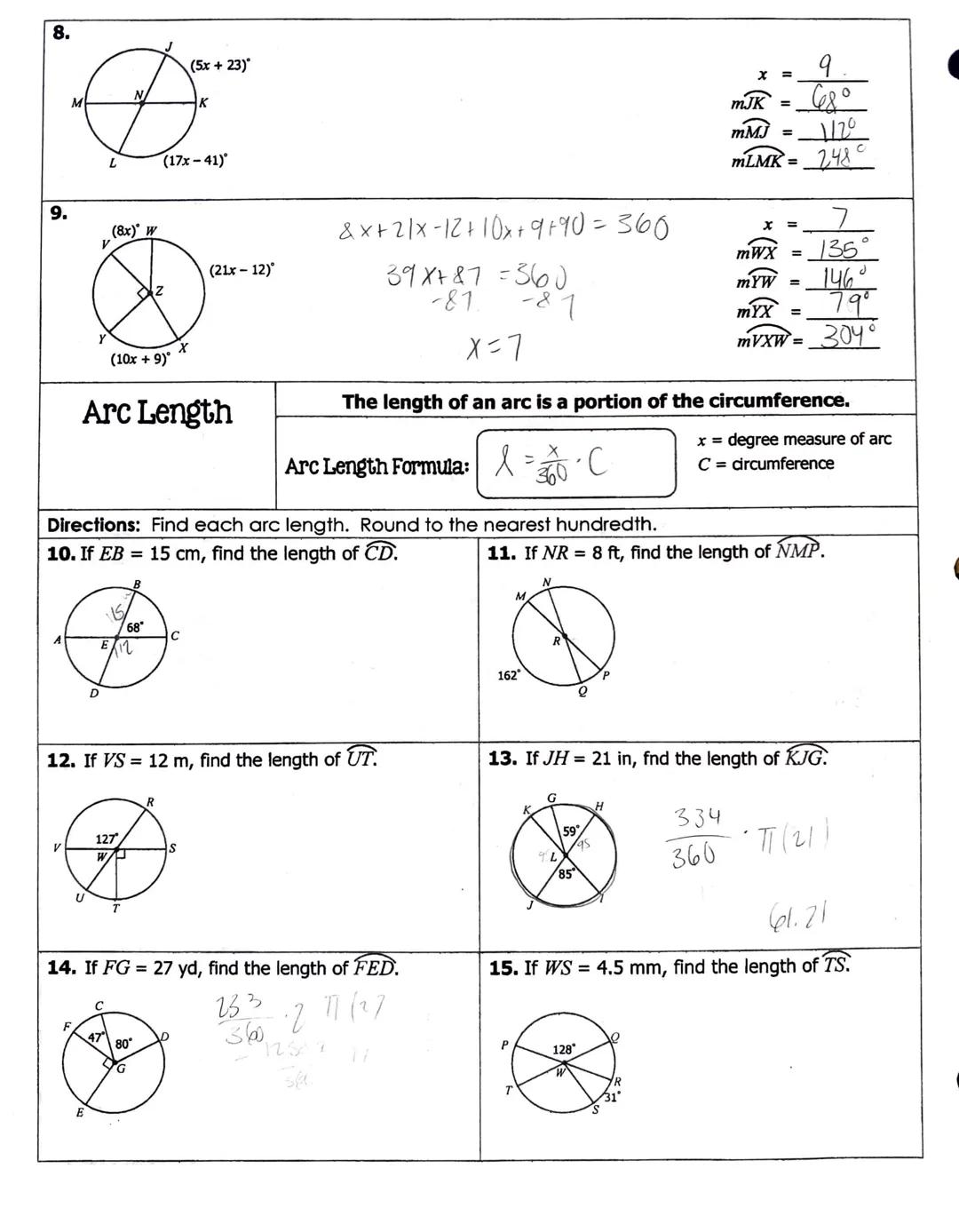
Arc Length Calculations
Arc length represents a portion of the circle's circumference. Think of it as the distance along the curved edge of a slice of pizza! To find this length, we use a simple formula: × circumference.
The formula makes intuitive sense - if an arc measures 90°, it's 1/4 of the full 360° circle, so its length would be 1/4 of the circumference. Remember that circumference equals 2πr or πd, where r is radius and d is diameter.
When solving arc length problems, first identify what information you're given. You might have the radius (or diameter) and an angle measure. Convert this into the fraction of the circle represented by the arc, then multiply by the circumference to find the length.
Remember: Arc length calculations always follow the pattern: × (2πr). This proportion approach works because arc length is directly proportional to the central angle!
For more complex problems involving multiple arcs, break them down into individual calculations. Calculate each arc's measure first, then apply the formula to find its length. This step-by-step approach makes even challenging problems manageable.
We thought you’d never ask...
What is the Knowunity AI companion?
Our AI companion is specifically built for the needs of students. Based on the millions of content pieces we have on the platform we can provide truly meaningful and relevant answers to students. But its not only about answers, the companion is even more about guiding students through their daily learning challenges, with personalised study plans, quizzes or content pieces in the chat and 100% personalisation based on the students skills and developments.
Where can I download the Knowunity app?
You can download the app in the Google Play Store and in the Apple App Store.
Is Knowunity really free of charge?
That's right! Enjoy free access to study content, connect with fellow students, and get instant help – all at your fingertips.
Most popular content: Central Angle
2 Geometry
Most popular content in Algebra 1
9M
Algebra 1Mastering Algebra 1: Essential Flashcards
Learn key concepts of Algebra 1 with these flashcards. Explore slope-intercept form, properties, equations, and expressions. Boost your math skills and ace your exams!
8th1811
7
Algebra 17th Grade Math
Algebra 1 and all of the other stuff
7th4194
W
Algebra 1wizards
Mathematics is the most loved and also the most feared subjects by students across the world. Have you been worrying about your upcoming math test? Practice these 30 maths quiz questions to ensure you are at the top of your game!
980
Algebra 1Interior and exterior angle measures
Interior and exterior angle measures practice
9th2721
Algebra 1Expressions and Operations
Algebra 1 - unit 1 - covers: integer rules, order of operations, evaluating algerbraic expressions, simplifying algebraic expressions, and translating expressions.
9th1,46195
Algebra 1Math study guide: linear equations, standard form,proportional relationships, & dimensional analysis
This study guide shows you through all things about point-slope formula of a linear equation, and all the forms of a linear equation, as well as explaining the process of dimensional analysis.
9th821
Algebra 1Linear Function: Solving Linear Equations in 1 Variable
Study note on linear equations with one variable, rules on linear equations, examples on simple linear equations, algebra 2, algebra 1
9th3321
Algebra 1Solving leaner equations
About the topic
1739
Algebra 1Order Of Operations
PEMDAS (GEMDAS)
9th1521
Most popular content
9O
 AP US History
Origins and Dynamics of the Columbian Exchange
Analyze the ecological and economic motivations behind the initial transfer of goods, people, and diseases between the Old and New Worlds.
9th3,1280
I
AP US HistoryIntroduction to Early Cultural Interactions
Analyze the initial social and religious encounters between Europeans, Africans, and Indigenous peoples in the colonial Americas.
9th2,7730
O
 AP World History
Origins of Ancient River Civilizations
Analyze the environmental factors and technological innovations that led to the rise of early states in Mesopotamia, Egypt, and the Indus Valley.
9th3,1870
M
AP US HistoryMotivations for European Exploration
Analyze the economic, religious, and political factors that drove European powers to the Americas during the 15th and 16th centuries.
9th1,7780
F
 AP Psychology
Foundations of Ethical Guidelines in Research
Practice the core principles of the APA ethical code including informed consent, debriefing, and the role of Institutional Review Boards.
9th1,3360
I
AP US HistoryIntroduction to Native American Societies
Examine the diverse social, political, and economic structures of North American indigenous groups prior to European contact.
9th1,1100
I
 AP Biology
Introduction to Biological Elements of Life
Practice identifying the essential elements including carbon, nitrogen, phosphorus, and sulfur that compose biological macromolecules.
9th1,7390
I
AP US HistoryIntroduction to the Spanish Encomienda System
Explore the fundamental economic and social structures of the Spanish colonial system, focusing on the encomienda and the casta social hierarchy.
9th8890
O
AP World HistoryOrigins and Continuity of the Byzantine Empire
Analyze the political and cultural transitions from the Roman Empire to the Byzantine Empire, focusing on the reign of Justinian I and his code.
9th1,6320
Can't find what you're looking for? Explore other subjects.
Students love us — and so will you.
4.6/5App Store
4.7/5Google Play
The app is very easy to use and well designed. I have found everything I was looking for so far and have been able to learn a lot from the presentations! I will definitely use the app for a class assignment! And of course it also helps a lot as an inspiration.
Stefan SiOS user
This app is really great. There are so many study notes and help [...]. My problem subject is French, for example, and the app has so many options for help. Thanks to this app, I have improved my French. I would recommend it to anyone.
Samantha KlichAndroid user
Wow, I am really amazed. I just tried the app because I've seen it advertised many times and was absolutely stunned. This app is THE HELP you want for school and above all, it offers so many things, such as workouts and fact sheets, which have been VERY helpful to me personally.
AnnaiOS user
Algebra 1148 views·Updated Jun 9, 2026·2 pagesUnderstanding Central Angles and Arc Measures
Eithar Omer@eitharomer
Central angles and arc measures form the backbone of circle geometry. These concepts help us understand the relationship between angles at the center of a circle and the arcs they create on the circle's circumference. Let's explore how to calculate...
1
of 2
Sign up to see the content. It's free!
- Access to all documents
- Improve your grades
- Join milions of students
Central Angles and Arc Measures
A central angle has its vertex at the center of a circle with its sides formed by radii. The sum of all central angles in any circle is always 360°. When you see a central angle, remember that it creates an arc on the circle.
The measure of an arc equals the measure of its central angle. For example, if angle ABC is 84°, then the arc AC it creates also measures 84°. If you need to find a complementary arc (the rest of the circle), just subtract from 360° - like arc ADC = 360° - 84° = 276°.
Working with central angles means recognizing patterns. When given angle measures, you can determine arc measures directly, and vice versa. For multi-part problems, remember to account for the entire 360° of the circle when calculating unknown angles.
Quick Tip: When solving for an unknown variable in central angle problems, set up an equation based on the fact that all angles in a circle sum to 360°. This gives you a clear starting point for any problem!
For example, in problems with algebraic expressions like ° and °, you'll need to set up equations using the 360° total. Solving these equations reveals the value of x, which then helps you find all remaining angle and arc measures.
2
of 2Sign up to see the content. It's free!
- Access to all documents
- Improve your grades
- Join milions of students
Arc Length Calculations
Arc length represents a portion of the circle's circumference. Think of it as the distance along the curved edge of a slice of pizza! To find this length, we use a simple formula: × circumference.
The formula makes intuitive sense - if an arc measures 90°, it's 1/4 of the full 360° circle, so its length would be 1/4 of the circumference. Remember that circumference equals 2πr or πd, where r is radius and d is diameter.
When solving arc length problems, first identify what information you're given. You might have the radius (or diameter) and an angle measure. Convert this into the fraction of the circle represented by the arc, then multiply by the circumference to find the length.
Remember: Arc length calculations always follow the pattern: × (2πr). This proportion approach works because arc length is directly proportional to the central angle!
For more complex problems involving multiple arcs, break them down into individual calculations. Calculate each arc's measure first, then apply the formula to find its length. This step-by-step approach makes even challenging problems manageable.
We thought you’d never ask...
What is the Knowunity AI companion?
Our AI companion is specifically built for the needs of students. Based on the millions of content pieces we have on the platform we can provide truly meaningful and relevant answers to students. But its not only about answers, the companion is even more about guiding students through their daily learning challenges, with personalised study plans, quizzes or content pieces in the chat and 100% personalisation based on the students skills and developments.
Where can I download the Knowunity app?
You can download the app in the Google Play Store and in the Apple App Store.
Is Knowunity really free of charge?
That's right! Enjoy free access to study content, connect with fellow students, and get instant help – all at your fingertips.
Most popular content: Central Angle
2Most popular content in Algebra 1
9M
Algebra 1Mastering Algebra 1: Essential Flashcards
Learn key concepts of Algebra 1 with these flashcards. Explore slope-intercept form, properties, equations, and expressions. Boost your math skills and ace your exams!
8th1811
7
Algebra 17th Grade Math
Algebra 1 and all of the other stuff
7th4194
W
Algebra 1wizards
Mathematics is the most loved and also the most feared subjects by students across the world. Have you been worrying about your upcoming math test? Practice these 30 maths quiz questions to ensure you are at the top of your game!
980
Algebra 1Interior and exterior angle measures
Interior and exterior angle measures practice
9th2721
Algebra 1Expressions and Operations
Algebra 1 - unit 1 - covers: integer rules, order of operations, evaluating algerbraic expressions, simplifying algebraic expressions, and translating expressions.
9th1,46195
Algebra 1Math study guide: linear equations, standard form,proportional relationships, & dimensional analysis
This study guide shows you through all things about point-slope formula of a linear equation, and all the forms of a linear equation, as well as explaining the process of dimensional analysis.
9th821
Algebra 1Linear Function: Solving Linear Equations in 1 Variable
Study note on linear equations with one variable, rules on linear equations, examples on simple linear equations, algebra 2, algebra 1
9th3321
Algebra 1Solving leaner equations
About the topic
1739
Algebra 1Order Of Operations
PEMDAS (GEMDAS)
9th1521
Most popular content
9O
AP US HistoryOrigins and Dynamics of the Columbian Exchange
Analyze the ecological and economic motivations behind the initial transfer of goods, people, and diseases between the Old and New Worlds.
9th3,1280
I
AP US HistoryIntroduction to Early Cultural Interactions
Analyze the initial social and religious encounters between Europeans, Africans, and Indigenous peoples in the colonial Americas.
9th2,7730
O
AP World HistoryOrigins of Ancient River Civilizations
Analyze the environmental factors and technological innovations that led to the rise of early states in Mesopotamia, Egypt, and the Indus Valley.
9th3,1870
M
AP US HistoryMotivations for European Exploration
Analyze the economic, religious, and political factors that drove European powers to the Americas during the 15th and 16th centuries.
9th1,7780
F
AP PsychologyFoundations of Ethical Guidelines in Research
Practice the core principles of the APA ethical code including informed consent, debriefing, and the role of Institutional Review Boards.
9th1,3360
I
AP US HistoryIntroduction to Native American Societies
Examine the diverse social, political, and economic structures of North American indigenous groups prior to European contact.
9th1,1100
I
AP BiologyIntroduction to Biological Elements of Life
Practice identifying the essential elements including carbon, nitrogen, phosphorus, and sulfur that compose biological macromolecules.
9th1,7390
I
AP US HistoryIntroduction to the Spanish Encomienda System
Explore the fundamental economic and social structures of the Spanish colonial system, focusing on the encomienda and the casta social hierarchy.
9th8890
O
AP World HistoryOrigins and Continuity of the Byzantine Empire
Analyze the political and cultural transitions from the Roman Empire to the Byzantine Empire, focusing on the reign of Justinian I and his code.
9th1,6320
Can't find what you're looking for? Explore other subjects.
Students love us — and so will you.
4.6/5App Store
4.7/5Google Play
The app is very easy to use and well designed. I have found everything I was looking for so far and have been able to learn a lot from the presentations! I will definitely use the app for a class assignment! And of course it also helps a lot as an inspiration.
Stefan SiOS user
This app is really great. There are so many study notes and help [...]. My problem subject is French, for example, and the app has so many options for help. Thanks to this app, I have improved my French. I would recommend it to anyone.
Samantha KlichAndroid user
Wow, I am really amazed. I just tried the app because I've seen it advertised many times and was absolutely stunned. This app is THE HELP you want for school and above all, it offers so many things, such as workouts and fact sheets, which have been VERY helpful to me personally.
AnnaiOS user