

Learning to work with polynomials requires understanding both adding polynomials...
 Algebra 1410 views·Updated Jun 16, 2026·24 pages
How to Add and Subtract Polynomials: Worksheets and Awesome Examples!


1 / 10
1
of 10
Understanding Polynomials and Their Basic Operations
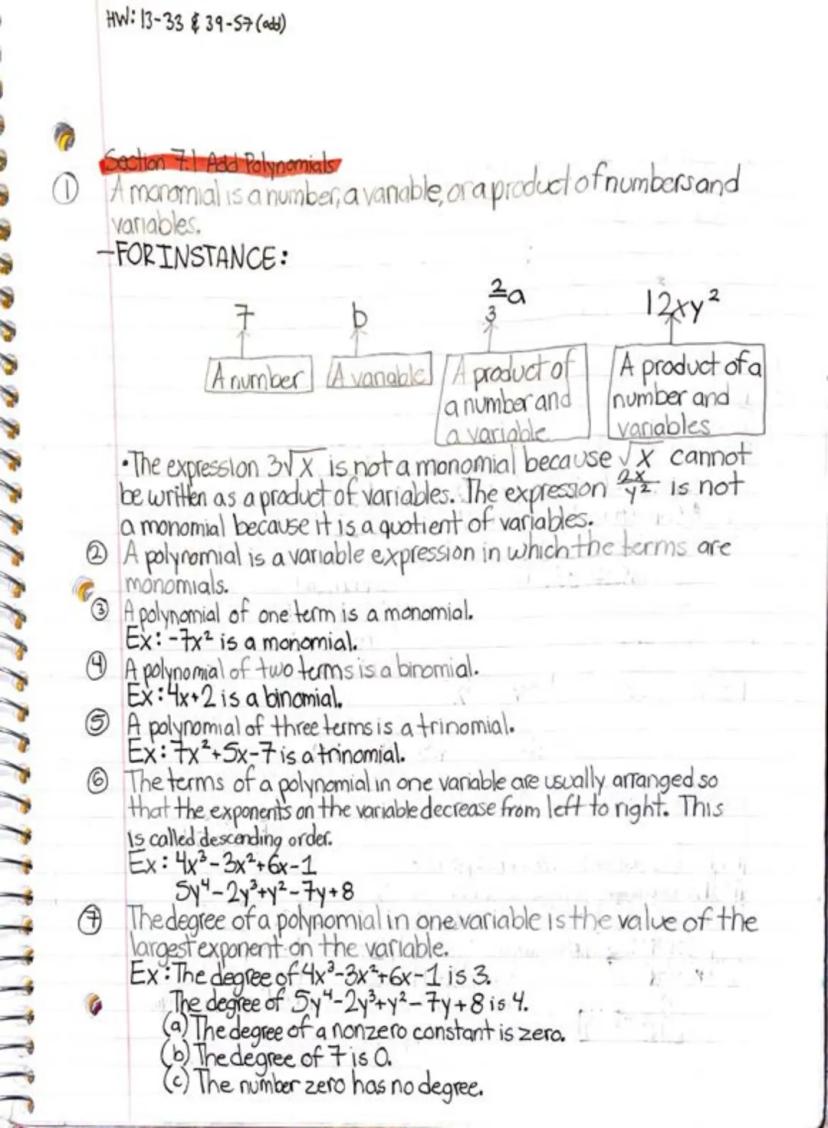
A polynomial expression consists of terms that are monomials - individual components made up of numbers, variables, or their products. When working with polynomials, it's essential to understand their fundamental structure and classification.
Definition: A monomial is a mathematical expression that can be a number, variable, or product of numbers and variables. Examples include: 7, x, 2xy².
The complexity of polynomials increases based on the number of terms they contain. A polynomial with one term is called a monomial , two terms make a binomial , and three terms create a trinomial . When writing polynomials in one variable, mathematicians typically arrange terms in descending order, meaning the highest power of the variable appears first.
Example: The polynomial 4x³-3x²+6x-1 is written in descending order, with the term containing x³ first, followed by x², then x, and finally the constant term.
The degree of a polynomial in one variable is determined by the highest exponent of that variable in any term. For instance, in the polynomial 5y⁴-2y³+y²-7y+8, the degree is 4 because the highest power of y is 4. It's important to note that constants have a degree of zero, while the number zero itself has no degree.
Highlight: When identifying polynomial degrees:
- A nonzero constant has degree 0
- The number 7 has degree 0
- Zero has no degree
- The highest exponent determines the overall degree
2
of 10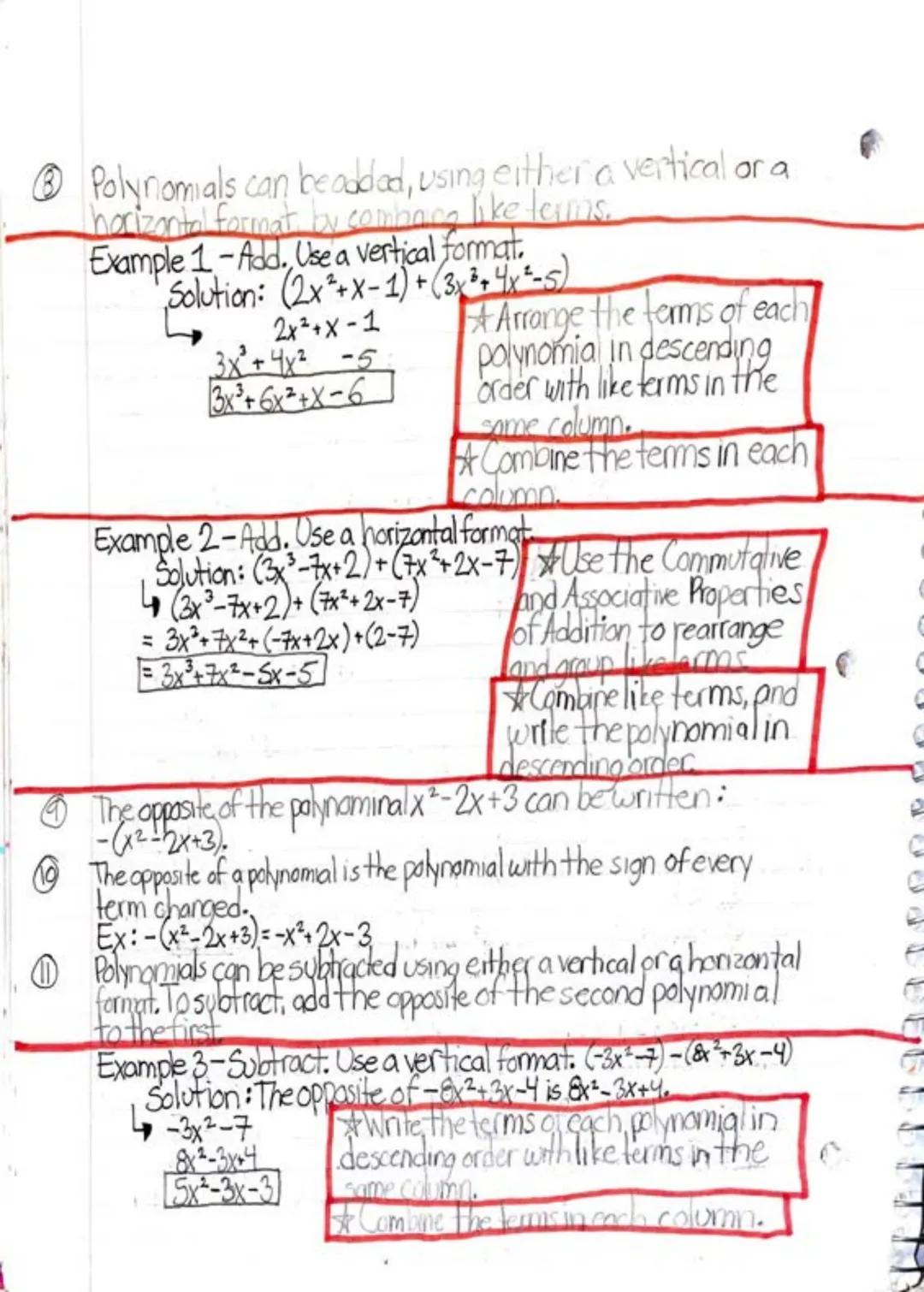
Adding and Subtracting Polynomials
Adding polynomials can be accomplished using either vertical or horizontal formats. Both methods rely on combining like terms - terms with identical variables raised to the same powers.
Example: When adding + vertically:
2x²+x-1
3x³+4x²-5
= 3x³+6x²+x-6
The horizontal format offers an alternative approach that uses the commutative and associative properties of addition. This method involves rearranging terms so that like terms are grouped together before combining them.
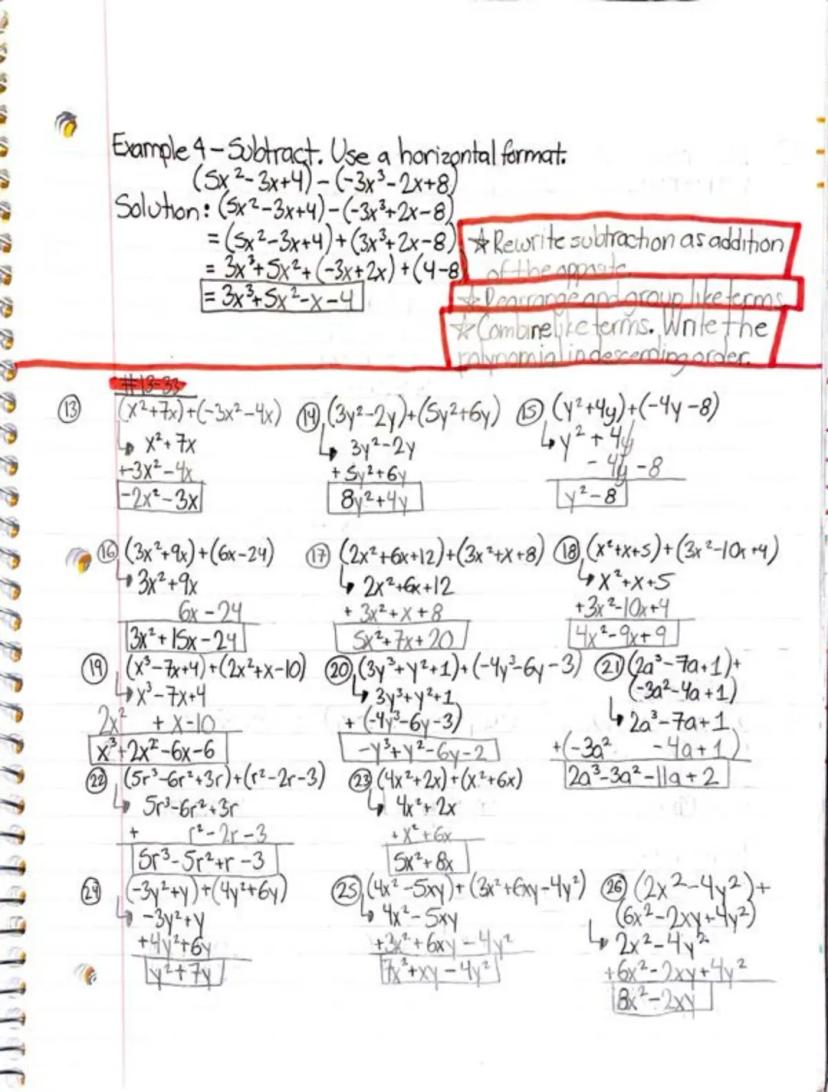
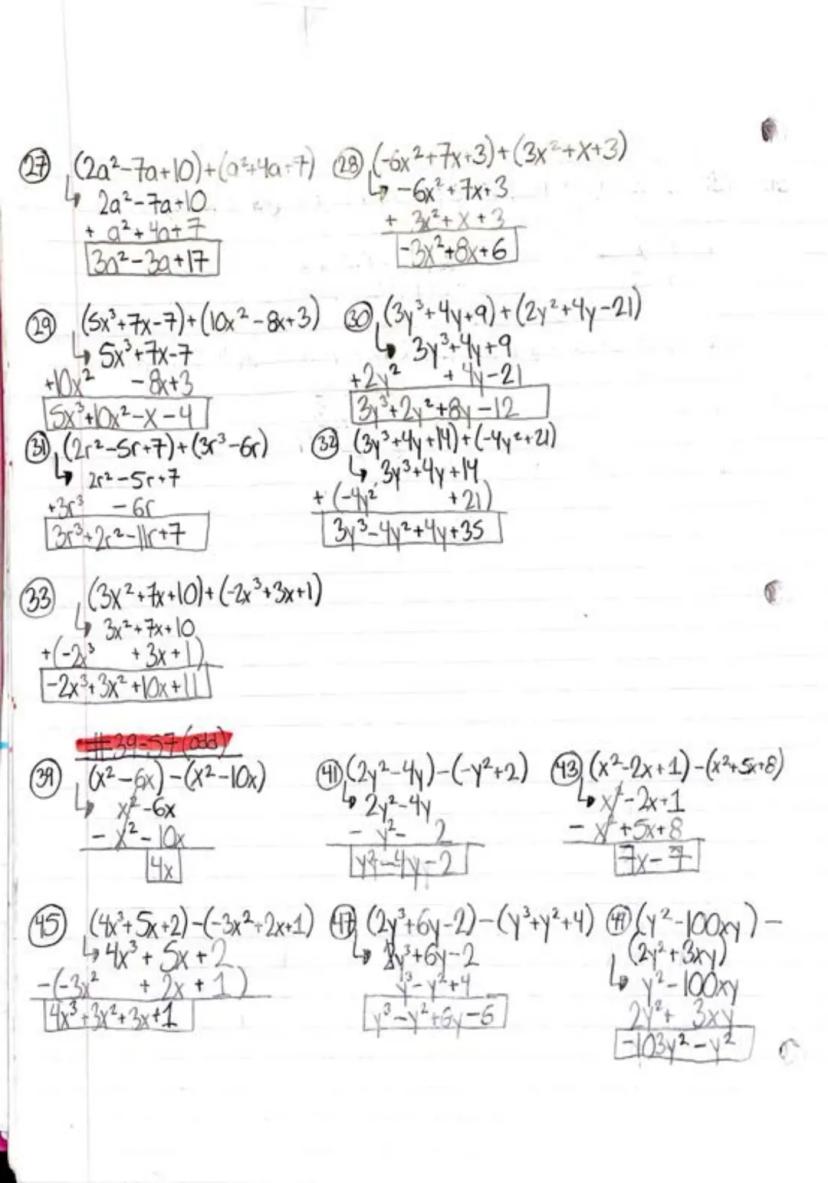
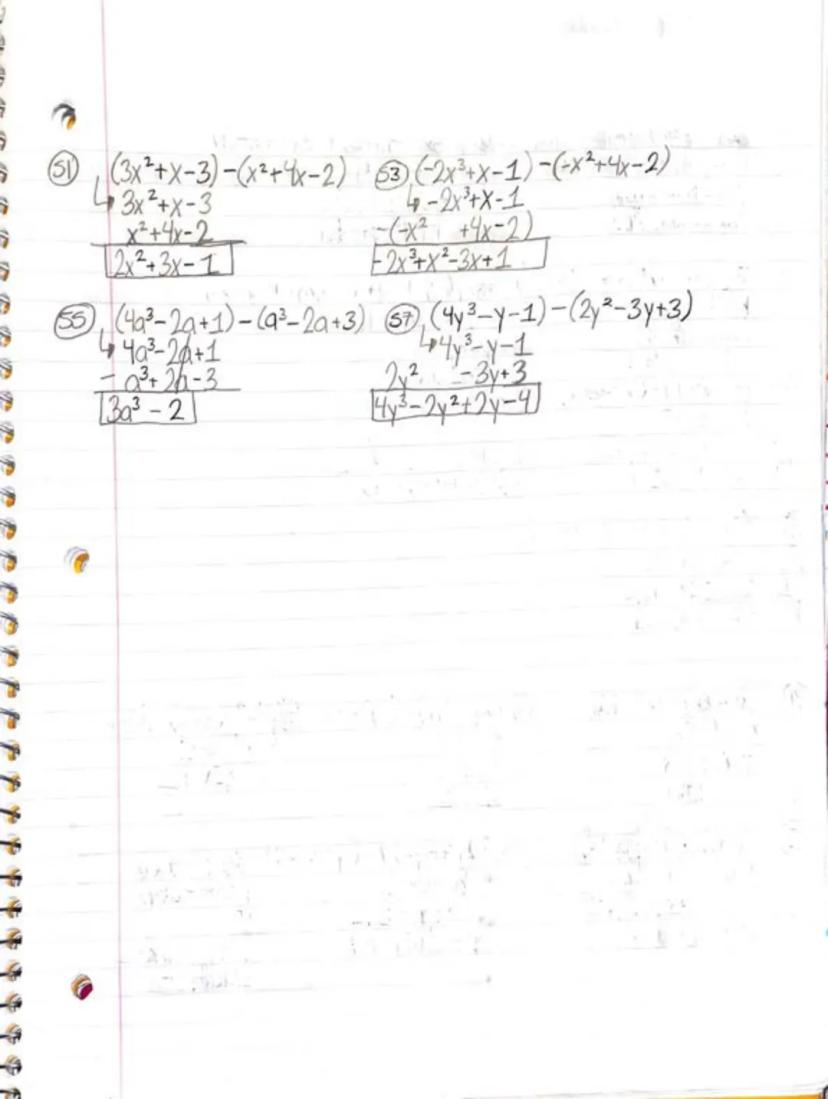
Highlight: When subtracting polynomials, add the opposite of the subtrahend (the polynomial being subtracted). The opposite of a polynomial is formed by changing the sign of every term.
For example, to find -, change each sign: -x²+2x-3
When performing polynomial subtraction, you can use either:
- Vertical format: Align like terms in columns
- Horizontal format: Rewrite as addition of the opposite, then combine like terms
3
of 10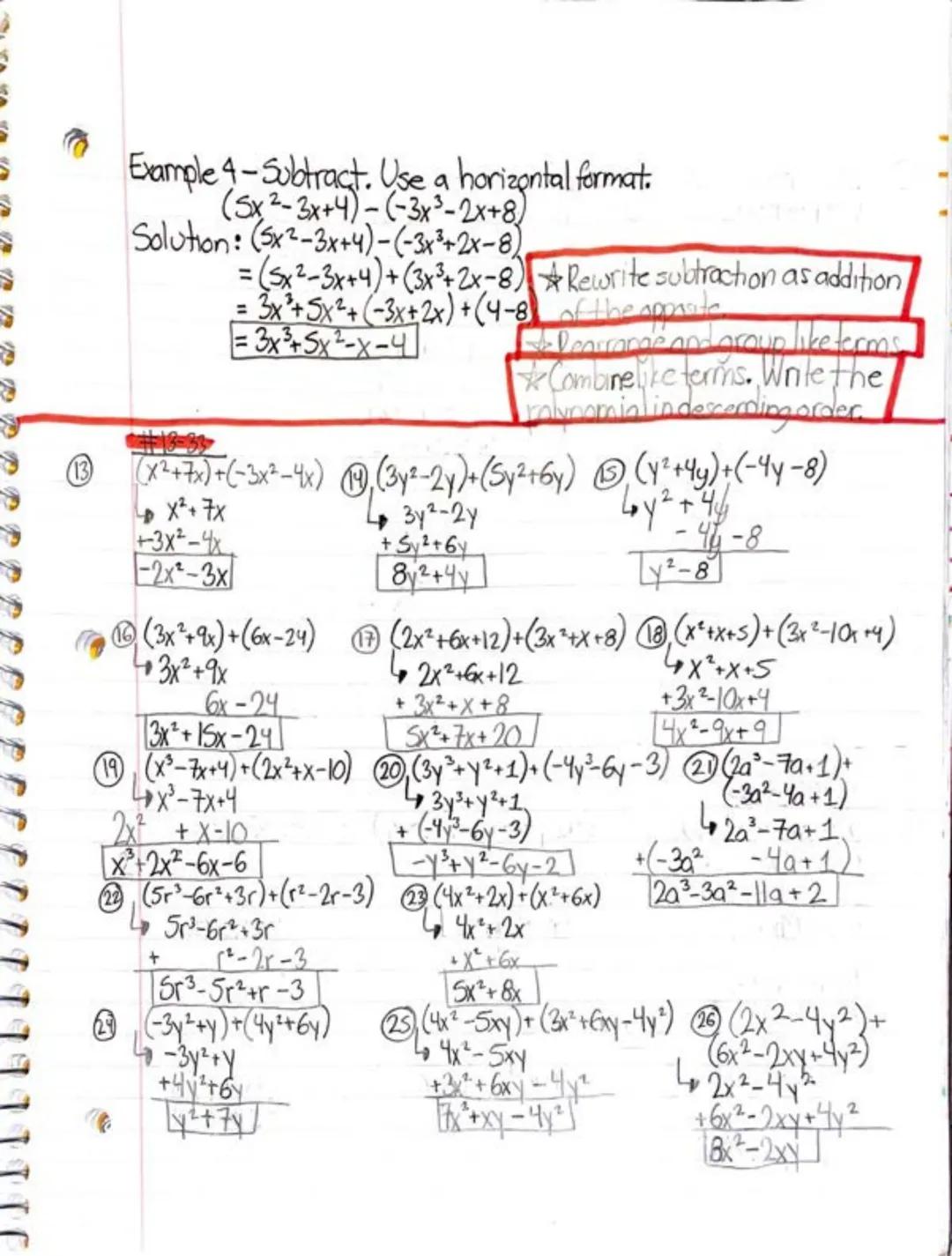
Advanced Polynomial Operations
Working with more complex polynomial expressions requires careful attention to signs and terms. When adding or subtracting multiple polynomials, maintain organization by consistently aligning like terms.
Example: For the expression -:
- Rewrite as addition: +
- Group like terms: 3x³+5x²++(4-8)
- Simplify: 3x³+5x²-x-4
The key to successful polynomial operations lies in systematic organization and careful attention to signs. Whether working vertically or horizontally, maintaining clear alignment of like terms prevents errors and simplifies calculations.
Vocabulary:
- Like terms: Terms with identical variables raised to identical powers
- Descending order: Arrangement of terms from highest to lowest degree
- Opposite: The result of changing all signs in an expression
4
of 10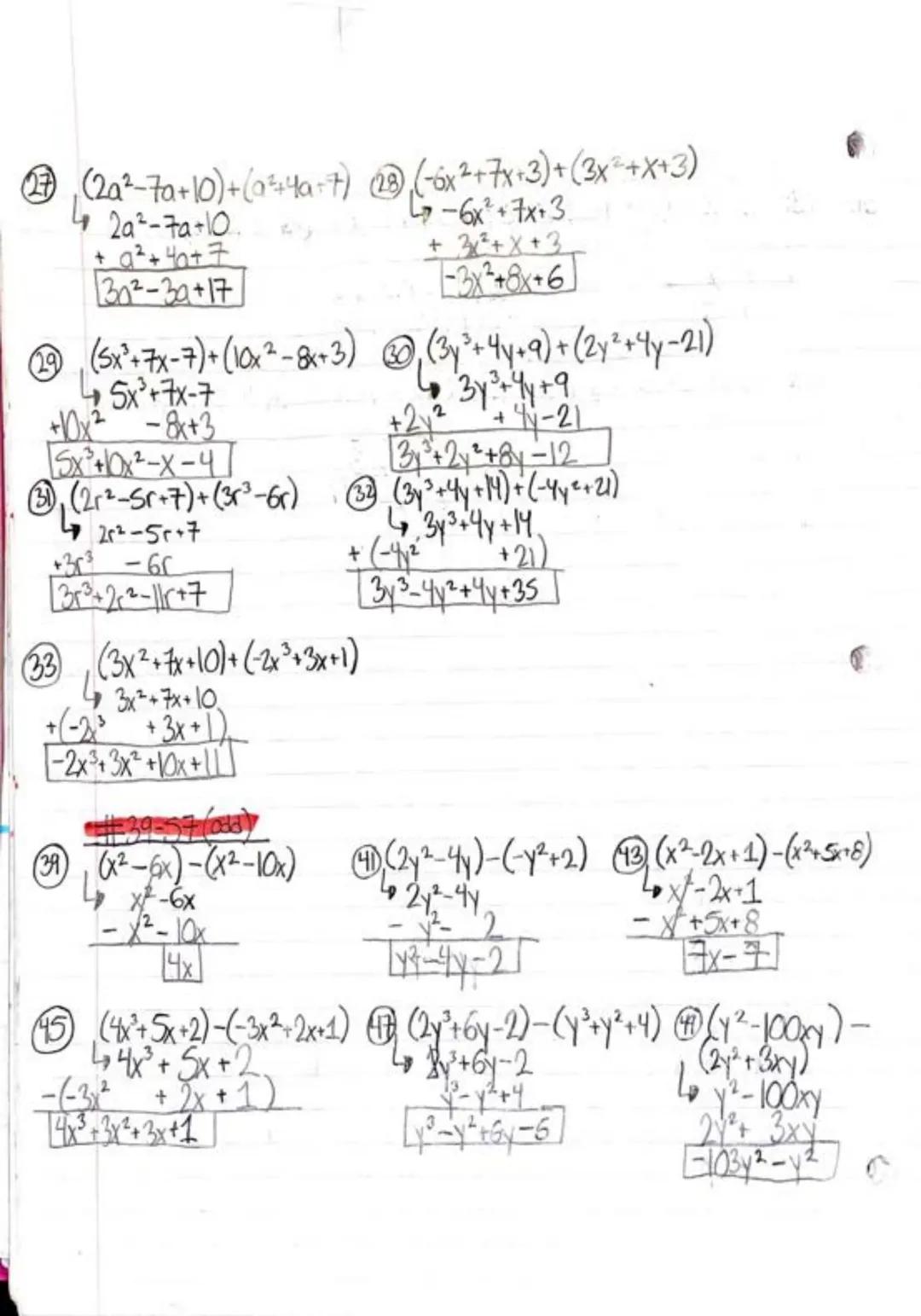
Practice and Applications
Mastering polynomial operations requires regular practice with various types of expressions. Common applications include:
Example: Practical problems involving:
- Area calculations where length and width are polynomials
- Volume computations with polynomial dimensions
- Financial models using polynomial functions
- Scientific formulas expressing relationships between variables
When solving problems, remember these key strategies:
- Always identify like terms before combining
- Maintain careful organization of terms
- Double-check signs when subtracting
- Verify that the final answer is in standard form (descending order)
Highlight: Common mistakes to avoid:
- Combining terms that aren't alike
- Forgetting to change all signs when finding opposites
- Misaligning terms in vertical format
- Overlooking negative signs in horizontal format
5
of 10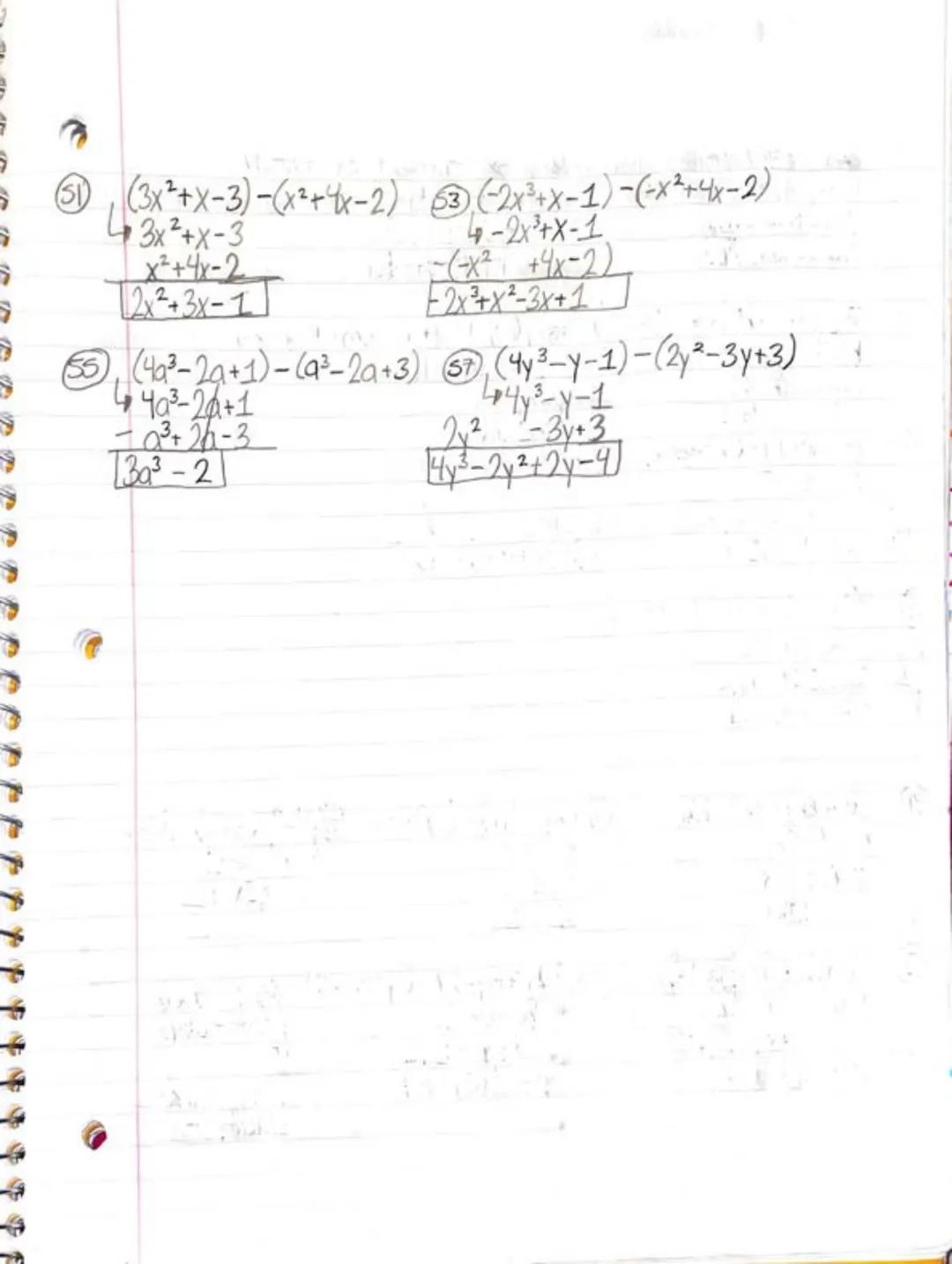
Understanding Polynomial Operations and Exponents
Adding polynomials and working with exponents requires careful attention to mathematical rules and proper organization. Let's explore these concepts in detail.
Definition: A polynomial is an algebraic expression made up of variables and coefficients, where variables can only have whole number exponents.
When adding polynomials horizontally, you must identify like terms and combine them while maintaining their signs. For example, when adding 3x² + 2x + 1 and 2x² - 3x + 4, group like terms: + + (1 + 4) = 5x² - x + 5.
How to add polynomials vertically follows a similar principle but with a different visual organization:
   3x² + 2x + 1
   2x² - 3x + 4
   ____________
   5x² - x + 5
Example: When subtracting polynomials, remember to distribute the negative sign to all terms in the second polynomial: - = 4x³ - 2x² + x - 3 - 2x³ - x² + 2x - 1 = 2x³ - 3x² + 3x - 4
6
of 10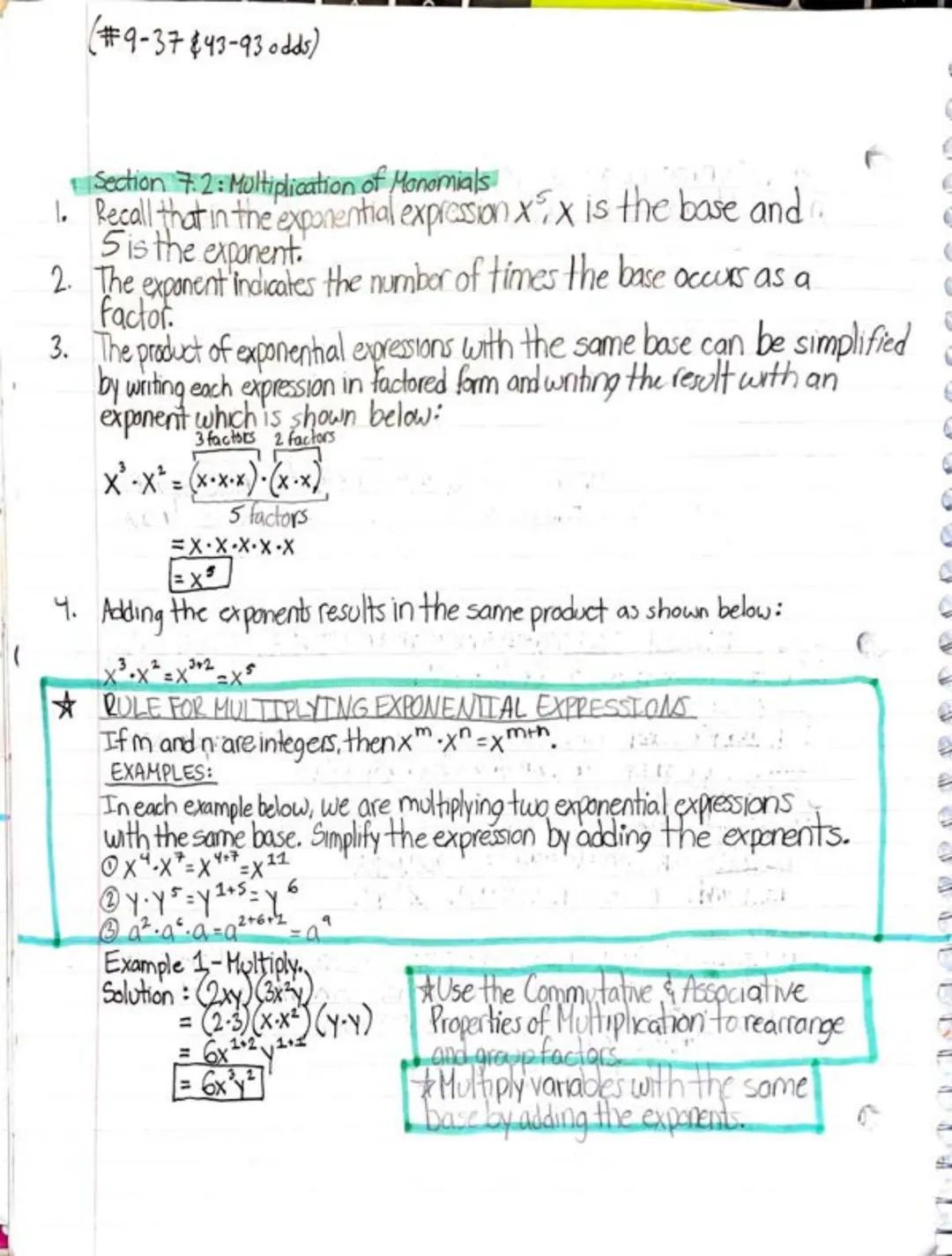
Working with Monomials and Exponent Rules
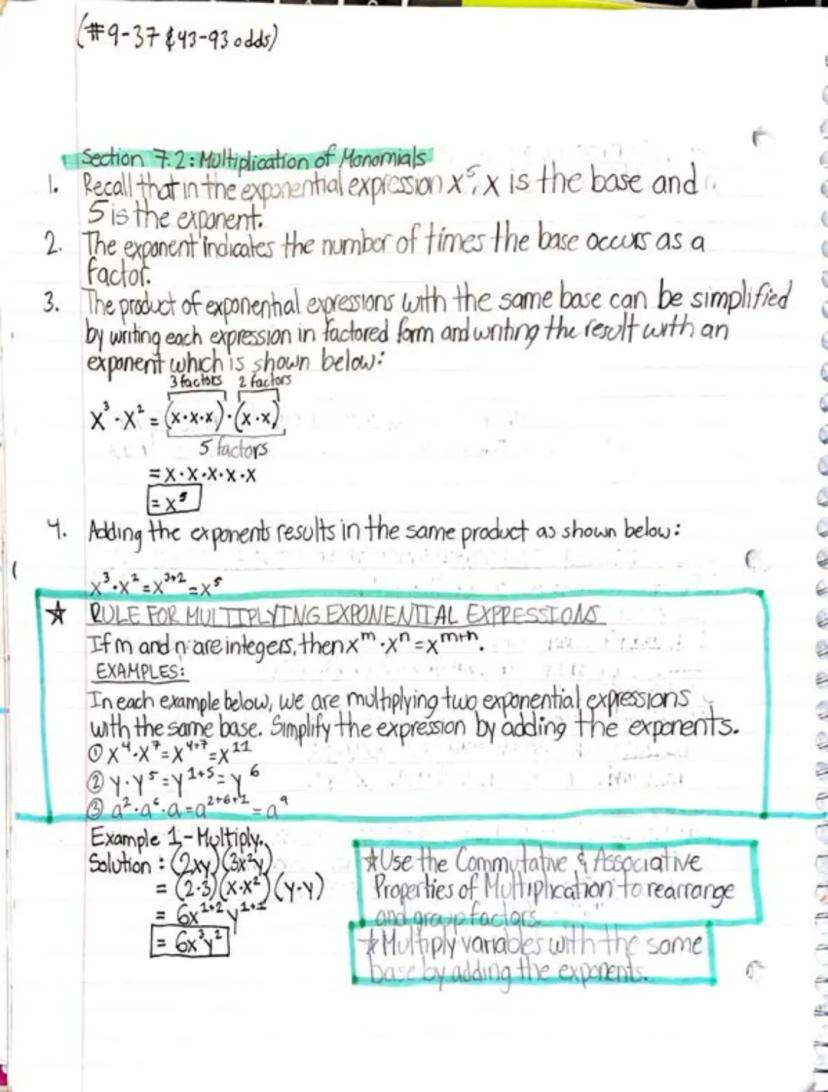
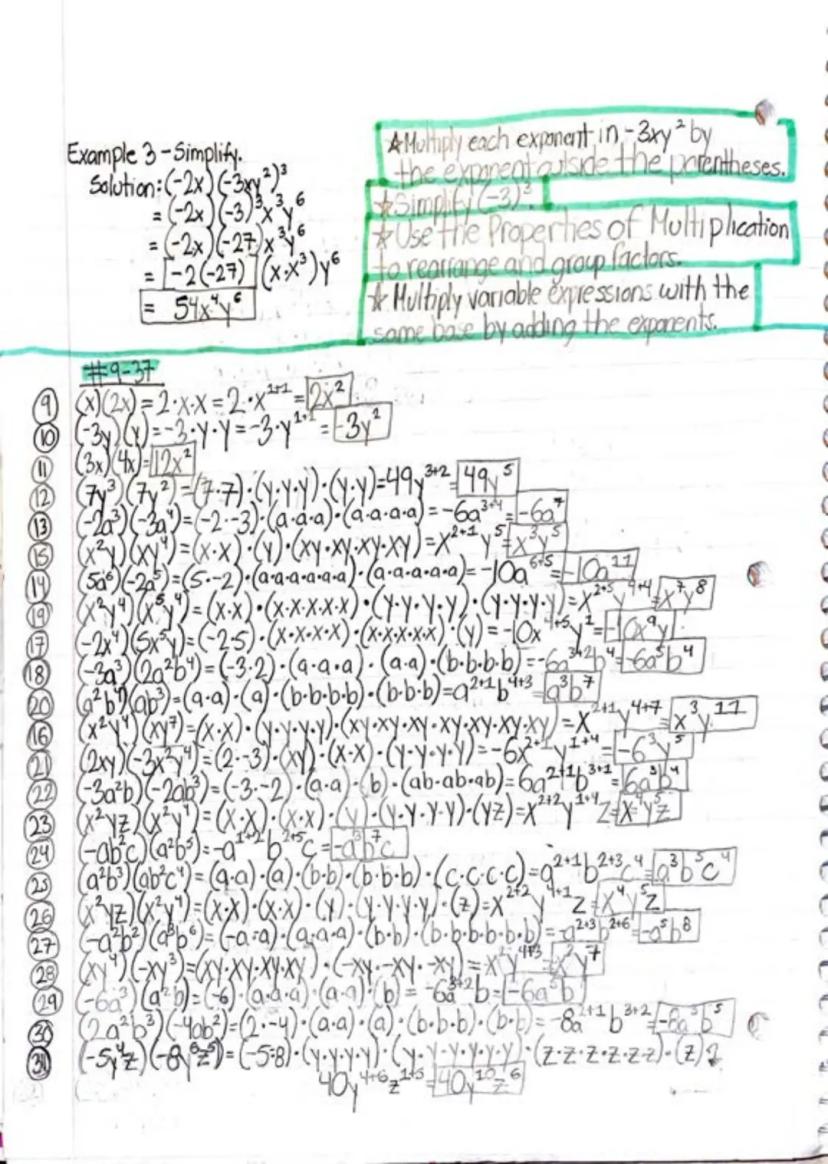
Understanding how to multiply monomials requires mastery of exponent rules. When multiplying terms with the same base, add the exponents while keeping the base the same.
Highlight: The fundamental rule for multiplying exponential expressions: x^m • x^n = x^
For example, when multiplying (3x²y)(2xy³), follow these steps:
- Multiply the coefficients: 3 • 2 = 6
- Add exponents of like variables: x² • x = x³
- Add exponents of y: y • y³ = y⁴ Final result: 6x³y⁴
Vocabulary: A monomial is an algebraic expression that consists of a single term, such as 5x³y².
7
of 10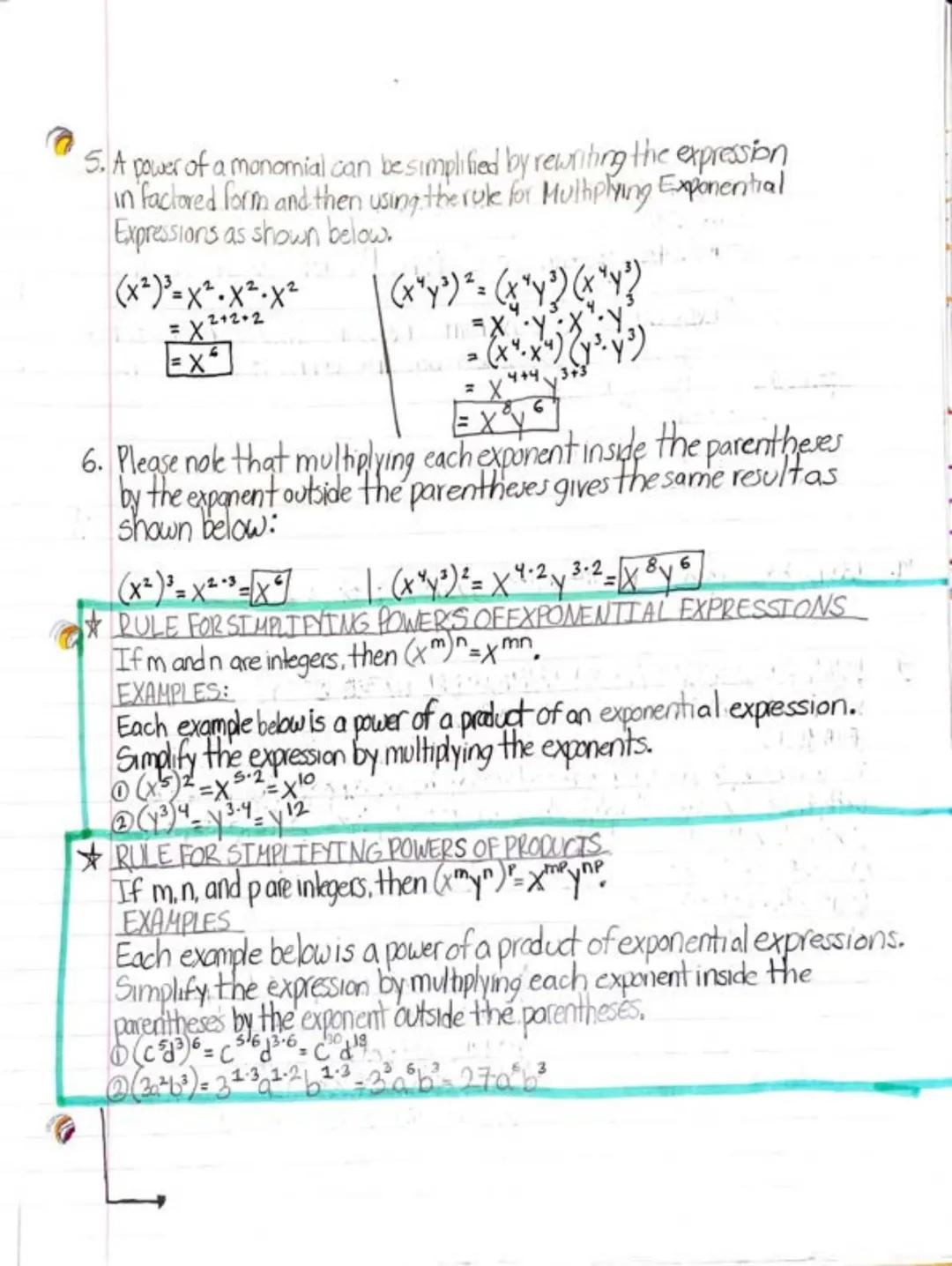
Powers of Monomials and Complex Operations
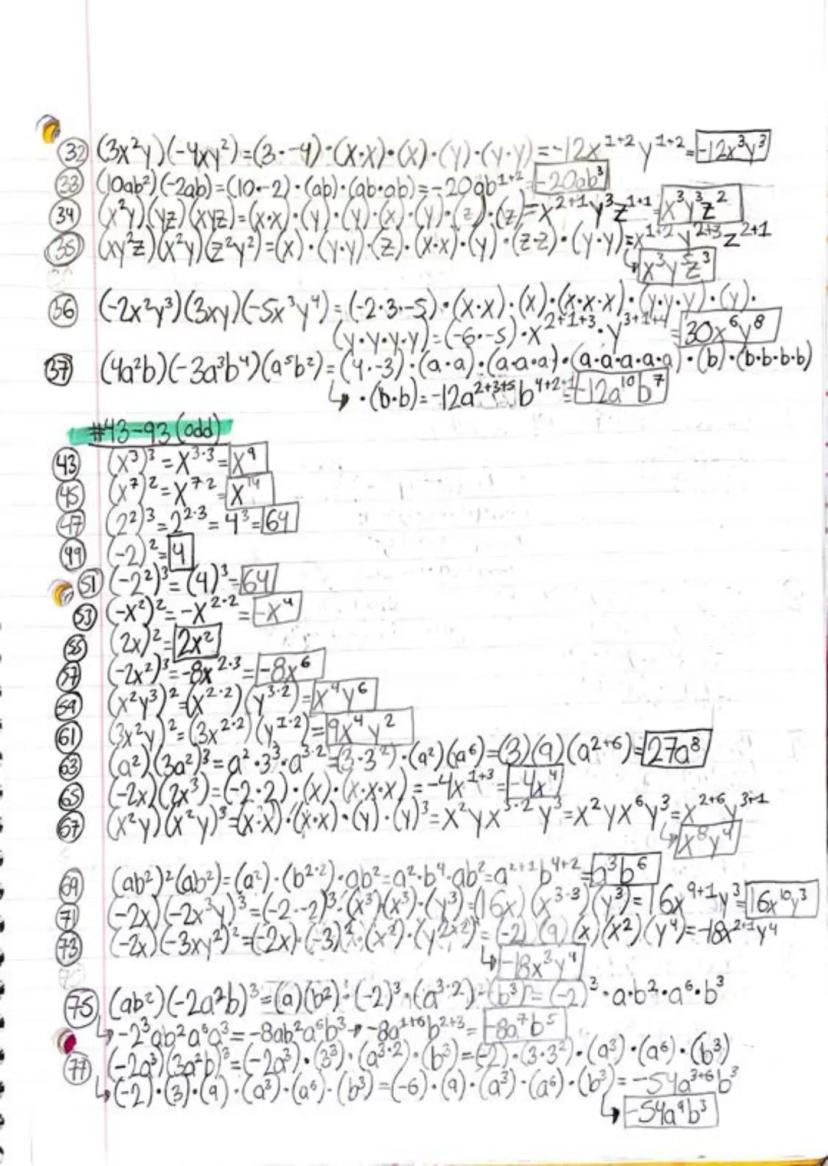
When dealing with powers of monomials, multiply the exponent outside the parentheses by each exponent inside. This is known as the power rule for exponents.
Rule: For any expression ^n = x^(m•n)
For example: (x²y³)⁴ = x^(2•4)y^(3•4) = x⁸y¹²
When working with multiple operations:
- Simplify expressions in parentheses first
- Apply exponent rules
- Combine like terms
- Simplify numerical coefficients
Example: Simplify (2x²y)³ Solution: (2x²y)³ = 2³(x²)³(y)³ = 8x⁶y³
8
of 10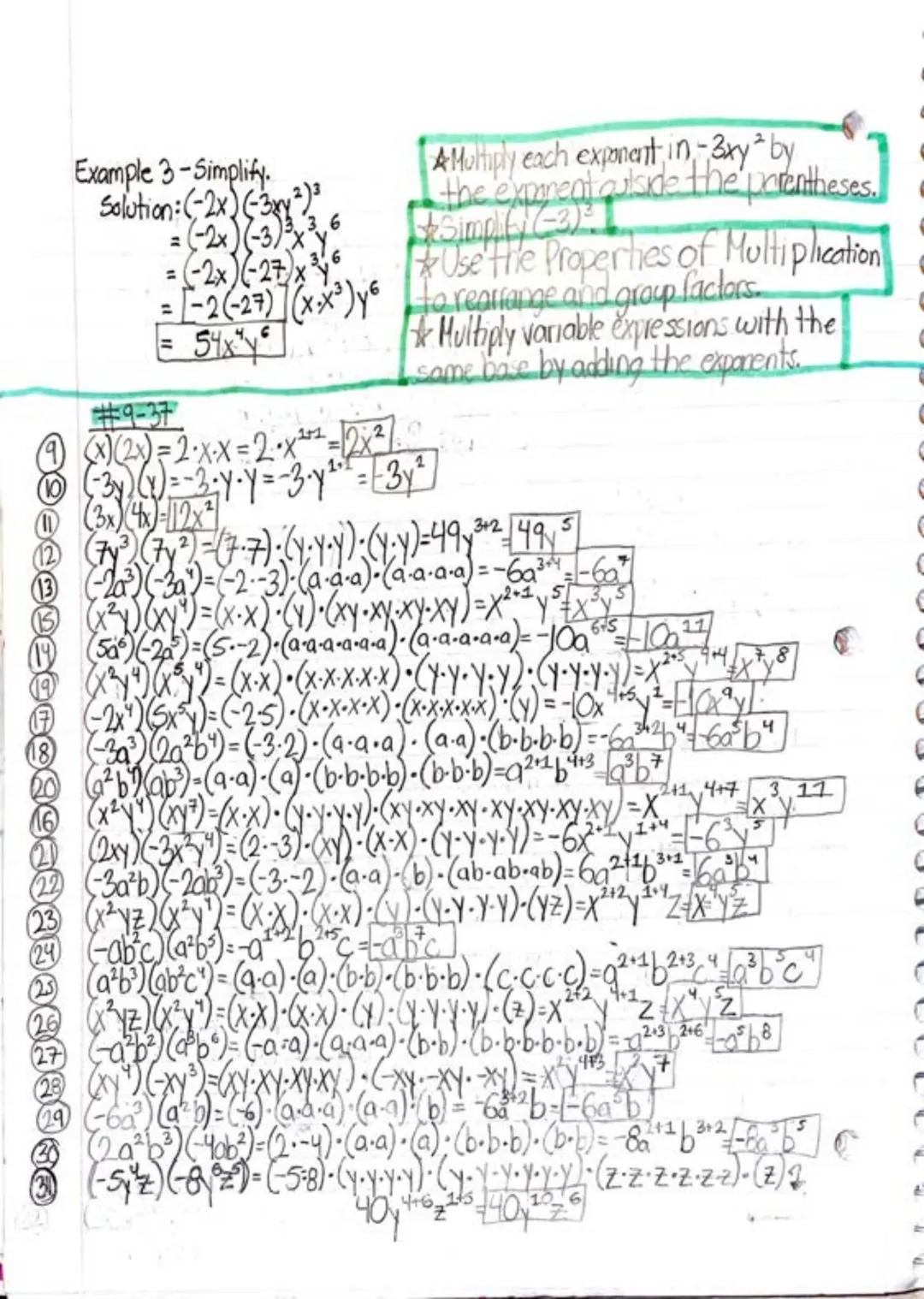
Advanced Polynomial Operations
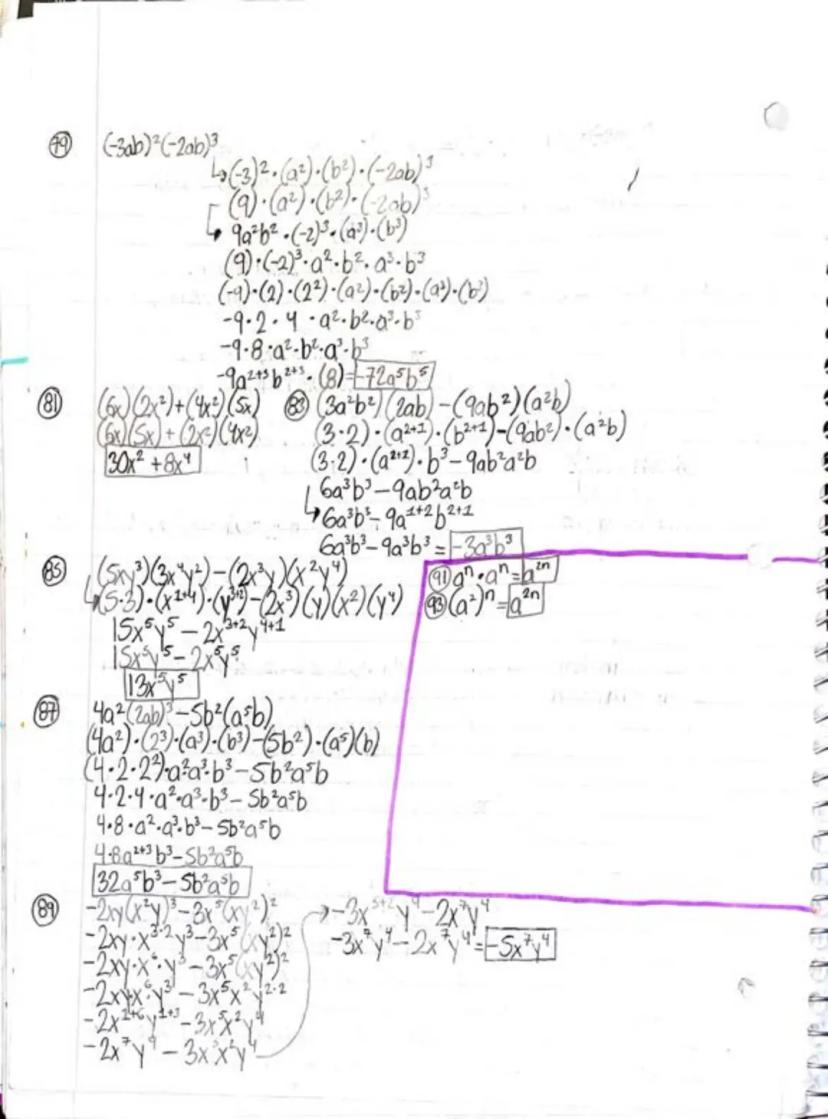
Complex polynomial operations often combine multiple concepts including addition, subtraction, multiplication, and exponent rules. Success requires systematic approach and careful attention to detail.
When working with expressions containing multiple variables and operations:
- Identify the operation sequence
- Group like terms
- Apply appropriate exponent rules
- Simplify numerical coefficients
- Write final answer in standard form
Highlight: Always check that the degree of each term in your answer makes mathematical sense based on the original expression.
For expressions like (3xy²), follow these steps:
- Multiply coefficients: -2 • 3 = -6
- Add exponents of x: x² • x = x³
- Add exponents of y: y³ • y² = y⁵ Final result: -6x³y⁵
9
of 10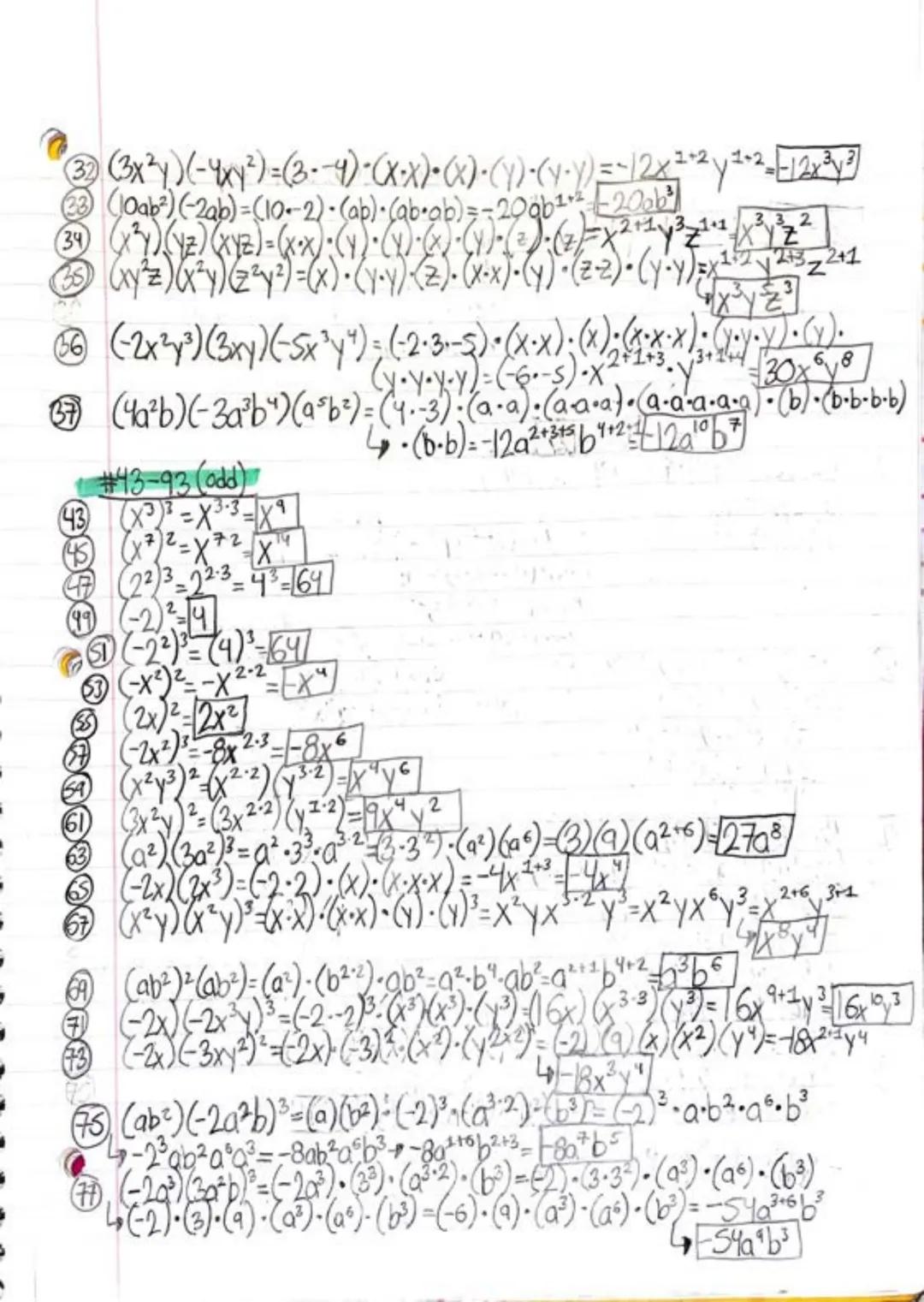
Adding and Subtracting Polynomials: Vertical and Horizontal Methods
Adding polynomials and subtracting polynomials requires careful attention to like terms and proper alignment of variables and their exponents. When working with polynomial expressions, you can use either vertical or horizontal formats to organize your work effectively.
Definition: A polynomial is an algebraic expression made up of variables and coefficients, using only addition, subtraction, multiplication and positive whole number exponents.
The vertical format provides a structured approach where terms with like variables and exponents are aligned in columns. When adding polynomials vertically, write each polynomial with like terms aligned in columns, draw a horizontal line underneath, and combine terms moving from right to left. This method helps prevent errors by keeping similar terms organized.
How to add polynomials step by step begins with identifying like terms - those with identical variables raised to the same powers. For example, when adding 3x² + 2x + 1 and 2x² - 4x + 5, align the x² terms, x terms, and constant terms in columns before adding vertically:
  3x² + 2x + 1
  2x² - 4x + 5
  ____________
  5x² - 2x + 6
Example: When subtracting polynomials, remember to distribute the negative sign to all terms in the subtrahend (the polynomial being subtracted) before combining like terms:
  4x³ - 2x² + 3x - 1
-(2x³ + 5x² - 2x + 4)
  ____________________
  2x³ - 7x² + 5x - 5
10
of 10
Understanding Polynomial Degree and Variables
The degree of a polynomial in one variable is crucial for understanding its behavior and properties. It represents the highest power of the variable in the polynomial expression after combining like terms.
Vocabulary: The degree of a polynomial is the greatest sum of exponents in any term after the polynomial is simplified.
When working with polynomials in one variable, identifying the degree helps classify the polynomial and predict its graphical behavior. For example, a polynomial of degree 5 is called a quintic polynomial, and it will have at most five x-intercepts on its graph.
How to find the degree of a polynomial with multiple variables requires examining each term and finding the highest sum of exponents. For instance, in the expression 2x³y² + 4xy⁴ - 3x²y³, calculate the sum of exponents in each term:
- 2x³y²: 3 + 2 = 5
- 4xy⁴: 1 + 4 = 5
- 3x²y³: 2 + 3 = 5 The degree of this polynomial is 5, as it's the highest sum found.
Highlight: When finding the degree of a polynomial, remember to:
- Combine like terms first
- Look at each term's total exponent sum
- Select the highest sum as the polynomial's degree
We thought you’d never ask...
What is the Knowunity AI companion?
Our AI companion is specifically built for the needs of students. Based on the millions of content pieces we have on the platform we can provide truly meaningful and relevant answers to students. But its not only about answers, the companion is even more about guiding students through their daily learning challenges, with personalised study plans, quizzes or content pieces in the chat and 100% personalisation based on the students skills and developments.
Where can I download the Knowunity app?
You can download the app in the Google Play Store and in the Apple App Store.
Is Knowunity really free of charge?
That's right! Enjoy free access to study content, connect with fellow students, and get instant help – all at your fingertips.
Similar Content
 Maths
MathsMost popular content in Algebra 1
9M
Algebra 1Mastering Algebra 1: Essential Flashcards
Learn key concepts of Algebra 1 with these flashcards. Explore slope-intercept form, properties, equations, and expressions. Boost your math skills and ace your exams!
8th1811
7
Algebra 17th Grade Math
Algebra 1 and all of the other stuff
7th4194
W
Algebra 1wizards
Mathematics is the most loved and also the most feared subjects by students across the world. Have you been worrying about your upcoming math test? Practice these 30 maths quiz questions to ensure you are at the top of your game!
980
Algebra 1Interior and exterior angle measures
Interior and exterior angle measures practice
9th2721
Algebra 1Expressions and Operations
Algebra 1 - unit 1 - covers: integer rules, order of operations, evaluating algerbraic expressions, simplifying algebraic expressions, and translating expressions.
9th1,46195
Algebra 1Math study guide: linear equations, standard form,proportional relationships, & dimensional analysis
This study guide shows you through all things about point-slope formula of a linear equation, and all the forms of a linear equation, as well as explaining the process of dimensional analysis.
9th821
Algebra 1Linear Function: Solving Linear Equations in 1 Variable
Study note on linear equations with one variable, rules on linear equations, examples on simple linear equations, algebra 2, algebra 1
9th3321
Algebra 1Solving leaner equations
About the topic
1739
Algebra 1Order Of Operations
PEMDAS (GEMDAS)
9th1521
Most popular content
9O
 AP US History
Origins and Dynamics of the Columbian Exchange
Analyze the ecological and economic motivations behind the initial transfer of goods, people, and diseases between the Old and New Worlds.
9th3,1280
I
AP US HistoryIntroduction to Early Cultural Interactions
Analyze the initial social and religious encounters between Europeans, Africans, and Indigenous peoples in the colonial Americas.
9th2,7730
O
 AP World History
Origins of Ancient River Civilizations
Analyze the environmental factors and technological innovations that led to the rise of early states in Mesopotamia, Egypt, and the Indus Valley.
9th3,1870
M
AP US HistoryMotivations for European Exploration
Analyze the economic, religious, and political factors that drove European powers to the Americas during the 15th and 16th centuries.
9th1,7780
F
 AP Psychology
Foundations of Ethical Guidelines in Research
Practice the core principles of the APA ethical code including informed consent, debriefing, and the role of Institutional Review Boards.
9th1,3360
I
AP US HistoryIntroduction to Native American Societies
Examine the diverse social, political, and economic structures of North American indigenous groups prior to European contact.
9th1,1100
I
 AP Biology
Introduction to Biological Elements of Life
Practice identifying the essential elements including carbon, nitrogen, phosphorus, and sulfur that compose biological macromolecules.
9th1,7390
I
AP US HistoryIntroduction to the Spanish Encomienda System
Explore the fundamental economic and social structures of the Spanish colonial system, focusing on the encomienda and the casta social hierarchy.
9th8890
O
AP World HistoryOrigins and Continuity of the Byzantine Empire
Analyze the political and cultural transitions from the Roman Empire to the Byzantine Empire, focusing on the reign of Justinian I and his code.
9th1,6320
Can't find what you're looking for? Explore other subjects.
Students love us — and so will you.
4.6/5App Store
4.7/5Google Play
The app is very easy to use and well designed. I have found everything I was looking for so far and have been able to learn a lot from the presentations! I will definitely use the app for a class assignment! And of course it also helps a lot as an inspiration.
Stefan SiOS user
This app is really great. There are so many study notes and help [...]. My problem subject is French, for example, and the app has so many options for help. Thanks to this app, I have improved my French. I would recommend it to anyone.
Samantha KlichAndroid user
Wow, I am really amazed. I just tried the app because I've seen it advertised many times and was absolutely stunned. This app is THE HELP you want for school and above all, it offers so many things, such as workouts and fact sheets, which have been VERY helpful to me personally.
AnnaiOS user
Algebra 1410 views·Updated Jun 16, 2026·24 pagesHow to Add and Subtract Polynomials: Worksheets and Awesome Examples!
Learning to work with polynomials requires understanding both adding polynomials and subtracting polynomials using different methods and formats.
When adding polynomials, students can use either horizontal or vertical formats. The vertical format involves aligning like terms in columns based...
1
of 10
Sign up to see the content. It's free!
- Access to all documents
- Improve your grades
- Join milions of students
Understanding Polynomials and Their Basic Operations
A polynomial expression consists of terms that are monomials - individual components made up of numbers, variables, or their products. When working with polynomials, it's essential to understand their fundamental structure and classification.
Definition: A monomial is a mathematical expression that can be a number, variable, or product of numbers and variables. Examples include: 7, x, 2xy².
The complexity of polynomials increases based on the number of terms they contain. A polynomial with one term is called a monomial , two terms make a binomial , and three terms create a trinomial . When writing polynomials in one variable, mathematicians typically arrange terms in descending order, meaning the highest power of the variable appears first.
Example: The polynomial 4x³-3x²+6x-1 is written in descending order, with the term containing x³ first, followed by x², then x, and finally the constant term.
The degree of a polynomial in one variable is determined by the highest exponent of that variable in any term. For instance, in the polynomial 5y⁴-2y³+y²-7y+8, the degree is 4 because the highest power of y is 4. It's important to note that constants have a degree of zero, while the number zero itself has no degree.
Highlight: When identifying polynomial degrees:
- A nonzero constant has degree 0
- The number 7 has degree 0
- Zero has no degree
- The highest exponent determines the overall degree
2
of 10Sign up to see the content. It's free!
- Access to all documents
- Improve your grades
- Join milions of students
Adding and Subtracting Polynomials
Adding polynomials can be accomplished using either vertical or horizontal formats. Both methods rely on combining like terms - terms with identical variables raised to the same powers.
Example: When adding + vertically:
2x²+x-1
3x³+4x²-5
= 3x³+6x²+x-6
The horizontal format offers an alternative approach that uses the commutative and associative properties of addition. This method involves rearranging terms so that like terms are grouped together before combining them.
Highlight: When subtracting polynomials, add the opposite of the subtrahend (the polynomial being subtracted). The opposite of a polynomial is formed by changing the sign of every term.
For example, to find -, change each sign: -x²+2x-3
When performing polynomial subtraction, you can use either:
- Vertical format: Align like terms in columns
- Horizontal format: Rewrite as addition of the opposite, then combine like terms
3
of 10Sign up to see the content. It's free!
- Access to all documents
- Improve your grades
- Join milions of students
Advanced Polynomial Operations
Working with more complex polynomial expressions requires careful attention to signs and terms. When adding or subtracting multiple polynomials, maintain organization by consistently aligning like terms.
Example: For the expression -:
- Rewrite as addition: +
- Group like terms: 3x³+5x²++(4-8)
- Simplify: 3x³+5x²-x-4
The key to successful polynomial operations lies in systematic organization and careful attention to signs. Whether working vertically or horizontally, maintaining clear alignment of like terms prevents errors and simplifies calculations.
Vocabulary:
- Like terms: Terms with identical variables raised to identical powers
- Descending order: Arrangement of terms from highest to lowest degree
- Opposite: The result of changing all signs in an expression
4
of 10Sign up to see the content. It's free!
- Access to all documents
- Improve your grades
- Join milions of students
Practice and Applications
Mastering polynomial operations requires regular practice with various types of expressions. Common applications include:
Example: Practical problems involving:
- Area calculations where length and width are polynomials
- Volume computations with polynomial dimensions
- Financial models using polynomial functions
- Scientific formulas expressing relationships between variables
When solving problems, remember these key strategies:
- Always identify like terms before combining
- Maintain careful organization of terms
- Double-check signs when subtracting
- Verify that the final answer is in standard form (descending order)
Highlight: Common mistakes to avoid:
- Combining terms that aren't alike
- Forgetting to change all signs when finding opposites
- Misaligning terms in vertical format
- Overlooking negative signs in horizontal format
5
of 10Sign up to see the content. It's free!
- Access to all documents
- Improve your grades
- Join milions of students
Understanding Polynomial Operations and Exponents
Adding polynomials and working with exponents requires careful attention to mathematical rules and proper organization. Let's explore these concepts in detail.
Definition: A polynomial is an algebraic expression made up of variables and coefficients, where variables can only have whole number exponents.
When adding polynomials horizontally, you must identify like terms and combine them while maintaining their signs. For example, when adding 3x² + 2x + 1 and 2x² - 3x + 4, group like terms: + + (1 + 4) = 5x² - x + 5.
How to add polynomials vertically follows a similar principle but with a different visual organization:
   3x² + 2x + 1
   2x² - 3x + 4
   ____________
   5x² - x + 5
Example: When subtracting polynomials, remember to distribute the negative sign to all terms in the second polynomial: - = 4x³ - 2x² + x - 3 - 2x³ - x² + 2x - 1 = 2x³ - 3x² + 3x - 4
6
of 10Sign up to see the content. It's free!
- Access to all documents
- Improve your grades
- Join milions of students
Working with Monomials and Exponent Rules
Understanding how to multiply monomials requires mastery of exponent rules. When multiplying terms with the same base, add the exponents while keeping the base the same.
Highlight: The fundamental rule for multiplying exponential expressions: x^m • x^n = x^
For example, when multiplying (3x²y)(2xy³), follow these steps:
- Multiply the coefficients: 3 • 2 = 6
- Add exponents of like variables: x² • x = x³
- Add exponents of y: y • y³ = y⁴ Final result: 6x³y⁴
Vocabulary: A monomial is an algebraic expression that consists of a single term, such as 5x³y².
7
of 10Sign up to see the content. It's free!
- Access to all documents
- Improve your grades
- Join milions of students
Powers of Monomials and Complex Operations
When dealing with powers of monomials, multiply the exponent outside the parentheses by each exponent inside. This is known as the power rule for exponents.
Rule: For any expression ^n = x^(m•n)
For example: (x²y³)⁴ = x^(2•4)y^(3•4) = x⁸y¹²
When working with multiple operations:
- Simplify expressions in parentheses first
- Apply exponent rules
- Combine like terms
- Simplify numerical coefficients
Example: Simplify (2x²y)³ Solution: (2x²y)³ = 2³(x²)³(y)³ = 8x⁶y³
8
of 10Sign up to see the content. It's free!
- Access to all documents
- Improve your grades
- Join milions of students
Advanced Polynomial Operations
Complex polynomial operations often combine multiple concepts including addition, subtraction, multiplication, and exponent rules. Success requires systematic approach and careful attention to detail.
When working with expressions containing multiple variables and operations:
- Identify the operation sequence
- Group like terms
- Apply appropriate exponent rules
- Simplify numerical coefficients
- Write final answer in standard form
Highlight: Always check that the degree of each term in your answer makes mathematical sense based on the original expression.
For expressions like (3xy²), follow these steps:
- Multiply coefficients: -2 • 3 = -6
- Add exponents of x: x² • x = x³
- Add exponents of y: y³ • y² = y⁵ Final result: -6x³y⁵
9
of 10Sign up to see the content. It's free!
- Access to all documents
- Improve your grades
- Join milions of students
Adding and Subtracting Polynomials: Vertical and Horizontal Methods
Adding polynomials and subtracting polynomials requires careful attention to like terms and proper alignment of variables and their exponents. When working with polynomial expressions, you can use either vertical or horizontal formats to organize your work effectively.
Definition: A polynomial is an algebraic expression made up of variables and coefficients, using only addition, subtraction, multiplication and positive whole number exponents.
The vertical format provides a structured approach where terms with like variables and exponents are aligned in columns. When adding polynomials vertically, write each polynomial with like terms aligned in columns, draw a horizontal line underneath, and combine terms moving from right to left. This method helps prevent errors by keeping similar terms organized.
How to add polynomials step by step begins with identifying like terms - those with identical variables raised to the same powers. For example, when adding 3x² + 2x + 1 and 2x² - 4x + 5, align the x² terms, x terms, and constant terms in columns before adding vertically:
  3x² + 2x + 1
  2x² - 4x + 5
  ____________
  5x² - 2x + 6
Example: When subtracting polynomials, remember to distribute the negative sign to all terms in the subtrahend (the polynomial being subtracted) before combining like terms:
  4x³ - 2x² + 3x - 1
-(2x³ + 5x² - 2x + 4)
  ____________________
  2x³ - 7x² + 5x - 5
10
of 10Sign up to see the content. It's free!
- Access to all documents
- Improve your grades
- Join milions of students
Understanding Polynomial Degree and Variables
The degree of a polynomial in one variable is crucial for understanding its behavior and properties. It represents the highest power of the variable in the polynomial expression after combining like terms.
Vocabulary: The degree of a polynomial is the greatest sum of exponents in any term after the polynomial is simplified.
When working with polynomials in one variable, identifying the degree helps classify the polynomial and predict its graphical behavior. For example, a polynomial of degree 5 is called a quintic polynomial, and it will have at most five x-intercepts on its graph.
How to find the degree of a polynomial with multiple variables requires examining each term and finding the highest sum of exponents. For instance, in the expression 2x³y² + 4xy⁴ - 3x²y³, calculate the sum of exponents in each term:
- 2x³y²: 3 + 2 = 5
- 4xy⁴: 1 + 4 = 5
- 3x²y³: 2 + 3 = 5 The degree of this polynomial is 5, as it's the highest sum found.
Highlight: When finding the degree of a polynomial, remember to:
- Combine like terms first
- Look at each term's total exponent sum
- Select the highest sum as the polynomial's degree
We thought you’d never ask...
What is the Knowunity AI companion?
Our AI companion is specifically built for the needs of students. Based on the millions of content pieces we have on the platform we can provide truly meaningful and relevant answers to students. But its not only about answers, the companion is even more about guiding students through their daily learning challenges, with personalised study plans, quizzes or content pieces in the chat and 100% personalisation based on the students skills and developments.
Where can I download the Knowunity app?
You can download the app in the Google Play Store and in the Apple App Store.
Is Knowunity really free of charge?
That's right! Enjoy free access to study content, connect with fellow students, and get instant help – all at your fingertips.
Similar Content
Most popular content in Algebra 1
9M
Algebra 1Mastering Algebra 1: Essential Flashcards
Learn key concepts of Algebra 1 with these flashcards. Explore slope-intercept form, properties, equations, and expressions. Boost your math skills and ace your exams!
8th1811
7
Algebra 17th Grade Math
Algebra 1 and all of the other stuff
7th4194
W
Algebra 1wizards
Mathematics is the most loved and also the most feared subjects by students across the world. Have you been worrying about your upcoming math test? Practice these 30 maths quiz questions to ensure you are at the top of your game!
980
Algebra 1Interior and exterior angle measures
Interior and exterior angle measures practice
9th2721
Algebra 1Expressions and Operations
Algebra 1 - unit 1 - covers: integer rules, order of operations, evaluating algerbraic expressions, simplifying algebraic expressions, and translating expressions.
9th1,46195
Algebra 1Math study guide: linear equations, standard form,proportional relationships, & dimensional analysis
This study guide shows you through all things about point-slope formula of a linear equation, and all the forms of a linear equation, as well as explaining the process of dimensional analysis.
9th821
Algebra 1Linear Function: Solving Linear Equations in 1 Variable
Study note on linear equations with one variable, rules on linear equations, examples on simple linear equations, algebra 2, algebra 1
9th3321
Algebra 1Solving leaner equations
About the topic
1739
Algebra 1Order Of Operations
PEMDAS (GEMDAS)
9th1521
Most popular content
9O
AP US HistoryOrigins and Dynamics of the Columbian Exchange
Analyze the ecological and economic motivations behind the initial transfer of goods, people, and diseases between the Old and New Worlds.
9th3,1280
I
AP US HistoryIntroduction to Early Cultural Interactions
Analyze the initial social and religious encounters between Europeans, Africans, and Indigenous peoples in the colonial Americas.
9th2,7730
O
AP World HistoryOrigins of Ancient River Civilizations
Analyze the environmental factors and technological innovations that led to the rise of early states in Mesopotamia, Egypt, and the Indus Valley.
9th3,1870
M
AP US HistoryMotivations for European Exploration
Analyze the economic, religious, and political factors that drove European powers to the Americas during the 15th and 16th centuries.
9th1,7780
F
AP PsychologyFoundations of Ethical Guidelines in Research
Practice the core principles of the APA ethical code including informed consent, debriefing, and the role of Institutional Review Boards.
9th1,3360
I
AP US HistoryIntroduction to Native American Societies
Examine the diverse social, political, and economic structures of North American indigenous groups prior to European contact.
9th1,1100
I
AP BiologyIntroduction to Biological Elements of Life
Practice identifying the essential elements including carbon, nitrogen, phosphorus, and sulfur that compose biological macromolecules.
9th1,7390
I
AP US HistoryIntroduction to the Spanish Encomienda System
Explore the fundamental economic and social structures of the Spanish colonial system, focusing on the encomienda and the casta social hierarchy.
9th8890
O
AP World HistoryOrigins and Continuity of the Byzantine Empire
Analyze the political and cultural transitions from the Roman Empire to the Byzantine Empire, focusing on the reign of Justinian I and his code.
9th1,6320
Can't find what you're looking for? Explore other subjects.
Students love us — and so will you.
4.6/5App Store
4.7/5Google Play
The app is very easy to use and well designed. I have found everything I was looking for so far and have been able to learn a lot from the presentations! I will definitely use the app for a class assignment! And of course it also helps a lot as an inspiration.
Stefan SiOS user
This app is really great. There are so many study notes and help [...]. My problem subject is French, for example, and the app has so many options for help. Thanks to this app, I have improved my French. I would recommend it to anyone.
Samantha KlichAndroid user
Wow, I am really amazed. I just tried the app because I've seen it advertised many times and was absolutely stunned. This app is THE HELP you want for school and above all, it offers so many things, such as workouts and fact sheets, which have been VERY helpful to me personally.
AnnaiOS user